Feeds:
Posts
Comments

(Updated April 6, 2026)

Five facts that may surprise you about Cardinals center fielder Curt Flood:
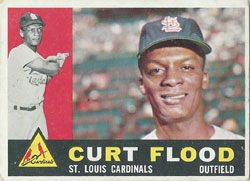
curt_flood7No. 1: Cardinals foe

Flood made his major-league debut against the Cardinals.

On Sept. 9, 1956, at St. Louis, Flood, 18, was a pinch-runner for Smoky Burgess, the stocky Reds catcher who hit a double in the eighth inning off Cardinals starter Murry Dickson.

Flood was stranded when Bob Thurman popped out to third, ending the inning. Boxscore

As a September call-up, Flood played in five games for the 1956 Reds and three for the 1957 Reds. The Cardinals were the foe in three of those eight games.

Flood and outfielder Joe Taylor were traded by the Reds to the Cardinals for pitchers Willard Schmidt, Ted Wieand and Marty Kutyna on Dec. 5, 1957.

It was the first trade made by Cardinals general manager Bing Devine and it was one of his best. Devine credited Cardinals manager Fred Hutchinson with encouraging him to make the deal.

In his book “October 1964,” author David Halberstam wrote, “Devine was uneasy because it was his first deal and because he had not only never seen (Flood) but he had no sense of him either. But (Hutchinson) seemed confident of Flood’s ability and Devine had a good deal of faith in Hutchinson’s ability to judge talent.”

No. 2: Cardinals infielder

Flood, who won seven consecutive Gold Glove awards as a Cardinals center fielder from 1963-69, played two games at third base and one at second for St. Louis.

In all three instances, Flood shifted from the outfield to the infield late in games. The breakdown:

_ On July 6, 1958, Flood started in center field against the Giants at San Francisco. In the ninth, Ken Boyer moved from third base to shortstop and Flood replaced Boyer at third. Flood didn’t field any chances in the inning. Boxscore

_ On May 10, 1959, at St. Louis against the Cubs, Flood moved from center field to second base in the 10th, replacing Don Blasingame, who had been lifted for a pinch-runner the previous inning. Flood played two innings at second base and didn’t field any chances. Boxscore

_ On June 21, 1960, Flood started in center field versus the Pirates at Pittsburgh. In the eighth, Boyer was ejected and Flood replaced him at third base. Flood had one ball hit to him at third _ by Burgess, then with the Pirates _ and fielded it cleanly. Boxscore

In the book “Redbirds Revisited,” Flood said to authors David Craft and Tom Owens, “There was a time when I was with Cincinnati … when they were hoping to teach me to play the infield (but) I had trouble making the double play, trouble throwing toward shortstop.”

No. 3: Tough and durable

At 5 feet 9 and 165 pounds, Flood was an iron man. He played in 150 or more games in a season seven times.

Flood ranks eighth all-time in games played (1,738) as a Cardinal. Just ahead of him is Red Schoendienst (1,795).

No. 4: Hit man

Flood ranks 10th all-time in most hits (1,853) by a Cardinal, just two behind Ken Boyer (1,855).

No. 5: Hitting the best

Flood often was at his best when facing the best.

Here are his career batting marks against some Hall of Fame pitchers:

_ .394 (13-for-33) vs. Don Sutton.

_ .326 (29-for-89) with a home run vs. Warren Spahn.

_ .319 (44-for-138) with two home runs vs. Don Drysdale.

_ .296 (32-for-108) with two home runs vs. Sandy Koufax.

_ .286 (34-for-119) with four home runs vs. Juan Marichal.

_ .286 (14-for-49) with two home runs vs. Ferguson Jenkins.

On May 3, 1968, at San Francisco, before a crowd that included his mother and other relatives, Flood hit two home runs in a game against Marichal. Flood hit a solo home run in the first and a two-run shot in the fifth “Curt hit a good pitch (fastball) the first time, but I hung a slider on the second home run,” Marichal told the St. Louis Post-Dispatch. Boxscore

Postscript

Flood was an integral member of a Cardinals franchise that won two World Series championships and three National League pennants in the 1960s.

In 12 seasons with the Cardinals, Flood was a three-time all-star who hit .293 with 1,853 hits in 1,738 games, including two consecutive seasons (1963-64) with 200 or more hits. When the Cardinals traded him to the Phillies after the 1969 season, Flood refused to report and challenged baseball’s reserve clause, paving the way for free agency.


(Updated Sept. 20, 2023)

In the seven seasons they played together for the Cardinals, Bob Forsch and Ted Simmons formed a special bond. Forsch pitched 12 shutouts during that time, including his first big-league win and a no-hitter, and Simmons was the catcher for each of those dozen gems.

simmons_forsch2When Forsch debuted with the Cardinals on July 7, 1974, in the first game of a doubleheader against the Reds at Cincinnati, Tim McCarver was the catcher and Simmons played first base. After that, Simmons caught the majority of Forsch’s games while they were Cardinals teammates from 1974-80.

Simmons caught more of Forsch’s games than any other catcher during the pitcher’s 16 seasons in the majors.

Forsch pitched in 498 regular-season games. Simmons was his catcher in 181 of those (or 36 percent), according to baseball-reference.com.

(The catchers who caught Forsch the next-most were Darrell Porter at 85 and Tony Pena at 40. Craig Biggio, inducted into the National Baseball Hall of Fame as a second baseman, broke into the major leagues as a catcher and was Forsch’s batterymate in 25 games for the Astros in 1988 and 1989.)

Simmons, who led the Cardinals in RBI for seven consecutive seasons (1972-78), helped Forsch develop into a Cardinals ace. Forsch had a career ERA of 3.76. In games caught by Simmons, Forsch’s ERA was 3.43.

Opponents had a career batting average against Forsch of .261. In games caught by Simmons, foes hit .254 versus Forsch.

“Bob had a work ethic that was unsurpassed, but mainly he had a sinkerball that hitters just couldn’t lift,” Simmons told Cardinals Magazine. “It was such an effective pitch that it wasn’t unusual for him to throw six consecutive sinkers and sometimes as many as 10 in a row.

“Did you ever try to get a bowling ball in the air? A lot of nights, that’s what his sinker was like. The sinker came to him naturally. There is something about the combination of a pitcher’s release and his arm slot that enables him to turn the reverse-side spin of a sinker into a funky pitch. Bob had the gift. The only other pitcher I caught who had a comparable sinker was Mike Caldwell in Milwaukee.”

Here is a breakdown of the shutouts Forsch pitched with Simmons as his catcher:

First win

In his second appearance with the Cardinals _ and his first with Simmons as his catcher _ Forsch pitched a four-hit shutout against the Braves for his first win in the major leagues.

Forsch held the Braves to four singles at St. Louis on July 12, 1974. He also singled off Lew Krausse for his first big-league hit.

Simmons was 1-for-3 with a run scored. He also walked and was hit by a pitch.

The Cardinals supported Forsch with a nine-run first inning and won, 10-0.

“With a lead like that, I just wanted to make sure I didn’t walk anybody,” Forsch said to the Associated Press. Boxscore

Beat the Mets

Forsch yielded a leadoff single to Bud Harrelson, then didn’t give up another hit until the fifth. He pitched a four-hitter in a 3-0 Cardinals victory against the Mets on Sept. 6, 1974, at St. Louis.

Simmons contributed two singles against Jerry Koosman and a double off a former teammate, Harry Parker. Boxscore

Fast start

In the Cardinals’ second game of the season, Forsch pitched a two-hitter in a 4-0 victory over the Expos at St. Louis on April 9, 1975. The Expos were limited to singles by Tony Scott and Barry Foote.

Simmons had a sacrifice fly, a single and a RBI-double off Steve Rogers. Boxscore

Astros grounded

Cesar Cedeno singled in the first, Larry Dierker singled in the third and the Astros were held hitless by Forsch for the rest of the game. Forsch pitched a two-hitter in a 6-0 Cardinals victory at Houston on June 6, 1975.

Simmons had a single, a walk and scored a run. Boxscore

Cubs all wet

In a game delayed by rain for more than two hours at the start, Forsch retired the first 10 Cubs batters in a row before Rick Monday doubled with one out in the fourth. Forsch pitched a four-hitter in a 4-0 triumph on Aug. 2, 1975, at Chicago.

Simmons and Forsch each had a RBI. Boxscore

Big finale

In his last start of the season, Forsch pitched a three-hitter in a 1-0 victory over the Pirates on Sept. 26, 1975, at St. Louis. Simmons drove in the run with a single off Jim Rooker in the first, scoring Lou Brock.

Forsch limited the Pirates to singles by Rennie Stennett, Willie Stargell and Manny Sanguillen. Boxscore

Cruise control

Forsch pitched a three-hitter in a 4-0 Cardinals victory over the Astros at St. Louis on July 21, 1977. Jose Cruz, Forsch’s former teammate, had two of the hits. Enos Cabell had the other. Simmons twice drove in Garry Templeton from third with RBI-groundouts off J.R. Richard. Boxscore

Mets muzzled

After yielding a single to Bruce Boisclair in the first inning, Forsch gave up one other hit _ a Lenny Randle single in the sixth _ in pitching a two-hitter against the Mets on Aug. 17, 1977, at St. Louis.

Simmons had a single and a walk and scored a run in the Cardinals’ 2-0 triumph. Boxscore

Unhittable

Forsch pitched the first of his two no-hitters, beating the Phillies, 5-0, on April 16, 1978, at St. Louis.

“Forsch threw a profound power sinker, and that day it was so powerful that we all knew he was going to throw it, but that wasn’t going to make a bit of difference,” Simmons recalled to Cardinals Magazine.

“By the fifth inning, they realized he was going with his sinker 98 percent of the time and they weren’t going to be able to lift it. If they made contact, it was going to be a groundball and they were going to be out.”

In the ninth, Forsch got Jay Johnstone, Bake McBride, Larry Bowa on groundouts.

Simmons was 2-for-4 with a run scored. Boxscore

On a roll

In his third start after the no-hitter, Forsch pitched a five-hitter in a 9-0 Cardinals victory over the Giants on May 2, 1978, at St. Louis. Simmons and Forsch each had a RBI.

The Giants had three doubles, including one by Jack Clark, and stranded seven. Boxscore

Ted goes deep

Simmons broke a scoreless tie in the seventh with a home run off Burt Hooton and Forsch pitched a three-hitter in a 2-0 Cardinals victory over the Dodgers on May 11, 1978, at Los Angeles.

In the bottom of the ninth, Vic Davalillo, the former Cardinal, led off with a single. Forsch then got Ron Cey to hit into a double play and followed that with a strikeout of Steve Garvey. Boxscore

Phillies baffled

Forsch held the Phillies to three singles _ including one by their 37-year-old catcher, McCarver _ in a 5-0 Cardinals victory on July 27, 1979, at Philadelphia.

Pete Rose and Mike Schmidt were a combined 0-for-6 with a walk against Forsch.

Simmons and Forsch each contributed a RBI. Boxscore


(Updated June 4, 2020)

Unable or unwilling to manage his personal finances, outfielder Willie Davis left the Cardinals during a pennant drive in an effort to protect his wages from being claimed by his ex-wife.

willie_davisOn Aug. 15, 1975, Davis, the Cardinals’ right fielder, was placed on the club’s disqualified list after informing management he was quitting because of financial problems.

The incident added another twist to a bizarre year in which Davis served a stint in jail, got into a shouting match with a manager, staged a protest during a game and got traded twice.

Trouble in Texas

Davis was the center fielder for the Dodgers throughout the 1960s and early 1970s. He appeared in three World Series for them, twice was named an all-star and twice led the National League in triples. He produced a 31-game hitting streak in 1969.

In an interview with the Los Angeles Times, Dodgers shortstop Maury Wills said of Davis, “He was so talented. God really blessed him with some great tools _ for any sport, really _ speed, strength, agility _ everything an athlete needs in order to make the big time.”

Asked about Davis, Hall of Fame pitcher Sandy Koufax told ESPN’s Roy Firestone, “There might have been guys who were quicker, but I don’t think anybody was faster going from first to third.”

The Dodgers traded Davis to the Expos in December 1973 and 12 months later the Expos dealt him to the Rangers. Soon after, on Feb. 13, 1975, Davis was released from the Los Angeles County jail after serving two days of a five-day sentence for failure to make child support payments, The Sporting News reported. Davis’ attorney arranged for the release by promising that the Rangers would withhold some of Davis’ salary for alimony and child support payments. Davis agreed to pay about $12,000 in back payments, the Associated Press reported.

Calm before storm

At spring training with the Rangers in 1975, Davis told columnist Melvin Durslag he was at peace because he had become a member of Nichiren Shoshu, a Buddhist religious order based on the teachings of a 13th-century Japanese monk. Davis said he spent one to four hours a day chanting. Believers say chanting enables a person to change bad karma and achieve enlightenment.

“I consider myself better adjusted than anyone else in this game,” Davis said. “That’s because nothing can make me unhappy.”

Two months later, on May 7, 1975, Davis and Rangers manager Billy Martin got into a shouting match after Davis interrupted Martin while the manager was berating the team during a locked-door clubhouse meeting.

“I just can’t play for anybody who wants to keep his foot on my neck,” Davis said, according to the Fort Worth Star-Telegram.

Three weeks later, Davis staged a protest by petulantly squatting in center field, his glove under his arm, throughout an inning because teammate Steve Hargan didn’t hit a batter with a pitch after a Red Sox pitcher threw at Davis.

Soon after, when the Rangers wouldn’t give Davis a salary advance for the third time, he refused to go with the team on a road trip to Baltimore.

Feeling bad karma, the Rangers looked to trade Davis.

“We’ve been exceedingly lenient with the guy since last winter on all matters pertaining to his financial affairs,” Rangers general manager Dan O’Brien told the Star-Telegram, “but at some point you’ve got to draw the line.”

Cardinals roll dice

The 1975 Cardinals were in the market for a hitter because their rookie first baseman, Keith Hernandez, was overmatched by big-league pitching.

According to the St. Louis Post-Dispatch, O’Brien called Cardinals general manager Bing Devine and said, “We’ve got to get rid of Willie Davis. You wouldn’t want him, would you?”

Devine said no, but changed his mind three days later after talks with manager Red Schoendienst and others.

On June 4, 1975, the Cardinals traded shortstop Ed Brinkman and pitcher Tommy Moore to the Rangers for Davis. Hernandez, batting .203, was sent to the minors. The Cardinals switched Reggie Smith from right field to first base and Davis, 35, joined an outfield with Lou Brock in left and Bake McBride in center.

“The Cards took a good gamble with Willie Davis, only if they can get him to stop spending money faster than he runs,” wrote columnist Dick Young.

Devine and Davis said they believed Schoendienst would be key to making the deal successful.

“We take chances on players other teams might not want because of Red Schoendienst’s philosophy,” Devine said. “All Red looks for is a guy’s ability and how he can fit into our picture. Then, when we get a guy, Red leaves him alone.”

Davis said Schoendienst is “a lot like Walter Alston when I was with the Dodgers. Both of them leave you alone and let you enjoy playing this game.”

Schoendienst gave Davis the honor of taking the lineup card to the umpires before his first game with his new team. “With the Cardinals, I know I can play baseball without being suppressed,” Davis said. “I can be loose again.”

Unexpected departure

A left-handed batter, Davis hit .382 for the Cardinals in July.

In early August, Schoendienst was asked why he didn’t fine Davis after the outfielder made a blunder against the Padres. “How can I?” Schoendienst replied. “He doesn’t have any money.”

Davis again had fallen behind in alimony and child support payments. His ex-wife indicated she would seek a court order to have the Cardinals withhold his pay and send the money to her.

Davis said he was quitting rather than having his salary withheld. “I’m going back home and look into starting a new career,” he told the Post-Dispatch. “If I stayed, I’d be playing two months for nothing. That will never take place.”

The Cardinals placed him on the disqualified list and provided attorneys to help Davis resolve the issue, the Associated Press reported.

Regarding Davis’ absence, Brock said, “With him, we had a chance for the pennant. Without, it’s going to be tough.”

Davis’ yearly salary was $110,000. He was due about $30,000 for the remainder of the season, according to United Press International.

After missing five games, Davis and his ex-wife reached an agreement to split his remaining salary in 1975. Davis said she would receive $17,000.

“She’s satisfied and I’m satisfied,” Davis said.

Welcome back

The Cardinals were within 4.5 games of the first-place Pirates when Davis left the club and he was hitting .308.

When he returned, Davis told reporters Buddhism helped him deal with his financial problem. He delivered a few sample chants before dropping a bombshell. “I want a contract for five years and a million dollars,” Davis said. “St. Louis will have the first shot at me, but I won’t care where I go.”

In his first game back from the disqualified list, Davis started in right field, received an ovation from the fans at Busch Stadium and went 4-for-4 with a triple, double and two singles against the Reds’ Gary Nolan. Boxscore

“I felt like I was reborn,” Davis said.

Davis hit .368 in August and his Cardinals batting average entering September was .335. The Cardinals were 20-11 in August and were 72-63 overall, four games out of first place.

Reggie Smith said Davis is “the difference between winning and losing.”

Tough times

In September 1975, Davis swooned and so did the Cardinals. He hit .141 in September. The Cardinals were 10-17 for the month and finished at 82-80 _ 10.5 games behind first-place Pittsburgh.

Davis hit .291 with the 1975 Cardinals, with 50 RBI and 10 stolen bases. His batting average versus right-handed pitching was .329.

The Cardinals sought to trade him and found little interest until Padres president Buzzie Bavasi, who’d been Dodgers general manager when Davis played for them, made an offer.

On Oct. 20, 1975, the Cardinals dealt Davis to the Padres for outfielder Dick Sharon.

After his playing career, Davis “had a very difficult time … living life away from the game,” said Tommy Hawkins, a Dodgers executive.

In 1996, Davis was arrested and charged with threatening to kill his parents and burn down their house unless they gave him $5,000, the Los Angeles Times reported. He was armed with a set of throwing knives and a samurai sword.

Said Bavasi: “There was nothing more exciting than to watch Willie run out a triple. He could have been a Hall of Famer, but he had million-dollar legs and a 10-cent head.”


(Updated Oct. 17, 2024)

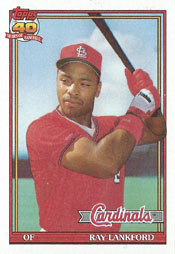
Put at ease by management and welcomed by teammates, including those he might replace, Ray Lankford felt at home with the Cardinals and delivered a stellar performance in his big-league debut.

ray_lankford6On Aug. 21, 1990, Lankford, 23, went 2-for-4 with a RBI, a run scored and a stolen base against future Hall of Fame pitcher John Smoltz of the Braves in his first game with the Cardinals.

Batting sixth and starting in center field, Lankford singled in his first at-bat and swiped second base.

In the eighth, Lankford doubled with two outs, driving in Todd Zeile from second, and scored on a single by Rex Hudler.

“I did a little bit of everything,” Lankford said to the St. Louis Post-Dispatch. “I’m happy. I couldn’t have asked for much more.” Boxscore

Top prospect

Lankford was selected by the Cardinals in the third round of the 1987 amateur draft. He and another Cardinals outfield prospect, Bernard Gilkey, became friends and were road roommates with the 1990 Class AAA Louisville farm club.

With Willie McGee eligible to become a free agent after the 1990 season, speculation was Lankford would replace McGee as Cardinals center fielder in 1991.

“When he plays hard, he’s awesome,” Gilkey said of Lankford. “… He reminds me of Kal Daniels of the Los Angeles Dodgers, but he plays better defense and he runs better (than Daniels). His style is like Daniels and he’s built like Willie Mays.”

One of the few to cast doubts about Lankford was Whitey Herzog. After abruptly quitting as Cardinals manager in July 1990, Herzog remained with the club as a vice president and was sent in August to scout Cardinals prospects.

“You can talk about prospects all you want, but if you and I are hitting .270 at Louisville … those aren’t good credentials to take Willie McGee’s job,” Herzog said.

The Post-Dispatch reported Herzog said in a Louisville radio interview his opinions on Cardinals prospects “might not be the same” as those of director of player development Ted Simmons. Herzog concluded Lankford could benefit from another season at Class AAA.

No war zone

Disregarding Herzog’s advice, the Cardinals called up Lankford on Aug. 20, 1990. He was batting .260 for Louisville, but had a .362 on-base percentage, with 25 doubles, 72 RBI, 30 stolen bases, 72 walks and 123 hits in 132 games.

After reporting to Busch Stadium on Aug. 21, Lankford met with Simmons, manager Joe Torre and instructor George Kissell in Torre’s office.

“Teddy told him he wasn’t going to Vietnam,” Torre said. “This isn’t war here. Just go out and have a good time.”

Torre met with Cardinals starting outfielders McGee, Vince Coleman and Milt Thompson and explained to them he would start Lankford in center and move McGee to right, putting Thompson on the bench.

Torre said he wanted Lankford to play center “in the event McGee’s not here next year. We want to get him used to the bigger outfield here (at Busch Stadium).”

One of the first to greet Lankford in the clubhouse was Thompson. “I just have to keep my head up and keep working hard,” Thompson said.

McGee and Coleman also were friendly to Lankford. “Willie and Vince are both great players and I’m not here to take any jobs away,” Lankford said.

McGee said he hadn’t played right field since attending Diablo Valley College in California. Asked his reaction to being moved from center to right, McGee said, “I’m the employee. I do what I’m told.”

Let loose

Lankford batted .400 (6-for-15) in his first four games for the Cardinals.

“We’ll baby Lankford a little bit, but we want to get a good read on him so we know what to expect,” Torre said.

Post-Dispatch columnist Bernie Miklasz endorsed the decision to play Lankford. “The Cardinals need to turn Lankford loose, let him flail away at big-league pitching,” Miklasz wrote. “… Lankford can’t be held back. Stunting his progress at this stage is counterproductive.”

On Aug. 29, 1990, the Cardinals traded McGee to the Athletics for outfielder Felix Jose, infielder Stan Royer and minor-league pitcher Daryl Green.

In 39 games with the 1990 Cardinals, Lankford hit .286 with 10 doubles, eight stolen bases and a .353 on-base percentage.

After getting the chance to see Lankford, Gilkey and Jose play in the big leagues in September 1990, the Cardinals made the trio their regular outfield in 1991.

In the 1991 Cardinals Yearbook, Ted Simmons said of Lankford, “He has the best tools of any prospect we’ve had in the two years I’ve been here (as director of player development). He’s got the kind of tools that are as good as anybody and the kind that should let him have as good a rookie season as anybody.”


(Updated Dec. 21, 2024)

Having already worked one grand slam miracle as an Angel, David Eckstein performed another for the Cardinals.

david_eckstein2On Aug. 7, 2005, Eckstein hit a walkoff grand slam in the bottom of the ninth inning against Chris Reitsma, lifting the Cardinals to a 5-3 victory over the Braves.

“Every once in a while, you get a miracle like this,” Cardinals manager Tony La Russa told the St. Louis Post-Dispatch.

Eckstein, 5-foot-6 and slightly built, appeared better suited for singles than slugging.

However, the feat wasn’t a first for Eckstein. Three years earlier, on April 28, 2002, Eckstein hit a walkoff grand slam for the Angels against Pedro Borbon of the Blue Jays. It was one of three grand slams Eckstein hit for the Angels that season.

Eckstein’s grand slam for the Cardinals against the Braves was the fourth and last of his big-league career.

Subs deliver

The Braves scored a run in the top of the ninth against Jason Isringhausen, extending their lead from 2-1 to 3-1.

Reitsma, a right-hander who had yielded one run over his last 11 appearances and had converted nine consecutive save opportunities, was the choice of Braves manager Bobby Cox to pitch the bottom of the ninth.

Each of the first three Cardinals batters _ Abraham Nunez, So Taguchi and Hector Luna _ singled with two strikes, loading the bases with none out.

Nunez, subbing for injured Scott Rolen, hit a groundball single to center and Taguchi, subbing for injured Larry Walker, followed with a low liner up the middle.

Luna, pinch-hitting for catcher Mike Mahoney, who was subbing for injured Yadier Molina, slapped a grounder that deflected off Reitsma’s glove toward second baseman Marcus Giles. As Taguchi dashed in front of him, Giles tried to scoop the ball and swipe Taguchi with a tag, but he couldn’t get a handle on the ball and all the runners were safe on what was ruled an infield hit.

“If I let that go, maybe we turn two,” Reitsma said to the Associated Press. “You just react in that situation and it hit the top of my glove.”

Said Cox: “We butchered a double-play ball. You tell your pitchers not to touch a ball like that because it’s a routine double play.”

With the bases loaded and none out, La Russa called for Scott Seabol to bat for pitcher Ray King. Seabol, who hadn’t produced a hit for the Cardinals since June 21, popped out to third baseman Wilson Betemit.

Mighty mite

Next up was Eckstein, who had hit four home runs on the season and 21 since entering the major leagues in 2001.

After taking the first pitch from Reitsma for a ball, Eckstein swung at the next and drove the ball over the left-field fence and into the seats. Video

“I was trying to go down and away with a sinker for a double play,” Reitsma told the Atlanta Journal-Constitution. “I just left it down the middle.”

Said Eckstein of his home run swing: “That’s probably all I’ve got right there.” Boxscore

After being mobbed by his teammates at the plate, Eckstein doffed his helmet to the crowd of 47,714 who had turned out on what the Cardinals promoted as Transplant Awareness Day. Eckstein’s father was scheduled to become the fourth family member to receive a kidney transplant.

Walkoff winners

The seven previous walkoff grand slams hit by Cardinals:

_ Pepper Martin hit a grand slam off George Jeffcoat of the Dodgers, breaking a 7-7 tie in the ninth inning and giving the Cardinals an 11-7 victory on July 14, 1936, at St. Louis. Boxscore

_ Joe Cunningham hit a grand slam off Ruben Gomez of the Giants, breaking a 3-3 tie in the ninth and giving the Cardinals a 7-3 victory on July 30, 1957, at St. Louis. Boxscore

_ Carl Taylor hit a grand slam off Ron Herbel of the Padres, erasing a 10-7 San Diego lead in the ninth and giving the Cardinals an 11-10 victory on Aug. 11, 1970, at St. Louis. Boxscore

_ Joe Hague hit a grand slam off Mike Marshall of the Expos, breaking a 6-6 tie in the 10th and giving the Cardinals a 10-6 victory on Sept. 24, 1971, at St. Louis. Boxscore

_ Roger Freed hit a grand slam off Joe Sambito of the Astros, erasing a 6-3 Houston lead in the 11th and giving the Cardinals a 7-6 victory on May 1, 1979, at St. Louis. Boxscore

_ Darrell Porter hit a grand slam off Bob Lacey of the Giants, breaking a 4-4 tie in the 11th and giving the Cardinals an 8-4 victory on July 18, 1984, at St. Louis. Boxscore

_ Tommy Herr hit a grand slam off Jesse Orosco of the Mets, breaking an 8-8 tie in the 10th and giving the Cardinals a 12-8 victory on April 18, 1987, at St. Louis. Boxscore

Since Eckstein’s walkoff grand slam, five other Cardinals achieved the feat:

_ Gary Bennett hit a grand slam off Bob Howry of the Cubs, breaking a 6-6 tie in the ninth and giving the Cardinals a 10-6 victory on Aug. 27, 2006, at St. Louis. Boxscore

_ Aaron Miles hit a grand slam off Bryan Corey of the Padres, breaking a 5-5 tie in the ninth and giving the Cardinals a 9-5 victory on July 20, 2008, at St. Louis. Boxscore

_ Matt Carpenter hit a grand slam against J.P. Howell of the Blue Jays, breaking a 4-4 tie in the 11th and giving the Cardinals an 8-4 victory in the first game of a doubleheader on April 27, 2017, at St. Louis. Boxscore

_ Paul Goldschmidt hit a grand slam against Ryan Borucki with two outs in the 10th for a 7-3 Cardinals victory over the Blue Jays on May 23, 2022, at St. Louis. Boxscore

_ Nolan Arenado hit a curve from Trevor Megill of the Brewers for a grand slam with one out in the 10th inning for a 10-6 Cardinals triumph at St. Louis. Boxscore

(Updated Jan. 8, 2025)

In an unusual play that involved a Penguin, a Bull and Vince Coleman establishing a major-league rookie record, the Cardinals stole four bases on one pitch in a game against their archrivals, the Cubs.

vince_coleman2On Aug. 1, 1985, at Wrigley Field in Chicago, Cardinals speedsters Coleman and Willie McGee turned a double-steal attempt into a successful quadruple steal.

In the first inning, Coleman was on second base and McGee on first with none out and Tommy Herr at-bat, facing Scott Sanderson.

Coleman entered the game with 72 steals, tying him with Juan Samuel of the 1984 Phillies for the big-league single-season record for a rookie.

Dead duck

On a pitch to Herr, Coleman and McGee took off for third and second. Catcher Jody Davis threw to third baseman Ron “Penguin” Cey in an attempt to nab Coleman.

Coleman slid across the bag, “way deep in foul territory, almost in back of the coach’s box,” Cubs manager Jim Frey told the Arlington Heights (Ill.) Daily Herald.

Slow to react, Cey didn’t rush to tag Coleman. “He would have been a dead duck had there not been a brain-dead Penguin on the scene,” wrote Mike Lucas, covering the game for the Madison (Wis.) Capital Times.

Seeking an escape route, Coleman got up and scampered down the third-base line, with Cey in pursuit.

“When Ron went after him … (Coleman) ran out of the base line,” Frey said.

Knowing he had no chance to catch Coleman, Cey tossed the ball to Davis. Coleman applied the brakes and headed back toward Cey. Davis ran toward Coleman, then lobbed the ball to Cey.

No one at home

When Coleman looked back, he saw Davis near him and no Cubs player protecting the plate. Sanderson had gone over to cover third. First baseman Leon “Bull” Durham, the former Cardinal, should have covered the plate but instead stood frozen along the first-base line, watching the rundown.

Coleman whirled around, slipped past Davis and sped toward the plate. Cey, clutching the ball, gave chase.

Wrote Lucas, “Cey’s only option was to chase down Coleman from behind (but) he couldn’t chase down (actor) Gary Coleman, let alone Vince Coleman.”

Coleman crossed the dish and McGee dashed uncontested from second base to third. The official scorer credited each with two stolen bases on the play.

Wrote Rick Hummel for The Sporting News, “One pitch, four stolen bases _ sounds something like (Hall of Famer) Cool Papa Bell flicking off a light switch and jumping in bed before it was dark.”

Said Coleman to the Associated Press, “I’ve never seen a play like that before. I couldn’t get back to third, so my reaction was to go to the next base.”

Record setter

In so doing, Coleman had 74 steals for the season, breaking the rookie record.

“Just another day’s work, but I am honored about the record,” Coleman said. “I’m looking for more records. No goals. I just let my ability dictate my future.” Boxscore

Coleman achieved 110 stolen bases in 1985 and was named winner of the NL Rookie of the Year Award. He also topped more than 100 steals in 1986 (107) and 1987 (109) and led the NL in stolen bases for six consecutive years (1985-90) with the Cardinals.

“If you played against me, you hated me, because I’m bringing it to the table every day,” Coleman told Jerry Crasnick for Memories and Dreams magazine. “It was like trying to guard Michael Jordan one-on-one. You could only try to contain him, and you could only try to contain me. You can’t stop me, because it’s me against you, and there’s nothing you can do once you let that ball go.”

McGee contributed a career-high 56 steals in 1985 and was selected winner of the NL Most Valuable Player Award, batting a league-high .353 with 216 hits.

In an article for the 1985 World Series program, Cardinals manager Whitey Herzog said to Rick Hummel, “The whole key to what Willie hits is how many strikes he swings at. Ever since he came to the big leagues, the question is would he ever stop swinging at bad balls.”

The 1985 Cardinals had 314 steals. No other team in the major leagues that season had more than 182.