Feeds:
Posts
Comments

(Updated Feb. 2, 2022)

Whether mentoring a future Hall of Famer or helping a prospect change positions, George Kissell compiled a string of impressive successes as a minor-league manager in the Cardinals system.
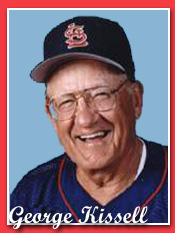
george_kissellKissell worked in the Cardinals organization from 1940 (when he started as a player in Class D) until his death at 88 in 2008. He was a Cardinals coach from 1969-75 and a longtime instructor. He also managed Cardinals minor-league clubs from 1948-57 and 1961-68.

The top 5 most interesting facts about George Kissell as a manager in the St. Louis system:

Educating Earl

Earl Weaver, the St. Louis native who was elected to the National Baseball Hall of Fame after managing the Orioles to four American League pennants and a World Series championship, played three seasons for Kissell in the Cardinals’ organization.

A second baseman, Weaver, 19, hit .276 with 20 doubles in 127 games for a 1950 Winston-Salem team managed by Kissell. Winston-Salem won the Carolina League championship with a 106-47 record.

In 1951, Kissell managed Weaver at Omaha. Weaver hit .279 with 35 doubles in 142 games. Omaha won the Western League title with a 90-64 mark and Weaver was named to the league’s all-star team.

Kissell and Weaver returned to Omaha in 1952. Weaver hit .278 with 15 doubles in 97 games. Omaha finished 86-68 under Kissell.

Weaver played in the Cardinals’ system from 1948-53. With three consecutive seasons playing for Kissell, it’s reasonable to assume the lessons and fundamentals Weaver learned from Kissell helped him become one of the game’s best managers.

Pitcher to third

Ken Boyer began his first two minor-league seasons, 1949-50, as a pitcher in the Cardinals’ system. During the 1950 season, he became a third baseman.

In 1951, Boyer, 20, played his first full season as a third baseman for an Omaha club managed by Kissell. Boyer hit .306 with 28 doubles and 14 homers, launching him on a path that would lead to him winning five Gold Glove awards and a 1964 National League Most Valuable Player Award with the Cardinals.

When Boyer missed some games with Omaha because of an injury, Kissell, 30, filled in for him at third base.

Power prospect

Playing for Kissell with the 1957 Winston-Salem team, Gene Oliver, 22, established himself as a Cardinals power-hitting prospect. Oliver, a first baseman and catcher, hit 30 home runs, breaking the Winston-Salem club record held by Steve Bilko.

Two years later, Oliver was called up by the Cardinals. beginning a 10-year career in the major leagues, including four seasons with St. Louis.

Comeback trail

After the Giants released minor-league third baseman Coco Laboy, he was signed by the Cardinals. Playing for Kissell at Raleigh in 1964, Laboy revived his career, hitting .340 with 29 doubles and 24 home runs in 112 games.

Chosen by the Expos in the 1968 expansion draft, Laboy was the starting third baseman for Montreal in its first two National League seasons, 1969 and 1970.

Prized potential

In 1967, Kissell managed a pair of teenagers in their first year as professional players: catcher Ted Simmons, 17, and pitcher Jerry Reuss, 18. Simmons was selected by the Cardinals in the first round of the June 1967 draft; Reuss was a second-round choice.

The first place the Cardinals sent them was to their Gulf Coast League club managed by Kissell.

Simmons hit .350 in six games for the Gulf Coast League Cardinals. He would go on to a 21-year big-league career, collecting 2,472 hits and 1,389 RBI.

In his Hall of Fame induction speech, Simmons said, “It was George Kissell, the Cardinals’ Mr. Everything, who had the greatest impact on me. He taught me fundamental baseball and how to play to win. I also learned from George how to win and lose with grace. He gave me my first taste of humility.”

Reuss was 0-0 with a 5.14 ERA in two appearances for Kissell’s team. Reuss would go on to a 22-year big-league career, earning 220 wins.
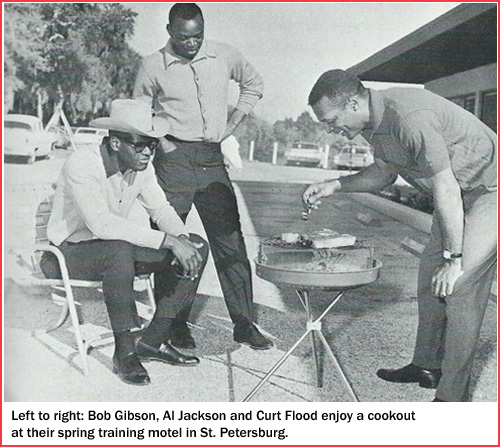
On the field, pitcher Bob Gibson and center fielder Curt Flood were all-star players who exceled for a Cardinals club that won two World Series titles and three National League pennants in the 1960s. Off the field, Gibson and Flood were road roommates and confidantes.

In his book “Stranger to the Game,” Gibson called Flood “my best friend in baseball.”

In 12 years (1958-69) with the Cardinals, Flood batted .293 (1,853 hits in 1,738 games) and three times led the NL in singles. He also won the Gold Glove Award seven times and was named an all-star three times.

“Curt Flood was more than my best friend on the ballclub,” Gibson said in his book. “To me, he personified what the Cardinals were all about. As a man and teammate, he was smart, funny, sensitive and, most of all, unique. As a ballplayer, he was resourceful, dedicated and very, very good.”

After being traded by the Cardinals to the Phillies in October 1969, Flood refused to report and challenged baseball’s reserve clause, opening the path to free agency for players.

“As Flood’s suit made the judicial circuit, Curt waited it out in Copenhagen, Denmark,” Gibson recalled. “I received long, philosophical letters from him every now and then. I missed him.

“At the ballpark, I missed Flood in center field, where his remarkable catches would often bring his cynical teammates to the top step of the dugout in applause. But I also missed his discussions about the latest works of (writer) James Baldwin and I missed his play on words. When, for instance, he took his place in the outfield between Stan Musial and Minnie Minoso, he referred to the alignment as Old Taylor and Ancient Age with a little Squirt for a chaser.

“I especially missed him as a roommate. By that time, Curt and I understood each other so well that we no longer had to talk to communicate.”

Regarding Flood’s self-sacrifice in challenging the reserve clause and, by so doing, shortening his playing career, Gibson said in his 1994 book, “The modern player has gotten fat from the efforts of Curt Flood and has returned him no gratitude or any other form of appreciation.

“I’ve often thought of what an appropriate and decent thing it would be if every player in the major leagues turned over 1 percent of his paycheck just one time to Curt Flood. They certainly owe him that much and more.”

gibson_jackson_flood


Previously: George Crowe was Cardinals mentor to Curt Flood

Joining a starting rotation that featured future Hall of Famers Jesse Haines and Grover Cleveland Alexander, rookie Fred Frankhouse strung together a September winning streak that nearly lifted the Cardinals to a second consecutive National League pennant.

fred_frankhouseFrankhouse, 23, won each of his first five starts after being promoted from the minor leagues to the Cardinals in September 1927.

Stretch run

Frankhouse, 5 feet 11 and 175 pounds, was the ace of the Cardinals’ minor-league Houston affiliate in the Texas League in 1927. The right-hander with the sidearm delivery was 21-9 with a 3.24 ERA in 261 innings for Houston.

The defending World Series champion Cardinals, in a four-way race with the Pirates, Giants and Cubs for the 1927 pennant, called up Frankhouse and gave him a start in his big-league debut in the opener of a doubleheader against Chicago on Sept. 7 at St. Louis. The Cardinals started the day in third place, 2.5 games behind the Pirates, 1.5 behind the Giants and a half-game ahead of the Cubs.

Using a sweeping curve, Frankhouse held the Cubs to two runs in seven innings before being relieved by Haines. A 24-game winner in 1927, Haines, making his second and last relief appearance of the season, shut out the Cubs over the final two innings, earning the save and preserving the win for Frankhouse in a 6-2 Cardinals victory. Frankhouse also contributed two hits in three at-bats. Boxscore

Four days later, on Sept. 11, Frankhouse got his second start. He responded with a four-hit shutout, pitching the Cardinals to a 5-0 victory over the Dodgers at St. Louis. The game finished in 1:48. Left fielder Harvey Hendrick got three of the Dodgers’ hits (two singles and a double). The win lifted the Cardinals into a second-place tie with the Giants, two games behind the Pirates. Boxscore

On a roll

Cardinals manager Bob O’Farrell started Frankhouse for the third time on Sept. 15 in the second game of a doubleheader against the Giants at St. Louis. The Giants had five future Hall of Famers in the No. 2 through No. 5 spots in the batting order: Freddie Lindstrom, Edd Roush, Rogers Hornsby, Bill Terry and Travis Jackson.

Frankhouse yielded five runs, but got the win and his second consecutive complete game in an 8-5 Cardinals victory. The game was called after the top of the eighth because of darkness. Frankhouse retired another future Hall of Famer, Mel Ott, with a runner on base to end the game. The Cardinals, who had lost the opener, closed the day still tied with the Giants for second place, but 4.5 behind the Pirates. Boxscore

The Pirates, featuring a lineup with Pie Traynor and brothers Paul and Lloyd Waner, were distancing themselves from the Cardinals and Giants, winning 11 in a row from Sept. 9 through Sept. 17.

On Sept. 19, Frankhouse made his fourth start and pitched his third consecutive complete game, a 12-5 Cardinals victory over the Phillies at St. Louis. Backed by five RBI from his catcher, Frank Snyder, Frankhouse improved his record to 4-0, even though he yielded nine hits and walked five. The Cardinals trailed the Pirates by four with 10 to play. Boxscore

Five days later, on Sept. 24, the Giants beat the Pirates. The Cardinals, behind a fourth consecutive complete game by Frankhouse, defeated the Braves, 4-3, at St. Louis. With Frankhouse improving to 5-0, the Cardinals were within two of the Pirates. Boxscore

NL staple

St. Louis won five of its last six _ the lone loss was by Frankhouse, a 3-2 setback at Cincinnati against the Reds _ and finished the season in second place at 92-61, 1.5 behind the champion Pirates (94-60). The Giants (92-62) finished third, a half-game behind the Cardinals, and the Cubs ended up fourth at 85-68.

In six starts for the 1927 Cardinals, Frankhouse was 5-1 with a 2.70 ERA. The Sporting News called him a “sensational flash.” He pitched a total of 311 innings that season, including 50 for the Cardinals.

Frankhouse was 3-2 in 21 games for the NL champion 1928 Cardinals and 7-2 in 30 games for the 1929 Cardinals. After a rough start to the 1930 season (2-3 with a 7.32 ERA in eight games), Frankhouse and pitcher Bill Sherdel were shipped to the Braves for pitcher Burleigh Grimes on June 16. In four years with the Cardinals, Frankhouse was 17-8 with a 4.05 ERA.

The trade was significant for the Cardinals. Grimes helped them win consecutive pennants and a World Series title. Grimes was 13-6 for St. Louis in 1930 and 17-9 in 1931. He also earned two wins against the Athletics in the 1931 World Series, including the decisive Game 7.

Frankhouse pitched seven years with the Braves (63-61) and three years with the Dodgers (26-28). In 13 big-league seasons, his overall record was 106-97 with a 3.92 ERA.

He died on Aug. 17, 1989, at 85.

Previously: Cardinals home opener links Michael Wacha, Jerry Reuss

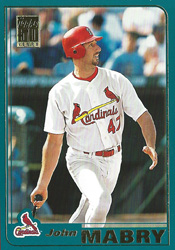
Starting with a walk to Yadier Molina and culminating with a home run by John Mabry, the Cardinals completed the biggest ninth-inning comeback in franchise history.

john_mabry2On May 2, 2005, the Cardinals overcame a six-run deficit by scoring seven runs in the ninth and defeating the Reds, 10-9, at Cincinnati.

The Cardinals sent 12 batters to the plate in that memorable inning and rallied against two relievers on a combination of four singles, two walks, two home runs and an error.

“I’ve never seen this happen,” Cardinals infielder Abraham Nunez told the St. Louis Post-Dispatch. “I hope I don’t see it happen again either.”

The Cardinals never had rallied from six runs behind in the ninth inning. The Reds hadn’t blown a six-run lead in the ninth since June 29, 1952, when an 8-2 advantage turned into a 9-8 loss to the Cubs at Cincinnati. Boxscore

“It’s not easy to give a big-league game away, but that’s what we did,” said Reds reliever Danny Graves after yielding the game-winning home run to Mabry. “It takes 27 outs, not 26 (to win).”

Walks will haunt

With the Reds ahead, 5-3, in the eighth, Graves began to throw in the bullpen in preparation for pitching the ninth. When the Reds scored four in the eighth, however, manager Dave Miley decided to save his closer and instead sent David Weathers to pitch the ninth, entrusting the 15-year big-league veteran with a 9-3 lead.

“The only way they could get back in the game is if we walked guys _ and I walked guys,” Weathers said to The Cincinnati Post.

Weathers walked the first two batters, Molina and Nunez. David Eckstein singled, loading the bases with none out.

“I was just all over the place,” Weathers said of his pitches.

Still, he almost escaped the jam unscathed.

Roger Cedeno struck out.

When Albert Pujols followed with a grounder to shortstop Rich Aurilia, it appeared the Reds might turn a game-ending double play.

Aurilia fielded the ball cleanly and tossed to D’Angelo Jimenez for the forceout of Eckstein at second base. Jimenez, however, couldn’t complete the turn and Pujols was safe at first. Molina scooted home from third on the play, making the score, 9-4.

The Cardinals remained alive, with Nunez on third, Pujols on first and two outs.

Reggie Sanders, the ex-Red, then singled, plating Nunez, moving Pujols to second and making the score 9-5.

Said Weathers: “It’s embarrassing … No excuses. That’s just bad pitching.”

Edmonds delivers

Miley lifted Weathers and replaced him with Graves, who had converted all eight of his save chances that season.

The first batter Graves faced was Jim Edmonds.

Hoping to catch the Reds by surprise, “I was thinking about bunting, honestly,” Edmonds told the Associated Press.

The slugger changed his mind, though, and decided to swing away.

Graves’ third pitch to Edmonds was a hanging breaking ball.

Edmonds belted it for a three-run home run, making the score 9-8.

Reds unravel

The Reds were reeling, but the Cardinals still trailed with the bases empty and two outs.

“Nobody wants to make that last out,” said Mabry. “That’s what it comes down to.”

Following Edmonds was Mark Grudzielanek. He smacked a grounder directly at Sean Casey. The ball ricocheted off the first baseman’s arm for a two-base error.

That brought up Mabry, who started the game at third base in place of Scott Rolen, who was nursing a back strain.

With the tying run at second, “I was just trying to drive the run home by staying inside the ball and driving it to the big part of the ballpark,” Mabry said.

Mabry did even better. He hit the first pitch over the center-field fence, a two-run homer, giving the Cardinals a 10-9 lead.

“That’s why baseball’s a beautiful game,” Mabry said.

A rattled Graves yielded singles to Molina and Nunez before retiring Eckstein on a fly out to right.

As Graves left the mound, the crowd, estimated at fewer than 10,000 in the ninth, was “booing at the top of their lungs,” The Post reported.

“To have that happen just makes us feel really small,” Graves said to Post columnist Lonnie Wheeler.

Finish the job

With closer Jason Isringhausen unavailable, Cardinals manager Tony La Russa chose Julian Tavarez to pitch the bottom of the ninth.

The first batter, Joe Randa, singled. Aurilia tried a sacrifice bunt, but Randa was forced out at second.

Tavarez then plunked Jason LaRue with a pitch, advancing Aurilia to second.

The drama finally ended when Austin Kearns grounded into a double play. Boxscore

“We have no baseball luck, I guess,” said Graves, “and in this game you do need a lot of luck along with skill.”

Three weeks later, Graves ran out of luck with the Reds. They released him.

Previously: How David Bell rang up a special Cardinals home run

Previously: Jim Edmonds was dandy for Cardinals in 2004 NLCS

Previously: Slugging, fielding give Jim Edmonds hope for Hall of Fame

(Updated Nov. 1, 2025)

Unwilling to bend on principle, Cardinals general manager Dal Maxvill reluctantly traded a slugger he wanted to keep. In a stroke of good fortune, he got in exchange a closer who would rank among the franchise’s all-time best.

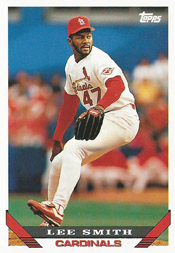
On May 4, 1990, the Cardinals acquired Lee Smith from the Red Sox for outfielder Tom Brunansky.

lee_smith3It was one of Maxvill’s best trades during his tenure (1985-94) as Cardinals general manager. On Dec. 9, 2018, Smith was elected to the National Baseball Hall of Fame.

The deal came about after Brunansky demanded a no-trade clause in exchange for waiving free agency and staying with St. Louis. “I haven’t been looking to trade him,” Maxvill told the St. Louis Post-Dispatch. “We wanted to keep Brunansky.”

Seeking security

The Cardinals had acquired Brunansky from the Twins for second baseman Tommy Herr on April 22, 1988, six months after Minnesota had prevailed in a seven-game World Series with St. Louis.

Early in the 1990 season, the Cardinals approached Brunansky about a three-year contract. Eligible to become a free agent after the 1990 season, Brunansky wanted a no-trade provision in any new contract. “We don’t have those in St. Louis,” Cardinals manager Whitey Herzog said.

Brunansky explained “my wife and I wanted to settle down and buy a house here,” but couldn’t commit to that without the no-trade clause, the Post-Dispatch reported. “For me to stay here, I would need some kind of security,” Brunansky said. “I wasn’t going to sign here for three years, buy a house and everything and keep hearing trade rumors … It was a big issue for me and, of course, it was a big issue for the ballclub.”

Motivated to act

The Red Sox were eager to deal because they needed a right fielder to replace Dwight Evans, who was restricted to designated hitter duties because of back problems. The Cardinals needed an established closer to replace Todd Worrell, who was recuperating from elbow surgery.

Herzog said to the Post-Dispatch, “We felt if we waited any longer, (Smith) wouldn’t be there.”

Smith became available when the Red Sox signed another closer, Jeff Reardon.

The Cardinals also had talked with the White Sox about closer Bobby Thigpen, according to the Post-Dispatch. The Red Sox, though, were motivated to act.

“They called us. It’s as simple as that,” Red Sox manager Joe Morgan said to the Worcester (Mass.) Telegram and Gazette. “Nobody would give us the kind of pitcher we wanted, so we went with the right-handed power.”

According to the Boston Globe, the Red Sox turned down a two-for-one swap with the Braves involving pitcher Tommy Greene and third baseman Jim Presley for Smith. “We offered them a heck of a deal.” Braves general manager Bobby Cox said to The Sporting News.

Reunited with Roarke

Brunansky hit 43 home runs in three years with the Cardinals, but only 11 at Busch Memorial Stadium in St. Louis. “He’ll hit homers in Fenway (Park),” said Red Sox catcher Tony Pena, a former Cardinal.

Smith posted a 2-1 record with four saves, a 1.88 ERA and 17 strikeouts in 14.1 innings for the 1990 Red Sox. In joining the Cardinals, he was reunited with coach Mike Roarke, who had been his coach as a rookie with the 1980 Cubs.

Smith welcomed the chance to be the Cardinals’ closer. With Reardon the primary closer in Boston, Smith said he “sort of felt like the odd man out” there.

“I’m going to get an opportunity to pitch in the situation that I’m used to,” Smith said to Boston reporters. “I’m really pleased.”

Smith earned his first save for the Cardinals on May 11, 1990, pitching a flawless ninth inning in relief of Bryn Smith in St. Louis’ 5-2 victory over the Braves. Boxscore Smith posted 27 saves and a 2.10 ERA for the 1990 Cardinals.

Brunansky played four years with the Red Sox and hit 56 home runs.

Smith played four years with the Cardinals and earned 160 saves. Only Jason Isringhausen (217) has more saves as a Cardinal.

Smith was the first Cardinal to record 40 saves in consecutive seasons. He twice had back-to-back 40-save seasons: 1991-1992 and 1992-1993. He had 47 saves in 1991, 43 in 1992 and 43 again in 1993.

In 1993, less than two hours before the Sept. 1 trade deadline, the Cardinals dealt Smith to the Yankees for pitcher Rich Batchelor, clearing the way to test Mike Perez as the closer the rest of the season. The trade “took me off the hook” from having to inform Smith he was being removed from the closer role, said Joe Torre, who’d replaced Herzog as Cardinals manager.

(Updated May 5, 2020)

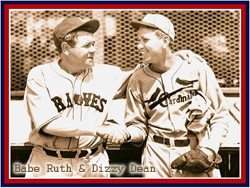
In a showdown of two master showmen, Dizzy Dean upstaged Babe Ruth.

babe_dizzyRuth, 40, entered his final big-league season with the 1935 Braves. The fading home run king had gone to the National League after 21 years (1914-34) in the American League with the Red Sox and Yankees.

Dean, 25, was the colorful Cardinals ace and reigning NL strikeout king who had earned 30 wins the year before and pitched St. Louis to the 1934 World Series championship.

They faced one another for the first time in a regular-season game on May 5, 1935, at Boston before a crowd of at least 30,000, including three sons of President Franklin Roosevelt.

Seeking a strikeout

In the book “Diz,” Dean biographer Robert Gregory wrote, “He had been looking forward to his first league showdown with Babe Ruth and telling everybody he’d have no choice in the matter. He would have to strike him out.”

Ruth and Dean greeted each other cordially before the game and took part in a newspaper-sponsored promotion with local youth players.

Then, it was show time.

“Babe was watching me pretty closely while I was warming up before the game,” Dean said in the book “Ol’ Diz” by Vince Staten. “He had that old eagle eye of his on every move I made.”

In his first at-bat, Ruth walked.

When Ruth came to the plate for the second time, Dean upped the ante. “I figured that if I didn’t steal the show he would,” Dean said.

Play deep

As Ruth took his practice cuts, Dean smiled at him and turned toward his outfielders.

“He motioned them to play farther back,” wrote Gregory. “They retreated a few steps, but Diz shook his head, no, no, that’s not deep enough, and kept waving his glove until they were almost at the walls.”

Then, Dean went to work on Ruth. He got the count to 1-and-2. On his fourth delivery, Dean unleashed his best fastball. Ruth took a mighty swing and missed. Dean had his strikeout of the Bambino.

“Babe almost broke his back going for that steaming third fastball,” according to the Associated Press.

Dean “whiffed the great man with marvelous eclat,” wrote the Boston Globe.

In his third at-bat, Ruth got “a fast one through the middle, waist high,” the St. Louis Post-Dispatch reported. “Ruth took a tremendous swing at the ball, but he missed.”

Ruth and Dean looked at one another and laughed.

“I never saw a man take such a cut in my whole life,” Dean told the Post-Dispatch. “Lordy me, if he had hit that ball it would have gone to New York or Pensacola. I had to laugh at him swinging like that and he was laughing because he hadn’t expected to get a fast one like that, right through the heart of the plate.”

When the at-bat resumed, Ruth grounded out to shortstop Leo Durocher, who was playing back on the grass on the first base side of second.

Basking on the stage set for him, Dean slugged a home run that sailed over Ruth’s head before clearing the left-field wall. He earned the shutout in a 7-0 Cardinals victory. Boxscore

“Dizzy Dean stole the Babe’s thunder and color,” the Boston Globe declared.

Encore performance

Two weeks later, on May 19 at St. Louis, Ruth and Dean had a rematch. Again, Dean prevailed. Ruth was 0-for-4 with a strikeout. Dean pitched another complete game and drove in two runs, leading St. Louis to a 7-3 victory. Boxscore

In five games against the Cardinals in 1935, Ruth batted .071 (1-for-14) with a single, three walks and five strikeouts. With his overall average at .181 in 28 games that season, Ruth retired at the end of May.

In his prime, Ruth faced the Cardinals in two World Series. He hit .300 (6-for-20) with four home runs and 11 walks in the seven-game 1926 World Series. In the 1928 World Series, Ruth hit .625 (10-for-16) with three home runs and three doubles in four games.

Previously: Stan Musial: ‘Babe Ruth was the greatest who ever played’