Feeds:
Posts
Comments

(Updated April 22, 2020)

With water filling the dugouts and lapping at the feet of spectators in the box seats, the Cardinals and Reds raced to complete a game at Cincinnati before flooding made conditions unplayable.

crosley_fieldCompleting nine innings in 1:56, the Reds beat the Cardinals, 6-1, on April 22, 1940, at Crosley Field.

The night before, the Ohio River reached the 55-foot stage. Reds officials knew Crosley Field, located near Mill Creek, started flooding when the river got to 57 feet, or five feet above normal flood stage, International News Service reported.

It was expected the river stage would reach 57 feet in late afternoon or early evening on April 22. The Reds moved up the starting time of their game with the Cardinals that afternoon by an hour, from 3 p.m. to 2 p.m.

At game time, however, water stood a foot deep in both dugouts _ even deeper in nearby parking lots _ and a crowd of 5,197 “had to puddle-jump their way into the park,” the Associated Press reported.

Patrons seated in field-level box seats behind third base “pulled their feet higher and higher” as the game progressed and water continued to rise.

“Shortly before game time, there was no water in the front row of the lower tier boxes,” the Cincinnati Enquirer reported, “but before the game was half over the fans in those seats were straddling quite a little pond. Most of them refused to move, although there were plenty of seats right in back of them.”

The players sat on benches in foul territory because the water in the dugouts eventually reached three feet deep, according to the book “Cardinals Journal.”

The game matched starting pitchers Bucky Walters, a 27-game winner in 1939 when he earned the National League Most Valuable Player Award, for the Reds against Bill McGee.

According to the St. Louis Globe-Democrat, “the Cardinals were at low tide” in their performance on the field.

Cincinnati, the defending National League champion, broke a scoreless tie with three runs in the fifth against McGee. The Reds added three more in the seventh off Clyde Shoun.

Walters drove in three runs and pitched eight scoreless innings before the Cardinals struck for a run in the ninth. By then, water was seeping onto the field. Boxscore

“Water backing up from sewers was ready to flow over the wall or the dugouts as the game ended,” the St. Louis Post-Dispatch reported.

The Cardinals were supposed to play the Reds again on April 23 and April 24, but both games were postponed. By then, the Ohio River had reached 58 feet and water covered the Crosley Field outfield. Another foot would put home plate under water.
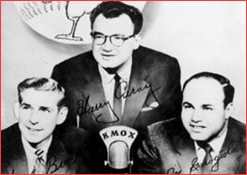
 

At 29, Joe Garagiola ended a big-league playing career and began a big-league broadcasting career, joining Harry Caray and Jack Buck on the Cardinals radio team. Caray had encouraged Garagiola to make the move, but eventually regretted doing so when the pair had a falling out.

buck_caray_garagiolaIn 1955, KMOX in St. Louis became the exclusive flagship radio station of the Cardinals. The 50,000-watt CBS affiliate signed a deal to broadcast the team’s entire 1955 schedule, including spring training games. KMOX hadn’t broadcast a complete Cardinals schedule in 15 years.

Caray, Buck and Milo Hamilton had broadcast Cardinals games on a rival station, KXOK, in 1954. Caray and Buck were recruited to KMOX in 1955. Hamilton was let go. At the urging of Caray, Garagiola replaced Hamilton.

Recruited by Caray

“Harry didn’t get along with Milo any better than he got along with me at the time and we knew he wanted to get somebody else on the broadcasts with whom he was more friendly,” Buck said in his book “That’s a Winner.”

“The man he wanted _ and got _ was Joe Garagiola. He and Harry had become friends when Garagiola was playing with the Cardinals … Harry kept bending his ear about getting into broadcasting … Harry talked the brewery and advertising people into hiring Joe.”

In his book “Baseball is a Funny Game,” Garagiola said, “I made a real effort to become a talk-for-pay guy. Every day I agitated Harry Caray … about what a soft job he had. His answer was that if I could hit like I could talk I wouldn’t have any worries. The kidding got on the square when he kept encouraging me about a future in broadcasting. Harry was a big help to me as a broadcaster.”

Goodwill ambassador

Garagiola, a St. Louis native, was 20 when he made his big-league playing debut as a catcher with the 1946 Cardinals. He played in the World Series that year, hitting .316 with four RBI in five games against the Red Sox.

The Cardinals traded Garagiola to the Pirates in June 1951.

In 1954, Garagiola played in his final big-league season for the Cubs and Giants. In his book “Holy Cow,” Caray implied the Cardinals knew in 1954 that they wanted Garagiola for their 1955 broadcast team.

“The third spot on the team was being saved for Joe Garagiola … Once he was done playing, Joe was going to join up with me,” Caray said.

Garagiola spent the winter before the 1955 season “traveling the banquet circuit in his new role as sportscaster of the Cardinals games and goodwill ambassador for Anheuser-Busch.”

Odd man out

When it came time for spring training, Caray and Garagiola went to Florida to do the games. Buck was left behind in St. Louis.

“It was difficult for me because Joe became Harry’s right hand and I was the odd man out,” Buck said. “I was all set to go to spring training that year, 1955, and Joe bumped me out of the trip. He talked the brewery into sending him instead. He also became the full-time partner for Harry on the road, leaving me at home in the studio to do the commercials and scoring updates of other games.”

Garagiola’s wife, Audrie, became the Busch Stadium organist. She was as popular as her husband. According to The Sporting News, the “ballpark switchboard received several calls complimenting” the musical skill of the organist, while Joe “has made a favorable impression … as a broadcaster of Redbird games.”

Said Buck: “Nobody at the time knew how well Garagiola was going to do in the broadcast booth … He walked right in and started doing it. It helped that Harry liked him, but I give Joe a lot of credit for working at it.”

Hurt feelings

Caray, Garagiola and Buck formed the Cardinals’ broadcast team from 1955-59. In 1960, Buck departed, leaving Caray and Garagiola as a duo.

“Caray was helping make Garagiola the success he became, but they probably were too much alike to remain partners for long,” Buck said in his 1997 book. “Harry resented the fact that Joe became a national celebrity and never gave Harry credit … The relationship between Harry and Joe fell apart to the point that they’re still not friends today.”

Buck rejoined Caray and Garagiola in 1961 and they remained Cardinals broadcast partners in 1962. Garagiola departed to join NBC on its national broadcasts in 1963 and was replaced in the Cardinals booth by Jerry Gross.

The Ford C. Frick Award, presented annually since 1978 to a broadcaster for major contributions to baseball, has been awarded to Buck (1987), Caray (1989), Garagiola (1991) and Hamilton (1992).


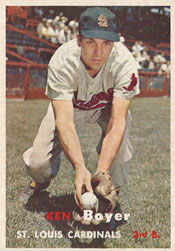
Before he played a game for the Cardinals, Ken Boyer was hyped as their best third baseman all-time. In his debut, he heightened expectations, hitting a home run against a Cardinals nemesis.

ken_boyer9On April 12, 1955, Boyer appeared in his first game in the majors, playing third and batting sixth in the Cardinals’ season opener against the Cubs at Chicago’s Wrigley Field.

In the eighth inning, with two outs, Red Schoendienst on first and the Cubs ahead, 14-2, Boyer slugged a home run off starter Paul Minner. The longball ignited a productive rookie season and a standout Cardinals career.

The Natural

After hitting .319 with 42 doubles, 21 home runs, 116 RBI and 29 stolen bases for the Cardinals’ minor-league Houston affiliate in 1954, Boyer was assured a spot with the 1955 Cardinals. In December 1954, the Cardinals traded their starting third baseman, Ray Jablonski, to the Reds, making Boyer the heir apparent at that position entering spring training.

In an interview with The Sporting News, Art Routzong, Houston’s general manager, said of Boyer, “He is the best prospect I’ve seen in 17 years in baseball.”

In a preview to spring training, St. Louis writer Bob Broeg opined, “If looks didn’t deceive, the Cardinals would have their greatest third baseman ever in Kenton Lloyd Boyer. It does seem possible _ it would be daring to say ‘probable’ _ that the rookie will become the Redbirds’ best at their most vexing position.”

Broeg’s colleague, J. Roy Stockton, added that Boyer “would be the Cardinals’ first complete infielder since Red Schoendienst.”

Solid spring

In spring training, Boyer played well at both third base and shortstop. In a poll of baseball correspondents for The Sporting News, Boyer and Indians pitcher Herb Score were selected the best rookies entering the 1955 season.

Scout Tony Kaufmann compared Boyer with a Hall of Famer, saying the rookie could become “another Pie Traynor.”

“He’s deadly efficient and with no apparent weakness,” Cardinals manager Eddie Stanky said of Boyer.

Wrote Broeg: “He can run fast, throw hard, field well and hit with power.”

Quick adjustment

Boyer’s performance in his debut game affirmed his skills and his ability to adapt.

Minner, a left-hander, often baffled the Cardinals. In a 10-year career with the Dodgers and Cubs, Minner was 21-8 versus St. Louis. He was 48-76 against the rest of the National League. In 1955, when he finished 9-9, Minner was 5-0 against the Cardinals.

In his first big-league at-bat in the season opener, Boyer flied out to right. In his next two at-bats, Boyer struck out against Minner, both times with a pair of runners on base.

In the eighth, Schoendienst singled with two outs. Boyer followed with his home run. Boxscore

(A month later, May 30, 1955, Boyer hit two home runs in a game against Minner, including a two-run, two-out shot in the bottom of the ninth that tied the score.)

Strong season

Boyer had a successful rookie year. He hit .264 with 27 doubles, 18 home runs and 22 stolen bases. Boyer was one of four National League players to achieve double figures in home runs and steals in 1955. The others: Willie Mays of the Giants (51 homers, 24 steals), Sandy Amoros of the Dodgers (10 homers, 10 steals) and Boyer’s teammate, Wally Moon (19 homers, 11 steals).

Among NL third basemen in 1955, Boyer ranked second in double plays turned (24), third in assists (253) and third in fielding percentage (.952).

Yet, Boyer’s teammate, outfielder Bill Virdon, won the 1955 NL Rookie of the Year Award. Virdon hit .281 with 18 doubles and 17 home runs.

As predicted, Boyer developed into the all-time best Cardinals third baseman. In 11 years with St. Louis, he hit .293 with 255 home runs and 1,001 RBI. Boyer also won five Gold Glove awards and the 1964 NL Most Valuable Player Award with the Cardinals.

Previously: 1964 effort supports Ken Boyer Hall of Fame case

Previously: With Ron Santo in Hall, Ken Boyer should be there, too

Previously: Ken Boyer converted from infield to center

On a gray, chilly Tuesday afternoon at Chicago’s Wrigley Field, the Cardinals opened their 1991 season with a textbook example of how playing fundamental baseball _ the George Kissell way _ can bring a positive result.

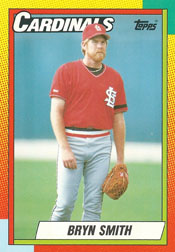
bryn_smithRelying on effective pitching, good base running, plate discipline and timely contact, the Cardinals beat the Cubs, 4-1, on April 9, 1991. Cardinals manager Joe Torre sent the game ball and lineup card to Kissell, the club’s long-time instructor. “Kissell gets this for teaching the Cardinals organization how to play baseball,” Torre told the St. Louis Post-Dispatch.

Smith vs. Jackson

Bryn Smith, 35, a nine-game winner for the 1990 Cardinals, was the starting pitcher for St. Louis in the 1991 opener. Torre selected a batting order of center fielder Rex Hudler, shortstop Ozzie Smith, left fielder Bernard Gilkey, first baseman Pedro Guerrero, right fielder Felix Jose, third baseman Todd Zeile, catcher Tom Pagnozzi, second baseman Jose Oquendo and Bryn Smith.

Cubs manager Don Zimmer chose Danny Jackson as his starting pitcher. Chicago’s lineup featured a pair of future Hall of Famers, second baseman Ryne Sandberg and right fielder Andre Dawson, and standouts such as first baseman Mark Grace, shortstop Shawon Dunston and left fielder George Bell.

Game time temperature was 42 degrees. Rick Hummel of the Post-Dispatch described it as a “numbing, cold, drizzling day.” His colleague, Dan O’Neill, wrote, “The grass was green, but soaking wet and bent by a wintry breeze.”

The Cardinals scored first in the fifth. With the bases loaded and two outs, Gilkey fell behind in the count 0-and-2 before drawing a walk, scoring Pagnozzi from third. The full-count pitch from Jackson to Gilkey “missed inside by a few inches,” according to the Chicago Sun-Times.

Dunston led off the bottom half of the inning with a home run, tying the score at 1-1.

Small ball

In the eighth, the Cardinals struck for three runs, using a walk and three ground balls that never left the infield as their weapons.

Here’s how it happened:

With the bases loaded and one out, Paul Assenmacher relieved Jackson. Oquendo hit a dribbler toward the left side of the infield. “I broke my bat in three pieces,” Oquendo said.

The ball eluded Assenmacher. Dunston raced in from his shortstop position, grabbed the ball and flipped it to second. Pagnozzi beat the toss. Jose streaked home from third on the fielder’s choice play, putting the Cardinals ahead, 2-1, and the bases remained loaded.

“I was panicking,” the slow-footed Pagnozzi said of his sprint from first to second. “I didn’t think I was going to get there.”

Said Oquendo: “He surprised me.”

Bunch of runts

Torre sent Craig Wilson to hit for Bryn Smith. Wilson slapped a grounder toward the mound. Assenmacher reached for it and the ball deflected off his glove toward Dunston, who had no play. Zeile scored from third, putting the Cardinals ahead, 3-1. Wilson was credited with a RBI-single. The bases still were loaded.

“We’ve got the guy (Zeile) at home if I don’t touch it, but the reflex is to go for it,” Assenmacher said.

Said Wilson: “I think he thought it was hit harder than it was.”

Zimmer yanked Assenmacher and replaced him with Les Lancaster. Hudler grounded to Dunston, whose spikes “stuck in the moist dirt,” the Sun-Times reported.

Instead of an inning-ending double play, Dunston settled for a force of Wilson at second, with Pagnozzi scoring from third.

The Cardinals’ bullpen protected the 4-1 lead. Mike Perez pitched a scoreless eighth and Lee Smith earned the save with a scoreless ninth. “I’m glad I’m playing with this bunch of runts,” Lee Smith said of the Cardinals.

Said Bryn Smith: “This was our type of baseball. We’re a patient club and we have to play our game … We feel if we play our caliber of ball you’re going to have to beat us because we won’t beat ourselves.” Boxscore

Previously: Ernie Banks and his greatest hits against Cardinals

Previously: Bob Gibson vs. Billy Williams: a classic duel

Previously: Reds-Cardinals: Easter night to remember

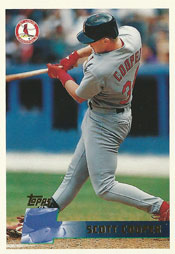
In theory, the trade for Scott Cooper appeared to be ideal for the Cardinals. Cooper was a St. Louis native, a Cardinals fan and a two-time all-star third baseman who looked to be entering his prime. In reality, the deal was a bust.

scott_cooper2On April 8, 1995, the Cardinals acquired Cooper and reliever Cory Bailey from the Red Sox for outfielder Mark Whiten and pitcher Rheal Cormier.

Cooper, 27, was thrilled to join his hometown team and the Cardinals were thrilled to get a player with a reputation for producing steady hitting and solid defense.

After a fairy tale debut _ he hit a two-run single in the bottom of the ninth to lift the Cardinals to a 7-6 victory over the Phillies in the season opener at St. Louis _ Cooper failed to meet expectations. He hit .230 with three home runs for the 1995 Cardinals and made 18 errors.

When the season ended, he became a free agent and went to Japan.

Replacing a legend

Cooper was 15 when the Cardinals won the 1982 World Series title. The exhilarating experience of seeing his favorite team become big-league champions “left a dent in my soul,” he told the Associated Press.

A standout player at Pattonville High School in the St. Louis suburb of Maryland Heights, Mo., Cooper was chosen by the Red Sox in the third round of the 1986 amateur draft. He signed with them and made his big-league debut with Boston in 1990.

When free-agent Wade Boggs left the Red Sox for the Yankees after the 1992 season, Cooper replaced the five-time American League batting champion as Boston’s third baseman.

Cooper responded splendidly to the challenge. He was named an AL all-star in 1993 and 1994. His batting average in five years with Boston was .284.

Cardinals calling

In April 1995, general managers Walt Jocketty of the Cardinals and Dan Duquette of the Red Sox discussed a deal. The Red Sox wanted Whiten and Cormier. Jocketty wanted Cooper.

Jocketty agreed to trade Whiten but offered pitcher Tom Urbani instead of Cormier.

“We needed Cormier in the deal to make it go,” Duquette said.

Talks stalled. Jocketty gave the Red Sox a deadline of April 8.

When it became clear the Red Sox wouldn’t make the deal without Cormier being included _ “They were pretty adamant about it,” Cardinals manager Joe Torre told the St. Louis Post-Dispatch _ Jocketty relented.

No joke

On the afternoon of April 8, Cooper and teammates Roger Clemens and Eric Wedge were golfing in Fort Myers, Fla. “I was getting ready to hit this ball and this guy in a cart comes barreling around the corner,” Cooper said.

“Are you Scott Cooper?” asked the man in the cart. “Mr. Dan Duquette wants you to call him immediately.”

Said Cooper: “My heart sank. I looked at Clem and said, ‘Are you messing with me?’ … Roger looked at me and he was real serious. He said, ‘I would never play that kind of trick on you.’ ”

Duquette told Cooper of the trade to the Cardinals.

Contacted soon after by Rick Hummel of the Post-Dispatch, Cooper said, “I can’t begin to describe the emotion I’m feeling right now. I’m numb all over. The Red Sox let me fulfill my dream. They gave me the opportunity to be a major leaguer. But my lifetime dream as a kid was to play for the St. Louis Cardinals.”

Asked about the pressure of playing at home, Cooper told The Sporting News, “If I can come in and take the place of Wade Boggs and play in front of that crowd in Boston and make two all-star teams, I can play in my hometown in front of my family and friends.”

Lineup shifts

The Cardinals moved Todd Zeile, a converted catcher, from third base to first base, replacing Gregg Jefferies, who had become a free agent and signed with the Phillies. Brian Jordan, a highly-regarded prospect, replaced Whiten in right field. Urbani took over for Cormier in the starting rotation.

“Cooper is known for his defense and that was one of the major reasons we wanted to get him,” Jocketty said. “Plus, he’s a good left-handed bat.

“We feel Zeile will be a better first baseman than Jefferies was and we feel Cooper will make us better defensively at third. He has good hands, a good arm. He’s a real third baseman.”

(Bailey, the other player acquired from Boston by the Cardinals, became a productive reliever. He spent most of the 1995 season as the closer at Class AAA Louisville, earning 25 saves, and was 5-2 with a 3.00 ERA in 51 games for the 1996 Cardinals.)

Plans unravel

By mid June, the 1995 Cardinals were scuffling. Torre got fired. Zeile was traded to the Cubs.

Cooper, hitting .310 as late as May 20, had a miserable summer. He batted .164 in July and .183 in August.

For the season, Cooper hit .210 (21-for-100) with runners in scoring position. He had almost as many strikeouts (85) as hits (86).

After spending the 1996 season in Japan (where he hit .243 in 81 games), Cooper returned to the big leagues with the 1997 Royals and batted .201.

That would be his final major-league season. At age 30, three years after being named an all-star, his big-league playing career was finished.

Previously: How Scott Cooper made memorable Cardinals debut

Previously: How a tragic accident brought Mark Whiten to Cardinals

(Updated April 7, 2020)

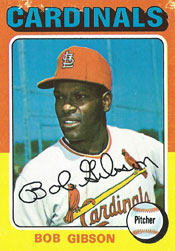
At 39, his knees aching and his arm suspected of lacking its familiar zip, Bob Gibson made what he knew was his last Opening Day start for the Cardinals and delivered a performance in which he overpowered and fooled batters barely more than half his age.

bob_gibson18On April 7, 1975, Gibson made the last of 11 consecutive Opening Day starts for the Cardinals. He struck out 12 Expos in eight innings, but took the loss in Montreal’s 8-4 victory at St. Louis.

Before the season began, Gibson had said 1975 would be his last year as a player.

In spring training at St. Petersburg, Fla., he told the Newspaper Enterprise Association, “I’d be a fool if I said I’m as good as I’ve ever been. But I wasn’t all that bad last season. I’ve been playing ball for something like 30 years _ 30 years! _ and I’m tired … Last season, I had my knee drained 22 times before almost every start and that’s tiring.”

Gibson had been the Cardinals’ Opening Day starting pitcher every year since 1965. (In the 1966 opener, Gibson started against the Phillies and pitched a perfect inning before the game was called off because of rain.)

In the zone

The 1975 opener matched Gibson against an Expos club that started seven players ages 24 or younger: shortstop Tim Foli (24), catcher Barry Foote (23), left fielder Tony Scott (23), second baseman Pete Mackanin (23), center fielder Pepe Mangual (22), third baseman Larry Parrish (21) and Gary Carter, a catching prospect who got the start in right field the night before his 21st birthday.

After seven innings, the Cardinals led, 4-3. Gibson struck out at least one batter in each of those innings. He struck out the side in the second.

In the eighth, Carter grounded out and Mackanin struck out, giving Gibson a dozen strikeouts in a game for the first time since he compiled 14 versus the Giants on Aug. 30, 1972.

With two outs and none on, Parrish singled to center. Larry Biittner, pinch-hitting for pitcher Dave McNally, singled to left.

Scott, a switch-hitter who would play for the Cardinals from 1977-81, was up next. He was 0-for-3 in his first game against Gibson.

Batting left-handed, Scott fell behind in the count 0-and-2. Gibson was a strike away from escaping the jam and preserving the lead.

His next pitch was high and Scott slashed at it, driving the ball down the line and into the left-field corner for a two-run double, putting the Expos ahead, 5-4.

“That was the first time I’d faced Gibson,” Scott told The Sporting News. “The only time I’d seen him was on TV. I like to hit off him because he’s always around the plate. He works so fast it seems like he doesn’t even take the sign.”

Gallant effort

Gibson was lifted for a pinch-hitter in the bottom of the eighth. In the ninth, Carter hit a three-run home run off Elias Sosa, making his Cardinals debut after being acquired from the Giants.

Gibson’s line: 8 innings, 9 hits, 5 runs, 5 walks, 12 strikeouts.

It was the 72nd and final time Gibson achieved double-digit strikeouts in a game.

“That’s as great as I’ve seen him pitch since ’73,” Expos manager Gene Mauch said to the Associated Press. “He mixed his pitches beautifully and threw the ball hard when he had to.”

Cardinals catcher Ted Simmons told the St. Louis Post-Dispatch, “It compares to nothing I’ve seen from him for a while.”

Said Carter, who was 5 years old when Gibson made his big-league debut in 1959: “Bob Gibson had good stuff out there. He’s a fantastic pitcher.”

Gibson threw 151 pitches.

“I guess my stuff was all right,” Gibson said to Steve Porter of the Alton (Ill.) Telegraph, “but I don’t care what I’ve done unless we win the game.” Boxscore