Feeds:
Posts
Comments

When the Cardinals reacquired Ken Hill, they thought they’d found an ace. Instead, he was a dud.

ken_hillOn April 5, 1995, in one of the first big trades made by general manager Walt Jocketty, the Cardinals got Hill from the Expos for pitchers Bryan Eversgerd and Kirk Bullinger and outfielder DaRond Stovall.

The deal was considered a steal. Hill had 16 wins for the 1994 Expos, sharing the National League lead with Greg Maddux of the Braves.

A right-hander, Hill joined left-handers Danny Jackson, Allen Watson, Donovan Osborne and Tom Urbani in the rotation.

An intimidator

“In acquiring Kenny Hill, we’ve got probably one of the top two or three pitchers in the game today,” Jocketty said to the St. Louis Post-Dispatch. “I think we’re on our way to putting together the championship club we thought we could.”

Said manager Joe Torre: “Kenny Hill is the type of pitcher we really haven’t had. He’s the type of pitcher who can go out and dominate a game. He’s an intimidator, a guy who can go out and pitch a no-hitter.”

Hill, 29, became available because the Expos were slashing expense and general manager Kevin Malone was under orders to unload top-salaried players.

The Blue Jays and Rockies also made strong bids for him. “The Jays thought they had offered a better deal for Ken Hill than the one the Expos accepted with the Cardinals,” The Sporting News reported, adding that the cash-strapped Expos were in no mood to help their Canadian counterparts.

Jocketty was thrilled he didn’t have to trade to the Expos one of the Cardinals’ top three pitching prospects: Alan Benes, Brian Barber or John Frascatore.

Said Torre: “This shows how serious we are. It’s very exciting to me that the Cardinals have gone out and established themselves as helping the club _ right now. That should put to rest any question about the desire of the Cardinals to win.”

First time around

Hill was a prospect in the Tigers’ minor-league system when the Cardinals acquired him and first baseman Mike Laga from Detroit for catcher Mike Heath on Aug. 10, 1986.

Hill made his big-league debut with St. Louis in 1988 and in the next four seasons with the Cardinals he was 23-32. According to catcher Tom Pagnozzi, Hill and pitching coach Joe Coleman “didn’t get along.”

After the 1991 season, Cardinals general manager Dal Maxvill sought to acquire Expos first baseman Andres Galarraga. The Expos wanted pitcher Rheal Cormier, a Canadian, in return, but Maxvill instead offered Hill and the Expos accepted.

Plagued by injuries, Galarraga was limited to 95 games and hit .243 with 10 home runs and 39 RBI for the 1992 Cardinals. A free agent, he departed for the Rockies after the season. Hill had 16 wins for the 1992 Expos and in three years with Montreal he was 41-21.

When Jocketty brought back Hill to St. Louis, it was as if a wrong had been righted.

Welcome back

“The Cardinals made belated amends for one of their worst trades in recent years,” Rick Hummel wrote in the Post-Dispatch.

Hummel’s colleague, Bernie Miklasz, opined, “Walt Jocketty needed one long distance phone call to erase one of Dal Maxvill’s worst mistakes.”

In The Sporting News, Bob Nightengale offered, “The Cardinals, always regretting they traded Hill … made up by stealing Hill back.”

Mark Riggins, who coached Hill in the minors, was the Cardinal’ pitching coach in 1995 and Bob Gibson had been added to the coaching staff as well.

Said Hill: “I love the deal … I couldn’t stand it when they (the Cardinals) traded me out. But I think that change of scenery helped.”

Pitching potential

Hill won his first four decisions for the 1995 Cardinals, but lost his next four in a row. He said he wasn’t happy with Pagnozzi as his catcher and asked to be traded to a contender.

With a 6-7 record and 5.06 ERA, Hill was traded again by the Cardinals on July 27, 1995, to the Indians for infielder David Bell, pitcher Rick Heiserman and catcher Pepe McNeal.

“I was not happy with his performance or with his attitude,” Jocketty said.

In two stints with St. Louis over five seasons, Hill was 29-39 with a 4.23 ERA. He pitched in the big leagues until 2001. In 14 years with the Cardinals, Expos, Indians, Rangers, Angels, White Sox and Rays, Hill was 117-109 with a 4.06 ERA.
 

(Updated March 12, 2023)

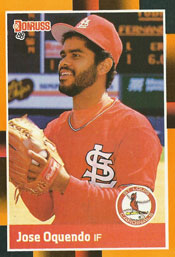
The Cardinals acquired Jose Oquendo with the idea he would become the eventual replacement for Ozzie Smith at shortstop. Instead, Oquendo became their second baseman and paired with Smith to form a top keystone combination.

jose_oquendo5On April 2, 1985, the Cardinals got Oquendo from the Mets in the first trade engineered by general manager Dal Maxvill.

Maxvill knew what it took to play shortstop, having been the Cardinals’ starter at that position on pennant-winning clubs in 1967 and 1968. Like Maxvill, Smith was a Gold Glove Award winner. Like Maxvill in 1967, Smith helped the 1982 Cardinals to a pennant and World Series title.

The Cardinals wanted Smith to remain their shortstop, but he was eligible to become a free agent after the 1985 season. If Smith and the Cardinals were unable to negotiate a contract extension, Maxvill was prepared to trade him.

Shoring up shortstop

A headline in an April 1985 edition of The Sporting News declared, “Cardinals Admit Ozzie May Be Dealt.”

“If we can’t sign him, there’s got to be some thought about trading him,” said Fred Kuhlmann, Cardinals chief operating officer.

Said Smith: “A trade is a possibility.”

Also, Smith had a serious shoulder injury (a torn rotator cuff) in 1985. Smith wanted to let the injury heal naturally rather than undergo surgery, so the Cardinals were concerned whether he could make it through the season.

The Cardinals, though, had no suitable replacement for Smith.

That’s when Maxvill went to work.

The Cardinals dealt shortstop Angel Salazar, whom they had acquired from the Expos three months earlier, and minor-league pitcher John Young to the Mets for Oquendo and minor-league pitcher Mark Davis. Four days later, April 6, 1985, the Cardinals got veteran shortstop Ivan DeJesus and reliever Bill Campbell from the Phillies for reliever Dave Rucker.

Maxvill saw DeJesus, 32, as the stopgap and Oquendo, 21, as the long-term answer at shortstop if Smith was traded or couldn’t overcome the bum shoulder.

“You have to prepare yourself for any eventuality,” Maxvill said. “I looked in our system and there was nothing there at shortstop. You have to backstop yourself whether (Smith) is here or not.”

Mets prospect

Oquendo was 15 when he signed with the Mets as an amateur free agent in 1979 and made his professional debut that year with their Class A affiliate, the Grays Harbor Loggers of Aberdeen, Wash., in the Northwest League. He made 40 errors in 63 games at shortstop that season.

Four years later, Oquendo, 19, became the starting shortstop for the 1983 Mets under manager George Bamberger.

In 1984, the Mets were managed by Davey Johnson. He saw Rafael Santana, a former Cardinal, and Ron Gardenhire as shortstop options.

“Johnson felt Oquendo had to be a better hitter,” The Sporting News wrote. “He also was less enamored of Oquendo’s fielding than that of other shortstops in the organization.”

Smith stays

Maxvill was more impressed with Oquendo than Johnson was. (After the deal was made, Johnson learned Gardenhire had back problems. “If I had known about this,” said Johnson, “Jose Oquendo might still be here.”)

The Cardinals assigned Oquendo to Class AAA Louisville.

“You can look for the Wizard to pack his bags any day now,” Bill Conlin, a columnist for The Sporting News, wrote of Smith after the Cardinals got Oquendo and DeJesus.

Instead, on April 15, hours before the Cardinals played their 1985 home opener that night against the Expos, Smith agreed to a four-year contract extension to remain with St. Louis.

The deal was worth $8.7 million. Smith received a $700,000 signing bonus and salaries of $1.8 million a year in 1986 and 1987 and $2.2 million a year in 1988 and 1989, The Sporting News reported. Also, the Cardinals provided Smith a $500,000 loan at 10 percent interest and Anheuser-Busch promised him consideration for a wholesale beer distributorship.

Smith played the entire 1985 season despite the bad shoulder. He would play for the Cardinals through the 1996 season before retiring.

Shift to second

Oquendo spent the 1985 season with Louisville. His manager was Jim Fregosi, who had been an all-star shortstop with the Angels. Oquendo hit .211 in 133 games for Louisville and made 23 errors at shortstop.

In 1986, Oquendo stuck with the Cardinals as a backup to Smith at shortstop and to Tommy Herr at second base. He hit .297 in 76 games, establishing himself as a valuable utility player.

After Herr was traded to the Twins in 1988, Oquendo became the Cardinals’ starter in 1989. He led National League second basemen in fielding percentage in 1989 (.994) and 1990 (.996).

In 10 seasons with the Cardinals (1986-1995), Oquendo hit .264 with an on-base percentage of .359. In 1989, he was eighth in the NL in batting at .291.

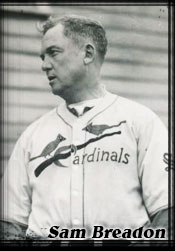
Five months after the 1934 Cardinals won the World Series title in seven games against the Tigers, owner Sam Breadon expressed a desire to move the franchise from St. Louis to Detroit.

sam_breadon3Disheartened by attendance figures for a franchise that won five National League pennants and three World Series championships from 1926-34, Breadon was willing to relocate the Cardinals after a bid to sell them collapsed.

The Cardinals’ regular-season home attendance in 1926, when they won the pennant and World Series title for the first time, was 681,575. It increased to 778,147 in 1928, when they again won the pennant.

After the Great Depression began soon after the stock market crash of October 1929, Cardinals attendance spiraled, even though the team was successful.

For sale

The Cardinals, who shared Sportsman’s Park with the American League Browns, drew 519,647 during the regular season in 1930, when they won their third pennant. Their attendance was 623,960 in 1931, when they won the pennant and World Series title.

After regular-season attendance totals of 290,370 in 1932 and 268,404 in 1933, the Cardinals drew 334,863 in 1934, when the colorful Gashouse Gang team of Dizzy Dean, Joe Medwick, Pepper Martin and Frankie Frisch won the pennant and World Series crown.

Fearing for the long-term financial prospects and figuring the value of his World Series championship club was at a premium, Breadon instructed general manager Branch Rickey to negotiate a sale with Lew Wentz, an Oklahoma oil baron who offered to buy the Cardinals.

Wentz, though, withdrew because of the asking price. Breadon wanted $1.1 million, according to the Murray Polner book “Branch Rickey: A Biography.”

With no prospects of a sale, Breadon explored relocation as an option.

Motor City madness

On March 28, 1935, during spring training in Bradenton, Fla., Breadon told reporters he would move the Cardinals to Detroit if Tigers owner Frank Navin approved.

The 1934 Tigers had a regular-season attendance of 919,161 _ nearly three times the Cardinals’ total _ and Breadon saw the job-generating Motor City as a town better suited than St. Louis to support two major-league franchises.

Sid Keener, sports editor of the St. Louis Star-Times, reported, “Breadon intimated that he would make overtures to the two major leagues during the coming season to rearrange the current setups of the National and American leagues. He said he believed baseball would profit by changing St. Louis to a one-club major league city, leaving the Browns as the sole representative in the Missouri city and by moving his own National League franchise to Detroit.”

Said Breadon to Keener: “We can put this over if Frank Navin … will take a sensible view of conditions. I can swing the deal from the National League angle. By that, I mean I have received the consent of the National League club owners to transfer the Cardinals to Detroit. However, we must convince Mr. Navin that it would be a good thing for everyone concerned in baseball before we can put it over.”

Profit over loyalty

According to the Associated Press, Breadon said, “Detroit has enough high-salaried fans to attend ballgames every day and it would help the Tigers. Think of the profit of a spring series alone.”

The Sporting News, the St. Louis-based weekly, quoted Breadon as saying, “I think Detroit would be an ideal spot for the Cardinals and I would go there in a minute if Navin opened the way to come in. But I doubt that he would want us.”

On March 29, 1935, the day after his stunning remarks, Breadon backpedaled. When asked by the Associated Press whether there was an immediate plan for a move, Breadon replied, “Not at all.”

In its April 4, 1935, edition, The Sporting News claimed Breadon “was merely doing a little off-the-record wishing” when he expressed interest in relocating the Cardinals to Detroit. Navin had no interest in sharing his market with the Cardinals, The Sporting News reported.

Still, the magazine left open the possibility of a Cardinals move.

“The meager draw (in 1934) caused Breadon to do a lot of thinking and the club would have shown a loss on the year’s operations had not the team smashed its way into the World Series,” The Sporting News opined. “While Detroit is out of the question as a stamping ground for the Redbirds, there are other possible future landing places for the Cardinals … The time may not be far distant when the Redbirds will be flying away to some other community.”

The Cardinals’ regular-season attendance improved to 517,805 in 1935, when the team finished in second place, but from 1935 through 1945, the Cardinals never drew more than 642,496 for a regular season.

In 1946, the first regular season after World War II, the Cardinals totaled an attendance of more than a million for the first time.


Bob Gibson and Steve Carlton appeared together in a regular-season game as Cardinals three times. Two of those games represented milestones for Carlton: his big-league debut and his first major-league save. In all three, Gibson started and Carlton relieved.

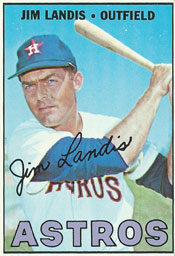
jim_landisThe first time Gibson and Carlton appeared together in a Cardinals regular-season game was April 12, 1965, the season opener for the defending World Series champions against the Cubs at Chicago.

Gibson left after yielding five runs in 3.1 innings.

In the 11th, with the score tied at 10-10, the Cubs had Ron Santo on second with one out and George Altman at the plate. Red Schoendienst, in his regular-season debut as Cardinals manager, lifted Barney Schultz and brought in Carlton to face Altman.

Carlton, 20, making his big-league debut, walked Altman. Schoendienst then brought in Bob Purkey, who got out of the jam without allowing a run.

At that point, the game was called because of darkness, ending in a tie. All the statistics counted. Boxscore

Mopping up

Four months later, on Aug. 25, 1965, Gibson faced the Cubs at St. Louis and gave up six runs in seven innings.

With the Cubs ahead, 6-1, Carlton relieved and pitched two scoreless innings. The Cubs won, 6-3.

Joey Amalfitano, a career .244 hitter, had a single off Gibson and a single off Carlton, becoming the first batter to get hits off both Cardinals in the same regular-season game. Boxscore

Carlton a closer

Entering the 1967 season, Schoendienst told The Sporting News, “We now have men like Dick Hughes, Steve Carlton and Nelson Briles, who can start or relieve. In fact, I’d say only Bob Gibson and Ray Washburn would have to be regarded strictly as starters.”

On April 16, 1967, Gibson faced the Astros at St. Louis. Lou Brock hit a pair of solo home runs off former teammate Mike Cuellar and the Cardinals built leads of 5-0 and 7-3. Gibson, though, wasn’t sharp.

“Gibson admitted he did not have anything today and that he was struggling throughout,” wrote Tom McNamara of the Edwardsville (Ill.) Intelligencer.

The Astros, paced by John Bateman’s two-run home run, scored four in the sixth off Gibson, tying the score at 7-7. The Cardinals regained the lead, 8-7, in the bottom half of the inning on an Orlando Cepeda home run off Carroll Sembera.

After Jim Landis led off the seventh with a double against Gibson, Carlton, making his first appearance of the season, relieved him.

Carlton retired Joe Morgan on a fly out and struck out Jim Wynn and Eddie Mathews, stranding Landis. Like Carlton, Morgan and Mathews were destined for election to the National Baseball Hall of Fame.

The Cardinals scored three off Turk Farrell in the bottom of the seventh, extending their lead to 11-7.

In the eighth, Carlton struck out the first two batters, Bob Aspromonte and Aaron Pointer, giving him four consecutive strikeouts, before Bateman grounded out.

The Astros scored a run in the ninth off Carlton. The key hit in the inning was a Landis double.

Landis, a career .247 hitter, joined Amalfitano as the only batters to get hits off Gibson and Carlton in the same regular-season game.

Carlton earned the save for Gibson in an 11-8 Cardinals victory. Carlton’s line: 3 innings, 1 run, 1 hit, 1 walk, 4 strikeouts. Boxscore

Carlton would earn 329 big-league wins but only two saves. His second came 20 years after his first.

On April 9, 1987, in his first regular-season appearance for the Indians, Carlton, 42, got the save with four shutout innings in relief of Phil Niekro, 48, in a 14-3 Cleveland victory at Toronto. Boxscore


When the 1945 Cardinals reported to spring training at Cairo, Ill., they found the outfield better suited for fishing than for chasing fly balls. Unable to have fielding or batting practice because of flooding at Cotter Field, the Cardinals abandoned the Illinois river town and conducted spring training at Sportsman’s Park in St. Louis.

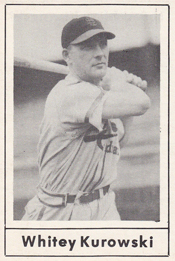
whitey_kurowskiIn March 1945, the defending World Series champion Cardinals planned to hold spring training in Cairo for the third consecutive year. St. Petersburg, Fla., was the Cardinals’ spring training base, but the Redbirds, like all big-league clubs, trained at sites closer to home from 1943-45 in order to conserve resources through reduced travel during World War II.

Training at Cairo worked well for the Cardinals in 1943 and 1944. They had more than 100 wins and earned a National League pennant in each of those years, including a World Series title in 1944.

River runs through it

Cairo is located on the southern tip of Illinois, where the Ohio River flows into the Mississippi River. In March 1945, rain swelled the rivers. Even with walls and levees protecting the town, water seeped into the ballpark used by the Cardinals.

The stages of the rivers were 10 feet above the level of the ballpark, according to the Associated Press. Under orders from club owner Sam Breadon, Cardinals traveling secretary Leo Ward searched throughout Cairo for an alternative spot to conduct batting and fielding practice, “but he mired in mud and returned gloomily to the hotel.”

“There was talk of moving the training camp back to St. Louis as early as March 13, the second day the players were in camp,” The Sporting News reported. “However, Breadon gave the Cairo people a few days more to get their park in shape.”

Losing battle

Cairo Mayor E.A. Smith and city fire and street departments “did everything they knew to get the field in shape. They dug draining ditches and put the fire pumps to work in the outfield, but each morning a new film of seepage water covered the infield,” The Sporting News wrote.

In a story filed on March 19, 1945, the Associated Press reported, “The outfield of the practice diamond was under four feet of water and it appeared doubtful that the park would be useable for baseball during the two weeks the team will be in town.”

Among those in camp for the Cardinals were pitchers Max Lanier, Blix Donnelly and Bud Byerly, first baseman Ray Sanders, second baseman Emil Verban, third baseman Whitey Kurowski, outfielder Debs Garms and rookie Red Schoendienst.

A picture in The Sporting News showed Kurowski, Lanier and Sanders casting fishing lines in the outfield water.

Ohio option

Coach Mike Gonzalez was running the club while manager Billy Southworth was at home in Sunbury, Ohio, after spending weeks in New York while joining in a mission to search for his son, who was killed in a crash of a B-29 he was piloting.

Southworth was trying to find a training site for the Cardinals in Ohio. “Breadon announced Southworth is looking for a place and that the squad will leave (Cairo) if satisfactory arrangements can be made,” the Associated Press reported.

The Sporting News revealed Southworth wanted to bring the Cardinals to Miami University in Oxford, Ohio, where the minor-league Columbus and Rochester teams were training.

“Miami University officials hustled around to find living quarters for the Cardinals and a series of games among the three clubs was being worked up,” The Sporting News wrote. “Manager Billy Southworth … believed the arrangement was set, but owner Sam Breadon vetoed the move to Oxford.”

Homeward bound

Breadon ordered the team instead to return to St. Louis. The last time the Cardinals had spent spring training at home was in 1919. The reason then was lack of finances.

Wrote The Sporting News of the deteriorating conditions in Cairo: “For a week, the Redbirds had no real baseball work. They indulged in pepper games on a hard cinder footing, did some throwing, running and calisthenics but had no batting practice or real infield workout … A soggy infield, no batting practice for five days and fishing in the outfield quickly convinced (Breadon) that he had to act quickly.”

Said Breadon: “Oh for a return to good old St. Petersburg.”

The Cardinals began workouts at Sportsman’s Park on March 26, 1945, and opened the season on April 17 at Chicago.

The disrupted spring training didn’t appear to hurt them much. The 1945 Cardinals had 95 wins and finished in second place, three games behind the Cubs.

Previously: Why the Cardinals chose Cairo, Ill., for spring training

Previously: Why Billy Southworth managed Cardinals with heavy heart

Instead of working with established big-leaguers, Bob Gibson spent the spring training of 1995 teaching basic grips to pitchers who normally would have had no chance to be in a Cardinals camp.

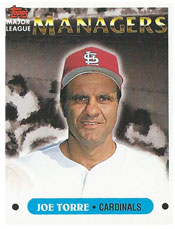
joe_torre6Spring training in 1995 was an odd, depressing experience for the Cardinals and other big-league teams because of the labor dispute between players and owners.

The players’ strike that began in August 1994 carried into spring training 1995. None of the players on the Cardinals’ big-league roster reported to camp at St. Petersburg, Fla. Instead, the Cardinals, like other clubs, brought in replacement players.

Hall of Fame helper

Manager Joe Torre and his staff were required to train the replacement players, with the intent of having them ready to open the regular season on April 3.

Gibson, the Hall of Fame pitcher who carried the Cardinals to two World Series championships, was hired by Torre to be a Cardinals coach.

Replacement player Paul Anderson, 26, a right-hander who was a combined 4-6 with a 6.65 ERA for two Cardinals farm clubs in 1994, asked Gibson for assistance in learning the proper grip to throw a slider.

“I was doing it wrong, so I did it the way he taught me,” Anderson told Rick Hummel of the St. Louis Post-Dispatch. “I like it a lot better. I’m learning from the best.”

Scribe and rejects

The 55-player Cardinals replacement team at training camp had no one who had appeared in a major-league game.

In the Cardinals’ exhibition opener against the Indians on March 4 at St. Petersburg, Mike Hinkle started and pitched three scoreless innings for St. Louis. Hinkle, 29, had last played professional baseball in Italy in 1993.

Outfielder Doug Radziewicz, 25, an aspiring journalist who was filing reports from camp for his hometown newspaper in Somerville, N.J., drove in the winning run with a pinch-hit single in the eighth, lifting the Cardinals to a 4-2 victory.

“You can’t judge baseball from one day, but it was well-played,” Torre said after the game. “The thing you’re concerned with is that playing for the first time they’re a little in awe.”

Walt Jocketty, hired in October 1994 to replace Dal Maxvill as general manager, was asked what it was like to watch replacement players instead of big-leaguers in his first Cardinals spring training game. “As long as I’ve got Joe (Torre) here, we can hold hands and go through this together,” Jocketty said.

Wrote Hummel: “There were no pickets, as the striking players earlier had advertised, which was good because the minor leaguers were nervous enough as it was. The clubhouse was very quiet before the game.”

Fans weren’t buying into replacement baseball. Hummel reported the Cardinals were averaging 1,470 tickets sold per exhibition game instead of the usual 5,000. In March, 54 percent of respondents to a Post-Dispatch poll said they probably or absolutely wouldn’t pay to see a game played by replacements.

Chasing a dream

The Cardinals broke camp with a roster of 32 replacement players, intending to open the season with them.

Anderson, Hinkle and Radziewicz were on the Opening Day roster. In a late move, the Cardinals also acquired Glenn Sutko, a catcher who had one hit in 10 at-bats for the 1991 Reds.

Among other replacement Cardinals on the Opening Day roster:

_ Ty Griffin, second baseman. A No. 1 pick of the Cubs in the 1988 amateur draft, Griffin also had played for the U.S. Olympic baseball team. He flopped in the Cubs system and spent the 1994 season with a pair of independent league teams.

_ Larry Shikles, starting pitcher. In eight seasons in the minor league systems of the Red Sox and Athletics, the right-hander compiled a 70-68 record.

_ Howard Prager, first baseman. He hit .239 for the Cardinals’ Class AAA Louisville club in 1994.

_ John “Skeets” Thomas, outfielder. He slugged 17 home runs for Louisville in 1994.

_ Tony Diggs, outfielder. A sixth-round draft choice of the Brewers in 1989, Diggs hit .215 for the Cardinals’ Class AA Arkansas team in 1994.

_ Anthony Lewis, outfielder. An eighth-round draft pick of the Cardinals in 1989, Lewis hit a combined .230 for two St. Louis farm clubs in 1994.

“We went with the players on the morning side of the mountain rather than the twilight side of the hill,” Torre said, explaining why the Cardinals (with the exception of Sutko) chose players without big-league experience.

On April 2, 1995, the day before the season was to open, the 234-day strike ended. The season opener was moved to April 26; spring training was re-opened for players on big-league rosters. The replacement players either were assigned to the minors or released.

Said Torre: “It feels weird starting all over again.”