Feeds:
Posts
Comments

The Cardinals traded two all-star infielders, first baseman Bill White and shortstop Dick Groat, to acquire Alex Johnson and told Lou Brock to shift outfield positions to accommodate the heralded newcomer.
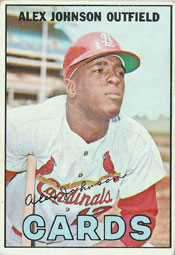
alex_johnsonJohnson never fulfilled his potential with St. Louis. Instead of joining Brock and Curt Flood as an outfield regular, Johnson got demoted to the minors in his first Cardinals season and backed up Roger Maris in his second and last year with St. Louis.

Phillies phenom

At 21, Johnson debuted in the big leagues with the 1964 Phillies. He hit .296 in two seasons with Philadelphia.

Cardinals general manager Bob Howsam envisioned Johnson as an ideal fit to join Brock and Flood in forming a fleet, productive St. Louis outfield.

On Oct. 27, 1965, the Cardinals dealt White, Groat and catcher Bob Uecker to the Phillies for Johnson, catcher Pat Corrales and pitcher Art Mahaffey.

White was a five-time all-star who hit .298 and won the Gold Glove Award six times. In three years with St. Louis, Groat was a two-time all-star who batted .289. Both were key contributors to the Cardinals’ World Series championship season in 1964.

Power potential

“We expect Johnson to hit the long ball for us,” Howsam told The Sporting News. “Playing everyday instead of just against left-handed pitchers, he may even surpass White in long-ball hitting over the full season.”

Said Cardinals vice president Stan Musial, who was consulted by Howsam before the deal was made: “Over the long haul is what we’re thinking about. We’re trying to analyze our team better and it’s a switch to the youth system.”

The Cardinals believed Johnson would hit for a higher average and had more speed than Mike Shannon, their right fielder in 1964 and 1965.

Johnson hit .307 against left-handed pitching for the 1965 Phillies. He also hit .424 in 11 games versus the Cardinals that season.

Move over, Lou

Johnson reported to the Cardinals’ Florida Instructional League camp at St. Petersburg and worked with manager Red Schoendienst and coach Dick Sisler. “He has a better arm than I thought he did,” Schoendienst said.

The Cardinals decided to shift Brock from left to right and start Johnson in left, with Flood in center. Shannon was relegated to a reserve role. “I know the Cardinals made a big deal to get Johnson, but all I want is a chance,” Shannon said. “… I think I can hit .300. I’m strong. I can run and I’ve got good power.”

Johnson hit .286 in spring training and opened the 1966 regular season as the left fielder. He started each of the Cardinals’ first 20 games and hit .195. The Cardinals’ record was 8-12 and Johnson received part of the blame. “It’s not the pitchers getting me out,” Johnson said. “I’ve been getting myself out. I’ve been going for the long taters.”

On May 8, 1966, the Cardinals played their final game at Busch Stadium, formerly Sportsman’s Park. Johnson had the last at-bat and hit into a game-ending double play. Boxscore

Four days later, the Cardinals played their first game at the new Busch Memorial Stadium. Johnson started in left field and was 1-for-4 with a run scored. Boxscore

On May 18, 1966, the Cardinals sent Johnson to Class AAA Tulsa and called up outfielder Bobby Tolan. Brock returned to left field and Shannon took over in right.

In 25 games with the Cardinals, Johnson batted .186 with two home runs.

“Johnson appeared overmatched in his first opportunity at a regular job.” The Sporting News declared. “He has plenty of raw talent and good speed. There is considerable hope for him, especially if he can develop the ability to learn from coaches both in the minors and in the majors. He has not adapted well to instruction and he has been easy to pitch to.”

At Tulsa, Johnson prospered under manager Charlie Metro, batting .355 with 104 hits in 80 games.

Carlton to Cubs?

After the 1966 season, Howsam agreed to a proposed deal to send Johnson, Tolan and pitchers Steve Carlton and Nelson Briles to the Cubs for outfielder Billy Williams, The Sporting News reported. The trade was vetoed by Cardinals “super brass,” who presumably included Musial. “We needed a lefthanded-hitting outfielder and we went after (Billy) Williams,” Musial confirmed.

After the proposed trade was nixed, Howsam dealt third baseman Charlie Smith to the Yankees for outfielder Roger Maris. Soon after, Howsam resigned to become general manager of the Reds and was replaced by Musial.

In spring training, the Cardinals assigned hitting instructor Joe Medwick to work with Johnson. “I told him, ‘The only guy who is keeping you down is yourself. You’ve got all the equipment,’ ” Medwick said. “Alex was pulling too many pitches.”

Some thought Johnson and Maris would platoon in right field for the 1967 Cardinals. Maris, though, won the job outright, with Shannon replacing Smith at third base and Johnson taking a reserve outfield role.

In May 1967, The Sporting News reported Johnson was “swinging at too many bad balls and fouling off too many good ones.” Musial “had tried hard to deal Johnson to an American League club, but there were no takers.”

Johnson hit .223 with one home run in 81 games for the 1967 Cardinals, who won the National League pennant. He didn’t appear in the World Series against the Red Sox.

After the Cardinals won the championship, Musial resigned in triumph and was replaced by Bing Devine, in his second stint as St. Louis general manager. Devine’s first trade was to send Johnson to the Reds for outfielder Dick Simpson on Jan.11, 1968.

In two seasons with the Cardinals, Johnson hit .211 in 106 games with three home runs and 18 RBI. “Alex just might put everything together one of these days and become quite a ballplayer,” Schoendienst said.

Red was right

Reunited with Howsam and Metro (who had become a Reds scout), Johnson hit .313 with 146 RBI in two seasons with Cincinnati.

Traded to the Angels, Johnson was the 1970 American League batting champion, hitting .329, but his career continued to be marred by controversy and accusations of an indifferent attitude.

Said Cardinals coach Dick Sisler: “The tag on Johnson is that he will not accept advice from a manager or a competent coach. He easily could have become a great Cardinal player, but he showed no interest.”

In 13 years with the Phillies, Cardinals, Reds, Angels, Indians, Rangers, Yankees and Tigers, Johnson batted .288 with 1,331 hits.

Previously: Here’s how Mike Shannon became a Cardinals catcher

Previously: Bill White: We thought Lou Brock deal was nuts

Previously: How Charlie Metro miffed Stan Musial
(Updated March 9, 2019)

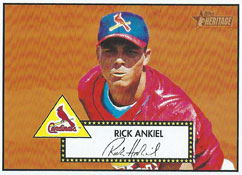
Disheartened by what he described as an erosion of his spirit and altering of his personality, Rick Ankiel changed the course of his baseball career.

rick_ankiel7On March 9, 2005, Ankiel announced he was transforming from a pitcher to an outfielder.

Ankiel, 25, entered 2005 spring training at Jupiter, Fla., as a strong candidate to earn a Cardinals Opening Day roster spot as a left-handed reliever.

After posting an 11-7 record with 194 strikeouts in 175 innings in 2000, Ankiel experienced a meltdown in the postseason against the Braves and Mets (nine wild pitches and 11 walks in four innings). He pitched briefly for the 2001 Cardinals and suffered a series of elbow injuries before returning to the big leagues with St. Louis as a reliever in September 2004.

Ankiel pitched in the Puerto Rico winter league after the 2004 Cardinals season, but cut short his stay there after experiencing a twinge in his left elbow. When he got to Cardinals camp in February 2005, his throwing sessions were erratic.

Change of plans

On March 8, 2005, the day before he was scheduled to make his spring training debut against the Marlins in a morning B squad game, Ankiel approached Cardinals manager Tony La Russa and informed him he was retiring as a player.

In his 2017 book “The Phenom,” Ankiel explained, “In my heart, I believed I could pitch in the big leagues. I’d earned it. It was just so hard. It was just so burdensome. It was time to stop, for those reasons. I was exhausted.”

Ankiel’s agent, Scott Boras, called Cardinals general manager Walt Jocketty and asked whether the club would be willing to let Ankiel go to the minor leagues, be an outfielder and get a chance to earn his way back to the majors. When Jocketty agreed, Boras called Ankiel, who was surprised by his agent’s actions, and convinced him to give the transformation a try.

The next day, Ankiel took indoor batting practice off pitches from Cardinals scout Jim Leyland. In a hastily called press conference, Ankiel announced his plans to switch positions and explained why he was giving up pitching.

“The frustration of not being effective, not being able to go out there and replicate my mechanics, and the way it affected me off the field, wasn’t worth it,” Ankiel said to the St. Louis Post-Dispatch. “The reward wasn’t there. I feel relieved now. It’s time to move on.

“This whole time, the frustration has built up. It seemed like it was eroding my spirit and affecting my personality off the field as well. It just became apparent it was time for me to move on and become an outfielder.”

According to the Post-Dispatch, Ankiel’s decision “stunned many within the Cardinals’ clubhouse.”

“Ongoing head case”

As a Cardinals pitcher, Ankiel hit .207 for his career with two home runs and nine RBI. He hadn’t played the outfield since his senior year at Port St. Lucie High School in Florida.

The reaction to his plan drew skepticism.

Bernie Miklasz, Post-Dispatch columnist: “The Cardinals wasted too much time, and emotion, in the lost cause that is Rick Ankiel. And now, as the organization recoils from Ankiel’s stunning surrender in his mission of regaining a foothold on the mound, the Cardinals are going to baby him one more time … It is time to stop treating Ankiel’s ongoing head case as if he’s a charity case … It’s time to let Ankiel move on with his life. The Cardinals did their part. Now they need to get out of the day care business.”

Rob Neyer, baseball analyst for ESPN.com: “He’s immensely talented, but almost certainly not talented enough to hit major-league pitching with any sort of consistency.”

Road to redemption

Ankiel began receiving instruction from coach Dave McKay on outfield play and from coach Hal McRae on hitting.

“I stood across from Dave McKay, an exceptional outfield coach, and put my feet where he told me to, and began to learn to become a big-league center fielder,” Ankiel said in his book. “I hit off a tee, and hit soft-toss, and hit batting practice fastballs, and faced real pitchers, and began to learn to be a big-league hitter.’

Out of options with the Cardinals, Ankiel could have been chosen on waivers by any of the other 29 big-league clubs before he was sent to the minors in the spring of 2005, but no one claimed him.

Ankiel spent 2005 in the minors, sat out 2006 because of a knee injury and hit 32 home runs in 102 games for Class AAA Memphis in 2007. On Aug. 9, 2007, he returned to the Cardinals as an outfielder and hit a home run against the Padres. Boxscore

Ankiel hit .285 with 11 home runs and 39 RBI in 47 games for the 2007 Cardinals. The next year, he slugged 25 home runs for St. Louis.

From 2007-2013, Ankiel was an outfielder for the Cardinals, Royals, Braves, Nationals, Astros and Mets.

In 2010, a decade after his wild streak against the Braves in the National League Division Series, he hit a home run for them in the NL Division Series against the Giants. Boxscore Ankiel and Babe Ruth are the only big-league players to both start a postseason game as a pitcher and hit a home run in the postseason as a position player.

Previously: How Rick Ankiel made happy return to St. Louis as pitcher

Previously: Rick Ankiel and his last hurrah as a pitcher

Previously: Pitching or hitting, Rick Ankiel was marvel and mystery

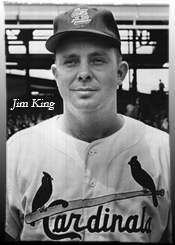
Jim King spent five years in the Cardinals organization, learning from the likes of George Kissell and Johnny Keane, but he twice departed and never got much of a chance to make an impact with St. Louis at the big-league level.

jim_kingKing, an outfielder who started in the first big-league game played in California, spent 11 seasons in the majors, primarily with the Senators.

After making his professional debut at 17 in 1950 with the independent Vernon Dusters of the Class D Longhorn League, King was signed by the Cardinals. He played in the St. Louis minor-league system from 1951-54, including two stints with Omaha clubs managed by Kissell, the franchise’s iconic instructor.

In 1954, King had his best season in the Cardinals organization, hitting .314 with 31 doubles and 25 home runs for Omaha. King, who had a strong arm, also contributed 19 outfield assists.

Courted by Cubs

King caught the attention of Wid Matthews, director of personnel for the Cubs, and on Nov. 22, 1954, the Cubs claimed King from the Cardinals in the minor-league draft.

King made his major-league debut with the Cubs in 1955 and played for them for two seasons.

In 1957, Cubs general manager John Holland was seeking to overhaul the roster. Cardinals general manager Frank Lane was seeking a left-handed pull hitter who could benefit from the Busch Stadium dimensions. The distance along the right field line from home plate to the outfield at the former Sportsman’s Park was an enticing 310 feet.

Holland made a special trip to Memphis to talk with Lane as the Cardinals headed north from spring training. Their talks continued in the Busch Stadium press box lounge when the Cubs and Cardinals played in St. Louis during the first week of the 1957 regular season, The Sporting News reported.

Second chance

On April 20, 1957, the Cardinals reacquired King from the Cubs for outfielder Bobby Del Greco and pitcher Ed Mayer.

“The deal for King was completed within 48 hours, culminating a lengthy series of conversations between Lane and Holland,” St. Louis writer Bob Broeg reported.

Broeg described King as “a pull hitter for whom the Busch Stadium dimensions are tailored” and declared the Cardinals were “stronger and deeper” with King on the roster.

Said Lane: “He’s got the knack of pulling, an asset especially with our short right field, and he won’t be handicapped in St. Louis by the wind blowing in as it does so often off the lake in Chicago, making hitting tough for left-handers.”

The Cardinals issued uniform No. 9 to King. It was the number worn by Cardinals standout Enos Slaughter before it was retired by the club.

King was used primarily as a pinch-hitter. On May 15, 1957, less than a month after he was acquired, the Cardinals sent King to Class AAA Omaha in order to get their roster to the mandated 25-player limit.

Wrote Broeg: “Entirely unexpected was the decision to send down King rather than Tom Alston, the good-field, no-hit first baseman … Although mum was the word around the club, it was apparent that owner Gussie Busch … had requested that Alston be given another chance or, at least, a longer look.”

At Omaha, King played for manager Johnny Keane (who, seven years later, would lead the Cardinals to a World Series title) and hit 20 home runs in 116 games before being called back to the Cardinals in September.

In 22 games overall for the 1957 Cardinals, King hit .314. All 11 of his hits were singles.

California connection

King appeared poised to earn a spot on the 1958 Cardinals. However, the Cardinals were seeking catching help and the Giants needed a lefthanded-hitting outfielder to replace Don Mueller. On April 2, 1958, the Cardinals traded King to the Giants for catcher Ray Katt.

When the Dodgers faced the Giants on April 15, 1958, at San Francisco’s Seals Stadium in the first regular-season major-league game played in California, King was in the starting lineup, playing left field and batting second, just ahead of Willie Mays. King was 2-for-3 with two walks, a run scored and a RBI-single off Don Drysdale. Boxscore

King had his best seasons with the 1963 Senators (24 home runs) and 1964 Senators (18 home runs). He broke Mickey Vernon’s Senators single-season record of 20 home runs by a left-handed batter. On June 8, 1964, King hit three solo home runs in a game at Washington against the Athletics. Boxscore

In a big-league career spanning 1955 to 1967 with the Cubs, Cardinals, Giants, Senators, White Sox and Indians, King hit .240 with 117 home runs.

Previously: How Cardinals nearly traded Bob Gibson to Senators

(Updated Feb. 8, 2016)

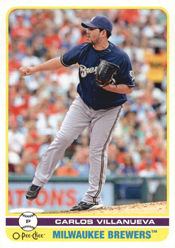
As a rookie, Carlos Villanueva almost kept the 2006 Cardinals from qualifying for the postseason and winning their first World Series title in 24 years.

carlos_villanuevaNine years later, Villanueva was competing for the 2015 Cardinals as an effective member of their relief staff.

On Oct. 1, 2006, the Cardinals entered the final day of the regular season needing a win over the Brewers at St. Louis or an Astros loss to the Braves in Atlanta to clinch outright the National League Central Division title. If the Cardinals lost and the Astros won, the Cardinals would need to win a regular-season makeup game against the Giants to clinch the division title and avoid a one-game playoff with the Astros to advance to the National League Division Series against the Padres.

Rookie starters

Cardinals manager Tony La Russa gambled and started rookie Anthony Reyes against the Brewers on three days of rest, choosing to hold back Chris Carpenter in the hope St. Louis would clinch the division crown versus Milwaukee and have their ace available for Game 1 of the NL Division Series.

Brewers manager Ned Yost chose Villanueva as his starter. Villanueva had faced the Cardinals for the first time on Sept. 20 at Milwaukee and pitched seven scoreless innings in a 1-0 Brewers victory. Boxscore

Reyes flopped.

The Brewers scored four in the first on a two-run home run by Prince Fielder, a solo home run by Geoff Jenkins and a RBI-single by David Bell. Reyes was lifted before he could complete the opening inning.

Keep me in, coach

Given a 4-0 lead, Villanueva faced Cardinals leadoff batter Aaron Miles. who “smacked a sharp one-hopper off Villanueva’s pitching hand,” the Milwaukee Journal Sentinel reported.

“It felt bad,” Villanueva said.

Yost went to the mound and asked his right-hander, “How are you doing?”

“Of course, I said, ‘I’m doing great,’ ” Villanueva said.

In truth, the hand throbbed.

Said Yost: “I came close to taking him out. He couldn’t even swing a bat. I kept an eye on him and if I noticed a drop-off in effectiveness I would have taken him out. But I didn’t see it.”

Villanueva baffled the Cardinals. With each inning, their hopes of beating the Brewers dimmed.

Bailout by Braves

Then, in the fifth, a roar erupted from the Busch Stadium crowd as the final from Atlanta was posted: Braves 3, Astros 1. The Braves had prevailed behind six shutout innings from starter John Smoltz and a home run by Jeff Francoeur. Boxscore

The loss by the Astros meant the Cardinals had clinched the division title, regardless of the outcome of their game with the Brewers.

As fans cheered in appreciation, Villanueva stepped off the mound. Derryl Cousins, the home plate umpire, motioned for the game to resume, but Villanueva lingered, letting “the celebration last a few more seconds,” the St. Louis Post-Dispatch reported.

“I wanted to give them their moment,” Villanueva said. “I knew what was going on.”

Drama in ninth

Villanueva shut out the Cardinals through eight innings, extending his scoreless streak against them to 15 innings over two starts.

In the bottom of the ninth, with the Brewers ahead, 5-0, Villanueva got Miles to fly out to right. Then, the Cardinals thundered to life. Chris Duncan launched a 414-foot home run. Albert Pujols followed with a 424-foot shot.

Francisco Cordero relieved and struck out Preston Wilson, but Scott Spiezio followed with a home run, cutting the deficit to two. Cordero then ended the drama _ and the regular season _ by striking out Juan Encarnacion, preserving a 5-3 victory for Villanueva and the Brewers. Boxscore

Unfazed, the Cardinals regrouped and beat the Padres in the NL Division Series, the Mets in the NL Championship Series and the Tigers in the World Series.

Previously: 2006 was critical to Tony La Russa earning Hall of Fame status

(Updated April 5, 2026)

As an infielder who struggled to hit, Dal Maxvill overcame the odds and started in 21 World Series games for the Cardinals. As a coach with no experience as a baseball executive, Maxvill again overcame the odds and became general manager of the Cardinals.

dal_maxvill3On Feb. 25, 1985, Maxvill was the surprise choice of the Cardinals to replace Joe McDonald as general manager. Maxvill was a coach with the Atlanta Braves when the Cardinals approached him about becoming their top baseball executive.

As Rick Hummel noted in a report for The Sporting News, “It seemed a rather sizeable leap to go from third-base coach to general manager.”

In his book “White Rat: A Life in Baseball,” Cardinals manager Whitey Herzog said, “I had my doubts about him when he was hired … He’d never made a trade, never negotiated a contract and I wondered what the hell was going through their minds when they hired him.”

Baseball and business

Maxvill, 46, said he hadn’t applied for the job and was approached by club officials. Team owner Gussie Busch said he was seeking a candidate who knew both baseball and the Cardinals organization and also had business experience.

To Busch, Maxvill met the criteria.

Maxvill played for the Cardinals from 1962-72. Replacing the injured Julian Javier, he started seven games at second base in the 1964 World Series. He started seven games at shortstop in the 1967 World Series and again in the 1968 World Series. Maxvill won a Gold Glove Award in 1968. He hit .220 as a Cardinal.

Maxvill was a Cardinals coach from 1979-80 and an instructor in 1981. He and former Cardinals reliever Joe Hoerner were co-owners of a St. Louis travel agency. Maxvill earned a degree in electrical engineering from Washington University in St. Louis and worked for a St. Louis engineering company during his off-seasons as a Cardinals player in the 1960s.

The Cardinals offered Maxvill a one-year contract.

“Of all the people we considered, myself and the other members of the executive committee unanimously agreed that Dal Maxvill has the qualifications we were looking for in a general manager,” Busch told the Associated Press.

Fred Kuhlmann, chief operating officer of the Cardinals, said Tal Smith, a consultant hired to lead the search for a general manager, gave Maxvill “as enthusiastic a recommendation as there could be.”

“We were looking for someone with a sense of business ability to go along with his baseball experience, the innate ability to cope with the business aspects of being general manager,” Kuhlmann said to the St. Louis Post-Dispatch.

Cardinals connections

Two other ex-Cardinals players _ Tim McCarver and Joe Torre _ were considered before Maxvill was offered the position, The Sporting News reported.

“I’ve been a Cardinals fan since I was 3,” said Maxvill. “My mother and father took me to see Enos Slaughter, Terry Moore and Red Schoendienst.”

Schoendienst, a Cardinals coach in 1985, was Maxvill’s manager from 1965-72. “Once, I was his boss,” Schoendienst said. “Now, he’s mine.”

Asked his opinion of the Cardinals hiring Maxvill, former general manager Bing Devine told Bob Broeg of the Post-Dispatch, “Why shouldn’t he be a good general manager? He always has done everything better than any of us expected. I think the selection was excellent.”

Good deal

On April 2, 1985, Maxvill made his first trade, acquiring infielder Jose Oquendo from the Mets for infielder Angel Salazar and minor-league pitcher John Young.

The Cardinals won two pennants, 1985 and 1987, with Maxvill as general manager. “He turned out to be a hell of a baseball executive,” Herzog said. “… Maxie is smart and he caught on fast.”

Maxvill was Cardinals general manager from 1985-94 until he was fired by team president Mark Lamping and replaced by Walt Jocketty.

In the 2005 book “Cardinals Where Have You Gone?” Maxvill said to writer Rob Rains, “Probably my biggest disappointment was that I couldn’t convince the powers that be that we needed more of an investment into the ballclub other than just the farm system. We needed to replace the free agents who were leaving us. I could never convince (Anheuser-Busch) that the ballclub needed to dip into their savings account so we could sign a major free agent.”

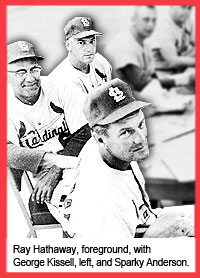
ray_hathawayAs a minor-league manager and pitching instructor for the Cardinals, Ray Hathaway worked closely with fellow teacher and Branch Rickey protégé George Kissell in helping prospects learn the fundamentals.

However, unlike Kissell, who devoted his career to the Cardinals, Hathaway left the organization amid a swirl of controversy.

Discovered by Dodgers

Hathaway, a right-handed pitcher, began his professional playing career in the Dodgers’ organization in 1939. His big-league career consisted of four appearances for the 1945 Dodgers. “My greatest thrill was walking into (Brooklyn’s) Ebbets Field for the first time,” Hathaway told the Asheville Citizen-Times.

Rickey, the Dodgers’ top baseball executive, was impressed by Hathaway, who earned a Bronze Star with the Navy in World War II’s Battle of Guadalcanal.

With the Cardinals, Rickey built a minor-league system that emphasized instruction based on an organizational philosophy. Rickey brought the same approach to the Dodgers. He saw Hathaway as someone who understood the system and could teach it.

In 1947, Rickey named Hathaway manager of the Dodgers’ farm club in Santa Barbara, Calif. It was the first of Hathaway’s 25 seasons as a minor-league manager.

“If I were starting a major-league franchise, I would have Ray Hathaway as my manager,” Bob Terrell, longtime sports editor of the Asheville Citizen-Times, said, according to the Web site MiLB.com. “He had the unique ability to get the most out of his players and was a master of baseball strategy.”

Joining the Cardinals

Hathaway was managing in the Pirates’ system when the Cardinals made him an offer after the 1964 season. He accepted and was named manager of the Cardinals’ Class A affiliate at Raleigh, N.C., in 1965.

Among those Hathaway mentored at Raleigh were future Cardinals pitchers Mike Torrez, Wayne Granger and Sal Campisi. Hathaway, 48, also pitched in a game for Raleigh, giving him 20 seasons as a minor-league player.

In 1966, Hathaway was the Cardinals’ minor-league pitching instructor. Among those also teaching Cardinals prospects then were Kissell, Sparky Anderson, Charlie Metro, Vern Rapp and Ron Plaza. Anderson, Metro and Rapp would manage in the majors.

Kissell, like Hathaway, devoted his career to teaching. Kissell joined the Cardinals’ organization under Rickey as a minor-league prospect in 1940 and worked for the Cardinals until his death at 88 in 2008.

Rookie welcome

After managing the Cardinals’ Class A Lewiston (Idaho) club in 1967, Hathaway replaced Kissell as manager of the Gulf Coast Cardinals rookie league team in 1968, enabling Kissell to become a roving instructor in the minor-league system.

Among the players on the 1968 Gulf Coast Cardinals was third baseman Bob Forsch. In his book, “Tales from the Cardinals Dugout,” Forsch, who would become a Cardinals pitcher, recalled his first encounter with Hathaway on the day he joined the team in Florida after traveling from his home in California.

“I hadn’t slept in almost two days, coming in from Sacramento, so I went up to my room and I overslept,” said Forsch. “I woke up at a quarter to five and I just jumped in a cab. I got to the complex … and ran to the bus. It was leaving right at five for the ballpark where we played the big night games.

“And Ray Hathaway, the manager, came up to me when I was getting on the bus. And the only thing he said to me was, ‘Don’t ever be late.’ That was it.”

Thank you, teacher

In 1969, the Cardinals named Hathaway manager of the Class AA Arkansas Travelers. Among the prospects on that team were future Cardinals outfielders Jose Cruz and Luis Melendez and pitchers Al Hrabosky and Reggie Cleveland.

According to his biography at SABR.org, Cleveland credited Hathaway and Cardinals coach Billy Muffett with teaching him how to pitch at the professional level. Cleveland had pitched for Hathaway at Lewiston and posted a 2.90 ERA with 11 complete games. He was the ace of Hathaway’s Arkansas club, compiling a 15-6 record with 13 complete games and a 3.39 ERA.

Trouble at Arkansas

The 1969 Arkansas team was 66-69 under Hathaway, finishing second to Memphis in the Eastern Division of the Texas League. After the season, Hathaway resigned and stunned the Cardinals by publicly criticizing the Arkansas front office headed by team president Max Moses and general manager Carl Sawatski.

“Ray Hathaway has tossed in the towel as manager of the Arkansas Travelers, firing an angry salvo at the front office as he departed,” The Sporting News reported. “It appears from a statement by Hathaway that in resigning he might have beaten management to the punch.”

Said Hathaway: “The Little Rock club has expressed its desire of not rehiring me as your manager for 1970. This request was made two days before I had planned on making the identical request to (Cardinals farm director) George Silvey. My decision is the result of a great number of problems our players have endured. They are too numerous and insulting to mention …

“Mr. Silvey and the entire (Cardinals) organization exerted themselves to help us succeed in producing a contending club, which we definitely were. This has been done without appreciation from anyone connected with the Little Rock club.”

Arkansas officials referred all comment to Silvey, who said, “It’s unfortunate Ray made a public statement of his grievances. We’re sorry this happened. He’s forthright and outspoken. That’s obvious. I had no idea he was planning anything like this.”

Ken Boyer replaced Hathaway as Arkansas manager. Hathaway spent the next three seasons managing teams in the Cleveland Indians organization. His final season as a manager was 1973 with Wilson, N.C., an independent team in the Carolina League.

Previously: Ron Plaza was mentor to Steve Carlton, Jose Cruz

Previously: Cardinals boosted managing career of Sparky Anderson