Feeds:
Posts
Comments

(Updated Nov. 13, 2025)

Jim Kaat was 41 when he stole a base and hit a home run in separate games for the 1980 Cardinals.
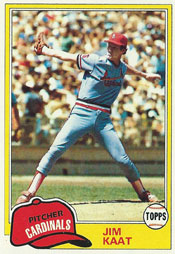
jim_kaat4At an age when most players are retired, Kaat remained a complete ballplayer.

Speed demon

On June 23, 1980, two months after he was acquired from the Yankees, Kaat earned the win and pitched a complete game for the Cardinals in their 6-1 victory over the Pirates at St. Louis. Kaat didn’t allow a walk or an extra-base hit. He held the Pirates scoreless over the last seven innings and earned his 266th career win, tying Hall of Famer Bob Feller.

In the seventh, he stole a base.

Bobby Bonds was at the plate when Kaat, noticing first baseman Bill Robinson wasn’t holding him on, dashed for second. Bonds took a pitch from Enrique Romo. Catcher Steve Nicosia gunned a throw to Phil Garner, covering second, and Kaat beat the peg.

“Kitty figured as long as somebody wants to give you something, you might as well take it,” Cardinals manager Whitey Herzog said to the St. Louis Post-Dispatch.

Fans at Busch Stadium rewarded Kaat with a standing ovation. “I guess they thought Lou Brock was back,” Kaat said.

In its account of the game, the Associated Press wrote, “It was the aging hurler’s speed that brought the customers to their feet … The accomplishment nearly overshadowed his hurling.”

Said Kaat: “It was the element of surprise. I had a good lead. It was worth it.” Boxscore

The steal was Kaat’s first in nine years. He was 32 when he swiped a base for the Twins against Yankees pitcher Stan Bahnsen and catcher Thurman Munson on July 30, 1971.

His stolen base for the Cardinals was Kaat’s fifth and last in a 25-year career (1959-83) in the majors.

Described by the Post-Dispatch as a “left-handed Methuselah,” Kaat needed only 82 pitches to complete the game. He threw a strike on the first pitch to 25 of 32 Pirates batters.

“He may be 41, but he has the body of a 28-year-old,” said Pirates manager Chuck Tanner.

Sultan of swat

Two months after his steal for the Cardinals, Kaat hit a home run for them.

On Aug. 26, 1980, Kaat homered off the Astros’ Joe Niekro at St. Louis.

“He hit a knuckleball up,” Niekro said to the Associated Press. “He’s a pretty good hitter. I’ve got a brother (Phil) who is 41 and he hits home runs. It’s not the first time I gave up one to a pitcher and it probably won’t be the last.” Boxscore

The home run was the last of 16 hit by Kaat. He slugged his first 18 years earlier on June 19, 1962, off Dom Zanni of the White Sox.

(The oldest player to hit a big-league home run was Mets first baseman Julio Franco, 48, against Randy Johnson of the Diamondbacks on May 4, 2007. Franco was three months shy of his 49th birthday.)

Going strong

Exactly one year after his home run, Kaat, 42, got his last big-league hit, a single for the Cardinals against 25-year-old Giants rookie Bob Tufts on Aug. 26, 1981. Boxscore

The next year, Kaat, 43, appeared in 62 regular-season games for the Cardinals (earning five wins and two saves) and pitched in four games of the 1982 World Series against the Brewers.

He pitched his last game at 44, tossing 1.1 scoreless innings in relief of Joaquin Andujar for the Cardinals against the Pirates on July 1, 1983, at Pittsburgh. Boxscore

Kaat was 19-16 with 10 saves in four seasons (1980-83) with the Cardinals.

Elected to the Baseball Hall of Fame, Kaat totaled 283 career wins and received 16 Gold Glove awards for fielding.

 

(Updated Nov. 24, 2017)

In 1964, Ken Boyer showed the qualities one would expect in a Hall of Fame player. The Cardinals third baseman consistently excelled with the glove and with the bat. He was a champion and a leader. He achieved feats that ranked him among the elite at his position all-time.

ken_boyer8Boyer hasn’t been elected to the National Baseball Hall of Fame at Cooperstown, N.Y. The only other third basemen of the 1958-64 era who fielded and hit at the same level as Boyer were Brooks Robinson of the Orioles, Eddie Mathews of the Braves and Ron Santo of the Cubs. All three have been elected to the Hall of Fame.

Special player

Though one outstanding year doesn’t qualify anyone for the Hall of Fame, Boyer’s 1964 season is important because it caps a seven-year stretch of consistently high quality and puts into context how Boyer elevated himself into a special category of third basemen.

Boyer, 33, played in all 162 Cardinals regular-season games in 1964. He led the majors in RBI with 119. Boyer also ranked in the top five in the National League in triples (10) and walks (70). He hit .295 with 185 hits, 30 doubles and 24 home runs. He scored 100 runs. His on-base percentage was .365.

Among NL third basemen in 1964, Boyer ranked second in both assists and double plays turned.

Calm and steady

His immense value to the Cardinals was proven with these statistics: Boyer hit .335 with 91 RBI in the Cardinals’ 93 wins in 1964; .238 with 28 RBI in the Cardinals’ 69 losses.

Remarkably consistent, Boyer in 1964 hit .296 against right-handed pitching; .291 versus left-handers.

Boyer was at his best against the Cardinals’ closest competitors, the Phillies and the Reds. Each finished a game behind the pennant-winning Cardinals. Boyer hit .351 with 17 RBI in 18 games against the 1964 Phillies; .309 with 13 RBI in 18 games versus the 1964 Reds.

In a profile of the Cardinals team captain in the Nov. 14, 1964, edition of The Sporting News, Ed Wilks wrote that Boyer “does everything well, but in the calm, steady, unspectacular fashion of a professional.”

Said Boyer: “The (1964) season couldn’t have been more satisfying. I think I did just about everything I had hoped to do.”

Rewarding year

Among the feats Boyer achieved in 1964:

_ He was named recipient of the NL Most Valuable Player Award on Nov. 24. Boyer became only the second NL third baseman and just the fourth in the big leagues to win a MVP Award. The others were Bob Elliott of the 1947 Braves in the NL and Al Rosen of the 1953 Indians and Brooks Robinson of the 1964 Orioles in the American League.

Top five in balloting for 1964 NL MVP were Boyer, Johnny Callison of the Phillies, Bill White of the Cardinals, Frank Robinson of the Reds and Joe Torre of the Braves. Boyer received 14 of 20 first-place votes. “That’s a lot when there are only 20 votes altogether and you have all that strong competition,” Boyer said. “Fourteen must be my lucky number. That’s my uniform number.”

_ The Sporting News named Boyer its Major League Player of the Year. He became the third Cardinals player to earn the honor, joining Marty Marion (1944) and Stan Musial (1946 and 1951).

_ For exemplifying the qualities of Lou Gehrig on and off the field, Boyer was presented the Lou Gehrig Memorial Award by the late Yankees first baseman’s Phi Delta Theta fraternity at Columbia University. He joined Musial (1957) as the second Cardinals player to receive the honor.

Run producer supreme

_ He became the first third baseman to lead the NL in RBI since Heinie Zimmerman (102) of the 1917 Giants. Boyer also was the first Cardinals player to lead the major leagues in RBI since Enos Slaughter (130) in 1946 and the first Cardinals player to lead the NL in RBI since Musial (109) in 1956.

_ Named to the all-star team for the seventh and last time, Boyer started at third base in the 1964 Midsummer Classic at Shea Stadium in New York and went 2-for-4, with a home run off Athletics reliever John Wyatt, in a 7-4 NL victory. Boxscore

_ Despite a hamstring injury, Boyer played in all seven games of the 1964 World Series against the Yankees. He hit a grand slam off Al Downing for all the Cardinals’ runs in a 4-3 Game 4 triumph Boxscore and produced three hits, including a solo home run against Steve Hamilton, in the Cardinals’ championship-clinching 7-5 victory in Game 7. Boxscore

_ The 1964 season was the last of seven in a row in which Boyer hit 23 or more home runs and produced 90 or more RBI.

Previously: If Ron Santo goes into Hall, Ken Boyer should, too

Previously: Ken and Clete Boyer: 1st brothers to each hit 25 HRs

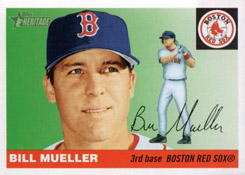
As an 11-year-old Cardinals fan, Bill Mueller attended Game 7 of the 1982 World Series at Busch Stadium in St. Louis and witnessed his hometown team clinch the championship against the Brewers.

bill_muellerTwenty-two years later, Mueller returned to a World Series for the first time.

As a 33-year-old big-league veteran, Mueller was the third baseman for the Red Sox in Game 4 of the 2004 World Series at Busch Stadium in St. Louis and witnessed Boston break the hearts of his hometown team by clinching the championship against the Cardinals.

Ten years after that, Mueller has come full circle.

On Nov. 17, 2014, Mueller was named assistant hitting coach of the Cardinals, replacing David Bell, who was promoted to bench coach after Mike Aldrete departed for a coaching job with the Athletics. Mueller had been hitting coach of the Cubs during the 2014 season. He will serve under Cardinals hitting coach John Mabry in 2015.

McGee a favorite

A native of the St. Louis suburb of Maryland Heights, Mo., Mueller grew up a Cardinals fan. Center fielder Willie McGee was his favorite player, Mueller told Jeff Horrigan of the Boston Herald in October 2004.

As a rookie in 1982, McGee sparked the Cardinals to their first National League pennant in 14 years. After splitting the first six games of the 1982 World Series with the Brewers, the Cardinals faced a Game 7 showdown at Busch Stadium.

Mueller attended the game with his father. Their seats were in the upper deck of the outfield. “The nosebleed section,” Mueller told The Patriot Ledger of Quincy, Mass., in 2004.

The Brewers’ Ben Oglive smacked a home run off Joaquin Andujar near the section where the Muellers sat. That’s one of Bill Mueller’s enduring memories of the game. What’s most memorable, of course, is that the Cardinals won, 6-3, earning their first World Series title since 1967. “Pretty cool,” Mueller said of the experience. Boxscore

Turning pro

Mueller became a baseball standout at De Smet Jesuit High School in Creve Coeur, Mo., and at Missouri State University in Springfield. He was drafted by the Giants and made his big-league debut with them in 1996.

In his first appearance at Busch Stadium with the Giants in August 1996, Mueller got five hits in 10 at-bats during a four-game series. Three years later, on May 25, 1999, Mueller hit a grand slam off Kent Mercker at Busch Stadium before more than 30 family and friends in a 17-1 Giants victory over the Cardinals. Boxscore

After the 2000 season, the Giants traded Mueller to the Cubs. He spent two years in Chicago, became a free agent and signed with the Red Sox. In his first season with Boston, Mueller was the 2003 American League batting champion, hitting .326 in 146 games.

Mueller vs. Rolen

The next season, Mueller helped Boston win the American League pennant, their first since 1986. He would be going to the World Series for the first time as a player and for the only time since he attended as a fan in 1982.

“That (1982) was my last experience with a World Series and now I’m going back for a World Series in St. Louis and I’m part of it,” Mueller said to Dan O’Neill of the St. Louis Post-Dispatch on the eve of the 2004 World Series. “It’s really a pretty amazing thing when you think about it.”

In most media previews of the 2004 World Series, the Cardinals, with Scott Rolen, were rated as having the advantage at third base over Mueller and the Red Sox. Rolen had hit 34 home runs with 124 RBI during the regular season and would win his fifth consecutive Gold Glove Award in 2004.

Mueller, though, proved the experts wrong.

The Red Sox swept the Cardinals, winning the first two games at Boston and the next two at Busch Stadium, and earned their first World Series championship since 1918, ending what some considered to be a curse placed on the franchise after it had traded Babe Ruth to the Yankees.

Mueller played an integral role in Boston’s dominance of the Cardinals. He batted .429 (6-for-14) with four walks in the World Series. His on-base percentage was .556. He scored three runs and drove in two.

His counterpart, Rolen, was hitless in 15 at-bats.

Previously: Paul Molitor vs. Cardinals: Sensational, strange 1982 World Series

(Updated Dec. 24, 2018)

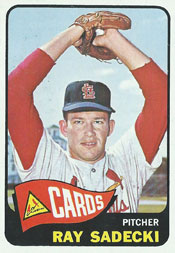
Five months after it appeared he might pitch his way out of the starting rotation, Ray Sadecki earned his 20th win and propelled the 1964 Cardinals into first place in the National League.

ray_sadecki4On Sept 29, 1964, Sadecki got the win, his career-best 20th of the season, in the Cardinals’ 4-2 triumph over the Phillies at St. Louis. The victory was the seventh in a row for the Cardinals and moved them into a tie for first place with the Phillies, who lost their ninth in a row after building a 6.5-game lead with 12 to play.

The Cardinals moved into sole possession of first place on Sept. 30 and went on to win the pennant five days later by a game over the Phillies and Reds.

Early troubles

Based on his subpar beginning, few could have predicted Sadecki would be such a stellar pitcher for the 1964 Cardinals.

Sadecki was 0-1 with a 9.00 ERA in three April appearances for St. Louis.

“Sadecki looked terrible in spring training, was beaten his first three times out during the season and was booed consistently by the normally restrained Cardinals fans,” The Sporting News reported.

Sadecki recovered, earning four wins in each of the next five months, with the last being the 20th on Sept. 29.

In a matchup of left-handers, the Phillies started Dennis Bennett against Sadecki. Bennett had a sore arm because of left shoulder tendinitis and pitchers such as Jim Bunning of the Phillies and Curt Simmons of the Cardinals told author David Halberstam in the book “October 1964” the Phillies should have started someone else.

Before the game, Sadecki looked into the Phillies’ dugout and thought the players, reeling from their losing streak, “resembled a bunch of ghosts” Halberstam wrote.

The Cardinals led, 3-0, after two innings and knocked out Bennett, who was lifted after recording four outs. Sadecki gave up a two-run single to pinch-hitter Gus Triandos in the fourth, but Bill White hit a home run in the sixth off John Boozer, extending the St. Louis lead to 4-2.

In the seventh, the Phillies had the tying runs on first and second, with two outs, when Cardinals manager Johnny Keane replaced Sadecki with Barney Schultz, who got Richie Allen to pop out to first. Schultz pitched 2.1 hitless innings in relief of Sadecki and earned his 13th save. Boxscore

World Series winner

Sadecki became the first Cardinals left-hander since Harvey Haddix in 1953 to win 20 in a season. Sadecki was the only National League left-hander to win 20 in 1964. Sandy Koufax of the Dodgers won 19; Bob Veale of the Pirates and Sadecki’s teammate, Curt Simmons, each won 18. The 1964 season was the only time Sadecki won more than 14 during an 18-year major-league career.

A week after winning his 20th, Sadecki started Game 1 of the World Series on Oct. 7 against Whitey Ford and the Yankees. He earned the win in a 9-5 Cardinals victory at St. Louis. The highlight of Sadecki’s performance was when he struck out Roger Maris to end the second and struck out Mickey Mantle to open the third.

“I had a good curve and was putting it where I wanted, but I had all kinds of trouble with my fastball,” Sadecki said. Boxscore

In “October 1964,” Halberstam explained Sadecki “liked to come in with a high fastball, and the Yankees murdered high fastballs.”


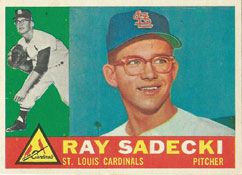
At 19, Ray Sadecki replaced Bob Gibson on the 1960 Cardinals staff. As if that wasn’t enough pressure, Sadecki also was given a spot in the starting rotation.

ray_sadecki3Initially, it appeared the Cardinals misjudged. Sadecki was 0-2 with a 7.50 ERA after his first five starts for the Cardinals.

However, in his sixth start, on June 15, 1960, at Cincinnati, Sadecki pitched a three-hit shutout for his first big-league win. It was the first shutout by a Cardinals pitcher in 1960.

All three Reds hits _ by Billy Martin, Gus Bell and Frank Robinson _ were doubles.

Sadecki walked eight and struck out nine. The Reds stranded 11 base runners. The eight walks were one shy of Vinegar Bend Mizell’s National League record for a nine-inning shutout win.

“I don’t know whether the pitching is that good, or our batters are that bad,” Reds general manager Gabe Paul said to The Sporting News.

Sadecki had a 68-64 record in eight seasons (1960-66 and 1975) with the Cardinals. He was 20-11 for the 1964 Cardinals and won Game 1 of the World Series versus Whitey Ford and the Yankees.

Bonus baby

Signed by Cardinals scout Runt Marr after graduating from high school in Kansas City, Kan., at age 17 in 1958, Sadecki opened the 1960 season at Class AAA Rochester. He was 2-1 with a 1.76 ERA in six games for Rochester when the Cardinals promoted him in May. Sadecki replaced Gibson, who was sent to Rochester after posting a 9.72 ERA in five appearances for the Cardinals.

Sadecki failed to go beyond six innings in any of his first five starts for St. Louis, but manager Solly Hemus stuck with the teenager as part of a rebuilt rotation that also included Larry Jackson, Ernie Broglio and Curt Simmons.

Change and speed

Against the Reds on June 15 at Crosley Field, Sadecki displayed “a brilliant changeup to go with a hopping fastball,” The Sporting News reported.

The Reds had a runner on base in every inning except the seventh and ninth, but Sadecki consistently worked out of trouble. In the fourth, the Reds had the bases loaded and two outs when Sadecki got Martin on a fly out to left, ending Cincinnati’s biggest threat.

Sadecki got support from Curt Flood, who hit a pair of home runs off starter Joe Nuxhall. Flood hit a three-run home run in the second and a solo shot in the fourth. It was the first time he hit two homers in a big-league game. Boxscore

Sadecki stayed in the Cardinals’ rotation for the remainder of the 1960 season, finishing 9-9 with a 3.78 ERA in 26 starts.

(Updated May 24, 2025)

A central figure in an unpopular trade, Alvin Dark responded with a hitting display that endeared him to Cardinals fans and gained him satisfaction against his former team.

al_darkDark was a three-time all-star shortstop with the Giants and 1948 National League Rookie of the Year with the Braves. He played for 14 seasons in the major leagues and hit a combined .323 in 16 World Series games for the Braves (1948) and Giants (1951 and 1954). Dark also managed four big-league clubs, winning a pennant with the 1962 Giants and a World Series championship with the 1974 Athletics.

On June 14, 1956, Cardinals general manager Frank Lane traded second baseman Red Schoendienst, a nine-time all-star, to the Giants. The key player the Cardinals received in return was Dark.

The full trade was Schoendienst, outfielder Jackie Brandt, catcher Bill Sarni, pitcher Dick Littlefield and two players to be named (shortstop Bob Stephenson and pitcher Gordon Jones) to the Giants for Dark, outfielder Whitey Lockman, catcher Ray Katt, pitcher Don Liddle and cash.

Lane made the trade because he wanted to move Don Blasingame from shortstop to second base. He figured trading Schoendienst would land him a shortstop in return. Lane had been trying for months to get Dark.

“The Giants wanted a second baseman, the Cardinals a shortstop and everybody was pleased except the Cardinals fans, who, understandably, loved Red. He was the finest second baseman in the game,” Dark said in his book “When in Doubt, Fire the Manager.”

Said Lane to The Sporting News: “We let Schoendienst go with great reluctance, naturally, but to get a star like Dark you’ve got to give a star.”

Cardinals fans expressed their displeasure. “The switchboard at Busch Stadium lighted up like a Christmas tree and stayed that way for more than two hours June 14,” wrote The Sporting News.

Dark, 34, hit .366 in his first 28 game for the Cardinals.

On July 12, the Giants visited St. Louis for the first time since the trade. Dark had nine hits in 11 at-bats and seven RBI, sparking the Cardinals to a three-game sweep. Schoendienst had three hits in 11 at-bats and walked twice.

In the first game of the series, won by the Cardinals, 5-3, on July 12, Dark drove in the winning run with a sacrifice fly in the seventh. Boxscore

Dark drove in the winning run again in Game 2, a 7-5 Cardinals triumph on July 13. With the score tied at 5-5 in the eighth, he hit a two-run double against Hoyt Wilhelm. Boxscore

In the series finale on July 14, Dark was 3-for-3 with three RBI against starter Al Worthington in the Cardinals’ 5-2 triumph. Boxscore

Dark had seven hits in his last seven at-bats of the series.

“He’s a polished professional, a real leader who leads without being ostentatious,” Lane said.

Dark hit .286 in 100 games for the 1956 Cardinals. According to the 2004 Cardinals Yearbook, no one in the majors used a bat as light as Dark’s: 28 ounces.

In 1957, Dark batted .290. One of his best games occurred July 24 when he tripled twice _ against Sal Maglie and Sandy Koufax _ and scored twice in a 3-0 Cardinals victory over the Dodgers. Boxscore

By 1958, Dark, 36, had lost fielding range. The Cardinals had a replacement, shortstop Eddie Kasko, on the roster. Dark was traded to the Cubs on May 20, 1958, for pitcher Jim Brosnan.

Dark had 306 hits in 258 games over three seasons for the Cardinals and batted .289. He produced four hits in a game seven times.