Feeds:
Posts
Comments

(Updated April 14, 2025)

Having achieved personal success while falling short of the team goal, Joe Torre’s six-year stay with the Cardinals came to an unsatisfying end.
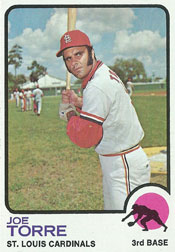
joe_torre5On Oct. 13, 1974, Torre was dealt to the Mets for pitchers Ray Sadecki and Tommy Moore.

Popular and productive, Torre hit .308 with 1,062 hits in 918 games for the Cardinals from 1969-74. His on-base percentage in that time was .382, nearly 20 points better than his career mark.

Though a multi-time all-star who regularly ranked among baseball’s top hitters, Torre exceeded all expectations in 1971 when he led the National League in hits (230), RBI (137) and batting average (.363) and was awarded the NL Most Valuable Player honor over Willie Stargell of the World Series champion Pirates.

Time for change

After the 1974 season, the Cardinals were ready to make Keith Hernandez, 21, their first baseman. In an interview with United Press International, Cardinals manager Red Schoendienst said of Hernandez, “He looks like a tremendous prospect. We had to make room for him.”

Though Torre also played third base and catcher, the Cardinals were set at those positions with Ken Reitz and Ted Simmons.

At 34 and with a yearly salary of $150,000, Torre was deemed expendable.

“His ample salary and his age may have been factors in arranging the deal,” the Associated Press reported. “He was one of a half dozen Cardinals players earning more than $100,000.”

Torre, too, was expecting a departure. In his book “Chasing the Dream,” Torre said, “I knew I wasn’t going to be back with the Cardinals. They had brought up a young first baseman from the minor leagues named Keith Hernandez and made him eligible for the playoffs if we won the East.”

Falling short

The Cardinals, though, finished in second place in the National League East Division in 1974 for the second consecutive year and for the third time in four seasons. They never qualified for the postseason during Torre’s time with the club.

Torre in 1974 hit .312 for the Cardinals in July and .320 in August before he slumped to a .200 batting mark with 22 strikeouts in September. After the season, The Sporting News reported Torre had played the last month of the season with a cracked thumb.

When Torre was acquired by the Cardinals from the Braves for Orlando Cepeda in March 1969, the Cardinals were a premier team, the two-time defending National League champions. “Torre did a heck of a job for us,” Cardinals general manager Bing Devine said. “I’m sincere when I say he took me off the spot by doing so well for us after we traded Cepeda for him.”

Meet the Mets

The Braves almost dealt Torre to the Mets instead of to the Cardinals. “The Mets thought they had him before the 1969 season and Gil Hodges, who was then their manager, went so far as to tell Torre during spring training that, ‘You’ll be with us in a couple of days.’ But that deal fell through because the Mets refused to part with Amos Otis, then a red-hot prospect to play center field for New York,” United Press International reported.

Six years later, the Mets finally got their man. It was the first trade for Mets general manager Joe McDonald, who would become general manager of the Cardinals from 1982-84.

“We’ve needed another right-handed hitter in our lineup and Torre gives us that,” Mets manager Yogi Berra said.

Said Torre, a Brooklyn native: “If I had to be traded anywhere, I’m glad I’m going to New York.”

Devine said Torre didn’t want to be a Cardinals reserve and his first choice among teams to be dealt to was the Mets.

In his book, Torre revealed, “I was going to a team whose season had just ended with 91 losses. That was a very fragile time for me. On top of being unhappy with my marriage, I hit rock bottom in the big leagues with a losing team. And to make matters worse, I became a part-time player. I hated it _ and it showed.”

Aftermath of the deal

Though Torre was the Mets’ starting third baseman on Opening Day in 1975, he eventually was platooned at first base with Ed Kranepool and at third base with Wayne Garrett. Torre hit .247 in 114 games for the 1975 Mets.

“In 1975, for the first time in my life, I dreaded going to the ballpark,” Torre said. “Baseball felt like work. I thought maybe it was time to quit.”

Torre became Mets player-manager in 1977 after he rejected a trade to the Yankees. As Torre recalled to Cardinals Yearbook in 2014, “In 1976, I was approached by Mets general manager Joe McDonald and he said, ‘How would you like to be traded to the Yankees?’ I didn’t jump at it … I said, ‘Not if it’s going to affect my chances of managing this team at some point.’ ”

Torre would manage the Mets, Braves, Cardinals, Yankees and Dodgers, winning four World Series titles with the Yankees and earning induction into the National Baseball Hall of Fame in 2014.

The pitchers the Cardinals got from the Mets for Torre had short stays.

Moore, 26, was 0-0 with a 3.86 ERA in 10 relief appearances for the Cardinals before he was traded in June 1975 with shortstop Ed Brinkman to the Rangers for outfielder Willie Davis.

Sadecki, 34, was in his second stint with St. Louis. He’d been a 20-game winner for the 1964 Cardinals and got the win in Game 1 of the World Series that year. In 1975, Sadecki was 1-0 with a 3.27 ERA in eight relief appearances for the Cardinals before being traded in May with pitcher Elias Sosa to the Braves for pitcher Ron Reed and outfielder Wayne Nordhagen.

Nine years earlier, in 1966, the Cardinals had sent Sadecki to the Giants for Cepeda. In proving the adage “what goes around, comes around,” the Cardinals dealt Sadecki for Cepeda, who later was traded to the Braves for Torre, who eventually was traded to the Mets for Sadecki.
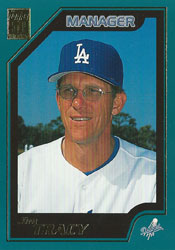
 

A decade after the Cardinals and Dodgers were matched again in a National League Division Series, the result was familiar. So was the touch of class.

jim_tracyAfter the Cardinals eliminated the Dodgers from the 2004 National League Division Series, players and staff from both teams met on the field and shook hands.

After the Cardinals eliminated the Dodgers from the 2014 National League Division Series, St. Louis manager Mike Matheny tipped his cap to his opponent.

On Oct. 7, 2014, the Cardinals beat the Dodgers, 3-2, in Game 4 at St. Louis and advanced to the National League Championship Series. Boxscore As Matheny entered the field to congratulate his team, he turned toward the Dodgers’ dugout, doffed his cap and, in a gesture of respect, nodded in their direction. Check out the video clip.

Ten years earlier, on Oct. 10, 2004, the Cardinals beat the Dodgers, 5-2, in Game 4 at Los Angeles and advanced to the National League Championship Series. In an unscripted act of sportsmanship prompted by Cardinals outfielder Larry Walker and led by managers Jim Tracy of the Dodgers and Tony La Russa of St. Louis, the teams met near the third-base line and the Dodgers offered congratulations.

A surprised Matheny, then the Cardinals’ catcher, told the St. Louis Post-Dispatch afterward, “I didn’t know what was going on. I thought we were going to brawl.”

Hockey lesson

Late in the regular season, after the Cardinals had clinched the 2004 Central Division crown, Walker suggested to La Russa that the Cardinals and their Division Series opponent shake hands on the field after the series finale. Walker, a Canadian, was impressed by how National Hockey League players formed a line on the ice after games and congratulated one another.

“Those guys (hockey players) go out and beat the daylights out of each other and then shake hands,” Walker said. “I think it’s a class thing.”

At the time Walker proposed his idea, the Cardinals didn’t know who they’d face in the first round of the postseason. “It sends a great message,” La Russa said of Walker’s suggestion. “But it depended on who we go up against. I know some managers better than others. But I know Jim Tracy really well.”

Before Game 1 of the Cardinals-Dodgers series, La Russa and Tracy discussed Walker’s idea, but neither mentioned it again.

Impromptu gesture

After the Cardinals’ clinching victory in Game 4, La Russa, like Matheny in 2014, went onto the field and turned toward the Dodgers’ dugout. He waved to Tracy. Then, La Russa made a handshake motion.

Tracy got the message.

He led the Dodgers onto the field.

“It was a class act,” said Cardinals pitching coach Dave Duncan. “Tracy led the way.”

Said an appreciative La Russa: “I know it had to be much more difficult for them to come out of the dugout and meet us halfway. It was impressive.” Boxscore

Walker, who had joined the Cardinals two months earlier in a trade with the Rockies, was delighted.

“This is something I’ve thought about for a long time,” Walker said. “You can laugh at it, but I think it’s something that can be done. It can’t hurt.”

Previously: Mike Matheny sparked Cardinals over Dodgers in 2004 NLDS

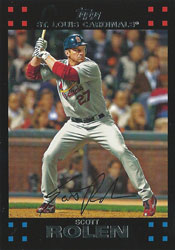
Cardinals third baseman Scott Rolen followed the most consistently excellent regular-season performance of his career with a postseason effort that was extraordinarily erratic.

scott_rolen2In 2004, the Cardinals won three of four games against the Dodgers in the National League Division Series, even though Rolen went hitless.

Super season

In the 2004 regular season, Rolen achieved career highs in home runs (34), RBI (124), batting average (.314), on-base percentage (.409) and slugging percentage (.598). His RBI total was second only to the 131 of the Rockies’ Vinny Castilla in the National League.

Rolen also was named a National League all-star in 2004, won a Gold Glove Award and finished fourth in the league’s Most Valuable Player Award balloting, behind Barry Bonds of the Giants, Adrian Beltre of the Dodgers and teammate Albert Pujols.

However, Rolen missed 16 games from Sept. 11 through Sept. 27 because of a calf strain. He still was experiencing soreness in the calf when the Cardinals opened the Division Series versus the Dodgers on Oct. 5, but he told the St. Louis Post-Dispatch he was “close to being close” to 100 percent.

Like 0-for-a-zillion

What happened next was unexpected. Rolen played in all four game of the Division Series and was hitless in 12 at-bats. He did walk six times, so along with a .000 batting average for the series Rolen had a .333 on-base percentage.

Batting in the cleanup spot, Rolen drew three walks in Game 4, a 6-2 Cardinals victory that eliminated the Dodgers and advanced St. Louis to the National League Championship Series versus the Astros. Boxscore

Said Rolen, who had sat out most of the 2002 postseason because of a shoulder injury: “I’m standing here after going 0-for-a-zillion and this feels so much better (than 2002). We’ve put ourselves in a position to do something special and I’m just glad to be part of it.”

Asked by Derrick Goold of the Post-Dispatch how he planned to end his slump before facing the Astros, Rolen replied, “I’m going to assess, approach, focus … Oh, that sounded pretty corny. A LaRussaism. He’s getting it in my head. That’s what Tony would say.”

Actually, what Cardinals manager Tony La Russa told Goold was: “Sometimes you have to go beyond the stats. (Rolen) was not a hitless hitter in the Dodgers series. You watch his at-bats, he had tough bases on balls.”

Timing is key

Cardinals hitting coach Mitchell Page said he told Rolen that six walks are as good as six singles.

“What six walks tells you is that they were pitching him careful,” Page said. “They weren’t just going to put something down the middle for him to hit.”

Rolen, though, acknowledged he had fouled off pitches he should have stroked for hits.

“My timing might have been here and there,” said Rolen. “I’m pulling some balls foul that I don’t normally pull foul.”

Rolen recovered, hitting .310 (9-for-29) with three home runs and six RBI in the League Championship Series. He produced the key hit, a two-run home run off Roger Clemens that snapped a 2-2 tie in the sixth inning of Game 7 and lifted St. Louis to a 5-2 pennant-clinching victory. Boxscore

Then, in the World Series versus the Red Sox, Rolen slumped again, going hitless in 15 at-bats.

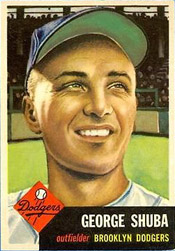
George “Shotgun” Shuba wasn’t an all-star, but he played like one against the Cardinals.

george_shubaIn seven seasons (1948-50, 1952-55) as a Dodgers outfielder, Shuba hit .259.

His career batting average against the Cardinals: .337 (33-for-98).

As a rookie in 1948, Shuba hit .267 in 63 games for the Dodgers.

Against the Cardinals that season, Shuba hit .385 (10-for-26), including .471 (8-for-17) at St. Louis’ Sportsman’s Park.

In his 1971 book “The Boys of Summer,” Roger Kahn wrote of Shuba, “His abiding love was hitting. All the rest was work. But touching a bat, blunt George became The Shotgun, spraying line drives with a swing so compact and so fluid that it appeared as natural as a smile.”

Two of the best performances of Shuba’s career came versus the Cardinals as a rookie.

Double trouble

On July 18, 1948, in the second game of a doubleheader at St. Louis, Shuba, a left-handed batter, was a prominent part of a Dodgers onslaught.

Brooklyn scored 13 runs in the first two innings. Each of the first 17 Dodgers batters reached base safely. Each of the three outs in the five-run Dodgers first was recorded on the base paths. The 17 reached base on four doubles, five singles, six walks and two force outs.

In the first, after Pee Wee Reese doubled and Jackie Robinson walked, Jim Hearn’s first two pitches to Gene Hermanski missed the plate.

Cardinals manager Eddie Dyer lifted Hearn and replaced him with Al Brazle. Hermanski drew a walk, loading the bases.

Shuba then ripped a two-run double.

In the second, with Gerry Staley pitching, Shuba doubled again, scoring Robinson, who had singled.

Shuba finished 3-for-5 with 3 RBI and 2 runs scored, sparking the Dodgers to a 13-4 triumph. Boxscore

Cardinals nemesis

The next month, Aug. 30, 1948, Shuba led the Dodgers to an improbable comeback victory versus the Cardinals in the first game of a doubleheader at St. Louis.

Cardinals starter Murry Dickson carried a 5-2 lead into the ninth. Hermanski led off with a single and Shuba followed with a double, advancing Hermanski to third. Pete Reiser doubled, driving in Hermanski and Shuba and cutting the Cardinals’ lead to 5-4.

Ted Wilks relieved Dickson. After the Dodgers tied the score at 5-5, Shuba came to the plate with Arky Vaughan on third and Bruce Edwards on first, one out.

Shuba singled to right, scoring Vaughan with the run that completed a four-run ninth and brought the Dodgers a 6-5 victory. Boxscore

Of all the Cardinals pitchers Shuba raked during his career, Wilks was his favorite. Shuba hit . 833 (5-for-6) with 4 RBI vs. Wilks.

Shuba had two other noteworthy games against the Cardinals.

He drove in three runs, including a two-run, two-out home run off Joe Presko, in a 10-4 Dodgers victory over the Cardinals on Aug. 24, 1952, at St. Louis. Boxscore

A year later, Aug. 1, 1953, Shuba was 3-for-4 with two runs scored in the Dodgers’ 11-4 win against the Cardinals at St. Louis. Boxscore

Previously: How Andy Pafko gave Cardinals inside-the-glove home run

Previously: Duke Snider, Stan Musial put on big show

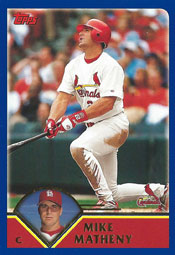
mike_matheny8Catcher Mike Matheny played a big role for the Cardinals in the 2004 National League Division Series versus the Dodgers.

On Oct. 5, 2004, Matheny contributed a solo home run against reliever Elmer Dessens in the Cardinals’ 8-3 victory in Game 1 of the best-of-five series at St. Louis.

Cardinals fans rewarded him with an ovation and urged a curtain call. A hesitant Matheny went to the top step of the dugout and acknowledged the sustained applause.

“It’s a huge honor,” Matheny, 34, said to the St. Louis Post-Dispatch. “It’s taken me five years (with the Cardinals) and this is the first year I’ve had one. I didn’t know how to get out there.” Boxscore

Hot hitter

Two days later, on Oct. 7, 2004, the Cardinals entered Game 2, knowing a victory would give them control of the series.

In the fifth inning, with the Cardinals ahead, 4-3, Matheny batted against starter Jeff Weaver with the bases loaded, two outs, and stroked a two-run single to center, giving the Cardinals a 6-3 lead and knocking Weaver out of the game.

“He gets fired up,” Cardinals manager Tony La Russa said.

Dan Haren, who followed starter Jason Marquis and Cal Eldred, held the Dodgers scoreless in the fifth and sixth, stabilizing the game for St. Louis. It was an impressive effort for a pitcher making his first postseason appearance.

A grateful La Russa called Haren, 24, “a cool dude” and “tough as nails” and said Haren’s shutdown of the Dodgers “turned the momentum.”

Said Matheny: “He came into a tough situation and made pitches right away.”

RBI record

In the seventh, the Cardinals, looking to stretch their three-run lead, had Reggie Sanders on second and Edgar Renteria on third, with two outs. Though first base was open and pitcher Ray King was on deck, the Dodgers decided to pitch to Matheny and he singled to left off a first-pitch curve from Giovanni Carrera, scoring both runners. The Cardinals won by the same score as the opener, 8-3. Boxscore

“The hit (Matheny) got off Weaver, he hit a good pitch,” said Dodgers manager Jim Tracy. “It was a breaking ball down and away and he got it. In the seventh, that wasn’t a good pitch.”

Wrote Post-Dispatch columnist Bernie Miklasz: “The Dodgers probably wonder how it is that Matheny became Johnny Bench.”

Matheny became the first Cardinals hitter to produce four RBI in a Division Series game.

“I know that I haven’t put up huge (regular-season) numbers offensively, but I also know what my purpose is on this team,” Matheny said. “First of all, it’s behind the plate _ and I put a whole lot more pressure and expectations on myself back there.”

The Cardinals eliminated the Dodgers with a Game 4 triumph, advancing to the National League Championship Series against the Astros. The Cardinals beat the Astros in four of seven games, winning their first pennant in 17 years and progressing to the World Series against the Red Sox.

Previously: Why Mike Matheny ended his playing career as a Giant

Previously: Pitcher for 1964 Cardinals was mentor to Mike Matheny

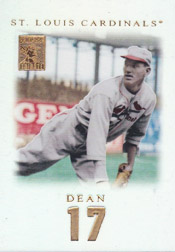
On the final day of the 1934 season, in a feat that combined endurance with skill, Dizzy Dean carried the Cardinals to the National League pennant by pitching his second shutout in the span of 48 hours.

dizzy_dean6On Sept. 30, 1934, Dean earned his 30th win of the year in the Cardinals’ 9-0 victory over the Reds at St. Louis. Dean became the last National League pitcher to achieve 30 wins in a season and the first since Grover Cleveland Alexander of the 1917 Phillies.

Dean’s performance enabled the Cardinals to finish a game ahead of the Giants and propelled them into the World Series against the Tigers.

September sizzle

The Cardinals, who trailed the first-place Giants by seven games on Sept. 7, won nine of 10 between Sept. 16 and Sept. 25.

On Sept. 28, the Cardinals were a half-game behind the idle Giants entering a Friday afternoon game against the Reds at St. Louis. Dean started and pitched a shutout. The 4-0 victory moved the Cardinals into a first-place tie.

The next day, after the Cardinals beat the Reds and the Giants lost to the Dodgers, St. Louis was alone in first place with a game remaining.

Cardinals manager Frankie Frisch chose Dean to start the Sept. 30 finale. It would be Dean’s fifth appearance in eight days.

Personal quest

In the book “Ol’ Diz,” author Vince Staten wrote, “Diz had made it his personal quest to pitch the Cardinals into the World Series. He wanted the ball every day.”

The Cardinals could clinch the pennant _ their fifth in nine years _ on Sept. 30 with a win over the Reds, or a Giants loss to the Dodgers. If the Cardinals lost and the Giants won, a playoff would be needed to determine the league champion.

“Give me a couple or three runs _ there ain’t going to be any playoff,” Dean said to his teammates.

Playing at the Polo Grounds, the Giants scored four in the first, but the Dodgers rallied. The score was tied at 5-5 after nine innings.

At St. Louis, before a packed house of 35,274, Dean and the Cardinals were cruising. Bill DeLancey drove in four runs. Rip Collins hit a two-run home run for his 200th hit of the season.

Fastballs like pistol shots

Entering the ninth, the Cardinals led, 9-0.

In the book “Diz,” author Robert Gregory wrote, “He was working on a five-hitter, his second straight shutout, and with fastballs that sounded like pistol shots he had made it a calm, effortless, one-sided game.”

The Reds, though, opened the ninth with two hits and a walk, loading the bases.

“Grinning in that cocksure way of his, Dizzy arose to the heights,” the Associated Press reported.

Dean struck out Clyde Manion.

Ted Petoskey was up next.

With the count 0-and-2, the scoreboard posted the final from the Polo Grounds:

Dodgers 8, Giants 5, in 10 innings.

The loss eliminated the Giants and assured the Cardinals the pennant.

All that remained to be settled was whether Dean would get the shutout.

Finish with a flourish

Petoskey struck out.

Sparky Adams followed by fouling out to the catcher.

Dean completed the shutout in 2:01. Boxscore

“A few minutes later … five cops were escorting Diz to the dugout as thousands of fans swept onto the field,” Gregory wrote.

The Cardinals celebrated their pennant by swigging soda pop.

Dean, though, “his eyes glazed with fatigue, was unusually quiet and bumming cigarettes.”

The final stats for Dean that season: 30-7 record, 2.66 ERA, 50 games pitched, 33 starts, 24 complete games, seven shutouts and 311.2 innings pitched.

Dean won Games 1 and 7 of the 1934 World Series and was chosen the recipient of the National League Most Valuable Player Award.

Previously: Cardinal cool: How Dizzy Dean survived armed robbery

Previously: Why Cardinals dealt Dizzy Dean to Cubs