Feeds:
Posts
Comments

(Updated Sept. 27, 2019)

In late September 1964 the Cardinals were five games behind the first-place Phillies entering a five-game series against the Pirates at Pittsburgh.
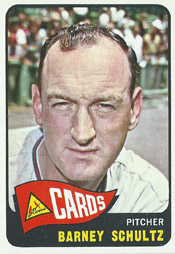
barney_schultzWith 11 games remaining in the regular season, Cardinals outfielder Bob Skinner said to teammate Dick Groat, “OK, Dick, the only thing we have to do is sweep the Pirates in five,” according to the book “October 1964.”

Skinner and Groat, both former Pirates, knew how unlikely it was for any club to accomplish such a task at Pittsburgh.

However, the Cardinals won both games of a doubleheader versus the Pirates on Sept. 24 and followed that with wins at Pittsburgh on Sept. 25 and Sept. 26.

In the series finale, played in a light rain on Sept. 27, 1964, the Cardinals started Roger Craig, who’d lost four consecutive decisions.

Craig delivered a stellar start, holding the Pirates scoreless and limiting them to six singles through 7.2 innings.

Save for Schultz

In the eighth, with the Cardinals ahead, 3-0, the Pirates had runners on first and second, two outs, when Cardinals manager Johnny Keane brought in knuckleball specialist Barney Schultz to face Roberto Clemente, who represented the tying run.

The odds seemed stacked in favor of Clemente, who hit .361 with runners in scoring position in 1964, but Schultz struck him out. Throwing nothing but knucklers, Schultz got Clemente to lunge for one and miss on a 2-and-2 count.

The Cardinals scored twice in the ninth and Schultz retired the Pirates in order in the bottom half of the inning, preserving a 5-0 St. Louis victory. Boxscore

In sweeping the five games at Pittsburgh, the Cardinals played nearly flawless baseball, committing one error and holding the Pirates to eight total runs.

“That was a disgrace in Pittsburgh,” Phillies scout Don Hoak, a former Pirates third baseman, said to Groat. “They just handed you five games.”

Groat replied, “You forgot to mention the most important thing about those five games _ that we didn’t make a single mistake in all five of them.”

Pennant push

The sweep moved the Cardinals 1.5 games behind the Reds, who had gone into first place as the fading Phillies lost their seventh in a row.

Pirates manager Danny Murtaugh said the Cardinals “looked like they mean business. They’re putting everything together,” the Pittsburgh Press reported.

Arriving at the St. Louis airport after their flight from Pittsburgh, the Cardinals were greeted by an adoring crowd of at least 8,000, The Sporting News reported.

“The adrenaline was flowing,” Cardinals outfielder Carl Warwick said to Peter Golenbock in the book “Spirit of St. Louis.” “All of a sudden you’re saying, ‘We’re not out of this thing.’ ”

Craig told the St. Louis Post-Dispatch, “Our guys believe they can win. They know we have the best club in the league.”

Finishing the season in St. Louis, the Cardinals won four of their last six against the Phillies and Mets, winning the pennant by a game over both the Phillies and Reds.

Previously: Why Gussie Busch fired Bing Devine in championship year
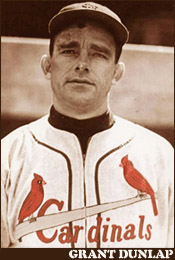
 

Grant Dunlap possessed a variety skills. He was a winning coach in multiple sports, an accomplished author and a pinch-hitter deluxe for the Cardinals.

grant_dunlapDunlap played his lone big-league season with the 1953 Cardinals.

A Stockton, Calif., native, Dunlap, 17, was signed by the Reds in 1941. He was given an $870 bonus and used the money to pay for surgery for his mother. A year later, he joined the Marines, became an officer and served in the South Pacific and China during World War II.

In 1952, Dunlap was the Texas League batting champion, hitting .333 for Shreveport. The first baseman, a right-handed hitter, was purchased by the Cardinals in December 1952 and placed on the big-league roster. The Cardinals said Dunlap would compete with Steve Bilko and Dick Sisler for the everyday first base role.

Ready to hit

A 29-year-old rookie, Dunlap made a favorable impression when he joined the Cardinals at their spring training camp at St. Petersburg, Fla., in February 1953.

In its March 11 edition, The Sporting News reported, “Perhaps the outstanding ‘sleeper’ in camp is Grant Dunlap … In the early batting drills, he attracted attention and in the first squad game he swung at the first pitch and whacked the ball far over the left field wall into Tampa Bay. Dunlap looks like a hitter. He poises his bat and is ready for every pitch.”

Said Cardinals manager Eddie Stanky: “Dunlap looks pretty shifty around first base, too.”

Two weeks later, The Sporting News wrote, “Grant Dunlap is another substantial hitter on the Cardinals squad and may remain because of his prowess with the war club.”

Wounded warrior

Late in spring training, during an exhibition game against the Braves, Dunlap suffered an injury that derailed his chances of winning the first base job. After stroking a single, Dunlap was on first when Hal Rice hit a grounder to second baseman Jack Dittmer. Dunlap braked to avoid a tag and Dittmer threw out Rice at first.

First baseman Joe Adcock then pursued Dunlap, who got trapped in a rundown. In the frenzy, Adcock accidently stepped on Dunlap’s left foot. Dunlap suffered “a five-suture spike wound” near the instep and was “carried off the field on a stretcher to minimize bleeding,” The Sporting News reported.

Bilko opened the season as the Cardinals’ starting first baseman. Stanky kept Dunlap on the roster as a pinch-hitter.

St. Louis slugger

Dunlap’s first two big-league hits were significant.

In his third big-league at-bat, Dunlap got his first hit _ a pinch-hit home run off Ken Raffensberger in a 5-2 Reds victory at Cincinnati on May 10, 1953. Boxscore

A month later, Dunlap got his second hit and it produced a Cardinals victory.

On June 12, 1953, at New York’s Polo Grounds, the Giants led the Cardinals, 1-0. In the seventh, with Cardinals runners on first and second, one out, Dunlap drove a pinch-hit triple off the right field wall against Dave Koslo. Ray Jablonski and Rip Repulski scored, giving the Cardinals a 2-1 lead. Pitcher Harvey Haddix ran for Dunlap and scored on Solly Hemus’ sacrifice fly. The Cardinals won, 3-1. Boxscore

Used primarily as a pinch-hitter, Dunlap batted .353 (6-for-17) for the Cardinals, but couldn’t displace Bilko at first base and wasn’t getting at-bats. In August, the Cardinals sent Dunlap to their minor-league affiliate at Houston. Stanky predicted Dunlap would be “a terrific man” for Houston given the chance to play regularly.

On Aug. 11, 1953, Dunlap went 5-for-5 for Houston in a game against Dallas. He hit .277 in 35 games for Houston.

Life after baseball

After the season, the Cardinals sold Dunlap’s contract to their Rochester affiliate. In December 1953, Rochester traded Dunlap to another Class AAA club, Minneapolis, for pitcher Bill Connelly.

Dunlap spent the 1954 and 1955 seasons in the minor leagues. Then he began a successful second career.

An all-conference baseball and basketball player at Occidental College, Dunlap returned to the Los Angeles school in 1955 and coached both sports teams.

In 30 years as Occidental baseball coach, Dunlap had a 510-316 record and won nine conference titles. He was 205-156 with five league championships in 16 years as Occidental basketball coach. Dunlap also was the Occidental athletic director from 1971-76. He retired in 1984.

Dunlap wrote an acclaimed mystery novel “Kill the Umpire” that was published in 1998. Dunlap was praised for his vivid, lively prose, drawing on his minor-league experience to recreate the feel of the Texas League towns of the 1940s and what it was like to be a ballplayer in that time. The book is available on Amazon.

Previously: Like Polish Falcons, 2013 Cardinals soar with doubles

Previously: The story of how Tom Alston integrated Cardinals

(Updated May 26, 2020)

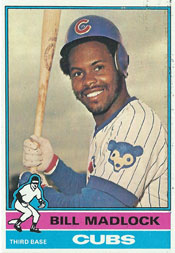
Ted Simmons slugged a Cubs player before he delivered a knockout punch to the entire Chicago team.

bill_madlockOn Sept. 22, 1974, at St. Louis, Simmons hit Cubs batter Bill Madlock, setting off a melee.

Soon after, Simmons got the game-winning hit.

In the ninth inning, with the score tied at 5-5, Madlock led off against Al Hrabosky. When Hrabosky stepped off the mound, turned his back on the batter and went into his routine of psyching himself for the confrontation, Madlock backed away and went toward the on-deck circle.

After Madlock returned to the batter’s box, Hrabosky exited the mound again. Madlock responded by walking back to the on-deck circle.

“I know what they were doing,” Hrabosky said to the Associated Press. “They were trying to out-psyche me.”

Play ball

Irritated, plate umpire Shag Crawford walked toward Madlock and ordered him to return to the batter’s box. “I said, ‘Bill, get back here,’ ” Crawford told the St. Louis Post-Dispatch. “I thought maybe he didn’t hear me because of the crowd noise. So I went after him and said it again.”

Cubs manager Jim Marshall and Jose Cardenal, the Cubs’ on-deck batter, rushed toward the umpire, protesting what they considered delay tactics by Hrabosky.

“The pitcher walked off the mound and just stood there,” Marshall said. “The pitcher is the one who should have been told to come in with the ball.”

Whirling away from Marshall and Cardenal, Crawford strode back toward the plate. With Marshall and Cardenal in pursuit, the umpire positioned himself behind the catcher, Simmons, and motioned to Hrabosky to make a pitch.

Hrabosky obliged and, with no one in the batter’s box, fired a high fastball that was called a strike.

Simmons rifled the ball back to Hrabosky and the pitcher quickly prepared to make another delivery.

Alarmed, Cardenal waved frantically to Madlock to get into the batter’s box.

Double trouble

Cardenal, fearing Madlock wouldn’t arrive in time, took a batting stance at the far end of the box. As he did, Madlock rushed into the box and took his stance in front of Cardenal, giving the Cubs two batters in the box, both with bats cocked, prepared to swing.

In his haste, Madlock brushed Simmons with the bat as Hrabosky’s fastball crossed the plate.

“I looked up and he (Madlock) was standing there with his bat, looking at me,” Simmons told reporters. “I said, ‘What are you looking at?’ And he said, ‘Get lost.’

“Then I hit him.”

Simba strikes

Simmons landed a punch to Madlock’s chin. “I must have hit him pretty good,” Simmons said to the Post-Dispatch. “I cut my knuckles.”

The benches emptied and fighting ensued. You can see a video of the incident by playing the first 1:05 of this You Tube clip.

After punching Madlock, Simmons pursued him up the third-base line and was struck from behind with a full body blow by Cubs first baseman Andre Thornton.

In a 2020 interview with Stan McNeal of Cardinals Gameday Magazine, Simmons recalled, “I got hit harder than I ever had been in my life when Andre Thornton ran up and laid into me … I went down and just laid there. I couldn’t breathe. I’m not mad that he hit me from behind because I’d have done the same thing if I had been him.”

Pat Dean, widow of Hall of Famer Dizzy Dean, whose uniform No. 17 was retired by the Cardinals before the game, witnessed the fight and told the Post-Dispatch, “They must have done this for Diz. It looked like the old Gashouse Gang.”

When order was restored, only Marshall was ejected because he complained to Crawford about Simmons remaining in the game. “I don’t think players should be thrown out for fighting,” Crawford told the Chicago Tribune.

Hrabosky said the fight “really psyched me up. It was just what the doctor ordered.” Hrabosky struck out Madlock and got Cardenal to pop out to Simmons before striking out pitcher Dave LaRoche.

In the bottom of the ninth, Lou Brock singled and advanced to second when Reggie Smith walked. With two outs, Simmons, batting right-handed, laced a single to center, scoring Brock and giving the Cardinals a 6-5 victory. Boxscore

Years later, in an interview with the Baseball Hall of Fame magazine, “Memories and Dreams,” Hrabosky said of Simmons, “His best attributes were his strong will to win and his dedication to being out there every day. He could motivate me better than anybody I’ve ever been around.”

The emotional triumph gave the division-leading Cardinals a 1.5-game advantage over the second-place Pirates with nine games remaining.

Basking in the afterglow of victory, Hrabosky said, “I really don’t intend to make people or players mad at me with what I’m doing. I’m just doing it for myself. But, if it makes them mad, it’s just serving my purpose all the more.”


Since 1944, the Cardinals are the only National League franchise to win three consecutive pennants.

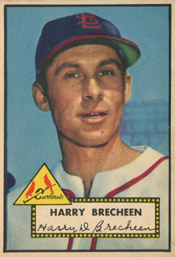
harry_brecheenBefore the Cardinals’ stretch of pennants from 1942-44, the last National League franchise to win three consecutive pennants was the Giants. They won four in a row from 1921-24.

Since 1900, the only other franchises that have won three National League pennants in a row are: Pirates (1901-03), Cubs (1906-08) and Giants (1911-13).

Managed by Billy Southworth, the 1942-44 Cardinals also were the first National League teams with 100 or more wins in each of three consecutive seasons.

Familiar feeling

In 1944, the Cardinals took the National League lead on April 29 and never relinquished it. A September slump kept them from clinching early in the month. They’d lost eight of nine entering a Sept. 21 doubleheader against the Braves at Boston.

In the first game of the doubleheader, the Cardinals broke a 4-4 tie in the eighth when George Fallon singled to right with two outs, scoring Whitey Kurowski from second. Harry Brecheen pitched five innings in relief of starter Mort Cooper and got the win.

The 5-4 victory clinched the pennant for the Cardinals, giving them a 13-game lead over the second-place Pirates with 12 remaining. Boxscore

Wrote The Sporting News, “The Redbirds walked off the field as if it had been an ordinary game, probably one of the least demonstrative reactions that has followed a pennant clincher. Except for the customary picture showing the players in a jubilant mood, there was no celebration in the clubhouse.”

Keep on rolling

In the second game, Cardinals pinch-hitter Walker Cooper slugged a two-run home run off starter Jim Tobin in the ninth, tying the score at 5-5, and Marty Marion drove in Ken O’Dea from second with a single in the 10th, lifting St. Louis to a 6-5 victory.

Brecheen pitched two scoreless innings, the ninth and 10th, to get his second win of the day and improve his record to 15-5. Boxscore

In saluting the 1944 Cardinals on their pennant-clinching day, The Sporting News noted, “Every player except two _ Danny Litwhiler and Debs Garms _ bears the Cardinals trademark, having come up through the club’s farm system.”

In an interview with author Peter Golenbock for the book “The Spirit of St. Louis,” Litwhiler said, “In 1944, we played the same Billy Southworth baseball. He never went for the big inning. Get a man on and get him over. At the time, we defined National League baseball. What I remember most about ’44 was that every day you knew you were going to win … It was so easy. And it wasn’t one person who did it. It was always someone new.”

The Cardinals finished the 1944 season at 105-49, 14.5 games ahead of the runner-up Pirates, and clinched the World Series championship with four wins in six games against the crosstown Browns.

Previously: Why the Cardinals played baseball in Delaware on D-Day

(Updated Jan. 8, 2019)

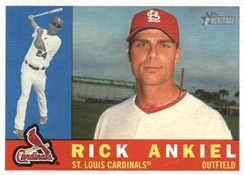
Three years after he left the Busch Stadium mound with his pitching career spiraling out of control, Rick Ankiel returned to St. Louis as a confident Cardinals reliever embraced by the fans.

rick_ankiel6On Sept. 19, 2004, Ankiel made his first Busch Stadium appearance since 2001 and pitched two hitless innings against the Diamondbacks, departing to a standing ovation.

In his previous home appearance, on May 10, 2001, Ankiel regressed against the Pirates, yielding three runs, three hits, five walks and two wild pitches in three innings, departing with his head down and bolting the ballpark without talking with reporters. Boxscore

After that debacle, Ankiel went to the minor leagues and pitched there for the remainder of 2001. After sitting out the 2002 season because of a left elbow sprain, Ankiel pitched in the minors in 2003 until undergoing left elbow surgery in July.

Ankiel spent most of the 2004 season on the disabled list, returned to the minors in August that summer and was called up by the Cardinals in September. Ankiel made a pair of scoreless one-inning stints at San Diego against the Padres and at Los Angeles against the Dodgers.

Welcome home

On Sept. 19, 2004, a Sunday afternoon at Busch Stadium, Ankiel relieved starter Jeff Suppan to start the fifth inning. As he walked to the mound, Ankiel tipped his cap to an appreciative crowd of 41,279.

“You walk out there with the electricity of the crowd and you feel like you’re floating,” Ankiel said to the St. Louis Post-Dispatch. “It’s pretty indescribable.”

Mixing a 91 mph fastball with a 66 mph curve, Ankiel faced three batters _ Luis Terrero, Alex Cintron and Danny Bautista _ in the fifth and struck out all three.

“His fastball was running and sinking hard,” Cintron said to the Post-Dispatch. “His curveball _ I’ve never faced anything like it in my life. He’s the Rick Ankiel everyone expected him to be.’

Facing Ankiel in the sixth, Shea Hillenbrand grounded out, Chad Tracy walked, Chris Snyder struck out and Doug DeVore lined out to right. “He was tricky,” Snyder said to the Belleville (Ill.) News-Democrat. “He was pretty deceptive. He had a good fastball and a good snap to his curveball.”

Said Cardinals catcher Mike Matheny: “He’s got good tempo … That curve’s amazing. You can hear it spinning all the way up there.”

Walking off the mound, Ankiel again tipped his cap to a standing ovation.

“Unbelievable … I was pretty much in the sky,” Ankiel said to the News-Democrat. Boxscore

Years later, in his 2017 book “The Phenom,” Ankiel said, “My fastball wasn’t what it was. That was by choice. It was more reliable at 89 mph or 90, at less than full effort, than it would be at 95. My career would have to be about control. I’d control my mind, which would settle my heart, and control my effort, which would guide my fastball.”

Last hurrah

In his next appearance, at Colorado, Ankiel yielded five runs in two innings. He rebounded five days later, on Oct. 1, in limiting the Brewers to a run in four innings and earning a win. Boxscore

“What became important was winning the game around the game, the one in my head,” Ankiel said in his book.

It would be Ankiel’s final big-league game as a pitcher.

In 2005, Ankiel declared he would convert into an outfielder and abandon his pitching career.

In 2007, Ankiel returned to the Cardinals and spent seven seasons in the big leagues as a power-hitting and strong-armed outfielder.

Previously: Rick Ankiel joins Babe Ruth, Joe Wood in postseason lore

Aided by the ineptness of a Cubs club that could neither field nor pitch effectively, the 1964 Cardinals achieved a feat that remains unmatched in franchise history.

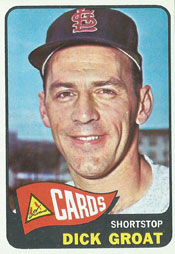
dick_groat2On Sept. 13, 1964, the Cardinals scored in each of the nine innings and beat the Cubs, 15-2, at Wrigley Field in Chicago.

It was only the second time since 1900 that a National League team scored in all nine innings. The Giants did it in a 22-8 victory over the Phillies on June 1, 1923, at Baker Bowl in Philadelphia. Boxscore

The Rockies became the first National League team to achieve the feat since the Cardinals did it. On May 5, 1999, the Rockies scored in each of the nine innings and defeated the Cubs, 13-6, at Wrigley Field. Boxscore

Culpable Cubs

In the game against the Cardinals, the Cubs committed seven errors and yielded 18 hits and two walks. Second baseman Joe Amalfitano and shortstop Andre Rodgers each made two errors.

The Cardinals scored against five pitchers _ starter Dick Ellsworth and relievers Don Elston, Sterling Slaughter, John Flavin and Lee Gregory.

Dick Groat had four hits. Curt Flood and Julian Javier had three apiece.

Five Cardinals _ Lou Brock, Ken Boyer, Flood, Groat and Javier _ each scored two runs. Five others _ Dal Maxvill, Bill White, Mike Shannon, Bob Uecker and Curt Simmons _ scored one apiece.

Simmons, the Cardinals’ starting pitcher, got an easy win despite yielding eight hits and five walks in eight innings. “How could anyone struggle with a 15-2 victory?” Simmons said to The Sporting News. “I was wilder than I had been all year.”

Ray Washburn, pitching the ninth, made his first Cardinals appearance since going on the disabled list July 22.

1 through 9

A look at each Cardinals inning:

_ First inning, 2 runs: Flood scored from third on Boyer’s single. Groat scored from third on White’s groundout.

_ Second inning, 1 run: Javier homered.

_ Third inning, 2 runs: Shannon’s two-run single scored Groat and Boyer.

_ Fourth inning, 2 runs: Brock homered. White scored from second when Rodgers made an error on Shannon’s grounder to short.

_ Fifth inning, 2 runs: Groat’s two-run single scored Uecker and Simmons.

_ Sixth inning, 1 run: Shannon homered.

_ Seventh inning, 3 runs: Groat’s two-run double scored Flood and Brock. Maxvill, who ran for Groat, scored on Boyer’s single.

_ Eighth inning, 1 run: Flood’s single scored Javier.

_ Ninth inning, 1 run: Shannon’s sacrifice fly to center scored Boyer from third, completing the streak of runs in nine consecutive innings. Boxscore

Previously: Cubs knew Lou Brock was on verge of stardom in 1964