Feeds:
Posts
Comments

Blinded by impatience, insecurity and inability to quell internal politics, Cardinals owner Gussie Busch ousted the general manager who built the team that two months later would win the franchise’s first World Series title in 18 years.

bing_devineOn Aug. 17, 1964, Busch fired general manager Bing Devine.

“It was a travesty,” St. Louis journalist Bob Broeg wrote in recalling the firing 40 years later. “A lot of the players on the team felt the same way.”

Trades engineered by Devine brought to the Cardinals core players on the championship club. They included outfielders Lou Brock and Curt Flood, infielders Bill White, Julian Javier and Dick Groat and pitchers Curt Simmons, Roger Craig, Ron Taylor and Barney Schultz.

Under Devine’s leadership, the minor-league system also developed essential Cardinals such as pitchers Bob Gibson, Ray Sadecki and Ray Washburn as well as outfielder Mike Shannon and catcher Tim McCarver. In the pipeline were prospects such as pitchers Steve Carlton and Nelson Briles.

Busch became convinced in August 1964 the Cardinals needed to dump Devine (and replace manager Johnny Keane with Leo Durocher after the regular season) in order to produce a champion.

The Cardinals were 62-55, nine behind the first-place Phillies, in the National League when Busch fired Devine. From there, the Cardinals went 31-14, finishing in first place at 93-69, one game ahead of both the Reds and Phillies.

In his book “October 1964,” author David Halberstam wrote, “Devine went quietly. It was something he had always expected. He had been dealing for the last seven years from a position of limited strength and the pressure to produce a winner had grown every year. Life under as volatile a man as Gussie Busch was like living on a precipice, he thought.”

The three key reasons why Busch fired Devine:

Impatience

The Cardinals hadn’t won a pennant since Busch took control of the club in February 1953. Devine had been general manager since replacing Frank Lane in November 1957.

After the Cardinals placed second in 1963, Busch had high expectations for the following year. His frustration reached a boiling point in August 1964.

“I have been worried about the Cardinals for a long time,” Busch said to The Sporting News after firing Devine. “The club has not been making any progress.”

In his book “The Memoirs of Bing Devine,” Devine said, “There’s no question in my mind I got fired because Mr. Busch was frustrated. He’d always had success with Anheuser-Busch. He’d owned the Cardinals for 10 years and he was tired of not succeeding in this other business.”

Insecurity

A mid-season incident involving Groat hurt Devine’s relationship with Busch.

Keane had given Groat approval to call for the hit-and-run play when he saw an opportunity to execute it. Groat handled the bat well, but, in Keane’s view, Groat abused the privilege.

When Keane banned Groat from calling the hit-and-run, Groat groused openly and often. Devine learned of Groat’s unhappiness and told Keane to conduct a team meeting and confront Groat. Keane did and the matter was resolved when Groat apologized to Keane and the team and stopped his complaining.

Devine didn’t inform Busch of the incident because he viewed such squabbles as commonplace in clubhouses. Besides, the problem wasn’t lingering.

Braves third baseman Eddie Mathews, though, was friendly with Groat and heard of Groat’s initial unhappiness. Mathews was dating Busch’s daughter, Elizabeth, and told her of the conflict. She, in turn, told her father.

Busch was angry Devine hadn’t informed him. He became suspicious, wondering what else Devine wasn’t telling him.

“Busch was upset and that may have affected his thinking about me,” Devine said.

According to Halberstam, Busch “was more than a little paranoid anyway; it seemed to go with the territory with a man who had so much power in, but knew so little about, the high-profile business of baseball.”

Internal politics

Busch had hired Branch Rickey, the former longtime Cardinals general manager, as a consultant. Rickey, 82, and Devine clashed. Rickey meddled and criticized Devine in talks with Busch.

Rickey had built the Cardinals’ minor-league system in the 1920s and his influence was evident in remarks Busch made after Devine was fired.

“I am concerned that we cannot trade our way to a pennant,” Busch said to The Sporting News in August 1964. “We must depend on production out of our own system and I have been disappointed with the operation of our farm department. There just seems to be a gap someplace between the signing of players, their development and their progress to the Cardinals as men ready to do a major league job.”

Busch insisted Rickey didn’t trigger his decision to fire Devine. “Rickey had nothing to do with it,” he said. “I did not consult him until I’d made up my mind.”

Few bought that explanation. “He (Rickey) was undercutting Bing,” wrote Broeg. “We all knew that.”

Wrote Halberstam, “Rickey gradually increased the tempo of his drive against Devine … The veteran players, who liked Devine, and who did not think the team needed two general managers, were not amused. They knew that the more senior they were, the more likely Rickey was to get rid of them at the end of the season.”

In his book “Stranger to the Game,” Gibson said, “The players were hurt by Devine’s firing, but we decided that instead of packing it in for the year, we would dedicate ourselves to redeeming Devine with a strong finish.”

According to the book “The Spirit of St. Louis,” Busch asked broadcaster Harry Caray to become general manager. Caray declined and suggested Busch hire former St. Louis Browns owner Bill Veeck, but Veeck demanded a controlling interest of the stock in the Cardinals.

On Rickey’s suggestion, Bob Howsam, who had joined Rickey in a failed bid to start a third major league, the Continental League, was named general manager.

“Howsam did nothing to win the pennant after he became GM,” Broeg wrote. “He led the league in cheers.”

After the Cardinals won the World Series title, beating the Yankees in four of seven games, Keane resigned, rather than accept a contract extension, in protest of Devine’s dismissal. Keane accepted an offer to manage the Yankees.

Humiliated, Busch ordered Howsam to fire Rickey, and he did so.

Devine joined the Mets front office.

Howsam lasted with the Cardinals for two years, then went to the Reds. Stan Musial replaced him.

When Musial resigned in triumph after the Cardinals won the 1967 World Series title, Devine was rehired by Busch to be the Cardinals general manager.

(Updated Aug. 16, 2019)

In the season that produced his highest hits total, Cardinals center fielder Curt Flood had his best day as a hitter.

curt_flood6On Aug. 16, 1964, Flood got hits in eight consecutive at-bats in a doubleheader against the Dodgers at Los Angeles. Four of those hits came against Sandy Koufax.

Flood had a chance to tie the big-league record for consecutive hits in a doubleheader, but he made his only out of the day in his final at-bat.

“I’m mighty happy to have gotten eight hits, even though I couldn’t get that last one,” Flood said to United Press International.

Flood became the first National League player with eight hits in a doubleheader since Pirates shortstop Stan Rojek did it against the Dodgers at Pittsburgh in 1948.

Joe Kelley, a left fielder for the Orioles, established the record of nine consecutive hits in a doubleheader on Sept. 3, 1894, against Cleveland.

Entering the day with a .291 batting average, Flood was at .302 after his 8-for-9 performance. He would finish the season with a .311 batting average and a career-best 211 hits, tying him with Roberto Clemente of the Pirates as the 1964 National League hits leader.

With his wife, four children and parents in attendance, Flood batted leadoff in each game of the doubleheader.

Dandy vs. Sandy

In the opener, the Dodgers started Koufax, who that season would lead the National League in ERA (1.74) and winning percentage (.792 with a 19-5 record).

Koufax was dominant against everyone except Flood that day. The left-hander struck out 13 and shut out the Cardinals on seven hits. Flood, though, went 4-for-4 against him. Flood, a right-handed batter, hit .296 (32-for-108) in his career against Koufax.

Here’s what Flood did in Game 1:

_ First inning. Flood led off the game with a double down the left-field line. He was stranded at second when Koufax struck out Lou Brock and retired Dick Groat on a fly out and Ken Boyer on a pop out.

_ Third inning. With two outs and none on, Flood doubled to left, a shot just inside the third-base line. Koufax followed with a strikeout of Brock.

_ Fifth inning. Flood looped a single to right with two outs and none on.

_ Seventh inning. With Julian Javier on first and two outs, Flood lined a single to center, sending Javier to third. Koufax struck out Brock for the third time, ending the threat.

Koufax told the Los Angeles Times, “Flood always is tough … He was hitting good pitches.”

The Dodgers won, 3-0. Boxscore

Igniting the offense

In Game 2, Flood sparked the Cardinals against Larry Miller, a rookie left-hander. Here’s what Flood did in that game:

_ First inning. Flood laced a triple into the right-field corner and scored on Groat’s sacrifice fly.

_ Third inning. With one out and none on, Flood lined a single to center.

_ Fourth inning. With two outs, the bases loaded and Flood at the plate, Dodgers manager Walter Alston replaced Larry Miller with Bob Miller, a former Cardinals right-hander. Flood singled to right, driving in two runs and giving the Cardinals a 4-0 lead.

_ Sixth inning. Flood stroked his eighth consecutive hit, a two-out single to left off right-hander Phil Ortega.

_ Ninth inning. With the Dodger Stadium crowd cheering for him, Flood waited in the on-deck circle to face left-hander Ron Perranoski. According to the Los Angeles Times, “teammate Bill White helpfully threw a broom into the circle, and Bob Gibson needled his buddy by waving a fungo bat.” The attempt to lighten the mood didn’t work. Perranoski struck out Flood.

“Perranoski threw me some sinkers and I missed them,” Flood said to The Sporting News.

The Cardinals won, 4-0, behind the 4-for-5 effort by Flood and the pitching of Curt Simmons. Boxscore

When reporters gathered around Flood’s locker after the game, catcher Tim McCarver, Flood’s friend and teammate, put on an ape mask, grabbed a pencil and pad and joined the throng.

McCarver: “How do you explain how you make monkeys out of the Dodgers pitchers?”

Flood laughed and replied: “I am sore and tired. I should have saved that triple in the first inning of the second game. That ruined me.”

Previously: Sandy Koufax: ‘I still don’t know how to pitch to Curt Flood’

(Updated June 4, 2024)

Larry Walker wasn’t looking to leave the Rockies, but the Cardinals convinced him to give them a chance.

larry_walker2On Aug. 6, 2004, Cardinals general manager Walt Jocketty performed a heist, acquiring Walker, 37, from the Rockies for three prospects.

Walker, a three-time National League batting champion and seven-time Gold Glove Award winner, joined an outfield of Jim Edmonds and Reggie Sanders and helped the Cardinals win their first pennant in 17 years.

On Jan. 21, 2020, 16 years after the Cardinals acquired him, Walker was elected to the Baseball Hall of Fame with 76.6 percent of the votes from the Baseball Writers Association of America.

The Rockies had approached Walker about trading him to the Rangers or Marlins. Because Walker was a 10-year veteran who had spent five of those years with the same team, his approval was needed before a deal could be made. He rejected the proposed trades to Texas and Florida.

Players make pitch

The Cardinals appealed to Walker’s competitive spirit. In a bid to seal the deal, Edmonds and teammate Scott Rolen called Walker, urging him to help them get to the World Series by accepting a trade.

Rolen offered to drop a spot in the batting order in case manager Tony La Russa wanted to bat Walker in the cleanup position Rolen held.

Inspired, Walker gave his OK to the Rockies to complete a trade with St. Louis.

“I think there were some people in Colorado who weren’t certain he would come,” Jocketty said to the St. Louis Post-Dispatch. “He weighed everything and it didn’t take him long. I think he’ll be energized to come here and play with us and I think he’ll energize our club.”

In a July 2018 interview with Cardinals broadcaster Dan McLaughlin, Walker recalled, “It was really a no-brainer. It didn’t take me but a couple of minutes to say yes.”

The Rockies, looking to free payroll in order to rebuild around players such as rookie outfielder Matt Holliday, agreed to a package of minor leaguers: pitchers Jason Burch, Luis Martinez and Chris Narveson. None would play in a big-league game for the Rockies.

MVP caliber

Walker joined Edmonds, Rolen, Edgar Renteria and Mike Matheny in giving the 2004 Cardinals Gold Glove winners at five of the nine fielding positions.

“We put an MVP in the lineup … This was a real impact move,” Rolen said.

Said Sanders: “You look at this lineup and you wonder, ‘How can it get any better?’ And it did.”

The Cardinals were in first place in the National League Central, 10.5 games ahead of the Cubs, on the day of the trade.

La Russa said, “I love the message that the people on top are sending to the players. I think they recognize how hard we’ve been playing and we have the chance to do something really special.”

What a welcome

Walker arrived in St. Louis during the Cardinals’ game with the Mets on Aug. 7, 2004. In the seventh inning, with two runners on base, one out and the score tied at 1-1, La Russa sent Walker to bat for Matheny against Mets starter Kris Benson. Cardinals fans welcomed Walker with a standing ovation and chanted his name.

“One of the most nervous at-bats I’ve had in my career,” Walker said.

On the Cardinals’ telecast, broadcaster Mike Shannon marveled, “Look how excited these people are … They smell World Series.”

Walker struck out, but as he returned to the dugout he received another standing ovation. Video

“I didn’t know what to do,” Walker said. “I thought maybe I should go back and ask if I could have another strike.” Boxscore

Primarily batting in the No. 2 spot in the order _ “I love it,” Walker told Cardinals Magazine. “I didn’t have to worry about driving people in all the time.” _ Walker hit .280 with 11 home runs and 27 RBI in 44 games for the 2004 Cardinals, who won the division title by 13 games over the runner-up Astros.

In the postseason, Walker hit six home runs _ two each in the Division Series, League Championship Series and World Series. Playing in the only World Series of his career, Walker hit .357 but the Cardinals were swept by the 2004 Red Sox. “No excuses,” Walker told Cardinals Magazine. “We got outperformed and we underachieved.”

Walker returned to the Cardinals in 2005, his final big-league season, and hit .289 with 15 home runs and 52 RBI in 100 games.

In a September 2017 interview with McLaughlin, Rolen said, “Larry Walker is the best player I ever played with. There’s nothing he couldn’t do out there. He knew how to run the bases and he knew running the bases was an offensive weapon. You’re on base to score runs.

“He played an unbelievable Gold Glove outfield. Threw the ball and never missed a cutoff. Hit the ball as hard as anybody and moved the ball around.”

In an interview with the Baseball Hall of Fame magazine, “Memories and Dreams,” La Russa said of Walker, “I think he would probably be in the top three of just about every category: Base running, defense, handling the bat.”

Tom Lasorda, in his big-league debut, helped Stan Musial achieve a personal best.

tom_lasorda2On Aug. 5, 1954, Musial had seven RBI in a game for the first time in his Cardinals career.

Facing the Dodgers at Ebbets Field in Brooklyn, Musial hit a pair of three-run home runs _ one each off Preacher Roe and Erv Palica _ in consecutive innings. His seventh RBI came on a sacrifice fly against Lasorda.

Musial, 33, was in the prime of a Hall of Fame playing career. Lasorda, 27, was a big-league rookie who had spent eight seasons in the minor leagues. The left-hander would appear in just 26 games in the majors _ eight with the Dodgers and 18 with the Athletics _ but would be elected to the Hall of Fame as a Dodgers manager.

Dodgers nemesis

After grounding out in the first inning, Musial hit the first of his three-run homers in the third against Roe, a left-hander who had debuted with the 1938 Cardinals.

It was Roe who, when asked his approach to pitching to Musial, replied, “I throw him four wide ones, then try to pick him off first base.”

Musial hit .377 with 12 homers and 28 RBI against Roe in his career.

In his autobiography, Musial said of Roe, “At Brooklyn, he became an outstanding pitcher, changing speeds and mixing up a well-controlled curve, screwball and, as the man admitted himself later, a spitter. Because I didn’t want him to load up one of those quick-dipping spitters on me, I always tried to keep him from getting two strikes on me.”

An inning after his home run off Roe, Musial crushed the second of his three-run homers, this time against Palica. Musial hit .429 in his career versus Palica.

Rookie reliever

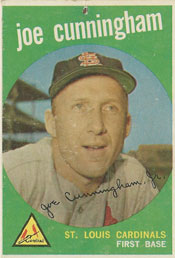
Lasorda relieved Palica in the fifth. The first big-league batter to face him was Red Schoendienst, who singled. The next batter, Bill Sarni, also singled. Lasorda then struck out Joe Cunningham and got Alex Grammas to ground into a double play.

In the sixth, Lasorda walked the leadoff batter, pitcher Brooks Lawrence. After Rip Repulski flied out, Wally Moon doubled, putting runners on second and third.

Musial then hit a fly ball to left. Sandy Amoros caught it, Lawrence tagged and scored, giving Musial his seventh RBI, and the Cardinals led, 10-2.

With those RBI, Musial became the first player in the majors to reach 100 in 1954. It was his seventh season of 100 RBI. His two home runs were Musial’s 29th and 30th of the season.

Paul Waner, the Hall of Fame outfielder, told The Sporting News, “No telling how many homers Stan could make if he weren’t unselfish.”

The Cardinals won, 13-4. Before then, the Dodgers had won 18 of the last 19 against the Cardinals at Ebbets Field. Boxscore

Lasorda pitched three innings in his debut and yielded three runs. Musial would face Lasorda a total of three times in his career. After the sacrifice fly, his other two plate appearances versus Lasorda resulted in a walk and a strikeout.

In his 22 seasons with the Cardinals, Musial had just one other seven-RBI game. That occurred on June 23, 1961, in a 10-5 Cardinals victory over the Giants at St. Louis. In that game, Musial had a three-run home run off starter Billy O’Dell and a grand slam off Bobby Bolin. Boxscore


(Updated July 5, 2018)

The catcher who displaced A.J. Pierzynski as the Giants’ starter before the 2005 season became his manager in 2014.

aj_pierzynskiPierzynski, signed by the Cardinals on July 26, 2014, to help compensate for the loss of injured all-star Yadier Molina, was the Giants’ starting catcher in 2004. The Giants were interested in having him return for 2005. Instead, given a chance for a defensive upgrade that better fit their budget, the Giants signed free-agent Mike Matheny in December 2004 and dumped Pierzynski.

A decade later, Matheny, 43, was the Cardinals’ manager and Pierzynski, 37, joined Tony Cruz as the St. Louis catchers.

The Giants paid a hefty price for Pierzynski when they acquired him from the Twins in November 2003 for pitchers Joe Nathan, Francisco Liriano and Boof Bonser.

Pierzynski produced a career-best 77 RBI with 28 doubles, 11 home runs and a .272 batting average for the 2004 Giants, but he was criticized by teammates and booed by fans. He caught only 23 percent of runners attempting to steal (15 of 66) and was charged with nine passed balls.

Let’s make a deal

After the season, Pierzynski was eligible for arbitration. Because of his hitting, he appeared poised to be awarded a judgment of more than $5 million for 2005. The Giants, unwilling to pay that much for one season, wanted Pierzynski to consider instead a multiyear contract in the $9 million to $10 million range.

When Pierzynski suggested a larger amount, the Giants turned to Matheny, a free agent who earned three Gold Glove awards as the Cardinals’ starting catcher from 2000-2004. The Cardinals hoped Matheny would return to continue to mentor Molina in 2005, but were unwilling to offer Matheny more than $4 million for two years, according to the San Francisco Chronicle and the St. Louis Post-Dispatch.

When the Giants offered a three-year, $10 million deal, Matheny accepted. Pierzynski requested his release, enabling him to become a free agent.

Run saver

Giants general manager Brian Sabean thanked Pierzynski for his contributions, but added, “We’re in a better position in a lot of ways going with Matheny.”

Matheny established the major league record for consecutive errorless games by a catcher (252 games from August 2002 until August 2004). He caught 30 percent (16 of 54) of runners attempting to steal in 2004 nd had just two passed balls.

”There’s no telling how many runs he’s going to save,” Sabean said to the San Jose Mercury News.

Said Matheny: ”As soon as the Giants hit the scene, we realized it could be a really special opportunity. There are a couple teams you want to play for and you’re not sure it will work out. In my case, it did.”

Chirpy personality

Several media reports cited Pierzynski’s personality as a factor in his departure.

_ Henry Schulman of the San Francisco Chronicle: “Pierzynski was a defensive liability and rubbed many in the organization the wrong way, even as pitchers grew to respect his game-calling ability.”

_ Jorge L. Ortiz of the Chronicle: “Pierzynski quickly fell into disfavor because of his chirpy personality and defensive deficiencies.”

_ John Shea of the Chronicle: “Pierzynski never seemed to fit in as a Giant … He slumped early and late and was criticized by multiple anonymous Giants pitchers in an Oakland Tribune report.”

_ Chris Haft of the Mercury News: “Though Giants management had publicly expressed interest in retaining Pierzynski … his difficulty in meshing with teammates did not endear him to the club.”

_ Laurence Miedema of the Mercury News: “Pierzynski was criticized by several unnamed (Giants) pitchers in April and was booed regularly at home.”

_ Bud Geracie of the Mercury News: ‘Sabean’s one-year rental of A.J. Pierzynski … ranks as his worst deal. A.J., we hardly knew ye. And we didn’t like ye.”

Matheny won his fourth Gold Glove Award with the 2005 Giants. Pierzynski signed with the 2005 White Sox and helped them to their first World Series championship in 88 years.

Previously: Why Mike Matheny ended his playing career as a Giant

Previously: The play that defined Mike Matheny as Cardinals Gold Glove

Tony La Russa and Joe Torre bring to 10 the number of managers in the National Baseball Hall of Fame who either played for or managed the Cardinals. Three of those 10 did both.

miller_hugginsLa Russa and Torre were inducted into the Cooperstown, N.Y., shrine on July 27, 2014.

The 10 Hall of Fame managers who either played for or managed the Cardinals are, in alphabetical order: Walter Alston, Leo Durocher, Whitey Herzog, Miller Huggins, Tony La Russa, John McGraw, Bill McKechnie, Wilbert Robinson, Billy Southworth and Joe Torre.

Huggins, Southworth and Torre are the three Hall of Fame managers who both played for and managed the Cardinals.

Several other Hall of Famers _ such as Roger Bresnahan, Frankie Frisch, Rogers Hornsby and Red Schoendienst, to name a few _ managed the Cardinals, but were inducted at Cooperstown because of their stellar playing careers, not for managing.

Another Hall of Fame manager, Sparky Anderson, managed Cardinals farm teams, but didn’t manage the Cardinals and didn’t play for them.

Here is a look at the 10 Hall of Fame managers who either played for or managed the Cardinals:

Walter Alston

If general manager Branch Rickey hadn’t left St. Louis to join the Dodgers after the 1942 season, Alston eventually may have become Cardinals manager.

Instead, Rickey lured Alston from the Cardinals to the Dodgers. In 23 years as Dodgers manager, Alston had 2,040 wins, four World Series titles and seven National League pennants from 1954-76.

Signed to a Cardinals contract by Frank Rickey, Branch’s brother, after he was graduated from Miami (Ohio) University, Alston played in the Cardinals’ farm system from 1935-44. He was a Cardinals minor-league player and manager at Class C Portsmouth (Ohio) in 1940 and at Class C Springfield (Ohio) in 1941 and 1942.

In the only major-league game in which he played, for the Cardinals against the Cubs in the season finale on Sept. 27, 1936, at St. Louis, Alston struck out against Lon Warneke in his lone at-bat and made an error in two fielding chances as a replacement for Johnny Mize at first base. Boxscore

In a 1965 interview with the Associated Press, Alston said of Branch Rickey, “I always will be grateful for the second chance he gave me (to become a manager).”

Leo Durocher

After firing general manager Bing Devine in August 1964, the Cardinals planned to hire Durocher as their manager after the season. Instead, the Cardinals rallied to win the pennant and the World Series crown. When manager Johnny Keane resigned to join the Yankees, the Cardinals, looking for a popular replacement, changed course and hired Schoendienst rather than Durocher.

Durocher was the Cardinals’ shortstop from 1933-37. He started for the World Series champions in 1934. He was an all-star in 1936. He led National League shortstops in fielding percentage in 1933 and 1936.

In 24 years as a manager with the Dodgers, Giants, Cubs and Astros, Durocher had 2,008 wins, three pennants and a World Series championship.

Whitey Herzog

As Cardinals manager, Herzog won a World Series title and three pennants, reviving a franchise that had gone without a postseason appearance throughout the 1970s. Herzog had a record of 822-728 in 11 years with the Cardinals. He had 1,281 wins overall in 18 years as manager with the Rangers, Angels, Royals and Cardinals.

Miller Huggins

Like Torre, Huggins played for and managed the Cardinals, but earned his Hall of Fame credentials for his work with the Yankees.

Huggins was a Cardinals second baseman from 1910-16 and was their manager from 1913-17. He had a .402 on-base percentage and .270 batting average as a Cardinals player. He led the National League in on-base percentage at .432 in 1913.

His best season as Cardinals manager was 1917 when St. Louis finished in third place at 82-70. In five seasons as Cardinals manager, he was 346-415.

Huggins was the Yankees manager when Babe Ruth joined the team. He won three World Series crowns and six pennants with the Yankees. He was their manager when the Cardinals beat them in the 1926 World Series and when they beat the Cardinals in the 1928 World Series.

In 17 seasons as a big-league manager, Huggins had 1,413 wins, 1,067 with the Yankees.

Tony La Russa

His 1,408 wins with the Cardinals are the most by any manager in the franchise’s history. In 16 seasons with the Cardinals, La Russa earned two World Series titles, three pennants and nine postseason berths.

La Russa ranks third all-time in wins (2,728) among big-league managers. In 33 years managing the White Sox, Athletics and Cardinals, La Russa won three World Series crowns and six pennants.

John McGraw

In 33 years managing the Orioles and Giants, McGraw had 2,763 wins. Only Connie Mack had more. McGraw won three World Series championships and 10 pennants with the Giants.

He played in 99 games as a third baseman for the 1900 Cardinals and led the National League that season in on-base percentage at .505. He also batted .344.

Bill McKechnie

In 1928, his first season as Cardinals manager, McKechnie won a pennant. He managed the Cardinals for part of the 1929 season before resigning and joining the Braves. In 25 years as manager with the Pirates, Cardinals, Braves and Reds, McKechnie had 1,896 wins, two World Series titles (with the 1925 Pirates and 1940 Reds) and four pennants.

Wilbert Robinson

Robinson won two pennants with the Dodgers, also known then as the Robins, and had 1,399 wins in 19 years as manager of the Orioles and Dodgers.

He was a backup catcher for the 1900 Cardinals, batting .248 in 60 games.

Billy Southworth

Like La Russa, Southworth won two World Series championships and three pennants as Cardinals manager. Southworth achieved the feat in three consecutive years (1942-44). He also won a pennant with the Braves. In 13 years as a manager with the Cardinals and Braves, Southworth had 1,044 wins.

In an interview for the 2008 Hall of Fame yearbook, Whitey Herzog said he was a boyhood fan of Southworth. “He was kind of my idol in high school,” Herzog said.

He was a Cardinals outfielder in 1926, 1927 and 1929, compiling a .305 batting average. Southworth hit a three-run home run off Yankees starter Urban Shocker, helping the Cardinals to a Game 2 victory in the 1926 World Series. Boxscore

Joe Torre

A case could be made that Torre qualifies for the Hall of Fame as a player. In 18 seasons with the Braves, Cardinals and Mets, Torre hit .297 with 2,342 hits and 1,185 RBI.

He played third base, first base and catcher for the Cardinals from 1969-74 and batted a collective .308 with 1,062 hits. He earned the 1971 National League Most Valuable Player Award when he led the league in batting average (.363), hits (239) and RBI (137).

In 29 years as a manager with the Mets, Braves, Cardinals, Yankees and Dodgers, Torre had 2,326 wins (fifth all-time) and won four World Series titles and six pennants (all with the Yankees). He was 351-354 in six seasons as Cardinals manager.

Previously: Great debate: When Tony La Russa first batted the pitcher eighth

Previously: Cardinals boosted managing career of Sparky Anderson

Previously: 1956 Cardinals groomed nine managers

Previously: Mike Matheny, Eddie Dyer share rare rookie achievement