Feeds:
Posts
Comments

(Updated April 5, 2026)

Determined to find a shortstop with the potential to quickly reach the majors as a starter, the Cardinals got it right when they chose Garry Templeton.

garry_templeton2Two years after he was drafted and taught how to switch-hit, Templeton made his Cardinals debut and became a fixture at shortstop for six seasons in St. Louis.

Prep phenom

In 1974, the Cardinals wanted a shortstop to succeed Mike Tyson, who was better suited to play second base.

Templeton, 18, a senior at Santa Ana Valley High School in California, was the prospect who most excited the Cardinals. A right-handed batter, Templeton hit .437 as a senior and .402 for his high school career.

On June 4, the night before the 1974 draft, Cardinals scout Bob Harrison called Templeton’s high school coach, Hersh Musick, and said, “We’re going to take Garry on the first round if he isn’t grabbed up before we get a chance,” the Santa Ana Register reported.

The Cardinals had reason to be concerned about Templeton’s availability by the time they got to select with the 13th pick in the first round. Shortstops were in high demand. Three of the 12 teams selecting ahead of the Cardinals took shortstops. None, it turned out, developed into as good a player as Templeton.

Shortstops chosen ahead of Templeton: Bill Almon (No. 1 pick), Padres; Mike Miley (No. 10 pick), Angels; and Dennis Sherrill (No. 12 pick), Yankees.

Asked his reaction to being selected, Templeton told the Santa Ana newspaper, “It is what I have been working for since I was 8 years old. It didn’t make any difference to me what club took me, just as long as I get a chance … I just hope I can make it into Busch Stadium quickly.”

Said Musick: “Garry is a fantastic hitter, has tremendous speed, possesses a strong arm, can field with the best and is dedicated. What more could any ballclub ask for?”

Lot to learn

The Cardinals signed Templeton for about $40,000, The Sporting News reported.

Templeton was assigned to the Cardinals’ Gulf Coast League rookie club in Florida. One of his teammates was another Cardinals infield prospect, Scott Boras, who would become a high-profile agent for professional athletes.

In a May 2014 interview with Washingtonian magazine, Boras said one reason he became an agent was because of the Cardinals’ handling of the Templeton signing. “The thing that really got me into this was the unfairness of the draft,” Boras said. “I thought it was wrong for the game. I go back to Garry Templeton. He’s an African-American kid _ no representation _ he walks in and they have all the techniques to sign you. It’s a one-way situation. He did not get his value.”

Because of his speed, the Cardinals worked on teaching Templeton how to hit from both sides of the plate.

“I watched Templeton learn to switch-hit in three weeks,” said Boras. “Three weeks! He was a remarkable athlete.”

Templeton hit .268 for the Gulf Coast League Cardinals and advanced to Class A St. Petersburg, where he struggled, batting .211.

Stick with it

Templeton, 19, opened the 1975 season at St. Petersburg and continued to perform below expectations. Discouraged by his lack of progress, Templeton approached manager Jack Krol. According to Ron Martz, columnist for the St. Petersburg Tmes, the ensuing conversation went like this:

Templeton: “I want to hit just right-handed.”

Krol: “Stick with it (switch-hitting). It’s not like you’re 24 or 25 years old. You’ve got plenty of time to learn.”

“The Redbirds are thirsting for a shortstop who can switch-hit, run well and dazzle in the field,” The Sporting News reported. “That’s why they had Garry Templeton try switch-hitting shortly after landing him out of high school.”

With Krol’s patient prodding, Templeton got his batting average to .264 and was sent to Class AA Arkansas, where he hit .401 in 42 games.

Templeton began the 1976 season at Class AAA Tulsa and produced 142 hits in 106 games, earning a promotion to the Cardinals.

The 20-year-old made his big-league debut on Aug. 9, 1976.

Templeton had 911 hits in 713 games over six seasons for the Cardinals, batting .305 with 138 steals. He twice was named an all-star as a Cardinal and led the National League in triples for three consecutive seasons: 1977 (18), 1978 (13) and 1979 (19). In 1979, Templeton produced a National League-best 211 hits and became the first major-league player to get 100 hits from each side of the plate in one season.

(In the 2005 book “Cardinals Where Have You Gone?” Templeton said he regretted becoming a switch-hitter. “I should never have let them talk me into becoming a switch-hitter,” Templeton told Rob Rains. “I should have been a right-handed hitter my entire career. I think I could have achieved more.”)

He also committed the most errors among NL shortstops for three seasons in a row: 1978 (40), 1979 (34) and 1980 (29).

After a run-in with manager Whitey Herzog for failing to hustle and for making obscene gestures to Cardinals fans who booed him, Templeton was traded to the Padres after the 1981 season. The deal brought shortstop Ozzie Smith to St. Louis, launching him onto a Hall of Fame career.


Managers Tony La Russa of the Cardinals and Lloyd McClendon of the Pirates engaged in a nose-to-nose public showdown, creating hard feelings that lasted deep into the following season.

tony_larussa13La Russa and McClendon were suspended for their actions.

On June 3, 2004, the Cardinals and Pirates were playing the last of a four-game series at Pittsburgh. The Cardinals won the first three and were leading, 4-2, in the ninth inning of the finale.

Tensions had run high since the series’ second game when the Cardinals’ Scott Rolen was hit in the head by a pitch from Ryan Vogelsong. Cardinals starter Jeff Suppan retaliated by plunking Daryle Ward in the at-bat after Ward had slugged a home run.

In the finale (in which catcher Yadier Molina got the start in his major-league debut), the Cardinals’ Albert Pujols was struck in the leg by an Oliver Perez delivery in the sixth inning. Jason Kendall, the Pirates’ first batter in the bottom half of the inning, got nailed by a Woody Williams pitch.

Bring it on

With two outs and none on in the ninth, Cardinals batter Tony Womack barely avoided a high, tight pitch from Mike Gonzalez.

From the dugout, La Russa yelled at Gonzalez.

Kendall, the catcher, yelled back at La Russa.

La Russa barked at Kendall, telling him to keep the pitches down.

Angered, McClendon charged onto the field and headed directly toward the Cardinals dugout.

Umpires Brian Gorman and Dale Scott tried to restrain McClendon, who called out La Russa.

Accepting the challenge, La Russa entered the field.

As both benches emptied, La Russa and McClendon stood toe to toe and exchanged heated words along the first-base line.

“As angry as the two were,” wrote Pittsburgh Post-Gazette columnist Ron Cook, “it’s surprising no punches were thrown.”

Gorman ejected both managers.

Crime and punishment

“I did what I feel I had to do,” McClendon said to the Post-Gazette. “He (La Russa) crossed the line by yelling at my players. If I don’t do anything there, I lose respect. I lose my team.”

Said La Russa to the St. Louis Post-Dispatch: “I can’t read anybody’s mind, but the way (Gonzalez) was looking and prancing, I was very suspicious (of his intent). That just doesn’t belong. If you’re going to pitch inside, get the ball below the shoulder.”

When the game resumed, Jason Isringhausen closed out the Pirates in the ninth and the Cardinals completed the sweep. Boxscore

The next day, Bob Watson, vice president of on-field operations for Major League Baseball, suspended each manager for two games and imposed fines.

La Russa and McClendon agreed the matter should be settled on the field.

“I think it’s really bad business,” La Russa said to the Associated Press. “But I also think Major League Baseball is not really attacking the problem _ of pitches up and in _ in the best way that they should.”

Said McClendon: “I guess what you’re supposed to do now … is when the opposing manager berates your players you should just sit there and not say a thing and allow your team to lose respect for you and for them to know that you’re not going to fight for them and stand up for them.”

Plot thickens

The story didn’t end there.

Two months later, in August 2004, McClendon asked umpires to check the cap of Cardinals pitcher Julian Tavarez for a foreign substance. The umpires found something suspicious and ejected Tavarez, who was suspended for 10 games.

In an interview with the Post-Dispatch, La Russa accused McClendon of “gamesmanship.”

Tavarez said McClendon “was trying to get back at Tony more than doing anything to me.”

Said McClendon to MLB.com: “Why would I hate the Cardinals? I don’t hate Tony … I respect them.”

A year later, however, in August 2005, McClendon and Pirates hitting coach Gerald Perry, a former Cardinals player, got into an altercation with Cardinals pitching coach Dave Duncan during batting practice. Perry may have struck Duncan in the jaw, according to published reports. Afterward, in discussing the incident with the media, Duncan labeled McClendon “an idiot.”

One month after that, the Pirates fired McClendon.

Previously: Wrangle at Wrigley: Tony La Russa vs. Dusty Baker

Previously: 1980s macho match: Whitey Herzog vs. Roger Craig

(Updated April 11, 2026)

In the span of five months, Mike Shannon transformed from Cardinals reject to World Series standout.

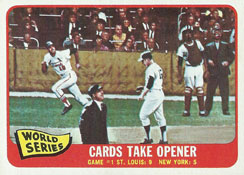
1964_game1Demoted to the minors in May 1964 and shunted by Cardinals consultant Branch Rickey, Shannon recovered and sparked St. Louis to a Game 1 victory over the Yankees in the World Series.

“Show you can hit”

After short stints with the 1962 and 1963 Cardinals, Shannon, 24, began the 1964 season as a reserve outfielder with St. Louis. He got three at-bats and struck out each time.

In early May, general manager Bing Devine informed Shannon he was being sent to Class AAA Jacksonville. According to the Associated Press, Shannon and Devine had this exchange:

Shannon: “What do you want of me?”

Devine: “We’d like to see you hit more. If you show us you can hit, we’ll bring you back.”

Shannon produced 80 hits in 70 games for a Jacksonville club managed by Harry Walker. Good to his word, Devine brought back Shannon to the Cardinals on July 7. Manager Johnny Keane gave him the chance to be the everyday right fielder.

In mid-August, with the Cardinals in fifth place and apparently out of contention, team owner Gussie Busch, acting on the advice of Rickey, fired Devine with six weeks left in the season.

Bob Broeg, longtime St. Louis sports journalist, uncovered an Aug. 10 memo written by Rickey that urged the Cardinals to dump Shannon, too.

“I would let Shannon go back to Jacksonville for the balance of the (1964) season.” Rickey wrote in the memo, which was published in The Sporting News. “I would even let Shannon go to the draft of Triple-A if major league waivers could be secured. I don’t believe we can win the pennant in 1965 with Shannon as a regular player on the Cardinals club, or (Carl) Warwick or (Charlie) James or (Bob) Uecker or (Jerry) Buchek.”

Shannon, however, remained with the 1964 Cardinals. Keane continued to play him and Shannon produced. He delivered nine home runs and 43 RBI after his promotion from Jacksonville, helping the Cardinals surge and win the National League pennant on the last day of the season.

Denting the scoreboard

In Game 1 of the World Series, Shannon started in right field and batted sixth, between left-handed batters Bill White and Tim McCarver. In his first World Series at-bat, Shannon singled off Whitey Ford and scored.

The Yankees led, 4-2, when Shannon batted with one on and one out in the sixth. A south wind was blowing about 15 mph toward left field. When Ford delivered a high slider, Shannon connected and sent a towering shot toward left. The ball cleared the wall and kept rising until it crashed between the letters “B” and “U” in the Budweiser sign atop the 75-foot scoreboard at Busch Stadium.

Witnesses estimated the home run traveled more than 450 feet and likely as far as 475 to 500 feet.

“That was about the longest ball I’ve ever seen hit out here,” Keane said.

In the book “Redbirds Revisited,” Shannon said, “In the World Series, in the first game, in my hometown, I hit a home run off Whitey Ford. I thought, ‘Good Lord, a guy can’t even dream this good.’ ”

The two-run home run, described by the Associated Press as a “Ruthian wallop,” tied the score at 4-4 and, according to The Sporting News, “seemed to ignite a spark among the Redbirds.” Video

The Cardinals scored twice more in the inning, taking a 6-4 lead, and won, 9-5. Shannon was 2-for-4 with three runs scored and two RBI. Boxscore

“If I picked the turning point of the game _ the one that got us the chance we needed and inspired the players _ it would have to be Shannon’s home run,” Keane said.

In his book “Whitey and Mickey,” Ford revealed that during the Cardinals’ four-run sixth, “My left hand went numb. It just went dead. No blood was getting down from the shoulder. The artery was blocked.”

Hit or miss

Shannon started in right field in all seven games of the 1964 World Series. He led the Cardinals in runs scored (six), but also struck out nine times, and batted .214 with no walks. Spanning two games, Shannon struck out in five consecutive at-bats: twice against Pete Mikkelsen in Game 5 and three times against Jim Bouton in Game 6.

He became the fifth player in World Series history to strike out in five consecutive at-bats. The others: Josh Devore, 1911 Giants; George Mogridge, 1924 Senators; George Pipgras, 1932 Yankees; and Mickey Mantle, 1953 Yankees.

Shannon was the first Cardinals batter to strike out nine times in a World Series since Jim Bottomley did so in 1930. Since then, Vince Coleman struck out 10 times with the Cardinals in the 1987 World Series.

For overcoming his doubters and contributing significantly to the Cardinals’ championship, Shannon was awarded a full World Series winners share: $8,622.19.

In a 1964 World Series Cardinals lineup of future Hall of Famer Lou Brock and standouts Ken Boyer, Curt Flood, Dick Groat, Bill White, the hitter who performed with the most sustained excellence was their 22-year-old catcher, Tim McCarver.

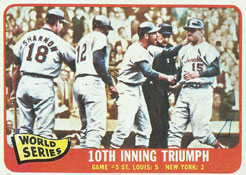
10th_inning_triumphDefeating the Yankees in seven games, the 1964 Cardinals received spectacular performances from pitcher Bob Gibson (two wins, 31 strikeouts in 27 innings), Boyer (two home runs, including a game-winning grand slam), Brock (nine hits, .300 batting average) and relievers Roger Craig and Ron Taylor (a combined 9.2 scoreless innings).

McCarver was every bit as good; perhaps the best of all. He hit a game-winning home run, stole home, led the Cardinals in hits (11) and walks (five) and fielded flawlessly (no errors in 63 innings) while helping a pitching staff navigate a Yankees lineup led by Mickey Mantle and Roger Maris.

Hot hitter

In hitting .478 with five RBI in the 1964 World Series, McCarver compiled a .552 on-base percentage.

The Cardinals have appeared in nine World Series since then and no St. Louis regular has had a higher on-base percentage than McCarver’s. (Among those who came close: Dane Iorg at .529 in 1982, Lance Berkman at .516 in 2011 and Brock, also at .516, in 1968.)

McCarver had the highest batting average by a Cardinal who played in every game of a World Series since Pepper Martin hit .500 in 1931, The Sporting News noted.

Gibson deservedly won the 1964 World Series Most Valuable Player Award, though a case could be made for McCarver, who was runner-up in the voting.

In Game 1, McCarver had a double and a triple against Whitey Ford, who was making his last World Series start in a Hall of Fame career. After his double in the sixth inning, McCarver scored the go-ahead run on a Carl Warwick single, breaking a 4-4 tie and sparking the Cardinals to a 9-5 victory at St. Louis. Boxscore

Swinging away

After the Cardinals and Yankees split the first four games, the score in Game 5 on Oct. 12, 1964, at Yankee Stadium was tied 2-2 after nine innings.

In the 10th, with White on third and Groat on first and one out, McCarver batted against reliever Pete Mikkelsen.

Cardinals manager Johnny Keane told The Sporting News he almost instructed McCarver to bunt.

“I considered a squeeze for Tim, but I was afraid of a pitchout,” Keane said.

With the count at 3-and-2, Mikkelsen threw a fastball and McCarver pulled it over the right-field fence for a three-run home run, lifting the Cardinals to a 5-2 victory. Boxscore and Video

“I was just trying to meet the ball, to get the guy (White) in from third base,” McCarver said. “I hit it good _ it was a waist-high fastball _ but at first I didn’t think it would be a homer. I didn’t think it would carry.

“I was dazed when I saw the ball go out. By the time I got to third, I was laughing out loud. I’m always laughing, even when I’m sad. The way I feel now, I’ll never be sad again.”

McCarver had singled in the two at-bats before hitting the home run. He also singled in his first two at-bats in Game 6, giving him five hits in a row. That was one short of the World Series record of six consecutive hits by Goose Goslin of the 1924 Senators.

Daredevil on base

In the fourth inning of Game 7, McCarver was on third and Mike Shannon on first with one out and the Cardinals ahead, 1-0. With Dal Maxvill at the plate and Mel Stottlemyre pitching, Shannon broke for second on a steal attempt.

Catcher Elston Howard threw to second, trying to nail Shannon, who eluded the tag of Bobby Richardson. McCarver dashed for home, beating Richardson’s return peg to Howard. McCarver had a steal of home. It would be his lone stolen base in 21 World Series games. Video

The Cardinals went on to a 7-5 victory and their first World Series title in 18 years. Boxscore

The next day, McCarver turned 23, celebrating his birthday as a World Series sensation.

(Updated May 2, 2023)

After managing the Cardinals, Whitey Herzog decided to extend his baseball career as an executive with the Angels.

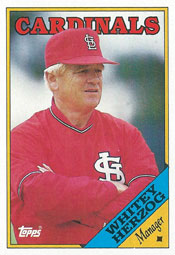
whitey_herzog4Herzog joined the Angels one year after his last season as Cardinals manager. He led the Cardinals to three National League pennants and one World Series title, quitting in midseason with the team mired in last place in July 1990.

Job confusion

In September 1991, Herzog was named senior vice president and director of player personnel of the Angels.

Herzog said he believed he was overseeing the entire Angels baseball operation.

Instead, he found himself in a power struggle.

Dan O’Brien was the Angels’ senior vice president for baseball operations when Herzog was hired.

Herzog thought O’Brien primarily would be his assistant, handling paperwork.

In his book “You’re Missin’ a Great Game,” Herzog said, “I made sure I worked out every detail in advance … I’d be in complete charge of baseball operations: the minor-league system, the hiring and firing of coaches and scouts, the ballclub’s trades and drafts.”

O’Brien thought Herzog primarily would be evaluating players, leaving O’Brien to direct most of the baseball operations, including approval of trades and free-agent signings.

Herzog won the battle _ O’Brien eventually was fired _ but lost the war, resigning before the Angels could become contenders.

Work from home

His friends, Angels owners Gene and Jackie Autry, hired Herzog with the goal of bringing the franchise its first American League pennant and World Series title.

Herzog was given an apartment in Anaheim, but kept his residence in the St. Louis area and did most of his work from that home. He didn’t have an office at the Angels ballpark.

“Whitey doesn’t want to be an office person and he doesn’t have to be,” Angels president Richard Brown told the Los Angeles Times. “My exact words to him were, ‘If I see you in Anaheim in the office, you’re not doing your job.’ He has to be on the road a lot. I’m going to be relying on him constantly to evaluate our young players, and I don’t want him reading scouting reports. I want him evaluating what he saw.”

O’Brien did have an office at the Angels ballpark.

In a March 1992 interview, six months after Herzog was hired, O’Brien told the Los Angeles Times, “You can’t do things in this business in 1992 as you did in 1990 because it’s in a constant state of change. Contracts, more than anything else, keep getting in the way. The talent is probably now one of the easier things to analyze.”

In 1992, Herzog’s first full season with the team, the Angels finished 72-90 and ranked last in the American League in hitting and runs scored.

The next year wasn’t much better. The 1993 Angels finished 71-91. Herzog and O’Brien remained at odds. Bob Nightengale of the Los Angeles Times described the working relationship of the two senior vice presidents as “deteriorated beyond repair.”

O’Brien ouster

In mid-September 1993, Brown convinced the Autrys to fire O’Brien. Bill Bavasi, the Angels’ farm director, was promoted to general manager, reporting to Herzog. Bavasi was to handle administrative duties. Herzog was given the title of vice president in charge of baseball operations and was allowed to continue to work primarily from his suburban St. Louis home.

Wrote Nightengale, “The Herzog-O’Brien conflict was set in motion by the Angels two years ago when they appointed Herzog as vice president in charge of player personnel. Herzog was told that he would be in charge of all baseball operations, but O’Brien carried the title of vice president in charge of baseball operations and never relented in his duties, creating the impression within baseball that no one was in charge.”

Said Angels manager Buck Rodgers: “It was doomed from Day 1 … They are two good baseball men, but it’s hard to succeed when you don’t have one guy in control. You have to have a No. 1 guy.”

(A year later, in a November 1994 interview with Nightengale, O’Brien said he was surprised by his firing. “The thing that I find funny is that people kept saying that Whitey and I never got along,” O’Brien said. “That wasn’t true. I mean, Whitey was never around. He did things his way and I did things my way. All I know is that I was there every day in the office.”)

In his book, Herzog said, “They never told (O’Brien) what my duties were until I’d arrived. He got protective of his job, cut me out of meetings and fought my authority for two years.”

Old-school dropout

With O’Brien gone, Herzog gave an ill-advised multi-year contract to pitcher Joe Magrane, the former Cardinal. (Magrane would have elbow surgery 12 days before spring training began.) Herzog also created a stir by exploring the possibility of acquiring another former Cardinal, outfielder Vince Coleman, who had flopped with the Mets. (It didn’t happen.)

Herzog’s old-school tactics backfired with some players or their agents. He also may have felt restricted by a reduced player payroll. In January 1994, four months after O’Brien was fired, Herzog resigned, stunning the Angels. Bavasi replaced him.

In a blistering column, Mike Penner of the Los Angeles Times opined, “Herzog was baseball’s first absentee general manager _ he ran a ballclub based in Anaheim from his den in St. Louis _ and the best thing he generally managed from there was his leisure time.”

Said Herzog: “I don’t really want to be traveling all over and going back and forth to California or anywhere else.”

Wrote Nightengale, “Herzog was told that the Angels’ budget would have to be slashed to about $19 million, and instead of acquiring players in the free-agent market, he couldn’t even secure his own. He alienated several of his players in negotiations with his brash, sometimes abusive, style. He screamed at starter Mark Langston in a closed-door session. He slammed the phone in reliever Steve Frey’s ear. He bullied agents.”

“He had a great deal of respect and recognition among his peers, but the reality now is that this is a different era, and he hasn’t crossed that bridge,” said Steve Comte, Frey’s agent.

Said Arn Tellem, Langston’s agent: “Whitey’s strengths were finding and evaluating players, but not in the art of diplomacy dealing with lawyers and agents.”

In his book, Herzog took credit for identifying Angels minor leaguers Garret Anderson, Tim Salmon, Jim Edmonds and Gary DiSarcina as prospects and for preparing them to advance to the majors.

Said Herzog, “When I finally handed the reins over to Billy Bavasi in ’94 _ I’d been grooming him to replace me _ he said, ‘Man, you’re leaving at the wrong time. You’re the guy who put this together and it’s ready to blossom.’ I knew it was, but I didn’t need any credit.”

In 1956, Cardinals rookie second baseman Don Blasingame sprayed singles to all fields, ignited the offense with stolen bases and was superb at bunting for base hits.

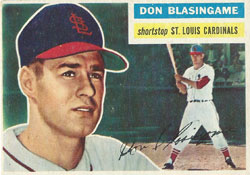
don_blasingameWith the bases empty, Blasingame bunted for 66 hits in 77 attempts _ an 86 percent success rate _ during his 12-year big-league career, according to research conducted by James Gentile of SB Nation.

Of Blasingame’s 1,366 big-league hits, 1,105 (81 percent) were singles. In five years (1955-59) with the Cardinals, Blasingame produced 663 hits, with 528 (80 percent) being singles.

Blasingame got an opportunity to become the starting second baseman for the Cardinals because of a trade involving a fan favorite. In June 1956, the Cardinals dealt second baseman Red Schoendienst to the Giants, opening the position for Blasingame.

Gashouse Gang connection

In five games for the 1955 Cardinals after his promotion from the minor leagues in late September, Blasingame gave an indication of his electrifying potential. He had six hits and six walks in 23 plate appearances (a .545 on-base percentage).

Cardinals manager Fred Hutchinson opened the 1956 season with Schoendienst at second base and Alex Grammas at shortstop, but after three games Blasingame replaced Grammas.

Journalist Bob Broeg noted Blasingame wore uniform No. 3, the same worn from 1932-37 by Frankie Frisch, the Cardinals’ fiery Gashouse Gang second baseman who was elected to the National Baseball Hall of Fame.

In The Sporting News, Broeg wrote, “Blasingame’s skill at winning fans and followers _ as well as his share of games _ is no accident. For one thing, he’s extremely fast, probably the fleetest man on a St. Louis club that has its greatest collective speed since the famed Swifties of 1942.”

Blasingame said his playing style was inspired by Hall of Famer Ty Cobb. “I never saw him, of course, but I’ve read a lot about him, the way he could put the pressure on the other club and keep it there,” Blasingame said.

Firebrand like Fox

Because of his throwing arm, the Cardinals projected Blasingame as a better fit for second base than for shortstop. One of the players general manager Frank Lane acquired from the Giants for Schoendienst was Alvin Dark. Blasingame replaced Schoendienst at second, with Dark taking over at shortstop.

According to The Sporting News, Lane saw Blasingame “as a firebrand,” much like Nellie Fox, all-star second baseman of the White Sox.

“It was evident he had a chance for future greatness if he could be placed at second,” Lane said of Blasingame.

Wrote Broeg, “Blasingame, taking advantage of his speed and his small stature, has developed into an able leadoff man, a spray hitter and able drag bunter.”

Nicknamed the “Corinth Comet” (he hailed from Corinth, Miss.) and the “Blazer,” Blasingame finished his rookie season with 153 hits in 150 games, with 72 walks and 94 runs scored.

In his four full seasons (1956-59) with the Cardinals, Blasingame ranked in the top 10 in the National League in singles each year. In 1959, Blasingame led the league in singles, with 144, seven ahead of the runner-up, Reds second baseman Johnny Temple.

Blasingame also ranked among the top 10 in the league in stolen bases for three consecutive Cardinals seasons (1957-59).

The Cardinals, however, were last in the league in home runs in 1958 and sixth among eight teams in 1959. Desperate for power, Cardinals general manager Bing Devine traded Blasingame to the Giants for shortstop Daryl Spencer and outfielder Leon Wagner in December 1959.