Feeds:
Posts
Comments

(Updated May 15, 2020)

Three factors combined to make the last home run of Joaquin Andujar’s career both special and unconventional: It was a grand slam, he called the shot and the Cardinals pitcher, a right-hander, hit it left-handed.

joaquin_andujar5On May 15, 1984, Andujar pitched a complete game and slugged the fifth and final home run of his big-league career in the Cardinals’ 9-1 victory over the Braves at St. Louis.

In the eighth inning, the Cardinals led, 5-1, and had Andy Van Slyke on third and Ozzie Smith on second with two outs and catcher Tom Nieto at bat. The Braves opted to walk Nieto intentionally, loading the bases.

As reliever Jeff Dedmon delivered the mandatory four pitches outside the strike zone to Nieto, Andujar, waiting at the on-deck circle, pointed to the right-field wall.

“I told (teammates) George (Hendrick) and Tito (Landrum) that I was going to hit a home run,” Andujar told The Sporting News.

Smith, watching from second base, confirmed to the St. Louis Post-Dispatch he saw Andujar call his shot. “He pointed while he was in the on-deck circle and said he was going to do it,” Smith said. “Can you believe that?”

Said Andujar to the Atlanta Constitution: “Everyone knows that I’m strong.”

Special formula

Leaving the on-deck circle, Andujar strode toward the plate and settled into the left side of the batter’s box.

His first four major-league home runs had been hit right-handed. Andujar hit three homers _ off Bill Lee of the Expos, Steve Rogers of the Expos and Rick Wise of the Padres _ with the Astros. The fourth was hit for the Cardinals, again off the Expos’ Rogers, on April 27, 1984, at Montreal.

A career .127 hitter in his 13 major-league seasons, Andujar used a personal formula to determine whether he would bat right-handed or left-handed. He usually opted for the left side when facing a right-hander (such as Dedmon) with runners in scoring position, according to St. Louis reporter Rick Hummel.

Watching from the dugout, Cardinals manager Whitey Herzog never knew what side of the batter’s box Andujar would choose. “What the hell do I know?” Herzog said to The Sporting News. “I’m only the manager.”

Sultan of Swat

With the bases loaded, “I knew they’d have to pitch to me,” Andujar told the Associated Press.

Andujar dug in and waited for a pitch in the strike zone.

Dedmon delivered.

“It was right down the middle,” said Braves manager Joe Torre.

Andujar uncoiled what the Atlanta Constitution described as “his left-handed going deep swing” and hit the ball to where he had pointed _ over the right-field wall _ for his lone grand slam and his only home run struck left-handed. Boxscore and Audio

“Every day, I hit five or six home runs in batting practice,” Andujar told The Sporting News. “I know I’m not a good hitter. I know I’m a lousy hitter. But … if I make contact, it’s gone.”

Previously: Cardinals pitchers enjoy grand slam streak

Tom Poholsky had a remarkable performance against the Dodgers on Aug. 3, 1956, at Ebbets Field in Brooklyn. The Cardinals pitcher gave up 14 hits, all singles, and managed to avoid getting a loss.

tom_poholskyThe latter was no small feat. Ebbets Field was a house of horrors for Poholsky. His career record against the Dodgers at Brooklyn: 0-11 with a 5.72 ERA. Ten of those losses were as a Cardinal, one as a Cub.

Poholsky, who pitched five years for the Cardinals and one for the Cubs, was 4-17 overall against the Dodgers. As a Cardinal, he was 4-15 versus the Dodgers.

In 1956, Poholsky, 26, a right-hander, was one of the Cardinals’ top starters. He ranked second on the staff in starts (29) and innings pitched (203).

6-run cushion

On Aug. 3, he appeared headed for a win at Brooklyn. The Cardinals led, 8-2, after five innings, but the Dodgers kept piling up singles against Poholsky. Jackie Robinson had three. Carl Furillo, Jim Gilliam, Gil Hodges and Duke Snider had two apiece. Sandy Amoros, Roy Campanella and Randy Jackson had one each.

Poholsky also unleashed two wild pitches, but he protected the lead, in part, because the Dodgers hit into three double plays against him.

When Poholsky was relieved by Larry Jackson, with one on and one out in the seventh, the Cardinals led, 8-4.

Jackson gave up a home run to the first batter he faced, Hodges, narrowing the margin to 8-6, and the Dodgers scored twice more in the eighth, tying the score at 8-8.

Poholsky’s line: 6.1 innings, 14 singles, 5 runs, 3 walks, 4 strikeouts, 2 wild pitches.

History repeats

The Cardinals prevailed because their third pitcher of the game, left-hander Jackie Collum, held the Dodgers scoreless for 4.1 innings in relief of Jackson. Collum yielded one hit, a single by Campanella.

In the 12th, facing Clem Labine, the Cardinals scored three runs, two on a single by their 41-year-old catcher, Walker Cooper, and won, 11-8. The Dodgers had 19 hits, 18 singles and the Hodges homer. Boxscore

Fifty-eight years later, May 9, 2014, the Mariners’ Brandon Maurer became the first pitcher since Poholsky to yield 14 hits in a game, with all being singles, ESPN.com reported. Unlike Poholsky, Maurer was the losing pitcher. The Royals beat the Mariners, 6-1, at Seattle.

Maurer’s line: 7.1 innings, 14 singles, 6 runs, 0 walks, 0 strikeouts. Boxscore

The Royals had 16 hits (including two off Tom Wilhelmsen), all singles.

Poholsky was 1-5 against the Dodgers in 1956. He pitched a complete-game three-hitter in a 4-1 Cardinals triumph over the Dodgers at St. Louis on May 5. Snider homered, Gilliam tripled and Amoros had the lone single.

Overall for the 1956 Cardinals, Poholsky was 9-14 with a 3.59 ERA. He was traded to the Cubs in December 1956 and was 1-7 (including two losses to the Cardinals) in his lone season with Chicago.

Previously: Duke Snider, Stan Musial put on big show

For George Hendrick, the combination of a nervous pitcher and a hanging changeup was a recipe for hitting heroics.

george_hendrickOn May 12, 1984, Hendrick, the Cardinals’ cleanup hitter, ruined a no-hit bid by the Reds’ Mario Soto, slugging a home run with two outs in the ninth inning.

Though the Reds recovered to win, 2-1, against closer Bruce Sutter, Hendrick’s home run after Soto got within a strike of a no-hitter got the headlines.

Soto, 27, a right-hander, was in his eighth season with the Reds when he faced the Cardinals on a Saturday afternoon at Cincinnati’s Riverfront Stadium. Primarily relying on a fastball, Soto struck out 10 Cardinals in the first six innings and 12 overall.

Backed by sparkling defensive plays from second baseman Ron Oester, who stopped an Ozzie Smith grounder in the seventh and swatted the ball to first baseman Dan Driessen, and from right fielder Dave Parker, who made a diving catch of Tommy Herr’s liner to the gap in right-center in the eighth, Soto held the Cardinals hitless.

Nervous ninth

With a 1-0 lead, Soto faced Ozzie Smith leading off the ninth. Most of the 24,355 in attendance rose and cheered wildly. Instead of inspiration, Soto felt fear.

“I was too nervous,” Soto told the Associated Press. “I just couldn’t stand it out there. I was nervous after I made the last out in the eighth. I’ve never felt that way before.”

Still, Soto had a promising start to the ninth. Ozzie Smith grounded out and Lonnie Smith popped out to second. That brought up Hendrick, who had entered the game with one home run and a .224 batting average.

Soto got two strikes on the right-handed batter. Hendrick then fouled off a couple of pitches, building the drama. Hoping to induce Hendrick to swing and miss, Soto threw his next two pitches high. Hendrick wasn’t tempted, though, and the pitches were called balls, evening the count at 2-and-2.

Looking to catch Hendrick off-guard, Soto delivered a changeup.

“As soon as I threw the pitch, I said, ‘That’s trouble.’ I hung the pitch,” Soto said.

Hendrick swung at the high, inside offering and walloped it over the left-field wall, tying the score at 1-1.

Nowhere to hide

Soto appeared stricken as Hendrick circled the bases.

“I almost died right there,” Soto said. “I don’t think anybody felt worse than I did. I wanted to leave. I almost walked out.”

Instead, he walked the next batter, Andy Van Slyke, before getting Ken Oberkfell on a fly out to center, ending the inning.

Cardinals manager Whitey Herzog sent in Sutter to pitch the bottom half of the ninth, even though it wasn’t a save situation. With one out, Dave Concepcion singled and swiped second. Brad Gulden, the Reds catcher who began the day with a .103 batting average, singled, scoring Concepcion, lifting the Reds to a 2-1 victory and salvaging the win for Soto. Boxscore

In his next start, Soto pitched a three-hitter and got the win against the Cubs, even though he yielded a two-run home run on a changeup to Jody Davis. “I’d say that three or four of the seven homers I’ve given up this season have come on the changeup, but that’s not going to stop me from throwing it,” Soto said to The Sporting News.

Soto, who three times led National League pitchers in most home runs given up in a season, finished 1984 with an 18-7 record while yielding 26 home runs, second-most in the league and one behind Bill Gullickson of the Expos.

In his last of seven seasons with the Cardinals. Hendrick finished 1984 with nine home runs and a .277 batting mark.

Previously: George Hendrick influenced hitting style of John Mabry

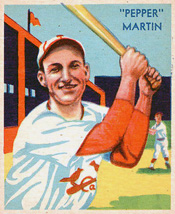
Given a chance at age 35 to return to the starting lineup, Pepper Martin played with a boldness that electrified the Cardinals and startled opponents.

pepper_martinOn May 8, 1939, Martin revived memories of his daring Gashouse Gang days by executing one of the most exciting plays in baseball. Martin made a straight steal of home for the run in the Cardinals’ 1-0 victory over the Dodgers at Brooklyn.

In sparking the Cardinals to World Series championships in 1931 and 1934 with fearless base running and relentless hitting, Martin symbolized the spirit of St. Louis’ Gashouse Gang.

As a center fielder, he hit .500 (12-for-24) and swiped five bases against the Athletics in the 1931 World Series. As a third baseman, he batted .355 (11-for-31) with two steals versus the Tigers in the 1934 World Series. Martin led the National League in stolen bases three times: 1933, 1934 and 1936.

Cardinals captain

By 1939, though relegated to being a role player under first-year manager Ray Blades, Martin also was paid an extra $500 to serve as Cardinals team captain. It was an honor he took seriously. Or, as The Sporting News reported, “it put a bee with a buzzer on Pepper.”

The 1939 Cardinals opened the season with an outfield of Enos Slaughter in right, Terry Moore in center and Joe Medwick in left. Slaughter, in his second big-league season in a career that would earn election to the National Baseball Hall of Fame, was batting .213 when, on May 5, Blades replaced him with Martin.

Wrote The Sporting News, “Pepper Martin was dusted off and installed in the outfield in place of Enos Slaughter.”

On May 8, the Cardinals matched Bob Weiland, 33, a left-hander, against the Dodgers’ Red Evans, 32, a right-hander who was back in the big leagues for the first time in three years.

Dust and glory

Scoreless in the sixth, Martin singled and advanced to second, then third, on a pair of infield outs.

Red Evans went into a long windup against the next batter, Terry Moore.

Martin, seeing his opportunity, broke for the plate.

Associated Press: “Evans stood open-mouthed, too surprised to make the throw to the plate until it was too late.”

New York Journal American: “Evans’ startled and belated throw was wide and Martin was over the plate in a cloud of dust and glory.”

The Sporting News: “Martin is the dynamic force that is … carrying the banner for the Cards as they fan the dying embers of what was the Gashouse Gang into a red glow.”

The steal was Martin’s first of the season. Boxscore

He played 88 games for the 1939 Cardinals, batting .306 with six stolen bases and instilling an aggressive attitude throughout the club.

Slaughter regained his starting job and hit .320, with a league-leading 52 doubles.

First baseman Johnny Mize led the league in batting average (.349) and home runs (28) and had 197 hits, with 44 doubles and 14 triples.

Joe Medwick produced 201 hits and 117 RBI.

The 1939 Cardinals led the league in hits (1,601), doubles (332), runs (779) and RBI (732). They were successful on 44 of 52 stolen base attempts. They finished with a 92-61 record and placed second, 4.5 games behind the Reds.

“Better ballplayers have come and gone in the big leagues than Pepper Martin,” wrote Bill Corum of the Journal American, “but never one who tried more desperately on every play.”


In 1979, Kirk Gibson rejected a chance to play for the St. Louis Cardinals.

kirk_gibsonThat’s because he was committed to playing baseball, not football.

On May 4, 1979, the St. Louis football Cardinals selected Gibson, a wide receiver at Michigan State, in the seventh round of the NFL draft.

A year earlier, June 1978, Gibson had been chosen by the Tigers in the first round of baseball’s amateur draft and signed a $200,000 contract with Detroit. The outfielder spent the summer of 1978 playing for the Tigers’ Class A Lakeland (Fla.) team managed by Jim Leyland before returning to Michigan State for his senior football season.

Gibson established school single-season records for receptions (42) and receiving yards (806) in 1978. He finished his Michigan State football career with four-year totals of 112 receptions, 2,347 yards receiving and 24 touchdown catches, all school records.

Gibson would have been “a certain first-round pick” in the 1979 NFL draft if he hadn’t already signed with the Tigers, United Press International reported. The Tigers assigned Gibson to start the 1979 baseball season with their Class AAA Evansville (Ind.) team, again managed by Leyland.

Calculated risk

Bing Devine, longtime general manager of the St. Louis baseball Cardinals, had become vice president for administration of the St. Louis football Cardinals just a week before the 1979 NFL draft. Cardinals football scouts approached Devine before selecting Gibson to find out how baseball teams viewed Gibson.

Devine offered a positive report. Gibson hadn’t played baseball at Michigan State until his junior year. He still was relatively inexperienced at the game and some thought Gibson might change his mind and return to football.

“It was a calculated risk,” Devine said to the Associated Press of the football Cardinals’ decision to draft Gibson. “At this level of the draft, everyone’s a calculated risk. With his amount of football talent, I guess the people over in the drafting office figured he was worth taking a chance on.

“Besides,” Devine continued, “in baseball, just as in football, there’s no such thing as a sure bet.”

Tigers general manager Jim Campbell told the Associated Press, “We’re not surprised that any major (football) team would want Kirk, but we are convinced that he will honor his contract with us.”

Said Gibson regarding the football Cardinals: “I imagine they will call me and I’ll probably say, ‘Hi,’ but I’m a baseball player … as of now.”

The Cardinals offered Gibson a financial deal similar to what he had with the Tigers. When reporter Jim Hawkins, a baseball correspondent for The Sporting News, visited Gibson at Evansville a month after the NFL draft, Gibson showed him four one-year contracts totaling $200,000 sent by the football Cardinals. The contracts, Hawkins reported, were for $35,000, $45,000, $55,000 and $65,000 for each of the next four NFL seasons.

“Right now, I’m not thinking about football at all,” Gibson said. “I made up my mind last year to play baseball and I don’t want to be second-guessing myself. I want to keep my mind on baseball.”

Baseball lifer

In his first game for Evansville, against an Iowa club managed by Tony La Russa, Gibson had a two-run home run, a RBI-double, two walks and a sacrifice bunt. Gibson went on to bat .245 with 42 RBI in 89 games for Evansville.

The Tigers promoted Gibson to the big leagues in September 1979 and he made his major-league debut on Sept. 8. Tigers manager Sparky Anderson sent the rookie to bat against Yankees closer Goose Gossage, who struck him out.

Gibson never was tempted again to try football. He built a 17-year big-league playing career, helping the Tigers (1984) and Dodgers (1988) to World Series championships with memorable home runs (off Gossage in 1984 and off Dennis Eckersley in 1988) and earning the 1988 National League Most Valuable Player Award. As manager of the Diamondbacks, Gibson won the 2011 NL Manager of the Year Award.

Even without Gibson, the football Cardinals had a spectacular draft in 1979. Their selections in the first through fourth rounds all became starters:

_ Halfback Ottis Anderson (7,999 yards rushing and 46 rushing touchdowns in eight years with St. Louis).

_ Fullback Theotis Brown (10 rushing touchdowns in three years with St. Louis).

_ Offensive guard Joe Bostic (122 games, 114 as a starter, in nine years with St. Louis).

_ Wide receiver Roy Green (522 receptions, 8,496 yards receiving and 66 touchdown catches in 12 years with the Cardinals in St. Louis and Arizona).


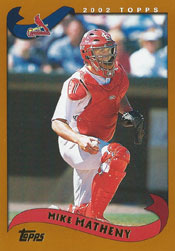
Cardinals catcher Mike Matheny made a play that his manager, Tony La Russa, called “the best I’ve ever seen to win a game.”

mike_matheny7On May 4, 2004, in the Cardinals’ first appearance at Philadelphia’s Citizens Bank Park, closer Jason Isringhausen recorded a save, but it should have been credited to his catcher.

In the bottom of the ninth, with the Cardinals ahead, 6-5, the Phillies loaded the bases with two outs against Isringhausen. Pat Burrell, who hit a home run off starter Chris Carpenter in the fifth inning, stepped to the plate.

Epic showdown

With the count 2-and-2, Burrell fouled off three consecutive 94 mph pitches from Isringhausen.

For the eighth pitch of the matchup, Matheny called for a cut fastball down and away. The catcher positioned himself accordingly.

Isringhausen delivered a pitch high and inside.

Burrell took a mighty rip. It appeared to some, including Isringhausen, that Burrell’s swing had resulted in a foul tip, because the ball sailed past Matheny and umpire Kerwin Danley and rocketed toward the brick backstop in front of the stands behind home plate.

“I thought it was a foul tip,” La Russa said to the Philadelphia Inquirer.

Matheny, who couldn’t shift in time to catch the pitch, knew Burrell had swung and missed for strike three. Burrell knew it, too, and he barreled toward first base.

Said La Russa: “I heard someone yell, ‘Chase it,’ and I started panicking.”

Matheny, his mind in overdrive, turned and pursued the ball, which, fortunately for the Cardinals, ricocheted off the backstop and toward the catcher.

“I knew there wasn’t a lot of time,” Matheny told the St. Louis Post-Dispatch. “There was a lot of stuff going through my mind.”

Retrieving the ball, Matheny whirled, quickly determined he had no chance to nail Marlon Byrd racing from third to home, and fired the ball to first baseman Albert Pujols.

“It’s all a blur,” Matheny said. “Fortunately, it took a good kick off that wall.”

Said La Russa: “(Matheny) had a long way to go. Where was his margin to throw the ball without hitting the runner?”

Gold Glove catcher

Matheny’s accurate missile beat Burrell by a half step for the third out and a 6-5 Cardinals victory.

“That’s one of the greatest plays I’ve ever seen to win a game,” La Russa said. “I’m sure if I thought about it overnight, I’d say it was the best play I’ve ever seen to win a game.”

Said Matheny: “If Burrell had beaten the throw, that would have been a nightmare. I wouldn’t have been able to sleep tonight.”

In an interview with the Bucks County Courier Times, Burrell added,  “I was way too overly aggressive in that at-bat. I ended up swinging at bad pitches.” Boxscore

Matheny won his third of four career Gold Glove awards in 2004. He also led National League catchers in fielding percentage at .999, committing one error in 977.2 innings caught.