Feeds:
Posts
Comments

Given a chance at age 35 to return to the starting lineup, Pepper Martin played with a boldness that electrified the Cardinals and startled opponents.
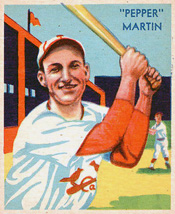
pepper_martinOn May 8, 1939, Martin revived memories of his daring Gashouse Gang days by executing one of the most exciting plays in baseball. Martin made a straight steal of home for the run in the Cardinals’ 1-0 victory over the Dodgers at Brooklyn.

In sparking the Cardinals to World Series championships in 1931 and 1934 with fearless base running and relentless hitting, Martin symbolized the spirit of St. Louis’ Gashouse Gang.

As a center fielder, he hit .500 (12-for-24) and swiped five bases against the Athletics in the 1931 World Series. As a third baseman, he batted .355 (11-for-31) with two steals versus the Tigers in the 1934 World Series. Martin led the National League in stolen bases three times: 1933, 1934 and 1936.

Cardinals captain

By 1939, though relegated to being a role player under first-year manager Ray Blades, Martin also was paid an extra $500 to serve as Cardinals team captain. It was an honor he took seriously. Or, as The Sporting News reported, “it put a bee with a buzzer on Pepper.”

The 1939 Cardinals opened the season with an outfield of Enos Slaughter in right, Terry Moore in center and Joe Medwick in left. Slaughter, in his second big-league season in a career that would earn election to the National Baseball Hall of Fame, was batting .213 when, on May 5, Blades replaced him with Martin.

Wrote The Sporting News, “Pepper Martin was dusted off and installed in the outfield in place of Enos Slaughter.”

On May 8, the Cardinals matched Bob Weiland, 33, a left-hander, against the Dodgers’ Red Evans, 32, a right-hander who was back in the big leagues for the first time in three years.

Dust and glory

Scoreless in the sixth, Martin singled and advanced to second, then third, on a pair of infield outs.

Red Evans went into a long windup against the next batter, Terry Moore.

Martin, seeing his opportunity, broke for the plate.

Associated Press: “Evans stood open-mouthed, too surprised to make the throw to the plate until it was too late.”

New York Journal American: “Evans’ startled and belated throw was wide and Martin was over the plate in a cloud of dust and glory.”

The Sporting News: “Martin is the dynamic force that is … carrying the banner for the Cards as they fan the dying embers of what was the Gashouse Gang into a red glow.”

The steal was Martin’s first of the season. Boxscore

He played 88 games for the 1939 Cardinals, batting .306 with six stolen bases and instilling an aggressive attitude throughout the club.

Slaughter regained his starting job and hit .320, with a league-leading 52 doubles.

First baseman Johnny Mize led the league in batting average (.349) and home runs (28) and had 197 hits, with 44 doubles and 14 triples.

Joe Medwick produced 201 hits and 117 RBI.

The 1939 Cardinals led the league in hits (1,601), doubles (332), runs (779) and RBI (732). They were successful on 44 of 52 stolen base attempts. They finished with a 92-61 record and placed second, 4.5 games behind the Reds.

“Better ballplayers have come and gone in the big leagues than Pepper Martin,” wrote Bill Corum of the Journal American, “but never one who tried more desperately on every play.”

 

In 1979, Kirk Gibson rejected a chance to play for the St. Louis Cardinals.

kirk_gibsonThat’s because he was committed to playing baseball, not football.

On May 4, 1979, the St. Louis football Cardinals selected Gibson, a wide receiver at Michigan State, in the seventh round of the NFL draft.

A year earlier, June 1978, Gibson had been chosen by the Tigers in the first round of baseball’s amateur draft and signed a $200,000 contract with Detroit. The outfielder spent the summer of 1978 playing for the Tigers’ Class A Lakeland (Fla.) team managed by Jim Leyland before returning to Michigan State for his senior football season.

Gibson established school single-season records for receptions (42) and receiving yards (806) in 1978. He finished his Michigan State football career with four-year totals of 112 receptions, 2,347 yards receiving and 24 touchdown catches, all school records.

Gibson would have been “a certain first-round pick” in the 1979 NFL draft if he hadn’t already signed with the Tigers, United Press International reported. The Tigers assigned Gibson to start the 1979 baseball season with their Class AAA Evansville (Ind.) team, again managed by Leyland.

Calculated risk

Bing Devine, longtime general manager of the St. Louis baseball Cardinals, had become vice president for administration of the St. Louis football Cardinals just a week before the 1979 NFL draft. Cardinals football scouts approached Devine before selecting Gibson to find out how baseball teams viewed Gibson.

Devine offered a positive report. Gibson hadn’t played baseball at Michigan State until his junior year. He still was relatively inexperienced at the game and some thought Gibson might change his mind and return to football.

“It was a calculated risk,” Devine said to the Associated Press of the football Cardinals’ decision to draft Gibson. “At this level of the draft, everyone’s a calculated risk. With his amount of football talent, I guess the people over in the drafting office figured he was worth taking a chance on.

“Besides,” Devine continued, “in baseball, just as in football, there’s no such thing as a sure bet.”

Tigers general manager Jim Campbell told the Associated Press, “We’re not surprised that any major (football) team would want Kirk, but we are convinced that he will honor his contract with us.”

Said Gibson regarding the football Cardinals: “I imagine they will call me and I’ll probably say, ‘Hi,’ but I’m a baseball player … as of now.”

The Cardinals offered Gibson a financial deal similar to what he had with the Tigers. When reporter Jim Hawkins, a baseball correspondent for The Sporting News, visited Gibson at Evansville a month after the NFL draft, Gibson showed him four one-year contracts totaling $200,000 sent by the football Cardinals. The contracts, Hawkins reported, were for $35,000, $45,000, $55,000 and $65,000 for each of the next four NFL seasons.

“Right now, I’m not thinking about football at all,” Gibson said. “I made up my mind last year to play baseball and I don’t want to be second-guessing myself. I want to keep my mind on baseball.”

Baseball lifer

In his first game for Evansville, against an Iowa club managed by Tony La Russa, Gibson had a two-run home run, a RBI-double, two walks and a sacrifice bunt. Gibson went on to bat .245 with 42 RBI in 89 games for Evansville.

The Tigers promoted Gibson to the big leagues in September 1979 and he made his major-league debut on Sept. 8. Tigers manager Sparky Anderson sent the rookie to bat against Yankees closer Goose Gossage, who struck him out.

Gibson never was tempted again to try football. He built a 17-year big-league playing career, helping the Tigers (1984) and Dodgers (1988) to World Series championships with memorable home runs (off Gossage in 1984 and off Dennis Eckersley in 1988) and earning the 1988 National League Most Valuable Player Award. As manager of the Diamondbacks, Gibson won the 2011 NL Manager of the Year Award.

Even without Gibson, the football Cardinals had a spectacular draft in 1979. Their selections in the first through fourth rounds all became starters:

_ Halfback Ottis Anderson (7,999 yards rushing and 46 rushing touchdowns in eight years with St. Louis).

_ Fullback Theotis Brown (10 rushing touchdowns in three years with St. Louis).

_ Offensive guard Joe Bostic (122 games, 114 as a starter, in nine years with St. Louis).

_ Wide receiver Roy Green (522 receptions, 8,496 yards receiving and 66 touchdown catches in 12 years with the Cardinals in St. Louis and Arizona).


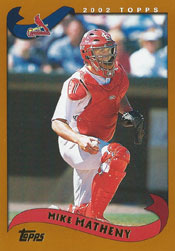
Cardinals catcher Mike Matheny made a play that his manager, Tony La Russa, called “the best I’ve ever seen to win a game.”

mike_matheny7On May 4, 2004, in the Cardinals’ first appearance at Philadelphia’s Citizens Bank Park, closer Jason Isringhausen recorded a save, but it should have been credited to his catcher.

In the bottom of the ninth, with the Cardinals ahead, 6-5, the Phillies loaded the bases with two outs against Isringhausen. Pat Burrell, who hit a home run off starter Chris Carpenter in the fifth inning, stepped to the plate.

Epic showdown

With the count 2-and-2, Burrell fouled off three consecutive 94 mph pitches from Isringhausen.

For the eighth pitch of the matchup, Matheny called for a cut fastball down and away. The catcher positioned himself accordingly.

Isringhausen delivered a pitch high and inside.

Burrell took a mighty rip. It appeared to some, including Isringhausen, that Burrell’s swing had resulted in a foul tip, because the ball sailed past Matheny and umpire Kerwin Danley and rocketed toward the brick backstop in front of the stands behind home plate.

“I thought it was a foul tip,” La Russa said to the Philadelphia Inquirer.

Matheny, who couldn’t shift in time to catch the pitch, knew Burrell had swung and missed for strike three. Burrell knew it, too, and he barreled toward first base.

Said La Russa: “I heard someone yell, ‘Chase it,’ and I started panicking.”

Matheny, his mind in overdrive, turned and pursued the ball, which, fortunately for the Cardinals, ricocheted off the backstop and toward the catcher.

“I knew there wasn’t a lot of time,” Matheny told the St. Louis Post-Dispatch. “There was a lot of stuff going through my mind.”

Retrieving the ball, Matheny whirled, quickly determined he had no chance to nail Marlon Byrd racing from third to home, and fired the ball to first baseman Albert Pujols.

“It’s all a blur,” Matheny said. “Fortunately, it took a good kick off that wall.”

Said La Russa: “(Matheny) had a long way to go. Where was his margin to throw the ball without hitting the runner?”

Gold Glove catcher

Matheny’s accurate missile beat Burrell by a half step for the third out and a 6-5 Cardinals victory.

“That’s one of the greatest plays I’ve ever seen to win a game,” La Russa said. “I’m sure if I thought about it overnight, I’d say it was the best play I’ve ever seen to win a game.”

Said Matheny: “If Burrell had beaten the throw, that would have been a nightmare. I wouldn’t have been able to sleep tonight.”

In an interview with the Bucks County Courier Times, Burrell added,  “I was way too overly aggressive in that at-bat. I ended up swinging at bad pitches.” Boxscore

Matheny won his third of four career Gold Glove awards in 2004. He also led National League catchers in fielding percentage at .999, committing one error in 977.2 innings caught.


Ever since Stan Musial became the first big-league player to hit five home runs in a doubleheader, only one other has matched the feat and no one has surpassed it.

musial_marisOn May 2, 1954, Musial hit three home runs in the Cardinals’ 10-6 victory in Game 1 and clubbed two more in Game 2, a 9-7 victory for the Giants at Busch Stadium in St. Louis.

Eighteen years later, on Aug. 1, 1972, Padres first baseman Nate Colbert, a St. Louis native who began his pro career in the Cardinals’ farm system, hit five home runs off five different pitchers in a doubleheader against the Braves at Atlanta.

Musial is the only left-handed batter to achieve the feat in the majors. Colbert is the only right-handed batter to do the same.

Although sluggers such as Roger Maris, Hank Aaron, Mark McGwire and Barry Bonds have broken single-season and career home run records in the years since Musial hit five home runs in a doubleheader, the record likely will continue to endure because of the degree of difficulty and because the number of doubleheaders played each season has decreased significantly.

For instance, in 2001, when he hit a single-season record 73 home runs for the Giants, Bonds didn’t play in both games of any doubleheader.

Move over, Babe

Maris came close to matching Musial’s feat.

In 1961, when he surpassed Babe Ruth by hitting 61 home runs for the Yankees, Maris played in both games of 23 doubleheaders. On July 25 that season, he hit four home runs in a doubleheader against the White Sox at Yankee Stadium. Maris hit two homers in Game 1 and two in Game 2. In his last at-bat of Game 2, with a chance to match Musial’s record, Maris grounded out to second base.

When Ruth hit 60 home runs for the 1927 Yankees, the most he had in a doubleheader were three against the Red Sox at Boston on Sept. 6. Ruth played in both games of a doubleheader 18 times that season. He also hit three home runs in a doubleheader, all in Game 1, on May 21, 1930, versus the Athletics at Philadelphia.

Jolting the Giants

In 1954, Musial hit more home runs (12) and had more RBI (27) versus the Giants than he did against any other team. He batted .338 against them that year.

Musial’s five home runs in the May 2, 1954, doubleheader came off three pitchers: left-hander Johnny Antonelli and right-handers Jim Hearn and Hoyt Wilhelm (who, like Musial, would be elected to the National Baseball Hall of Fame).

Musial hit well against all three throughout his career. Here’s a look:

_ vs. Antonelli, 11 home runs, .302 batting average.

_ vs. Hearn, 4 home runs, .326 batting average.

_ vs. Wilhelm, 4 home runs, .333 batting average.

5 for No. 6

In Game 1, Musial hit two home runs off Antonelli, with the bases empty in the third and one on in the fifth, and a three-run shot off Hearn in the eighth, breaking a 6-6 tie. Here is how The Sporting News described each:

_ Home run #1: “Swinging like a golfer with arms close to his body, Stan lifted a low pitch inside the strike zone onto the right field roof at Busch Stadium.”

_ Home run #2: Musial “socked a slow curve to the top of the 40-foot pavilion.”

_ Home run #3: Musial hit “a slider and the ball … reached the roof.”

It was the first time Musial hit three home runs in a big-league game. Boxscore

In Game 2, Musial hit both home runs off Wilhelm, with one on in the fifth and none on in the seventh. The Sporting News report:

_ Home run #4: Musial “hammered a slow curve clear out of the park onto Grand Boulevard.”

_ Home run #5: Musial “whacked a knuckler out on the streetcar tracks, this one farther toward right-center.”

In his book “Stan Musial: The Man’s Own Story,” Musial said of that fifth home run, “I’m especially proud that it was hit off a knuckleball. Not just any old knuckleball _ and they’re all pretty tough _ but a great knuckler’s, Wilhelm’s.”

Musial almost had a sixth home run that Sunday afternoon. In the third inning of Game 2, he “sent a tremendous drive to dead center, where it was caught by Willie Mays some 410 feet away and just 15 feet from the bleacher wall,” The Sporting News wrote.

In his book, Musial wrote of that long fly out, “The wind that day blew toward left field. If it had blown toward right, I believe I would have had two three-homer games the same afternoon.”

In his last at-bat of Game 2, facing right-hander Larry Jansen, a pitcher he hit .289 against in his career with four home runs, Musial admitted he was swinging for a home run. Instead, he popped out to first base. “It was high, inside _ a bad pitch,” Musial said to The Sporting News. Boxscore

Musial, batting third and playing right field in both games, was 4-for-4 with six RBI, three runs scored and a walk in the opener. He was 2-for-4 with three RBI, three runs scored and a walk in the second game.

Musial’s totals for the doubleheader: 6-for-8, five home runs, nine RBI, six runs scored, two walks.

“In the clubhouse afterward,” Musial said, “manager Eddie Stanky, who had been coaching third base, told reporters I not only had smiled, but actually had laughed as I trotted around the bases after that fifth homer. You know, I just couldn’t believe I’d hit five homers in one day _ and that no one else had.”

Previously: How Stan Musial got his fourth 5-hit game in one season

(Updated April 28, 2025)

In a 1954 series against the Cardinals, Hank Aaron hit his first and second home runs in the big leagues, solidifying his status with the Braves and launching him on a path toward breaking Babe Ruth’s most storied record.

musial_aaron

Aaron was 18 when he played his first season in the Braves’ system as a shortstop for Eau Claire (Wis.) in 1952. Braves scout Billy Southworth, the former Cardinals and Braves manager, filed a glowing account on the prospect. According to the book “Baseball’s Greatest Players,” Southworth wrote in his report, “For a baby-faced kid of 18, his playing ability is outstanding.”

Two years later, Aaron, 20, was on the Opening Day roster of the 1954 Braves. Six games into the season, the rookie outfielder was struggling, batting .217 with no home runs and no RBI.

As the Braves entered a three-game series against the Cardinals at St. Louis, speculation was Aaron might be benched whenever outfielder Bill Bruton recovered from a viral infection and returned to the lineup.

Aaron ended that talk with a strong series at St. Louis, hitting .500 (8-for-16) with a pair of home runs and three RBI. He went on to have a solid rookie season (.280 batting average, 27 doubles, 13 home runs and 69 RBI.).

Victim No. 1

In the opener of the Braves-Cardinals series on April 23, 1954, Aaron, batting sixth and playing right field, was 3-for-7 with two runs scored and two RBI in Milwaukee’s 7-5 victory in 14 innings.

In the sixth, with the Cardinals ahead, 4-2, Aaron hit the first of his 755 career home runs, a solo shot off starter Vic Raschi. A week earlier, Aaron got his first hit, a double, also against Raschi. In his autobiography, “I Had a Hammer,” Aaron said, “I was fortunate to be facing him near the end of his career.”

The Braves tied the score in the ninth and each team scored in the 13th.

In the 14th, with Cot Deal pitching for St. Louis, Andy Pafko singled with one out and Aaron also singled, moving Pafko to second. Joe Presko relieved and the first batter he faced, Johnny Logan, reached on an error by shortstop Solly Hemus, loading the bases. Jim Pendleton, batting for pitcher Dave Jolly, singled, scoring Pafko and Aaron. Boxscore

Two days later, on April 25, 1954, in the fifth inning against starter Stu Miller, Aaron hit his second career home run, tying the score at 1-1. Aaron was 5-for-6 in a game won by the Cardinals, 7-6, in 12 innings. Cardinals right fielder Stan Musial was 4-for-6 with a home run. Boxscore

Powerful wrists

Aaron and Musial eventually developed a mutual admiration.

In his book “Stan Musial: The Man’s Own Story,” Musial said Aaron was “one of the best hitters I ever saw … He has tremendous wrist action.”

In choosing his all-time National League outfield, Musial put Aaron in right, Willie Mays in center and Duke Snider in left. The one weakness Musial noticed in Aaron was “the slider bothered him enough to cause him to lose patience and often swing more wildly than he probably intended.”

Aaron said in his autobiography, “Stan Musial was one of my favorite ballplayers because he treated everybody the same _ black or white, superstar or scrub _ and he genuinely loved the game … When he and I were part of a group of players who toured Vietnam, Musial became the first white man I ever roomed with.

“We had been good friends for quite a while,” Aaron said. “Whenever the Braves played the Cardinals, he and I would always manage to meet up at the batting cage and talk about hitting … Basically, his method was to study the pitchers and swing the bat, and that was the way I felt about it … I concentrated on the pitcher. I didn’t stay up nights worrying about my weight distribution, or the location of my hands, or the turn of my hips.”

Big hits

On Sept. 23, 1957, at Milwaukee, Aaron hit a walkoff home run against the Cardinals’ Billy Muffett in the 11th inning, clinching the National League pennant for the Braves.

“I came up with Johnny Logan on first, looking for a pitch I could drive hard enough to bring Logan around,” Aaron said in his autobiography. “I got the breaking ball I was waiting for.” Boxscore

Aaron hit 91 career home runs against the Cardinals. Only the Reds (97) and Dodgers (95) yielded more home runs to him.

The Cardinals pitcher who gave up the most home runs to Aaron was a fellow Hall of Famer, Bob Gibson. Aaron hit eight home runs against Gibson, but batted .215 (35-for-163) versus the Cardinals ace. Aaron had more strikeouts (32) than RBI (26) versus Gibson.

In an interview with Joe Schuster for the 2018 Cardinals Yearbook, Aaron said, “Facing Bob Gibson was kind of like going to the dentist to get a tooth pulled. You know the doctor will give you a shot of Novocaine _ but it ain’t going to be enough. So you just hope it doesn’t hurt too much.”

Aaron’s first home run off Gibson on July 3, 1962, was No. 272 of his career Boxscore and his last home run off Gibson on June 14, 1974, was No. 724. Boxscore

In the book “Sixty Feet, Six Inches,” Gibson said of Aaron, “The man did not miss a fastball … The worst pitch in baseball is the changeup slider, but I’d throw Aaron that changeup slider and he’d be out on that front foot and hit rockets, two hops to the shortstop. All of our shortstops took balls in the chest off the bat of Aaron. They’d go, ‘Damn, Gibby.’ I’d say, ‘Hey, this is the way I get him out. He’s going to knock you over, so be ready for it.’ “

(Updated Sept. 10, 2025)

When 17-year-old Tim McCarver made his big-league debut with the Cardinals in September 1959, the catcher he hoped to replace someday was an all-star with a powerful arm and a reputation for handling a pitching staff well.

hal_r_smithHal Smith was regarded as one of the best catchers in the National League when he played for the Cardinals.

In the 2003 book “Few and Chosen,” McCarver said, “Behind the plate, Hal was as good as they come. He could catch. He could really catch, with soft, pliable hands, and he could throw lasers. He was a lot like Jerry Grote of the Mets, who was the best defensive catcher I ever saw. Hal Smith was on a par with Grote, and the pitchers loved to pitch to him … All pitchers loved Hal Smith.”

In the 1950s and 1960s, there were two players named Hal Smith in the major leagues and both were catchers.

Harold Wayne Smith, known as Hal, played for the Orioles, Athletics, Pirates, Colt .45s and Reds from 1955-64 and hit a three-run home run for Pittsburgh against the Yankees in the eighth inning of Game 7 of the 1960 World Series.

Harold Raymond Smith, also known as Hal, played for the Cardinals from 1956-61 and briefly for the Pirates in 1965.

In the book “We Played the Game,” Cardinals pitcher Tom Cheney said, “I liked when Hal Smith caught me. He was one of the best catchers in baseball. We were in synch … Vets like Smith really knew the hitters and you could depend on them.”

Taught by the best

After six seasons (1949-55) in the Cardinals’ minor-league system, including two at Omaha under manager George Kissell, Smith debuted with St. Louis in 1956. He established himself as an all-star in his second season, 1957, by hitting .279, ranking fourth in assists among National League catchers and committing just five errors in 795 innings. (Smith did lead the league in passed balls, primarily because the Cardinals had knuckleball specialist Hoyt Wilhelm.)

On May 8, 1957, Smith was 3-for-5 with six RBI, including a two-run home run, in the Cardinals’ 13-4 victory over the Giants at New York. Boxscore

However, Smith fell into disfavor with Cardinals manager Fred Hutchinson in 1958 for being overweight and having a sore arm, The Sporting News reported.

When Solly Hemus replaced Hutchinson for the 1959 season, he had Smith and Gene Green compete in spring training for the starting job. Smith won the role and earned the respect of his manager.

“You just can’t give enough credit to Hal Smith for the pitching improvement (of the Cardinals),” Hemus told The Sporting News in April 1959. “He takes charge out there and quickly gains the confidence of his pitchers.

“Defensively, I’ll rate Smitty right up with Del Crandall of Milwaukee. With that strong, accurate arm of his, Smitty isn’t going to let many runners steal on him this season. He can hit .220 or .230 and be my regular catcher.”

Smith hit .270 with 13 home runs and 50 RBI for the 1959 Cardinals and earned all-star status.

Slugging for Sharon

On May 9, 1959, Smith hit two home runs _ a three-run shot off Glen Hobbie and a two-run shot off Joe Schaffernoth _ in the Cardinals’ 11-1 victory over the Cubs at St. Louis. Boxscore

According to The Sporting News, Smith hadn’t been expected to start the game because he and his wife earlier rushed daughter Sharon to DePaul Hospital.

It was feared Sharon had a kidney ailment that would require surgery. When it was discovered the girl had a minor kidney infection and no surgery was required, Smith told Hemus he was ready to play and Hemus inserted Smith into the lineup. Relieved to learn of his daughter’s improved health, Smith responded with the only two-homer game of his big-league career.

Smith led National League catchers in highest percentage of runners caught attempting to steal in both 1959 and 1960. He threw out 32 of 76 attempted base stealers (42 percent) in 1959 and 34 of 66 (52 percent) in 1960.

A heart condition shortened Smith’s playing career with St. Louis. In 1962, Smith became a coach on the staff of Cardinals manager Johnny Keane. The next year, McCarver, 21, replaced Gene Oliver as the Cardinals’ catcher and helped them to three pennants and two World Series championships.

Cardinals connections helped Smith continue his coaching career. He coached for the 1965-67 Pirates staff of manager Harry Walker, who was a former Cardinals player and coach.

In 1968 and 1969, Smith coached on the staff of Reds manager Dave Bristol. The Reds were run by former Cardinals general manager Bob Howsam. Smith mentored Reds catcher Johnny Bench. In the Baseball Hall of Fame magazine “Memories and Dreams,” Bench said, “Hal always had the gentlest manner, even with the younger players. He told me, ‘I don’t have to work with you a lot, kid.’ I can never say enough about Hal.”

Smith returned to the Cardinals as a scout, coached on the 1976-77 Brewers staff of manager Alex Grammas, his former Cardinals teammate, and went back to the Cardinals to scout again.
