Feeds:
Posts
Comments

(Updated Dec. 10, 2023)

The Cardinals acquired Adam Wainwright from the Braves in the belief he would develop into an ace for them.

On Dec. 13, 2003, the Cardinals traded outfielder J.D. Drew and catcher Eli Marrero to the Braves for pitchers Jason Marquis, Ray King and Wainwright.

Describing Wainwright as the key player of the trade for the Cardinals, St. Louis general manager Walt Jocketty told the Atlanta Journal-Constitution, “Without him, there wasn’t a deal.”

At the time, Wainwright, 22, was a prospect who posted a 10-8 record and 3.37 ERA for Class AA Greenville (S.C.) in 2003.

“Adam is our No. 1 pitching prospect,” Braves general manager John Schuerholz told the Associated Press.

Said Jocketty to the St. Louis Post-Dispatch: “We see him as a top-of-the-rotation kind of guy in a couple of years.”

Baseball America magazine said Wainwright had “an ideal combination of size, talent and makeup. He started working off his 92 mph to 93 mph fastball more often at midseason and the positive results were immediate. He also throws a hard curveball and a solid changeup … He has a great work ethic and is one of the most intelligent pitching prospects … He needs to continue to gain confidence … He tends to be too fine with his pitches instead of challenging hitters.”

Slick move

Some thought the Cardinals had given up too much in dealing Drew, 28. In six years with St. Louis, he hit .282 and had a .377 on-base percentage, but he also was injury-prone and eligible for free agency after the 2004 season.

In retrospect, Jocketty took advantage of the Braves, who were desperate to replace the run production supplied by departed free agents Gary Sheffield in right field and Javy Lopez at catcher.

“That was tough to do,” Schuerholz said of including Wainwright in the deal, “but, under the circumstances, we had no choice.”

(Drew and Marrero each would play one season for the Braves. Drew departed through free agency for the Dodgers. Marrero was dealt to the Royals.)

The Cardinals were in the market for pitching and the Braves offered a bonanza.

“We felt that without pitching we weren’t going to have a chance to improve in the standings next year,” Cardinals manager Tony La Russa told the Associated Press.

Said Jocketty: “There were a couple deals we could have done. We just felt this was the best overall for us.”

Post-Dispatch columnist Bernie Miklasz endorsed the deal, though he was concerned whether La Russa and pitching coach Dave Duncan were best-suited to develop a young arm. “Wainwright is a legitimately bright prospect and a potential steal for the Cardinals,” Miklasz wrote, “but if Duncan and La Russa are around beyond the 2004 season, it may not matter because they can’t develop young pitchers. Perhaps Wainwright will be nurtured and saved by the next regime.”

Good results

The trade helped the Cardinals improve from 85 wins and a third-place finish in 2003 to 105 wins and a first-place finish in 2004. With Marquis contributing 15 wins as a starter and King appearing in 86 games as a left-handed relief specialist, St. Louis won the pennant in 2004 for the first time in 17 years.

Marquis posted 13 or more wins in each of his three seasons with St. Louis, helping the Cardinals to the postseason each time.

King pitched in 163 games in two seasons for St. Louis.

At Class AAA Memphis in 2004, Wainwright was 4-4 with a 5.37 ERA when elbow discomfort caused him to discontinue throwing in June.

He was 10-10 with a 4.40 ERA in 29 starts for Memphis in 2005, though he led the Pacific Coast League in innings pitched (182) and was second in strikeouts (147).

Wainwright was eased into his first big-league season in 2006 by La Russa and Duncan. Used exclusively in relief, Wainwright led all St. Louis relievers in holds (23) and strikeouts (72). In the postseason, he was 1-0 with four saves and 15 strikeouts in 9.2 scoreless innings.

Wainwright spent his entire big-league career with the Cardinals and produced a record of 200-128. He ranks second on the franchise list in strikeouts (2,202) and starts (411) and is third in wins.
(Updated Oct. 23, 2020)

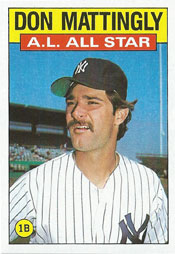
If general manager Dal Maxvill had been willing to part with pitcher Joe Magrane, Don Mattingly might have been a first baseman for the Cardinals instead of spending his entire playing career with the Yankees.

don_mattinglyIn 1988, Mattingly was feuding publicly with Yankees owner George Steinbrenner. That fueled media speculation the Yankees were willing to trade Mattingly, who expressed interest in the Cardinals because of the proximity of St. Louis to his hometown of Evansville, Ind.

“Growing up in Evansville, I was a fan of the St. Louis Cardinals,” Mattingly told the New York Daily News.

The Cardinals admitted interest in pursuing a deal. Media reports suggested the Yankees would want shortstop Ozzie Smith or center fielder Willie McGee in return, but the player New York apparently wanted most was Magrane, who at the time was St. Louis’ prized pitching phenom.

No respect

In August 1988, Mattingly, 27, was a five-time all-star who had earned an American League Most Valuable Player Award, one batting title and three Gold Glove awards, but he became disgruntled with the way he believed Steinbrenner was treating Yankees players.

“The players get no respect around here,” Mattingly said to the Associated Press. “They (management) give you money, that’s it. Not respect. Money is not respect.”

Reports spread quickly that an angry Steinbrenner intended to trade Mattingly. The Cardinals, who had just acquired first baseman Pedro Guerrero from the Dodgers, were willing to move Guerrero to left field and open the job at first base for Mattingly.

“I see where Mattingly wants to go to St. Louis,” Cardinals manager Whitey Herzog said to the St. Louis Post-Dispatch. “That takes care of us. Steinbrenner sure wouldn’t trade him where he wants to go. You know what I mean? He’d say, ‘I’ll show him. I’ll trade him to Seattle.’ ”

Still, baseball writers produced a stream of reports that speculated on a deal between the Yankees and Cardinals.

On Sept. 4, 1988, Rick Hummel of the Post-Dispatch wrote, “The Cardinals have some players in which the Yankees would seem interested. Certainly the Yankees would want a starting pitcher. Joe Magrane probably is unavailable. But Greg Mathews, if he shows he has recovered from elbow surgery, might be.”

Hummel suggested several possible packages to land Mattingly, including Mathews, McGee and catcher Tony Pena, or Mathews and Ozzie Smith.

About a month later, under the Post-Dispatch headline, “Maxvill Says He’ll Pursue Mattingly,” the general manager told Hummel, “I definitely want to talk to them.”

Wizard a Yankee?

Two days later, in a column that rocked Cardinals Nation, Tom Wheatley of the Post-Dispatch opined, “Ozzie Smith must go. And if the Wizard of Oz can be used as bait to land a whopper such as Don Mattingly, all the better.”

Maxvill said he made more inquiries about acquiring Mattingly, but he told Hummel, ‘I don’t think they’re interested in moving him as much as everybody thinks. That’s what I thought before and it’s been reinforced to me.”

Just when it appeared the possibility of a trade had waned, Murray Chass of the New York Times, citing an anonymous American League club executive, reported the Cardinals, Cubs, Padres or Giants were close to making a deal for Mattingly.

Wrote Chass: “If the Cardinals, for example, were really serious about the pursuit of Mattingly, they would have to offer the Yankees Joe Magrane … The Cardinals, however, will not offer Magrane; therefore, no deal.”

Magrane, 24, was the National League earned-run average leader (2.18) in 1988, his second season with St. Louis.

In December 1988, the Post-Dispatch reported why a deal for Mattingly appeared dead: “Maxvill said the New York Yankees never had asked seriously about acquiring (Ozzie) Smith in a Don Mattingly deal. Pitcher Joe Magrane’s name, on the other hand, did come up in discussions with the Yankees. But Maxvill said the Cardinals would be highly reluctant to part with him.”

Magrane achieved a career-high 18 wins for the 1989 Cardinals. Mattingly stayed with the Yankees and completed his 14-season big-league career with them in 1995. He finished with a .307 career batting mark and 2,153 hits.

(Updated April 30, 2020)

Stan Musial had such respect for the arm of Andy Pafko he included the National League veteran as part of the best-throwing outfield he’d ever seen.

andy_pafkoBecause he didn’t use that arm, Pafko committed a blunder that literally handed the Cardinals a comeback victory against the Cubs.

Wild ninth

Pafko was in center field for a Saturday afternoon game, April 30, 1949, against the Cardinals at Chicago’s Wrigley Field.

Behind the pitching of starter Bob Rush, who threw what the St. Louis Post-Dispatch described as a “crackling fastball and corner-cutting curve,” the Cubs entered the ninth inning with a 3-1 lead.

With Enos Slaughter on second base and two outs, Rush was on the verge of a victory until Eddie Kazak hit a pitch off his fists and looped a single to short left, scoring Slaughter and narrowing the Cubs’ lead to 3-2. Chuck Diering ran for Kazak and Rocky Nelson, a rookie first baseman, stepped to the plate for St. Louis.

With Pafko shaded toward right for the left-handed batter, Nelson lined the ball to left-center.

“Even though the ball was slicing away from him in a deep part of the park, his quick start and fleet legs enabled him to gain on the drive,” the Post-Dispatch reported. “Pafko lunged to his right, his gloved hand thrust outward in a bid for a backhanded catch.”

Pafko skidded across the grass before he “flung up his hand, clutching the ball, in a gesture of triumph,” the Post-Dispatch noted.

Umpire Al Barlick ruled Pafko trapped the ball, signaling with his hands extended and palms down in a safe call.

Diering and Nelson raced around the basepaths.

Great debate

According to The Sporting News, “Instead of throwing in the ball with his superb arm, Pafko, the ball still lodged in the webbing of his glove, came running in to second base to join the swarm of Cubs who were rushing toward Barlick.”

As Pafko held the ball, Diering scored the tying run and Nelson was waved toward the plate by third-base coach Tony Kauffman.

Pafko, unwilling to believe the no-catch ruling, waited too long before throwing the ball to the plate. The ball hit Nelson in the left shoulder as he was crossing the plate with the winning run.

Cubs fans protested by throwing objects, including cushions, fruit and vegetables, onto the field.

The stunned Cubs were retired in order by closer Ted Wilks in the bottom of the ninth and the Cardinals won, 4-3. Boxscore

The Sporting News summed up the game as probably the first in the history of big-league baseball “decided by what they describe not as an inside-the-park homer but as an in-the-glove homer.”

Two years later, June 1951, Pafko was dealt to the Dodgers, giving Brooklyn an outfield of Pafko in left, Duke Snider in center and Carl Furillo in right.

In his book “Stan Musial: The Man’s Own Story,” Musial said with Pafko, Snider and Furillo “the Dodgers had the best-throwing outfield I ever saw.”

“Andy was a strong hitter, a strong-armed fielder and good defensively,” Musial said. “He was steady, gave you a good day’s work.”

Playing for the Cubs, Dodgers and Braves from 1943-59, Pafko batted .285 with 213 home runs and 1,796 hits. In 258 games against the Cardinals, Pafko hit .273 with 22 homers and 120 RBI.

(Updated Oct. 7, 2018)

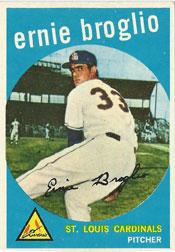
Ernie Broglio was a key player in two Cardinals trades _ the famous one involving Lou Brock and the largely forgotten one that led to him becoming a prominent part of the St. Louis rotation.

ernie_broglio3On Oct. 7, 1958, the Cardinals acquired Broglio and Marv Grissom from the Giants for Billy Muffett, Hobie Landrith and Benny Valenzuela.

The top names in the deal were relief pitchers Grissom and Muffett. Landrith was a backup catcher, Valenzuela a utility infielder and Broglio a minor-league pitcher.

Referring to managers Solly Hemus of the Cardinals and Bill Rigney of the Giants, columnist Dan Daniel of The Sporting News wrote, “Hemus wanted Grissom and Bill Rigney wanted Muffett, and the rest of it looks like parsley on the boiled potato.”

The St. Louis Post-Dispatch described the trade as “a can of salmon for a can of salmon.”

Regarding Ernest Broglio, he was “not to be confused either with movie Academy Award winner Ernest Borgnine or a plain old imbroglio,” the Post-Dispatch reported.

“Broglio must be suspect because he didn’t make it with the Giants last spring and no club needs pitching more than San Francisco,” the Post-Dispatch concluded.

Dixie delighted

Dixie Walker, who managed Broglio at Class AAA Toronto in 1958, was on good terms with the Cardinals. His brother, Harry Walker, was a Cardinals coach and Dixie worked with Cardinals general manager Bing Devine at Rochester in 1955.

It was on Walker’s advice that Devine pursued Broglio.

In the Giants’ organization since 1956, Broglio had opened the 1958 season with their Class AAA club at Phoenix and posted an 8-1 record. The Giants, though, were seeking a veteran pitcher and they made a deal with Toronto in July 1958 for former big-leaguer Don Johnson. The Giants sent Broglio, along with outfielder Jim King and pitcher Ray Crone, to Toronto.

Broglio, 23, apparently was loaned to Toronto, which wasn’t affiliated with any big-league club.

“Nobody said anything to me at Phoenix except when I was being shipped out,” Broglio said. “I was told I’d be back.”

Toronto throwback

Broglio was an immediate success with Toronto. In his first start for Dixie Walker, Broglio struck out a franchise-record 15 against Buffalo in 11.1 innings. Three days later, Broglio pitched a three-hitter against Montreal.

On Aug. 6, Broglio pitched a two-hit shutout against Havana. The next day, he pitched seven innings in relief.

“A throwback to pitchers of another era _ that is the reputation of Ernie Broglio, workhorse of the Toronto Maple Leafs’ mound corps, who appears to thrive on only two days rest,” Th Sporting News reported.

Broglio was 9-3 for Toronto in the regular season and 2-0 in the International League playoffs. For Phoenix and Toronto combined, Broglio had a 17-4 regular-season record.

Made in Japan

Two weeks after he was traded to St. Louis, Broglio was invited to join the Cardinals on their tour of Japan. The Cardinals were scheduled to play 16 games against Japanese teams in October and November. Broglio took full advantage of the chance to impress his new club.

Described by The Sporting News as “the big surprise,” Broglio was the Cardinals’ biggest winner on the tour, posting a 4-0 record and 1.55 ERA and striking out 30 in 28 innings.

Based on that showing, Hemus tabbed Broglio as the staff’s No. 4 starter entering spring training in 1959.

“I know that wasn’t big-league opposition,” Hemus said, “but he showed me enough to warrant this chance.”

Broglio further impressed the Cardinals by reporting to spring training three pounds under his assigned weight of 195.

“Wildness has been the bane of his six-year career (in the minors),” The Sporting News reported. “If pitching coach Howard Pollet can help Broglio with his control, the Cardinals might have their best rookie pitcher since Johnny Beazley in 1942.”

Broglio earned a spot in the 1959 Cardinals’ rotation and finished the season tied with Larry Jackson for the club lead in shutouts (three). Broglio also ranked second in strikeouts (133) and third in innings pitched (181.1) for the Cardinals.

After losing his first five decisions, Broglio completed the 1959 season at 7-12 with a 4.72 ERA. He was 7-9 in 25 starts and 0-3 in 10 relief appearances.

In six years (1959-64) with St. Louis, Broglio was 70-55, including seasons of 21 wins in 1960 and 18 wins in 1963.

When the Cardinals sent Broglio to the Cubs on June 15, 1964, in a deal involving Brock and others, most thought the transaction favored Chicago, but Broglio hurt his arm and went 7-19 with a 5.40 ERA in three years with the Cubs. Brock became a Hall of Fame player who broke stolen base records, achieved 3,000 hits and ignited the Cardinals to three pennants and two World Series titles.

Previously: Ernie Broglio built great home mark the hard way

Facing the Bronx Bombers, the 1943 Cardinals got buzzed by the real deal.

During Game 1 of the 1943 World Series between the Cardinals and Yankees at Yankee Stadium, a B-17 Flying Fortress bomber startled players and spectators by passing so low across the ballpark it nearly scraped the top of the flagpoles.

jack_watsonThree months later, the pilot, Lt. Jack W. Watson of the U.S. Army Air Force, made a brave landing of a burning B-17 at an airfield in England.

On Oct. 5, 1943, the Yankees were on their way to a 4-2 victory over the Cardinals when, in the eighth inning, four B-17s suddenly rumbled above the stadium packed with 68,676 fans.

Imagine the sight: The B-17 was a massive Flying Fortress that “bristled with armament,” according to Boeing. It was 74 feet long with a span of 103 feet. Powered by four engines, the B-17 carried about a dozen machine guns and was capable of holding up to 9,000 pounds of bombs.

Surprising stunt

Watson and his crew, along with three other crews, had left a training session in Florida and were flying their bombers to Maine for a stopover before heading to England.

When they reached the New York area and realized the World Series game was still going on that Tuesday afternoon, the crews, led by Watson, decided to buzz Yankee Stadium as a stunt, according to a Web site dedicated to the 303rd bomb group.

All four planes flew in formation over the ballpark, entering above home plate and roaring toward the outfield. Many initially thought it was an authorized show of military might and American pride by the Army Air Force.

But after the four planes rose and flew off, the B-17 piloted by Watson returned for an encore. It made a second pass, and then came back for a third that was alarmingly low, according to the book “Cardinals Journal.” The B-17 “was no more than 200 feet off the ground and hedge-hopped over the roof, narrowly missing the flagpoles.”

An Associated Press report also noted the plane “barely skimmed the flagpoles.”

“The roar of the plane drowned out the nationwide radio broadcast and stopped play as the players stood and watched the aircraft,” wrote John Snyder in “Cardinals Journal.”

Mad mayor

New York Mayor Fiorello La Guardia, who was at the game, told the Associated Press the Flying Fortress “flew right down over the stands” three times.

“If anything had happened, a thousand people would have been killed,” an angry La Guardia said.

The mayor demanded the Army Air Force investigate. “That pilot should be properly disciplined, endangering the lives of the citizenry of New York in that manner,” La Guardia said to The Sporting News.

Upon arriving in Maine, the four pilots were reprimanded and fined $75 apiece for the stunt. But, because the military needed pilots for combat, none were grounded, according to the 303rd bomb group Web site.

A couple of days later, Watson and his crew flew to England to begin bombing missions against the Nazis in Europe.

Described by United Press as a “freckled-face kid pilot,” Watson, of Indianapolis, was 21 years old.

Deadly mission

On Jan. 11, 1944, Watson and his crew, in a Flying Fortress dubbed “Meat Hound,” were part of a massive American-led air bombardment of central Germany. Watson and his crew were assigned to bomb a target in Oschersleben.

Just before he reached his target, the No. 3 engine failed on the B-17, Watson told the Associated Press. “But I stayed in formation,” he said.

Flying on three engines, Watson and his crew dropped the bombs, turned and started to head back to their base in England.

The Nazis, though, unleashed relentless waves of fighter planes to attack the bombers. Watson and his crew were over Holland when they encountered several fighter planes.

Shortly after the tail gunner on “Meat Hound” shot down a Nazi fighter, the B-17 was hit and the No. 2 engine went out, Watson told the Associated Press.

Wrote United Press: “A shell ripped a hole in the left elevator and another smashed between the right wing and the fuselage. A third hit just behind the No. 2 engine and that motor started smoking.”

In a gripping account to United Press, Watson described what happened next:

“I feathered it then and the fire soon appeared to go out. But a little later the left waist gunner reported smoke and flames pouring out of that engine again.

“We were over the sea, so I headed south to allow us to bail out over land.”

Uncertain whether the plane could remain airborne, Watson instructed his crew of nine to parachute out near Isselmeer, Holland.

(Four of the crew members landed in water and drowned. Of the five who survived, four were captured and became POWs. One, Clayton David, eluded capture and made his way back to England in May 1944, according to the 303rd bomb group Web site.)

‘Scared to death’

Alone in the B-17, Watson intended to bail out, too.

“I set the plane’s automatic control, put on my ‘chute and started to crawl out the hatch,” Watson told United Press. “I looked down and all I could see was water. I was scared to death. I didn’t want to go into the Channel. I decided I would rather blow up with the Fortress than drown in the Channel.

“I took a heading in the direction of England and said to myself, ‘Here goes.’ About that time, two enemy fighters buzzed in _ one from each side and both firing away.”

Watson pushed the bomber into thickening clouds and the Nazi fighter planes turned rather than follow him. “Meat Hound” kept flying, though flames were shooting from at least one of the two working engines on the battered bomber.

“It was pretty lonesome up there,” Watson said to United Press. “I radioed to the landing fields, ‘If you see a B-17 with two engines out, you’ll know that’s me.’

“Then I spotted a fighter field near the coast and they radioed, ‘Come on in, big friend.’ They kept calling me ‘big friend’ all the time and it sure sounded funny.”

Watson successfully landed the B-17 at the 353rd Fighter Group P-47 airfield at Metfield, England. It took a fire crew more than two hours to put out the raging flames on “Meat Hound.”

Forgiven

“I wonder whether Mayor La Guardia will forgive me,” Watson said in a radio interview, according to The Sporting News.

Learning of the remark, La Guardia responded to Watson in a cable: “Delighted to get your message. All is forgiven. Congratulations. I hope you never run out of altitude. Happy landings. Will be seeing you soon.”

Watson completed his 35-mission combat tour in June 1944 and was promoted to captain in December 1944.

jack_watson_plane

Previously: Why the Cardinals chose Cairo, Ill., for spring training in 1943

Snapshots from Stan Musial’s last game, Sept. 29, 1963, when the Reds played the Cardinals at St. Louis:

stan_musial29Mass and McMahon

Musial attended Mass that Sunday morning at St. Raphael the Archangel Catholic Church near his St. Louis home. He drove to the ballpark with his friend, actor Horace McMahon, who was visiting from Connecticut, The Sporting News reported. McMahon had received an Emmy nomination for his role as a detective in the TV show “Naked City.” Musial was godfather to McMahon’s son.

Visit with Ducky

After parking his steel blue Cadillac, Musial entered the ballpark at 10:50 a.m. One of the first to greet him in the clubhouse was Joe Medwick, a slugger for the Cardinals from 1932-40. “Fellows,” Musial said to the reporters on scene, “this is the guy I replaced as regular left fielder 22 years ago.”

Salute to Shannon

When Cardinals outfielders Gary Kolb, 23, and Mike Shannon, 24, walked by, Musial asked them to stop and sit with him. With Kolb on one side of the retiring legend and Shannon on the other, Musial said to reporters, “And these are my protégés who’ll replace me next year.”

Sharp tune-up

Entering the field wearing the familiar No. 6 on his jersey, Musial went directly to the batting cage. Bill White stepped aside for Musial, who took his swings against Lloyd Merritt, a St. Louis native who pitched for the Cardinals in 1957. Musial hit Merritt’s last batting-practice toss onto the pavilion roof in right field.

Reds rooters

When he left the cage, Musial was greeted by Reds veterans Joe Nuxhall and Frank Robinson and rookie Pete Rose. Nuxhall and Robinson brought baseballs for Musial to sign. Rose shook hands with Musial and wished him well.

Diamonds are forever

During ceremonies before the game, Ken Boyer, the Cardinals’ captain, presented Musial with a gift from his teammates: a ring with six diamonds shaped in the number 6. In his book “Stan Musial: The Man’s Own Story,” Musial said, “Of all the gifts I’ve been given at one time or another, I believe I cherish most the ring … that was presented by my 1963 teammates. My world championship rings had been stolen from my house several years earlier.”

Feeling the strain

Musial opened the game in left field. In his 22-year Cardinals career, Musial played 929 games in left, the most of the three outfield positions. “My legs were wobbly from emotion and exhaustion as I trotted to the outfield to start my last game,” Musial said.

At-bat interruption

Facing Jim Maloney, a 23-game winner in 1963, Musial struck out on three pitches in the first inning. Musial didn’t swing at the first pitch. Umpire Al Barlick took the ball from catcher Johnny Edwards’ glove and gave it to Musial, who trotted over to a box seat and handed the ball to Sid Keener, director of the National Baseball Hall of Fame. Musial fouled off the next pitch and watched a curve snap in for strike three. Said Musial: “As I returned to the dugout, trainer Bob Bauman growled, ‘You weren’t bearing down up there.’ ”

No no-hitter

Maloney struck out six of the first 10 batters. When Musial came up in the fourth, the Cardinals were hitless. “I crouched low, trying to forget all else except the giant pitcher and the ball he fired so fast,” Musial said. With the count 1-and-1, Musial swung at a fastball, low and inside, and drilled it to the right of Rose at second base for a single.

The final swing

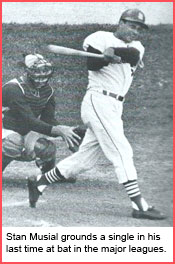
With Curt Flood at second in a scoreless game, Musial batted against Maloney in the sixth. Shadows covered the batting area. On a 2-and-1 pitch, Maloney threw a curve. “I picked up the spin of the ball in time,” Musial said. “My wrists whipped the bat down and in.” Musial grounded a RBI-single to right, his 3,630th hit.

Kolb relieves

Manager Johnny Keane lifted Musial for a pinch-runner, Kolb. It was the ninth time Kolb had been used as a pinch-runner for Musial, 42, in 1963. Kolb scored in the inning on a sacrifice fly by Charlie James, giving St. Louis a 2-0 lead. In the clubhouse, Musial told reporters, “I feel pretty good. Everyone was pulling for a home run, but I’m a singles hitter, so it seemed appropriate that I should go out with a pair of ’em.”

Classy warriors

After being replaced by a pinch-hitter in the eighth, Maloney went to the Cardinals clubhouse to congratulate Musial. When Musial saw Maloney enter, he said aloud, “Here’s a real tough guy. He had me worried.” Said Maloney to reporters: “I was glad to see him go out hitting.”

That’s a winner

The Cardinals won, 3-2, in 14 innings. Boxscore The Cardinals had won by the same score in Musial’s first game on Sept. 17, 1941. Like his finale, Musial had two hits in his debut game.

Holy cow

After saying more farewells, Musial did a post-game interview with Harry Caray for radio station KMOX. Musial told Caray that Warren Spahn was the best pitcher he faced in his career and Willie Mays was the best all-around player.

Celebration

At 7:45 p.m., nine hours after he had arrived, Musial left the ballpark, stopped home briefly and went with his family to a party in his honor at the restaurant he owned with business partner Biggie Garagnani. Among those attending the party were U.S. senator Stuart Symington, Missouri governor John Dalton and St. Louis mayor Raymond Tucker.

The next day, Musial and his wife, Lil, took a flight to New York to attend the World Series. Musial, dressed in a suit and with Joe DiMaggio at his side, threw the ceremonial first pitch on Oct. 2 before Game 1 between the Dodgers and Yankees. From there, the Musials went to Fort Riley, Kan., to get their first look at their first grandchild, Jeff, who was born Sept. 10.

Previously: Stan Musial and the Cardinals’ most iconic moments