Feeds:
Posts
Comments

(Updated Oct. 7, 2018)

Ernie Broglio was a key player in two Cardinals trades _ the famous one involving Lou Brock and the largely forgotten one that led to him becoming a prominent part of the St. Louis rotation.
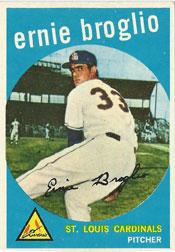
ernie_broglio3On Oct. 7, 1958, the Cardinals acquired Broglio and Marv Grissom from the Giants for Billy Muffett, Hobie Landrith and Benny Valenzuela.

The top names in the deal were relief pitchers Grissom and Muffett. Landrith was a backup catcher, Valenzuela a utility infielder and Broglio a minor-league pitcher.

Referring to managers Solly Hemus of the Cardinals and Bill Rigney of the Giants, columnist Dan Daniel of The Sporting News wrote, “Hemus wanted Grissom and Bill Rigney wanted Muffett, and the rest of it looks like parsley on the boiled potato.”

The St. Louis Post-Dispatch described the trade as “a can of salmon for a can of salmon.”

Regarding Ernest Broglio, he was “not to be confused either with movie Academy Award winner Ernest Borgnine or a plain old imbroglio,” the Post-Dispatch reported.

“Broglio must be suspect because he didn’t make it with the Giants last spring and no club needs pitching more than San Francisco,” the Post-Dispatch concluded.

Dixie delighted

Dixie Walker, who managed Broglio at Class AAA Toronto in 1958, was on good terms with the Cardinals. His brother, Harry Walker, was a Cardinals coach and Dixie worked with Cardinals general manager Bing Devine at Rochester in 1955.

It was on Walker’s advice that Devine pursued Broglio.

In the Giants’ organization since 1956, Broglio had opened the 1958 season with their Class AAA club at Phoenix and posted an 8-1 record. The Giants, though, were seeking a veteran pitcher and they made a deal with Toronto in July 1958 for former big-leaguer Don Johnson. The Giants sent Broglio, along with outfielder Jim King and pitcher Ray Crone, to Toronto.

Broglio, 23, apparently was loaned to Toronto, which wasn’t affiliated with any big-league club.

“Nobody said anything to me at Phoenix except when I was being shipped out,” Broglio said. “I was told I’d be back.”

Toronto throwback

Broglio was an immediate success with Toronto. In his first start for Dixie Walker, Broglio struck out a franchise-record 15 against Buffalo in 11.1 innings. Three days later, Broglio pitched a three-hitter against Montreal.

On Aug. 6, Broglio pitched a two-hit shutout against Havana. The next day, he pitched seven innings in relief.

“A throwback to pitchers of another era _ that is the reputation of Ernie Broglio, workhorse of the Toronto Maple Leafs’ mound corps, who appears to thrive on only two days rest,” Th Sporting News reported.

Broglio was 9-3 for Toronto in the regular season and 2-0 in the International League playoffs. For Phoenix and Toronto combined, Broglio had a 17-4 regular-season record.

Made in Japan

Two weeks after he was traded to St. Louis, Broglio was invited to join the Cardinals on their tour of Japan. The Cardinals were scheduled to play 16 games against Japanese teams in October and November. Broglio took full advantage of the chance to impress his new club.

Described by The Sporting News as “the big surprise,” Broglio was the Cardinals’ biggest winner on the tour, posting a 4-0 record and 1.55 ERA and striking out 30 in 28 innings.

Based on that showing, Hemus tabbed Broglio as the staff’s No. 4 starter entering spring training in 1959.

“I know that wasn’t big-league opposition,” Hemus said, “but he showed me enough to warrant this chance.”

Broglio further impressed the Cardinals by reporting to spring training three pounds under his assigned weight of 195.

“Wildness has been the bane of his six-year career (in the minors),” The Sporting News reported. “If pitching coach Howard Pollet can help Broglio with his control, the Cardinals might have their best rookie pitcher since Johnny Beazley in 1942.”

Broglio earned a spot in the 1959 Cardinals’ rotation and finished the season tied with Larry Jackson for the club lead in shutouts (three). Broglio also ranked second in strikeouts (133) and third in innings pitched (181.1) for the Cardinals.

After losing his first five decisions, Broglio completed the 1959 season at 7-12 with a 4.72 ERA. He was 7-9 in 25 starts and 0-3 in 10 relief appearances.

In six years (1959-64) with St. Louis, Broglio was 70-55, including seasons of 21 wins in 1960 and 18 wins in 1963.

When the Cardinals sent Broglio to the Cubs on June 15, 1964, in a deal involving Brock and others, most thought the transaction favored Chicago, but Broglio hurt his arm and went 7-19 with a 5.40 ERA in three years with the Cubs. Brock became a Hall of Fame player who broke stolen base records, achieved 3,000 hits and ignited the Cardinals to three pennants and two World Series titles.

Previously: Ernie Broglio built great home mark the hard way

Facing the Bronx Bombers, the 1943 Cardinals got buzzed by the real deal.

During Game 1 of the 1943 World Series between the Cardinals and Yankees at Yankee Stadium, a B-17 Flying Fortress bomber startled players and spectators by passing so low across the ballpark it nearly scraped the top of the flagpoles.

jack_watsonThree months later, the pilot, Lt. Jack W. Watson of the U.S. Army Air Force, made a brave landing of a burning B-17 at an airfield in England.

On Oct. 5, 1943, the Yankees were on their way to a 4-2 victory over the Cardinals when, in the eighth inning, four B-17s suddenly rumbled above the stadium packed with 68,676 fans.

Imagine the sight: The B-17 was a massive Flying Fortress that “bristled with armament,” according to Boeing. It was 74 feet long with a span of 103 feet. Powered by four engines, the B-17 carried about a dozen machine guns and was capable of holding up to 9,000 pounds of bombs.

Surprising stunt

Watson and his crew, along with three other crews, had left a training session in Florida and were flying their bombers to Maine for a stopover before heading to England.

When they reached the New York area and realized the World Series game was still going on that Tuesday afternoon, the crews, led by Watson, decided to buzz Yankee Stadium as a stunt, according to a Web site dedicated to the 303rd bomb group.

All four planes flew in formation over the ballpark, entering above home plate and roaring toward the outfield. Many initially thought it was an authorized show of military might and American pride by the Army Air Force.

But after the four planes rose and flew off, the B-17 piloted by Watson returned for an encore. It made a second pass, and then came back for a third that was alarmingly low, according to the book “Cardinals Journal.” The B-17 “was no more than 200 feet off the ground and hedge-hopped over the roof, narrowly missing the flagpoles.”

An Associated Press report also noted the plane “barely skimmed the flagpoles.”

“The roar of the plane drowned out the nationwide radio broadcast and stopped play as the players stood and watched the aircraft,” wrote John Snyder in “Cardinals Journal.”

Mad mayor

New York Mayor Fiorello La Guardia, who was at the game, told the Associated Press the Flying Fortress “flew right down over the stands” three times.

“If anything had happened, a thousand people would have been killed,” an angry La Guardia said.

The mayor demanded the Army Air Force investigate. “That pilot should be properly disciplined, endangering the lives of the citizenry of New York in that manner,” La Guardia said to The Sporting News.

Upon arriving in Maine, the four pilots were reprimanded and fined $75 apiece for the stunt. But, because the military needed pilots for combat, none were grounded, according to the 303rd bomb group Web site.

A couple of days later, Watson and his crew flew to England to begin bombing missions against the Nazis in Europe.

Described by United Press as a “freckled-face kid pilot,” Watson, of Indianapolis, was 21 years old.

Deadly mission

On Jan. 11, 1944, Watson and his crew, in a Flying Fortress dubbed “Meat Hound,” were part of a massive American-led air bombardment of central Germany. Watson and his crew were assigned to bomb a target in Oschersleben.

Just before he reached his target, the No. 3 engine failed on the B-17, Watson told the Associated Press. “But I stayed in formation,” he said.

Flying on three engines, Watson and his crew dropped the bombs, turned and started to head back to their base in England.

The Nazis, though, unleashed relentless waves of fighter planes to attack the bombers. Watson and his crew were over Holland when they encountered several fighter planes.

Shortly after the tail gunner on “Meat Hound” shot down a Nazi fighter, the B-17 was hit and the No. 2 engine went out, Watson told the Associated Press.

Wrote United Press: “A shell ripped a hole in the left elevator and another smashed between the right wing and the fuselage. A third hit just behind the No. 2 engine and that motor started smoking.”

In a gripping account to United Press, Watson described what happened next:

“I feathered it then and the fire soon appeared to go out. But a little later the left waist gunner reported smoke and flames pouring out of that engine again.

“We were over the sea, so I headed south to allow us to bail out over land.”

Uncertain whether the plane could remain airborne, Watson instructed his crew of nine to parachute out near Isselmeer, Holland.

(Four of the crew members landed in water and drowned. Of the five who survived, four were captured and became POWs. One, Clayton David, eluded capture and made his way back to England in May 1944, according to the 303rd bomb group Web site.)

‘Scared to death’

Alone in the B-17, Watson intended to bail out, too.

“I set the plane’s automatic control, put on my ‘chute and started to crawl out the hatch,” Watson told United Press. “I looked down and all I could see was water. I was scared to death. I didn’t want to go into the Channel. I decided I would rather blow up with the Fortress than drown in the Channel.

“I took a heading in the direction of England and said to myself, ‘Here goes.’ About that time, two enemy fighters buzzed in _ one from each side and both firing away.”

Watson pushed the bomber into thickening clouds and the Nazi fighter planes turned rather than follow him. “Meat Hound” kept flying, though flames were shooting from at least one of the two working engines on the battered bomber.

“It was pretty lonesome up there,” Watson said to United Press. “I radioed to the landing fields, ‘If you see a B-17 with two engines out, you’ll know that’s me.’

“Then I spotted a fighter field near the coast and they radioed, ‘Come on in, big friend.’ They kept calling me ‘big friend’ all the time and it sure sounded funny.”

Watson successfully landed the B-17 at the 353rd Fighter Group P-47 airfield at Metfield, England. It took a fire crew more than two hours to put out the raging flames on “Meat Hound.”

Forgiven

“I wonder whether Mayor La Guardia will forgive me,” Watson said in a radio interview, according to The Sporting News.

Learning of the remark, La Guardia responded to Watson in a cable: “Delighted to get your message. All is forgiven. Congratulations. I hope you never run out of altitude. Happy landings. Will be seeing you soon.”

Watson completed his 35-mission combat tour in June 1944 and was promoted to captain in December 1944.

jack_watson_plane

Previously: Why the Cardinals chose Cairo, Ill., for spring training in 1943

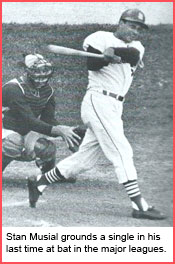
Snapshots from Stan Musial’s last game, Sept. 29, 1963, when the Reds played the Cardinals at St. Louis:

stan_musial29Mass and McMahon

Musial attended Mass that Sunday morning at St. Raphael the Archangel Catholic Church near his St. Louis home. He drove to the ballpark with his friend, actor Horace McMahon, who was visiting from Connecticut, The Sporting News reported. McMahon had received an Emmy nomination for his role as a detective in the TV show “Naked City.” Musial was godfather to McMahon’s son.

Visit with Ducky

After parking his steel blue Cadillac, Musial entered the ballpark at 10:50 a.m. One of the first to greet him in the clubhouse was Joe Medwick, a slugger for the Cardinals from 1932-40. “Fellows,” Musial said to the reporters on scene, “this is the guy I replaced as regular left fielder 22 years ago.”

Salute to Shannon

When Cardinals outfielders Gary Kolb, 23, and Mike Shannon, 24, walked by, Musial asked them to stop and sit with him. With Kolb on one side of the retiring legend and Shannon on the other, Musial said to reporters, “And these are my protégés who’ll replace me next year.”

Sharp tune-up

Entering the field wearing the familiar No. 6 on his jersey, Musial went directly to the batting cage. Bill White stepped aside for Musial, who took his swings against Lloyd Merritt, a St. Louis native who pitched for the Cardinals in 1957. Musial hit Merritt’s last batting-practice toss onto the pavilion roof in right field.

Reds rooters

When he left the cage, Musial was greeted by Reds veterans Joe Nuxhall and Frank Robinson and rookie Pete Rose. Nuxhall and Robinson brought baseballs for Musial to sign. Rose shook hands with Musial and wished him well.

Diamonds are forever

During ceremonies before the game, Ken Boyer, the Cardinals’ captain, presented Musial with a gift from his teammates: a ring with six diamonds shaped in the number 6. In his book “Stan Musial: The Man’s Own Story,” Musial said, “Of all the gifts I’ve been given at one time or another, I believe I cherish most the ring … that was presented by my 1963 teammates. My world championship rings had been stolen from my house several years earlier.”

Feeling the strain

Musial opened the game in left field. In his 22-year Cardinals career, Musial played 929 games in left, the most of the three outfield positions. “My legs were wobbly from emotion and exhaustion as I trotted to the outfield to start my last game,” Musial said.

At-bat interruption

Facing Jim Maloney, a 23-game winner in 1963, Musial struck out on three pitches in the first inning. Musial didn’t swing at the first pitch. Umpire Al Barlick took the ball from catcher Johnny Edwards’ glove and gave it to Musial, who trotted over to a box seat and handed the ball to Sid Keener, director of the National Baseball Hall of Fame. Musial fouled off the next pitch and watched a curve snap in for strike three. Said Musial: “As I returned to the dugout, trainer Bob Bauman growled, ‘You weren’t bearing down up there.’ ”

No no-hitter

Maloney struck out six of the first 10 batters. When Musial came up in the fourth, the Cardinals were hitless. “I crouched low, trying to forget all else except the giant pitcher and the ball he fired so fast,” Musial said. With the count 1-and-1, Musial swung at a fastball, low and inside, and drilled it to the right of Rose at second base for a single.

The final swing

With Curt Flood at second in a scoreless game, Musial batted against Maloney in the sixth. Shadows covered the batting area. On a 2-and-1 pitch, Maloney threw a curve. “I picked up the spin of the ball in time,” Musial said. “My wrists whipped the bat down and in.” Musial grounded a RBI-single to right, his 3,630th hit.

Kolb relieves

Manager Johnny Keane lifted Musial for a pinch-runner, Kolb. It was the ninth time Kolb had been used as a pinch-runner for Musial, 42, in 1963. Kolb scored in the inning on a sacrifice fly by Charlie James, giving St. Louis a 2-0 lead. In the clubhouse, Musial told reporters, “I feel pretty good. Everyone was pulling for a home run, but I’m a singles hitter, so it seemed appropriate that I should go out with a pair of ’em.”

Classy warriors

After being replaced by a pinch-hitter in the eighth, Maloney went to the Cardinals clubhouse to congratulate Musial. When Musial saw Maloney enter, he said aloud, “Here’s a real tough guy. He had me worried.” Said Maloney to reporters: “I was glad to see him go out hitting.”

That’s a winner

The Cardinals won, 3-2, in 14 innings. Boxscore The Cardinals had won by the same score in Musial’s first game on Sept. 17, 1941. Like his finale, Musial had two hits in his debut game.

Holy cow

After saying more farewells, Musial did a post-game interview with Harry Caray for radio station KMOX. Musial told Caray that Warren Spahn was the best pitcher he faced in his career and Willie Mays was the best all-around player.

Celebration

At 7:45 p.m., nine hours after he had arrived, Musial left the ballpark, stopped home briefly and went with his family to a party in his honor at the restaurant he owned with business partner Biggie Garagnani. Among those attending the party were U.S. senator Stuart Symington, Missouri governor John Dalton and St. Louis mayor Raymond Tucker.

The next day, Musial and his wife, Lil, took a flight to New York to attend the World Series. Musial, dressed in a suit and with Joe DiMaggio at his side, threw the ceremonial first pitch on Oct. 2 before Game 1 between the Dodgers and Yankees. From there, the Musials went to Fort Riley, Kan., to get their first look at their first grandchild, Jeff, who was born Sept. 10.

Previously: Stan Musial and the Cardinals’ most iconic moments

(Updated Sept. 27, 2019)

Reggie Cleveland may have been an unlikely candidate to nearly pitch the Cardinals’ first perfect game. Ken Rudolph may have been one of the unlikeliest batters to keep him from achieving perfection.

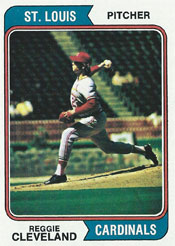
reggie_cleveland3On Sept. 27, 1973, Cleveland faced the minimum 27 batters in pitching a one-hitter against the Cubs at St. Louis.

Rudolph, a catcher batting eighth, was the only Cubs player to reach base. He singled in the sixth, then was erased on a double play.

Cleveland, 25, hadn’t won since Aug. 22, losing four consecutive decisions, but the right-hander threw just 78 pitches in subduing the Cubs.

“I had an unbelievable fastball,” Cleveland said to The Sporting News. “I put it where I wanted almost every time and the ball kept jumping.”

Said Cardinals catcher Ted Simmons: “That’s as good a one-hit perfecto as you’ll ever see. Reggie didn’t make a really bad pitch all night.”

Cleveland retired the first 16 Cubs batters. With one out in the sixth, Rudolph, who entered the game with a .196 batting average, singled sharply to left.

“Rudolph hit a good pitch, a slider low and away,” Simmons said.

The next batter, Burt Hooton, bunted. Cleveland fielded the ball and threw to shortstop Mike Tyson for the force on Rudolph at second. Tyson fired the relay to second baseman Ted Sizemore, covering first, to complete the double play.

In the bottom of the inning, Lou Brock lined a two-run home run into the seats in right against Hooton, producing the game’s only scoring.

“That was the first changeup I’ve hit out of the park in five years,” Brock said to the Chicago Tribune.

Cleveland set down the Cubs in order in the seventh, eighth and ninth innings, finishing the gem in 1 hour, 40 minutes.

He told the St. Louis Post-Dispatch, “The fastball was the best I’ve ever had.”

The ninth inning was relatively drama-free. Glenn Beckert flied out, Pete LaCock struck out and Adrian Garrett grounded out. Boxscore

The final out by Garrett provided a twist.

Four years earlier, May 27, 1969, Cleveland’s wife gave birth to their first child, a daughter. That night, Cleveland, pitching for the Cardinals’ minor-league Arkansas affiliate, pitched a one-hitter versus Shreveport, facing the minimum 27 batters. The lone hit was a second-inning single by Adrian Garrett.

The one-hitter versus the Cubs was the last game Cleveland pitched for the Cardinals. He was traded to the Red Sox after the season. A year later, October 1974, the Cardinals acquired Rudolph to be Simmons’ backup.

In a game filled with excellent catchers, the one who stood out was the unlikeliest of all.

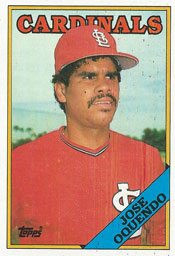
jose_oquendo4In 1988, Jose Oquendo caught an inning for the Cardinals in a game against the Mets at St. Louis.

In doing so, Oquendo became the first National League player in 70 years to play all nine positions in one season.

Before Oquendo, the last to accomplish the feat in the National League was Gene Paulette, primarily a first baseman for the 1918 Cardinals. Cesar Tovar of the American League Twins played all nine positions in 1968.

On Sept. 24, 1988, the Mets jumped to a 6-0 lead in the second inning against the Cardinals. Oquendo, 25, started the game at his primary position at second base and moved to shortstop in the sixth inning, replacing Ozzie Smith.

With the Mets ahead, 10-1, Cardinals manager Whitey Herzog, looking to give the home crowd something to cheer, decided the time was right to play Oquendo at catcher.

Move over, Tony

In the seventh, Oquendo moved from shortstop to catcher, replacing starter Tony Pena, the National League leader among catchers in fielding percentage in 1988.

First up for New York with Oquendo behind the plate was Gary Carter, the Mets’ 1988 all-star catcher.

“I told (Carter), ‘Don’t foul it off. I don’t want to get hit,’ ” Oquendo said to the St. Louis Post-Dispatch.

Facing reliever Steve Peters, Carter obliged, flying out.

Tim Teufel was the next batter. With the count 3-and-1, Peters shook off Oquendo’s sign. Before he could offer another, Peters went into his wind.

“I told Teufel, ‘Get ready. I don’t know what’s coming,’ ” Oquendo said. “He was laughing. That’s why he fouled the pitch off.”

On the next pitch, a 3-and-2 curve called by Oquendo, Teufel swung and missed, striking out.

Easy as 1,2,3

Kevin Elster then lined out to third. It was the only one of the nine innings the Mets were retired in order.

His goal accomplished, Herzog lifted Oquendo and replaced him with catcher Tom Pagnozzi in the eighth.

“It was fun,” Oquendo said. “I felt pretty good. I didn’t feel nervous at all.”

Said Peters to the Associated Press: “He called a good game … He’s got a nice, low target.” Boxscore

In 1988, Oquendo appeared in 69 games at second base, 47 at third base, 17 at shortstop, 16 at first base, nine in right field, four in center field, two in left field, one at catcher and one as a pitcher.

On May 14, 1988, Oquendo pitched four innings of relief against the Braves at St. Louis. Oquendo held Atlanta scoreless for three innings before the Braves scored twice in the 19th inning for a 7-5 victory. Boxscore

Oquendo took the loss, becoming the first non-pitcher to get a decision in a major-league game since the Yankees’ Rocky Colavito in 1968. Boxscore

Previously: Whiteyball: Willie McGee at shortstop; Ricky Horton in right

Like a scene from the movie “The Natural,” Stan Musial achieved one of baseball’s rarest hitting feats with flair.

stan_musial28Shedding the bandages from his ailing wrists, Musial took just five swings in the Cardinals’ game against the Braves at Boston on Sept. 22, 1948.

Each swing produced a hit.

It was Musial’s fourth five-hit game of the season. No major-league player had done that in 26 years. Only two have done it since.

Joining Musial as the only big-league players with four five-hit games in a season: Willie Keeler (1897 Orioles), Ty Cobb (1922 Tigers), Tony Gwynn (1993 Padres) and Ichiro Suzuki (2004 Mariners).

Musial had jammed his left wrist making a diving catch at Brooklyn on Sept. 17, 1948. The next day, he was hit on the right hand, near the wrist, by a pitch.

With his wrists taped, Musial remained in the lineup as the Cardinals pursued the National League-leading Braves.

A win over the Cardinals on Sept. 22 would clinch for the Braves their first pennant in 34 years. The Braves started their ace, left-hander Warren Spahn.

Going for broke

When Musial arrived at the Boston ballpark that day, he noticed the wind was blowing out toward right field, favoring a left-handed batter.

St. Louis writer Bob Broeg approached Musial at the batting cage and said, “A great day for the hitters.”

“Yeah, but I can’t hit like this,” Musial responded.

In his book “Stan Musial: The Man’s Own Story,” Musial said, “I held up the wrists with the flesh-colored tape. Angrily, I ripped it off.”

Without the tape to restrict him, Musial wanted to be able to snap his wrists, no matter how painful, and try to take advantage of the favoring wind and the short carry (319 feet) to the right-field bleachers.

Musial’s first two hits that day came against Spahn.

In the first inning, Musial singled to left. He said he punched the ball in that direction “to minimize wrist strain.”

In the third, Musial lined the ball over the head of left fielder Mike McCormick for a double.

Musial batted in the fourth against right-hander Red Barrett, who had been a teammate on the 1946 Cardinals.

Said Musial: “He tried to fool me with a 2-and-0 changeup, but I saw it coming and said to myself, ‘To hell with the wrists.’ ”

Musial pulled the pitch over the right-field wall for a two-run home run, his 38th of the season.

Swing away

In the sixth, Musial singled off left-hander Clyde Shoun. Musial said he was “entirely aware” Cobb had been the last player to achieve four five-hit games in a season.

“I wanted that fifth hit,” he said.

In the eighth. Musial got his chance against Al Lyons.

The first two pitches from the right-hander missed the strike zone. Musial didn’t want a walk.

“I made up my mind, with the Cardinals far ahead (8-2), that I’d swing at anything close to the plate _ wrists be hanged,” Musial said.

“The next pitch was a bit outside, but I jerked it around … It bounced in the hole between first and second and got through. Saving the sore wrists as much as possible, I had hit safely five times by taking the absolute minimum number of swings _ just five.” Boxscore

All four of Musial’s five-hit games in 1948 came away from home.

“If I could have played the 1948 season on the road, I might have hit .400 and ripped the record book apart,” Musial said.

Instead, Musial batted .376 overall _ .415 on the road and .334 at home.

Here is a look at his other five-hit games in 1948:

_ April 30, 1948, at Cincinnati: Musial hit a home run, two doubles and two singles off four right-handers in the Cardinals’ 13-7 victory over the Reds. The homer, a two-run shot, was off starter Howie Fox. Musial batted .447 (21-for-47) at Crosley Field in 1948. Boxscore

_ May 19, 1948, at Brooklyn: Musial singled twice off right-hander Rex Barney, tripled against right-hander Erv Palica and had a single and double off left-hander Preacher Roe in the Cardinals’ 14-7 victory over the Dodgers. Musial batted .522 (24-for-46) at Ebbets Field in 1948. Boxscore

_ June 22, 1948, at Boston: Musial had five singles, four off right-handed starter Bill Voiselle and another against Shoun that snapped a 2-2 tie in the ninth inning, in the Cardinals’ 5-2 triumph over the Braves. Musial hit .467 (21-for-45) at Braves Field in 1948. Boxscore

In his 22-year big-league career with the Cardinals, Musial had eight five-hit games. In addition to the four in 1948, the others were:

_  July 21, 1943, versus the Giants, at St. Louis. It was his only five-hit game at home.

_ Sept. 19, 1946, at Boston. Former Cardinals ace Mort Cooper started for the Braves.

_ Sept. 3, 1947, at Wrigley Field in Chicago.

_ Sept. 27, 1962, two months before his 42nd birthday, at Candlestick Park in San Francisco. The fifth hit was a single off former teammate Stu Miller.

Previously: How Stan Musial turned in a great comeback year at 41