Feeds:
Posts
Comments

(Updated Dec. 7, 2024)

One of the most exclusive Cardinals clubs is the one in which membership requires a World Series Most Valuable Player Award.
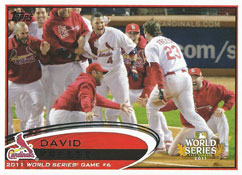
david_freese2Four Cardinals have earned the honor: Bob Gibson (twice), Darrell Porter, David Eckstein and David Freese.

Because a World Series most valuable player first was named in 1955 (Dodgers pitcher Johnny Podres), that left out Cardinals candidates from St. Louis’ World Series championship teams of 1926, 1931, 1934, 1942, 1944 and 1946.

Gibson is one of four players to twice be awarded a World Series MVP. The others: Sandy Koufax (1963 and 1965), Reggie Jackson (1973 and 1977) and Corey Seager (2020 and 2023).

In chronological order, a look at the Cardinals’ World Series MVP Award winners:

BOB GIBSON, 1964

Key stats: Three starts, 2-1 record, 3.00 ERA and 31 strikeouts in 27 innings.

Behind the numbers: In winning Games 5 and 7, Gibson relied on his fastball. He struck out 13 Yankees in 10 innings in Game 5 and nine in Game 7.

Fun fact: Gibson established a record with his 31 strikeouts in a World Series, breaking the mark of 28 set by Bill Dinneen of the 1903 Red Sox. Gibson struck out Mickey Mantle five times during the Series.

Best quote: “I was committed to this fellow’s heart more than anything else.” Cardinals manager Johnny Keane to the Associated Press, explaining why he stuck with a tiring Gibson in Game 7.

BOB GIBSON, 1967

Key stats: Three starts, 3-0 record, 1.00 ERA and 26 strikeouts in 27 innings.

Behind the numbers: Gibson held the Red Sox to a total of 14 hits in winning Games 1, 4 and 7. The 14 hits allowed were the fewest for three complete games in a World Series since Christy Mathewson yielded the same with the 1905 Giants.

Fun fact: Gibson hit a home run in Game 7.

Best quote: “Nothing. I gave the ball to Gibson.” _ Cardinals manager Red Schoendienst to the Associated Press when asked what he said to his team before Game 7.

DARRELL PORTER, 1982

Key stats: .286 batting mark (8-for-28), five RBI.

Behind the numbers: In the sixth inning of Game 2, the Brewers led, 4-2, and were close to clinching a second consecutive win in St. Louis. But Porter produced a two-out, two-run double, tying the score, and the Cardinals rallied to win the game. Porter hit a two-run home run in Game 6 and his run-scoring single in the eighth inning of Game 7 gave St. Louis a crucial insurance run.

Fun fact: Two years earlier, in the 1980 World Series while with the Royals, Porter batted just .143 (2-for-14).

Best quote: “I haven’t had a drink in two and a half years, or any pot or pills. I feel wonderful. I think I’ll go fishing.” _ Darrell Porter to United Press International.

DAVID ECKSTEIN, 2006

Key stats: .364 batting mark (8-for-22), four RBI, three runs.

Behind the numbers: In Game 4, with the Tigers ahead, 3-2, Eckstein led off the seventh with a double and scored the tying run. An inning later, in what Sports Illustrated described as a “Series-changing at bat,” he broke a 4-4 tie with a two-out double that scored Aaron Miles from second with the winning run. In the decisive Game 5, Eckstein gave St. Louis a 1-0 lead with a RBI-single in the third, drove in the winning run in the fourth and scored in the seventh.

Fun fact: Eckstein became the third player to start at shortstop for two different World Series champions (2002 Angels and 2006 Cardinals). The others: Dick Groat (1960 Pirates and 1964 Cardinals) and Everett Scott (1915, 1916 and 1918 Red Sox and 1923 Yankees).

Best quote: “He’s the toughest guy I’ve ever seen in a uniform.” _ Cardinals manager Tony La Russa, describing Eckstein to the Associated Press.

DAVID FREESE, 2011

Key stats: .348 batting mark (8-for-23), seven RBI, five walks, four runs.

Behind the numbers: His two-run triple with two outs in the ninth inning of Game 6 tied the score, 7-7, and his home run leading off the 11th gave St. Louis an epic 10-9 victory. In Game 7, his two-run double with two outs in the first tied the score, 2-2, and sparked St. Louis to the championship.

Fun fact: Freese hit safely in 16 of his 17 postseason games in 2011.

Best quote: “No dream is as good as this.” _ David Freese to USA Today.

Recalling his Game 6 walkoff homer in an interview for the 2016 Cardinals Yearbook, Freese said, “Right when the ball left, I remember telling myself to slow down and soak this all in. I wanted to enjoy it with my teammates and the fans … I remember rounding second, peeking into the dugout and seeing how fired up all the guys were coming to home plate … It was just an incredible feeling to have everybody waiting for you, and seeing that kind of excitement from grown men. That takes it to a whole new level.”

As for spiking his batting helmet as he approached the plate, Freese said, “I was so pumped up that I just wanted to make some noise somehow.”
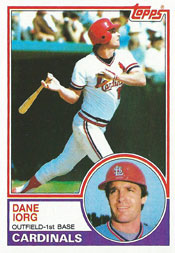
 

In 1982, when the Cardinals first used a designated hitter in a World Series, Dane Iorg delivered. dane_iorg3

A left-handed batter, Iorg, 32, was a reserve outfielder and first baseman for the 1982 Cardinals. He made 62 starts in the outfield and five at first base that season.

Iorg would have been a pinch-hitter in the 1982 World Series versus the Brewers if not for the designated hitter rule. In 1982, Major League Baseball allowed teams to use the DH in every World Series game.

Used as the designated hitter in five of the World Series games (manager Whitey Herzog went with Gene Tenace in Game 1 and Lonnie Smith in Game 5), Iorg batted .529 (9-for-17) with four runs scored. Five of his hits were for extra bases (four doubles and a triple).

In Game 6, Iorg had a double and triple versus Don Sutton and a double against Doc Medich.

Dave Nightingale, in his story in The Sporting News about that game, wrote, “Dane who? The same Dane Iorg who led all Series hitters in slugging percentage (.929) after six games? The same Dane Iorg who has spent more than a few sleepless nights wondering if he was good enough to play major league baseball; who thinks World Series pressure is a piece of cake compared to the strain of trying to make a ballclub in spring training? Yeah, that Dane Iorg.”

Described by columnist Bill Conlin as the “Cardinals’ sweet-swinging DH hero,” Iorg finished the Series with a slugging percentage of .882, the best of any hitter on either club.

In a 2007 interview with the Topeka Capital-Journal, Iorg said, “I always loved playing in the big game and I always wanted to be up there with the game on the line.”

Cardinals designated hitters batted .429 (12-for-28) in the 1982 World Series; their Brewers counterparts hit .125 (3-for-24).

(Updated Dec. 21, 2024)

In 2013, catcher Yadier Molina became the first Cardinals player in 67 years to appear in four World Series for them.

yadier_molina14Molina played in the 2004, 2006, 2011 and 2013 World Series.

In 21 World Series games, Molina batted .328 with 12 RBI. He hit .412 in the 2006 World Series versus the Tigers and .333 with nine RBI in the 2011 World Series against the Rangers.

As importantly, Molina’s strong arm and ability to manage a game on the field were attributes that helped the club become champions.

In an article he did for the 2019 Cardinals Yearbook, Tony La Russa, the manager for the World Series champion Cardinals clubs of 2006 and 2011, said, “I truly believe Yadier Molina was the key guy on both championship teams I managed with the St. Louis Cardinals … It comes down to pitching, and Yadi, along with our pitching coach Dave Duncan, was truly incredible guiding our staff through those Series … making the important calls, giving them confidence and helping to keep them calm. Then there was Yadi’s impact at the plate those postseasons _ his hitting was huge.”

In a November 2019 interview with broadcaster Dan McLaughlin, former Cardinals catcher Ted Simmons said Molina’s throwing skill was comparable to Johnny Bench and Carlton Fisk. Simmons called Molina “an extraordinary player” who “runs the game like no other I’ve ever seen.”

“Yadi has the ability to be the hitting instructor, pitching coach, manager and catcher,” said Simmons. “What is extraordinary about him is he could do them all at the same time. I’m not exaggerating.

“He can literally take young pitchers and force them to pitch above their skill set,” Simmons said. “… He will never let a young pitcher just give up. It’s how he makes really special pitchers out of ordinary ones. If a good pitcher pitches to Yadi, he has a chance of being a great pitcher. Yadi makes them do things that they don’t think they can do.”

Simmons also told the 2019 Cardinals Yearbook, “I’ve seen … all the great catchers going back to watching (Yogi) Berra on TV when I was a kid. (Molina) is the best I ever saw, the best defender. I wish I had his ability to throw.”

Until Molina, the last to play in four World Series for the Cardinals were Whitey Kurowski, Marty Marion and Stan Musial. Each played in the World Series of 1942, 1943, 1944 and 1946.

Molina is the 11th player (and first catcher) to appear in four World Series for St. Louis. In chronological order, a look at the 10 others who achieved the feat:

_ Jim Bottomley, 1926, 1928, 1930, 1931 World Series: The Hall of Fame first baseman, a career .310 hitter, batted .200 in 24 World Series games for St. Louis. He was spectacular in the 1926 World Series against the Yankees, hitting .345. He was 8-for-61 in the three World Series after that, including 1-for-22 with nine strikeouts in the 1930 matchup against the Athletics.

_ Chick Hafey, 1926, 1928, 1930, 1931 World Series: Like Bottomley, this Hall of Fame outfielder mostly was a World Series flop with St. Louis. A career .317 hitter, he batted .205 with two RBI and 19 strikeouts in 23 World Series games for the Cardinals. Hafey did produce five doubles in six games in the 1930 World Series.

_ Jesse Haines, 1926, 1928, 1930, 1934 World Series: The Hall of Fame pitcher was 3-1 with a 1.67 ERA in six World Series games for St. Louis. In 1926, he won Game 3 with a five-hit shutout of the Yankees and he started and won the epic Game 7 in which Grover Cleveland Alexander earned the save. He also recorded a complete-game win against Lefty Grove and the Athletics in Game 4 in 1930. Haines was 41 when he appeared in relief for St. Louis in Game 4 of the 1934 World Series versus the Tigers.

_ Bill Hallahan, 1926, 1930, 1931, 1934 World Series: The left-hander was 3-1 with a 1.36 ERA in seven World Series games for the Cardinals. In 1931, Hallahan earned two wins and a save against the Athletics. He had an 0.49 ERA, yielding one run in 18.1 innings. Hallahan pitched a three-hit shutout in Game 2, won Game 5 with another complete game and got the save in Game 7 when he relieved starter Burleigh Grimes with two outs and two on in the ninth and got Max Bishop to fly out to center.

_ Flint Rhem, 1926, 1928, 1930, 1931 World Series: The right-hander was 0-1 with a 6.10 ERA in four World Series games for St. Louis. In Game 4 of the 1926 World Series, Babe Ruth hit two home runs off Rhem.

_ Frankie Frisch, 1928, 1930, 1931, 1934 World Series: The Hall of Fame second baseman was player-manager of the 1934 champions. In Game 7 that year, Frisch hit a three-run double off Tigers starter Elden Auker in an 11-0 victory.

_ Ernie Orsatti, 1928, 1930, 1931, 1934 World Series: The outfielder, who spent his entire nine-year big-league career with the Cardinals, hit .273 in 13 World Series games for St. Louis. Orsatti, the starting center fielder in 1934, hit .318 with three walks in that year’s World Series.

_ Whitey Kurowski, 1942, 1943, 1944, 1946 World Series: In 1946, the third baseman tied with Enos Slaughter for the Cardinals World Series lead in hits, with eight. In 23 World Series games for St. Louis, Kurowski hit .253 with nine RBI.

_ Marty Marion, 1942, 1943, 1944, 1946 World Series: The shortstop hit just one home run during the 1943 regular season, but he belted a homer against Tiny Bonham in Game 2 of the 1943 World Series at Yankee Stadium. Marion hit .357 in that Series. In 23 World Series games for St. Louis, Marion hit .231.

_ Stan Musial, 1942, 1943, 1944, 1946 World Series: The Hall of Fame outfielder’s best World Series performance was in 1944 when he batted .304 versus the Browns. Musial hit his lone career World Series home run that year against Sig Jakucki in Game 4. In 23 World Series games, The Man batted .256 with 12 walks and eight RBI.

Previously: Yadier Molina: Most RBI in a World Series game by Cards catcher

(Updated Dec. 10, 2023)

The Cardinals acquired Adam Wainwright from the Braves in the belief he would develop into an ace for them.

On Dec. 13, 2003, the Cardinals traded outfielder J.D. Drew and catcher Eli Marrero to the Braves for pitchers Jason Marquis, Ray King and Wainwright.

Describing Wainwright as the key player of the trade for the Cardinals, St. Louis general manager Walt Jocketty told the Atlanta Journal-Constitution, “Without him, there wasn’t a deal.”

At the time, Wainwright, 22, was a prospect who posted a 10-8 record and 3.37 ERA for Class AA Greenville (S.C.) in 2003.

“Adam is our No. 1 pitching prospect,” Braves general manager John Schuerholz told the Associated Press.

Said Jocketty to the St. Louis Post-Dispatch: “We see him as a top-of-the-rotation kind of guy in a couple of years.”

Baseball America magazine said Wainwright had “an ideal combination of size, talent and makeup. He started working off his 92 mph to 93 mph fastball more often at midseason and the positive results were immediate. He also throws a hard curveball and a solid changeup … He has a great work ethic and is one of the most intelligent pitching prospects … He needs to continue to gain confidence … He tends to be too fine with his pitches instead of challenging hitters.”

Slick move

Some thought the Cardinals had given up too much in dealing Drew, 28. In six years with St. Louis, he hit .282 and had a .377 on-base percentage, but he also was injury-prone and eligible for free agency after the 2004 season.

In retrospect, Jocketty took advantage of the Braves, who were desperate to replace the run production supplied by departed free agents Gary Sheffield in right field and Javy Lopez at catcher.

“That was tough to do,” Schuerholz said of including Wainwright in the deal, “but, under the circumstances, we had no choice.”

(Drew and Marrero each would play one season for the Braves. Drew departed through free agency for the Dodgers. Marrero was dealt to the Royals.)

The Cardinals were in the market for pitching and the Braves offered a bonanza.

“We felt that without pitching we weren’t going to have a chance to improve in the standings next year,” Cardinals manager Tony La Russa told the Associated Press.

Said Jocketty: “There were a couple deals we could have done. We just felt this was the best overall for us.”

Post-Dispatch columnist Bernie Miklasz endorsed the deal, though he was concerned whether La Russa and pitching coach Dave Duncan were best-suited to develop a young arm. “Wainwright is a legitimately bright prospect and a potential steal for the Cardinals,” Miklasz wrote, “but if Duncan and La Russa are around beyond the 2004 season, it may not matter because they can’t develop young pitchers. Perhaps Wainwright will be nurtured and saved by the next regime.”

Good results

The trade helped the Cardinals improve from 85 wins and a third-place finish in 2003 to 105 wins and a first-place finish in 2004. With Marquis contributing 15 wins as a starter and King appearing in 86 games as a left-handed relief specialist, St. Louis won the pennant in 2004 for the first time in 17 years.

Marquis posted 13 or more wins in each of his three seasons with St. Louis, helping the Cardinals to the postseason each time.

King pitched in 163 games in two seasons for St. Louis.

At Class AAA Memphis in 2004, Wainwright was 4-4 with a 5.37 ERA when elbow discomfort caused him to discontinue throwing in June.

He was 10-10 with a 4.40 ERA in 29 starts for Memphis in 2005, though he led the Pacific Coast League in innings pitched (182) and was second in strikeouts (147).

Wainwright was eased into his first big-league season in 2006 by La Russa and Duncan. Used exclusively in relief, Wainwright led all St. Louis relievers in holds (23) and strikeouts (72). In the postseason, he was 1-0 with four saves and 15 strikeouts in 9.2 scoreless innings.

Wainwright spent his entire big-league career with the Cardinals and produced a record of 200-128. He ranks second on the franchise list in strikeouts (2,202) and starts (411) and is third in wins.

(Updated Oct. 23, 2020)

If general manager Dal Maxvill had been willing to part with pitcher Joe Magrane, Don Mattingly might have been a first baseman for the Cardinals instead of spending his entire playing career with the Yankees.

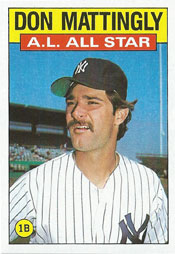
don_mattinglyIn 1988, Mattingly was feuding publicly with Yankees owner George Steinbrenner. That fueled media speculation the Yankees were willing to trade Mattingly, who expressed interest in the Cardinals because of the proximity of St. Louis to his hometown of Evansville, Ind.

“Growing up in Evansville, I was a fan of the St. Louis Cardinals,” Mattingly told the New York Daily News.

The Cardinals admitted interest in pursuing a deal. Media reports suggested the Yankees would want shortstop Ozzie Smith or center fielder Willie McGee in return, but the player New York apparently wanted most was Magrane, who at the time was St. Louis’ prized pitching phenom.

No respect

In August 1988, Mattingly, 27, was a five-time all-star who had earned an American League Most Valuable Player Award, one batting title and three Gold Glove awards, but he became disgruntled with the way he believed Steinbrenner was treating Yankees players.

“The players get no respect around here,” Mattingly said to the Associated Press. “They (management) give you money, that’s it. Not respect. Money is not respect.”

Reports spread quickly that an angry Steinbrenner intended to trade Mattingly. The Cardinals, who had just acquired first baseman Pedro Guerrero from the Dodgers, were willing to move Guerrero to left field and open the job at first base for Mattingly.

“I see where Mattingly wants to go to St. Louis,” Cardinals manager Whitey Herzog said to the St. Louis Post-Dispatch. “That takes care of us. Steinbrenner sure wouldn’t trade him where he wants to go. You know what I mean? He’d say, ‘I’ll show him. I’ll trade him to Seattle.’ ”

Still, baseball writers produced a stream of reports that speculated on a deal between the Yankees and Cardinals.

On Sept. 4, 1988, Rick Hummel of the Post-Dispatch wrote, “The Cardinals have some players in which the Yankees would seem interested. Certainly the Yankees would want a starting pitcher. Joe Magrane probably is unavailable. But Greg Mathews, if he shows he has recovered from elbow surgery, might be.”

Hummel suggested several possible packages to land Mattingly, including Mathews, McGee and catcher Tony Pena, or Mathews and Ozzie Smith.

About a month later, under the Post-Dispatch headline, “Maxvill Says He’ll Pursue Mattingly,” the general manager told Hummel, “I definitely want to talk to them.”

Wizard a Yankee?

Two days later, in a column that rocked Cardinals Nation, Tom Wheatley of the Post-Dispatch opined, “Ozzie Smith must go. And if the Wizard of Oz can be used as bait to land a whopper such as Don Mattingly, all the better.”

Maxvill said he made more inquiries about acquiring Mattingly, but he told Hummel, ‘I don’t think they’re interested in moving him as much as everybody thinks. That’s what I thought before and it’s been reinforced to me.”

Just when it appeared the possibility of a trade had waned, Murray Chass of the New York Times, citing an anonymous American League club executive, reported the Cardinals, Cubs, Padres or Giants were close to making a deal for Mattingly.

Wrote Chass: “If the Cardinals, for example, were really serious about the pursuit of Mattingly, they would have to offer the Yankees Joe Magrane … The Cardinals, however, will not offer Magrane; therefore, no deal.”

Magrane, 24, was the National League earned-run average leader (2.18) in 1988, his second season with St. Louis.

In December 1988, the Post-Dispatch reported why a deal for Mattingly appeared dead: “Maxvill said the New York Yankees never had asked seriously about acquiring (Ozzie) Smith in a Don Mattingly deal. Pitcher Joe Magrane’s name, on the other hand, did come up in discussions with the Yankees. But Maxvill said the Cardinals would be highly reluctant to part with him.”

Magrane achieved a career-high 18 wins for the 1989 Cardinals. Mattingly stayed with the Yankees and completed his 14-season big-league career with them in 1995. He finished with a .307 career batting mark and 2,153 hits.

(Updated April 30, 2020)

Stan Musial had such respect for the arm of Andy Pafko he included the National League veteran as part of the best-throwing outfield he’d ever seen.

andy_pafkoBecause he didn’t use that arm, Pafko committed a blunder that literally handed the Cardinals a comeback victory against the Cubs.

Wild ninth

Pafko was in center field for a Saturday afternoon game, April 30, 1949, against the Cardinals at Chicago’s Wrigley Field.

Behind the pitching of starter Bob Rush, who threw what the St. Louis Post-Dispatch described as a “crackling fastball and corner-cutting curve,” the Cubs entered the ninth inning with a 3-1 lead.

With Enos Slaughter on second base and two outs, Rush was on the verge of a victory until Eddie Kazak hit a pitch off his fists and looped a single to short left, scoring Slaughter and narrowing the Cubs’ lead to 3-2. Chuck Diering ran for Kazak and Rocky Nelson, a rookie first baseman, stepped to the plate for St. Louis.

With Pafko shaded toward right for the left-handed batter, Nelson lined the ball to left-center.

“Even though the ball was slicing away from him in a deep part of the park, his quick start and fleet legs enabled him to gain on the drive,” the Post-Dispatch reported. “Pafko lunged to his right, his gloved hand thrust outward in a bid for a backhanded catch.”

Pafko skidded across the grass before he “flung up his hand, clutching the ball, in a gesture of triumph,” the Post-Dispatch noted.

Umpire Al Barlick ruled Pafko trapped the ball, signaling with his hands extended and palms down in a safe call.

Diering and Nelson raced around the basepaths.

Great debate

According to The Sporting News, “Instead of throwing in the ball with his superb arm, Pafko, the ball still lodged in the webbing of his glove, came running in to second base to join the swarm of Cubs who were rushing toward Barlick.”

As Pafko held the ball, Diering scored the tying run and Nelson was waved toward the plate by third-base coach Tony Kauffman.

Pafko, unwilling to believe the no-catch ruling, waited too long before throwing the ball to the plate. The ball hit Nelson in the left shoulder as he was crossing the plate with the winning run.

Cubs fans protested by throwing objects, including cushions, fruit and vegetables, onto the field.

The stunned Cubs were retired in order by closer Ted Wilks in the bottom of the ninth and the Cardinals won, 4-3. Boxscore

The Sporting News summed up the game as probably the first in the history of big-league baseball “decided by what they describe not as an inside-the-park homer but as an in-the-glove homer.”

Two years later, June 1951, Pafko was dealt to the Dodgers, giving Brooklyn an outfield of Pafko in left, Duke Snider in center and Carl Furillo in right.

In his book “Stan Musial: The Man’s Own Story,” Musial said with Pafko, Snider and Furillo “the Dodgers had the best-throwing outfield I ever saw.”

“Andy was a strong hitter, a strong-armed fielder and good defensively,” Musial said. “He was steady, gave you a good day’s work.”

Playing for the Cubs, Dodgers and Braves from 1943-59, Pafko batted .285 with 213 home runs and 1,796 hits. In 258 games against the Cardinals, Pafko hit .273 with 22 homers and 120 RBI.