Feeds:
Posts
Comments

(Updated May 25, 2020)

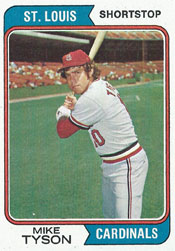
In 1974, when the Cardinals’ 5-foot-9 shortstop, Mike Tyson, arrived at spring training at about 185 pounds, teammates called him “Hoggie” because he was “considerably overweight,” The Sporting News reported.

His year went downhill from there.

mike_tysonDuring the Cardinals’ first regular-season road trip in 1974, Tyson was assaulted and robbed in his hotel room.

On April 17, 1974, with the Cardinals in Philadelphia to play the Phillies, Tyson was in his room at the Bellevue-Stratford Hotel when he received a call from someone who identified himself as a maintenance man, asking whether the air-conditioning was working.

“I said, ‘No,’ ” Tyson told The Sporting News. “They said they’d be right over. About 10 minutes later, there was a knock at the door and when I opened it I was facing a shotgun and a handgun.”

Two men tied Tyson’s hands and taped his mouth, according to The Sporting News.

In a 2020 interview with Stan McNeal of Cardinals Gameday Magazine, Tyson recalled, “It was going through my mind that they were going to kill me right there.”

Tyson said he felt better when one of the men asked him if he could breathe all right with the tape on his mouth. “I figured, ‘OK, they’re not going to try to do anything terrible.’ ” Tyson recalled.

The robbers ransacked the room and fled with Tyson’s wallet, containing $80 in cash and two credit cards.

Tyson managed to free himself and call police. Soon after, a suspect was arrested after trying to use one of the credit cards to buy clothes.

Five months later, two men pleaded guilty to robbery charges. According to The Sporting News, the gun used was a toy pistol.

Meanwhile, Tyson struggled on the field. He hit .200 in May. By June, the Cardinals, “concerned about shortstop,” according to The Sporting News, made trade offers for Don Kessinger of the Cubs and Bud Harrelson of the Mets, but both proposals were rejected. The Cardinals reportedly offered Tyson and pitchers Alan Foster and Mike Garman to the Cubs for Kessinger.

Desperate, the Cardinals had coaches Vern Benson and George Kissell “hit ground balls by the bushel” to outfielder Luis Melendez each day in the hope of converting him into a shortstop, but that experiment was scratched.

Instead, the Cardinals stayed with Tyson as their shortstop. He hit .180 in July.

Tyson was especially inept against the 1974 Reds, hitting .065 (2-for-31) overall against them and going hitless (0-for-15) at Cincinnati’s Riverfront Stadium. He also batted . 111 (4-for-36) versus the Braves.

Tyson did hit .360 against the Astros and .344 versus the Padres.

For the season, he batted .223 and made 30 errors at shortstop.

After the season, the Cardinals acquired Ed Brinkman to be their shortstop for 1975, but he flopped and Tyson ended up playing more games at shortstop for the 1975 Cardinals than any other infielder.

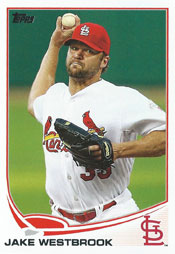
In four seasons with the Cardinals, Jake Westbrook pitched for two National League pennant winners and a World Series champion.

jake_westbook3Westbrook, acquired from the Indians on July 31, 2010, in a deal involving outfielder Ryan Ludwick, was 36-32 with a 4.27 ERA in regular-season games for the Cardinals.

A look at his top 5 games as a Cardinal:

1. Big win in big game

The Cardinals’ hitting heroics in Game 6 of the 2011 World Series might have gone for naught if it weren’t for the scoreless inning pitched by Westbrook.

After St. Louis scored twice in the 10th to tie the score at 9-9, Westbrook relieved closer Jason Motte and pitched a scoreless 11th against the Rangers. He got Nelson Cruz to fly out before Mike Napoli singled. Westbrook then retired David Murphy on a flyball and Esteban German on a groundout.

When David Freese followed with a game-winning home run leading off the bottom of the 11th, giving St. Louis a 10-9 victory, Westbrook got a World Series win. Boxscore

2. Rough on Reds

In the Cardinals’ 10-0 victory over the Reds on April 10, 2013, Westbrook pitched his only shutout as a Cardinal and his first since 2006 with the Indians.

Westbrook got 17 outs on ground balls and he held the Reds hitless in six at-bats with runners in scoring position. Boxscore

“The ball was in the zone and really moving a lot,” Westbrook said to the Associated Press.

3. Surprise slugger

A career .130 hitter, Westbrook hit his only big-league home run, a grand slam off Randy Wolf, and earned the win in the Cardinals’ 8-3 victory over the Brewers on Aug. 31, 2011. Boxscore

“It’s pretty special … I’m still not that great of a hitter,” Westbrook said to the Associated Press.

4. Tiger tamer

In his first complete game for St. Louis, Westbrook held sluggers Miguel Cabrera and Prince Fielder hitless and finished with a five-hitter in the Cardinals’ 3-1 triumph over the Tigers on June 20, 2012. Westbrook induced 15 ground ball outs with his sinker. Boxscore

5. Helping the cause

In September 2011, the Cardinals’ only realistic chance to qualify for postseason play was to overcome the Braves and secure the lone wild-card spot in the National League.

Westbrook enabled the Cardinals to complete a critical three-game sweep of the Braves by outdueling Tim Hudson and getting the win in a 6-3 St. Louis victory on Sept. 11, 2011.

Entering the game with a 4.65 ERA, Westbrook held the Braves scoreless for five innings and retired the first seven batters before yielding a hit. Boxscore

Inspired by the sweep, the Cardinals went on to catch the Braves, earn the wild-card spot and begin their postseason push to a World Series title.

Previously: Cardinals pitchers enjoy grand slam streak

(Updated May 30, 2020)

In his first game for the Cardinals, George Altman singled four times against Mets pitcher Roger Craig, who experienced the first of 22 losses in 1963. Boxscore

roger_craigSeven months later, Altman was traded for Craig, a deal that helped transform the Cardinals into World Series champions in 1964.

On Nov. 4, 1963, the Cardinals sent Altman and pitcher Bill Wakefield to the Mets for Craig.

Craig was 5-22 for the 1963 Mets and he lost 18 consecutive decisions between May 4 and Aug. 4, but the Mets were shut out in nine of Craig’s losses and he lost five times by 1-0 scores.

Devine intervention

The Cardinals acquired him because he could start and relieve, general manager Bing Devine said, and his 3.78 ERA in 1963 indicated Craig was a better pitcher than his won-loss record showed.

“Craig gives us stability and maneuverability in our pitching,” Devine told United Press International.

Cardinals manager Johnny Keane told New York columnist Red Smith, “We think Craig is a lot of pitcher.”

Said Craig to the Associated Press: “I knew I’d be traded. I was praying it wouldn’t be to another second-division club. I felt I suffered enough … I want to thank the Mets for dealing me to a good club. The Cardinals have the best-hitting team in the league and should be a contender for many years.

“I feel I’ve never pitched better than (1963) despite my record. I had better control, better stuff and my arm didn’t bother me despite all the work … My stay in New York made me a better pitcher because it taught me to bear down harder. There was plenty of opportunity.”

In an uncannily prescient prediction to The Sporting News in December 1963, Mets broadcaster Ralph Kiner said of the Cardinals’ acquisition of Craig, “It could mean the pennant for them. It gives the Cards a great middle relief man or maybe even another starter. Ask any manager what that means. Craig is a great competitor.”

Craig’s versatility for the 1964 Cardinals was reflected in these statistics: He was third on the club in games pitched (39), third in saves (five), fourth in starts (19) and fourth in innings pitched (166).

His best work for the 1964 Cardinals was out of the bullpen. Overall, he was 7-9 with a 3.25 ERA. In relief, he was 2-1 with a 2.20 ERA in 20 games.

Relieving Ray Sadecki, Craig won Game 4 of the 1964 World Series against the Yankees. Boxscore

Big bopper bust

George Altman, the right fielder for the 1963 Cardinals, had been expected to provide power and run production after being acquired from the Cubs, but he was a streaky hitter who failed to produce consistent power. He hit .274 with 18 doubles, nine home runs and 47 RBI in 135 games for the Cardinals.

Altman’s inconsistency was reflected in these statistics: He hit .370 for St. Louis in April, .184 in May, .305 in June and .226 in July.

“Altman wasn’t that bad a player for us,” Devine told the St. Louis Post-Dispatch. “It’s just that we looked for so much from him … We made the trade (for Craig) to strengthen our pitching as well as to open the way for our young outfielders. We’ve wanted Craig for some time.”

Altman hit .230 for the 1964 Mets and duplicated the home run and RBI totals (nine and 47) he had for St. Louis in 1963.

After returning to Chicago and playing for the Cubs from 1965-67, Altman revived his career in Japan.

In search of a late-night drink at a venerable St. Louis hotel, longtime Cardinals broadcaster Harry Caray nearly was killed when struck by a car.

harry_carayOn Saturday afternoon, Nov. 2, 1968, less than a month after he’d called the World Series between the Cardinals and Tigers, Caray did the broadcast of the Oklahoma State vs. Missouri football game at Columbia, Mo.

Afterward, he drove to St. Louis and, on a whim, decided to stop by and watch the NHL game between the Blues and North Stars. During the hockey game, Caray, who was estranged from his second wife at the time, called a friend and arranged to meet for dinner.

After dinner, unwilling to call it a night, Caray headed to the Chase Park Plaza Hotel, a landmark in St. Louis since the 1920s and a venue for music and shows. It was about 1:15 a.m., Sunday morning, Nov. 3, 1968, when Caray drove up to the hotel in the rain.

A regular at the Chase Park Plaza, Caray, 54, usually left his car with a parking attendant at the entrance, but, because of the rain, there was a backup of vehicles in the hotel driveway.

Impatient, Caray noticed an empty parking spot along the curb on the other side of the street, directly across from the hotel. He parked, exited the car and started to cross the busy street, Kingshighway.

Sent flying

Midway across, Caray told The Sporting News, “I turned to see if anything was coming from my left. The last thing I remember was, ‘Am I OK out here?’ ”

A car driven by Michael Poliquin, 21, a Vietnam War veteran from Overland, Mo., struck Caray. “He was knocked 40 feet in the air,” The Sporting News reported. “His shoes were found 25 feet south of the hotel and he landed 40 feet north.”

Poliquin, who hours earlier had been engaged to be married, told police he saw a pedestrian step into the street in midblock and wasn’t able to stop on the slickened pavement, the Associated Press reported. Poliquin said Caray saw the car at the last moment and jumped in the direction the vehicle was skidding.

In his book “Holy Cow!,” Caray said, “I was lying in the street … in the pouring rain. People started to gather around. Many recognized me; all were afraid to touch me.

“A Goodwill truck came down Kingshighway. The driver saw a body in the street and … stopped his truck. When he saw I was just lying unattended to in the rain, he pulled a few burlap bags from the back of the truck and covered me with them _ keeping me warm and dry _ then just drove away. I think he saved my life.”

Taken to a hospital, Caray was treated for compound fractures of both legs, a broken right shoulder, a broken nose and facial cuts, the Associated Press reported. “I had almost died on the street when the rainwater and blood nearly congested my lungs … I was extremely fortunate they didn’t have to amputate my left leg during surgery,” Caray said.

Police cited the driver of the car for failure to display a license and Caray was cited for crossing a street while not at an intersection, the Associated Press reported.

Party room

Initially, the only visitors permitted in Caray’s hospital room were family members and Robert Hyland, general manager of Cardinals flagship radio station KMOX, according to United Press International. “We can’t keep Harry from talking,” Hyland said. “He’s full of spirit and already tired of being in the hospital. He’s been pestering the doctors to let him go back to work.”

The doctors informed Caray he would need to remain in the hospital until just before Christmas. Caray convinced hospital staff his recovery would progress if he could have lots of visitors.

“My room became headquarters for off-duty nurses, for kids who wanted to talk baseball, for all my friends,” Caray said. “At night they would send martinis down from the restaurant on the top floor, as well as specially prepared meals, so I didn’t have to eat the awful hospital food. After a while, it was like a nightclub in there. It got so I hated to leave.”

Upon Caray’s release, Cardinals owner Gussie Busch offered the broadcaster the use of Busch’s beach house near St. Petersburg, Fla. Caray recuperated there _ under the care of a male nurse, he said _ and was back in the Cardinals’ broadcast booth for the start of the 1969 season.


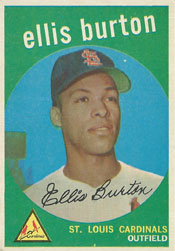
Ellis Burton was a Cardinals outfield prospect who recovered from a near-fatal car accident to earn a spot on St. Louis’ Opening Day roster in 1960.

ellis_burtonThough he enjoyed stellar seasons in the Cardinals’ minor-league system and impressed St. Louis manager Solly Hemus during spring training in 1960, Burton’s stint with the club was short and largely unproductive.

Accident survivor

Burton signed with the Pirates after he was graduated from high school in 1955.

Two years later, Burton “was nearly killed in an automobile crash,” according to The Sporting News. The publication reported that Burton’s car “went over a 115-foot cliff.” Burton broke his collarbone and also suffered a concussion and internal injuries, The Sporting News wrote.

“I was supposed to be in a cast for six months, but I couldn’t keep it on,” Burton said to writer Jack Herman. “I was playing ball again inside of a month.”

Tony Governor, West Coast scout for the Cardinals, long had followed Burton’s athletic career. When the Pirates, concerned about Burton’s ability to recover fully from the accident, made him available in the minor-league draft in December 1957, Governor recommended the Cardinals select him.

Plucked by Cardinals

Paying the $3,500 draft price, the Cardinals followed their scout’s advice, acquired Burton and assigned him to Class AA Houston of the Texas League for 1958.

Burton opened the season as a second baseman. His collarbone still hadn’t healed sufficiently enough to allow him to make long throws. Harry Walker, Houston’s manager, “literally worked hours with (Burton) on improving his throwing,” The Sporting News reported.

Burton recovered well enough to move from second base to the outfield that year.

Meanwhile, Paul Waner, the Cardinals’ minor-league hitting instructor, had noticed Burton often jerked his head around when he batted. “I want your head steady,” Waner said to Burton.

The tip worked. A switch-hitter, Burton hit .286 with a league-high 41 doubles and 22 home runs in 147 games for Houston.

In September 1958, Burton, 22, was rewarded with a promotion to the Cardinals. In eight games for St. Louis, he batted .233 (7-for-30) with two home runs.

Burton spent the 1959 season with the Cardinals’ Class AAA club at Omaha and hit .292 with 26 doubles, 14 homers and 18 stolen bases.

Bright prospect

At spring training in March 1960, Burton caught the attention of Hemus. In an article headlined, “Burton, Cardinals Comet, Escaped Death By An Eyelash,” The Sporting News recounted Burton’s 1957 car accident and touted his spring training performance.

“He is one of the most promising youngsters in the St. Louis camp,” The Sporting News wrote of Burton. “He’s as versatile with the glove as he is with the bat.”

Burton opened the 1960 season as a reserve outfielder for St. Louis behind starters Stan Musial, Curt Flood and Joe Cunningham.

On April 16, 1960, Burton gave a glimpse of his potential. Batting leadoff, Burton had two of the Cardinals’ four hits off the Dodgers’ Don Drysdale, who pitched a complete game in a 3-2 victory for Los Angeles. Boxscore

Two months later, June 11, Burton sparked a three-run ninth-inning rally for St. Louis, driving in a run and scoring in the Cardinals’ 7-6 victory over the Pirates. Boxscore

But Burton batted just .214 (13-for-58) in 37 games for the 1960 Cardinals. In mid-June, he was sent to Class AAA Rochester, where he spent the remainder of the season, hitting .257 with 14 home runs.

After the 1960 season, the Cardinals sent Burton to Toronto, then an independent Class AAA franchise, to complete a trade for pitcher Al Cicotte. In his two stints with St. Louis, the Cardinals Comet produced an overall batting average of .224 (13-for-58).

Burton eventually returned to the big leagues and played for the Indians and Cubs. In five major-league seasons, he hit .216 with 17 home runs.

Previously: Clyde King mentored young Cardinals of 1960s

(Updated Oct. 22, 2023)

In 1967, Reggie Smith hit two home runs for the Red Sox in the World Series against the Cardinals. Six years later, the Cardinals traded for Smith, hoping he could provide them with the power they needed.

reggie_smith2On Oct. 26, 1973, the Cardinals dealt pitcher Rick Wise and outfielder Bernie Carbo to the Boston Red Sox for Smith and pitcher Ken Tatum.

Smith, a switch-hitting right fielder, and Wise were the key players. The Cardinals, who had the fewest home runs (75) in the National League in 1973, wanted a slugger and Boston needed a starting pitcher to compete with the deep staffs of the Athletics and Orioles in the American League.

In his autobiography, Cardinals general manager Bing Devine said of the deal, “You hated to trade a productive pitcher, but everything else being equal, if you could get a guy who plays every day for a guy who plays every four or five days, you do it.”

Turning pro

Born in Shreveport, La., and raised in Los Angeles, Smith was 16 when he learned to hit from both sides of the plate, according to the St. Louis Post-Dispatch. Two years later, he signed with the Minnesota Twins.

Smith played shortstop for a Twins farm club, Wytheville, Va., in the Appalachian League in 1963. Made available in the minor-league draft, he was taken by the Red Sox in December 1963.

Moved to the outfield, Smith hit .320 in 1966 for Toronto, a Class AAA club managed by Dick Williams. In 1967, Williams was the Red Sox manager and he selected Smith, 22, to be their center fielder. The 1967 Red Sox won the American League pennant and faced the Cardinals in the World Series. Smith hit a home run against Nelson Briles in Game 3 and another versus Dick Hughes in Game 6, but the Cardinals prevailed in seven games.

Smith led the American League in doubles in 1968 (37) and 1971 (33). He also was the 1971 league leader in total bases (302) and extra-base hits (65).

The Red Sox moved Smith from center to right in 1972 and he made the American League all-star team for the second time.

Bad vibes

The 1973 season was a troubled one for Smith. His knees ached. He got into a fight with teammate Bill Lee in the dugout. He felt unappreciated.

According to the Associated Press, Smith “became the target of boos in Boston when he missed a pair of routine fly balls in the outfield. The fans felt Smith was loafing, but the outfielder said he couldn’t reach the balls because of bad knees. Smith angrily labeled Boston a racist city and sat out for two weeks.”

In The Sporting News, Peter Gammons wrote of Smith, “He always was burdened with the pressure of becoming Boston’s first black (baseball) star, a role he could not fill. In his final year, he had become embittered with fans who got on him about his occasional lackadaisical play, had entanglements with teammates (most of whom were unsympathetic) and missed a month with injuries.”

Still, in 115 games for the 1973 Red Sox, Smith hit .303 with 21 home runs and had an on-base percentage of .398.

His friend and teammate, Carl Yastrzemski, told the Boston Globe, “I know what Reggie went through. He was hurt and people didn’t believe him. He went out and tried to play hurt, and when he looked bad, they ridiculed him. He was embarrassed. They tell you to go out and play when you’re hurt, and when you do and play badly, they boo the hell out of you.”

Power supply

The Cardinals saw Smith, 28, as a player who could boost their run production and join an outfield with Lou Brock in left and Bake McBride in center. In eight seasons with the Red Sox, Smith had 1,064 hits, including 149 home runs.

“Nobody can be a big home run hitter in our park (Busch Memorial Stadium),” Cardinals manager Red Schoendienst told The Sporting News, “but Smith should help our offense a lot.”

Ted Simmons and Joe Torre tied for the Cardinals’ 1973 season high in home runs, each with 13.

The Sporting News noted, “The addition of Smith should enable the Cardinals to lift some of the pressure off Ted Simmons especially and Joe Torre … All too often last season, especially when Torre was hurt or slumping, the enemy was able to pitch around Simmons.”

For Boston in 1973, Smith hit .290 with 17 homers versus right-handers and .339 with four homers against left-handers. He told the Post-Dispatch, “I’m a lowball hitter left-handed and like the pitch up and away from me right-handed. I’ve learned that because my stroke at bat is quicker left-handed, I hit the long ball more often that way. I hit more line drives right-handed and for better average.”

Regarding the trade to St. Louis, Smith said to the Boston Globe, “I’m happy to be going to the National League because there they challenge a hitter. I’m happy to be going to a club where I am needed … I got awfully tired of people saying that I never lived up to my potential. Everybody expected me to be a Willie Mays or a Hank Aaron. A superstar. Why couldn’t I just be Reggie Smith?”

In Wise, 28, Boston got a starter to join a rotation with Luis Tiant and Bill Lee.

Wise had a 32-28 record, 3.24 ERA, 34 complete games and seven shutouts in two seasons with St. Louis after the Cardinals acquired him from the Phillies for Steve Carlton. Wise was 16-16 for St. Louis in 1972 and 16-12 in 1973, when he started and won the All-Star Game for the National League.

How it turned out

Smith hit .309 for the 1974 Cardinals and had an on-base percentage of .389. He totaled 160 hits (including 23 home runs) and 71 walks. He also produced 100 RBI, the only time he reached that mark in his career.

In his book “Stranger to the Game,” Cardinals pitcher Bob Gibson said, “Reggie Smith was both talented and tough. He improved our lineup in virtually every respect … My affinity for Reggie Smith was a natural because we were very much alike … Smith was a very bright, thoughtful guy who was ready to fight if somebody looked at him wrong. I called him Spike because he reminded me of those spike-collared bulldogs on Saturday morning cartoons.”

(The Cardinals, who were eighth in the 12-team National League in runs scored in 1973, were fourth in runs scored in 1974 but still ranked last in home runs.)

Two years later, in June 1976, the Cardinals traded Smith to the Dodgers for catcher Joe Ferguson and two prospects, outfielder Bob Detherage and first baseman Freddie Tisdale.

In three seasons with St. Louis, Smith hit .293 and had a .371 on-base percentage. With the Dodgers, he played in three World Series (1977, 1978 and 1981). Smith played 17 seasons in the majors and finished with 2,020 hits, 1,092 RBI and a .366 on-base percentage.

An arm injury limited Wise to nine starts and a 3-4 record for the 1974 Red Sox. He won 19 for the Red Sox in 1975 and helped them win the American League pennant. He was the winning pitcher in Game 6 of the 1975 World Series when Carlton Fisk hit his walkoff home run against the Reds. In four seasons with Boston, Wise was 47-32 with a 3.96 ERA.