Feeds:
Posts
Comments

(Updated April 12, 2025)

Ted Simmons was a key to Joe Torre being able to return to big-league managing in 1990 after a six-year hiatus. Without help from Simmons, Torre might never have gotten the chance to revive his career.

simmons_torreOn Dec. 9, 2013, three managers, Tony La Russa, Bobby Cox and Torre, were elected to the National Baseball Hall of Fame by the Expansion Era committee. A candidate needed 12 of the votes from the 16-member committee to earn election. Hall of Fame manager Whitey Herzog was one of those voters.

It was Herzog who triggered the chain of events that led to Torre becoming manager of the Cardinals.

Support for Simmons

On July 6, 1990, Herzog, the Cardinals’ manager since 1980, abruptly resigned.

Cardinals coach Red Schoendienst was named interim manager while general manager Dal Maxvill launched a search for Herzog’s replacement.

There was media speculation and popular sentiment for Simmons to get the job. The former St. Louis catcher was the Cardinals’ director of player development, overseeing the minor-league system.

Five days after Herzog quit, St. Louis Post-Dispatch columnist Bernie Miklasz opined that Simmons should be the manager.

“Simmons makes sense for a lot of reasons,” Miklasz wrote. “The manager must be a motivator, someone who can communicate with the millionaires in the dugout. Simmons … has fresh perspective on what makes today’s players click. And he’s wired. His high energy level is bound to be contagious. Maxvill said the new man must be intelligent … Simmons would beat Tony La Russa at ‘Jeopardy.’ ”

Two days later, in an interview with Vahe Gregorian of the Post-Dispatch, Simmons ended the speculation. “It’s flattering to have people asking me every five minutes if I’m going to be the next manager,” Simmons said. “But, however flattering, it’s not my objective. It’s safe and fair to say I won’t be the next manager. I don’t have any interest.”

After that, attention turned to Torre.

Friends in high places

Fired by the Braves in 1984, Torre became an Angels broadcaster. Six years later, he admitted he largely had abandoned hope of managing again.

Herzog’s surprise resignation provided the opportunity; Maxvill and Simmons provided the support.

Torre and Maxvill were friends and former teammates. They had played together for the Cardinals from 1969-72. Maxvill was on his coaching staffs when Torre managed the Mets and Braves.

Simmons was a Cardinals rookie when St. Louis acquired Torre from the Braves in March 1969. Torre, a five-time all-star catcher before converting to first baseman, became a mentor to Simmons, who was being groomed to replace Tim McCarver as the everyday catcher. Torre and Simmons were Cardinals teammates from 1969-74 and often batted back-to-back in the St. Louis order.

In late July 1990, Torre told the Los Angeles Times he would enjoy working with Maxvill and Simmons. “It would be the first time I’d be working with somebody instead of for somebody,” Torre said. “That can only be ideal.”

Maxvill told the Post-Dispatch he had seven candidates: Torre, big-league coaches Don Baylor, Hal Lanier, Pat Corrales and Gene Tenace, Class AAA Louisville manager Gaylen Pitts and Cardinals minor-league hitting instructor Mike Jorgensen. Torre, though, was the leading candidate all along.

When Torre was named Cardinals manager on Aug. 1, 1990, Herzog told Rick Hummel of the Post-Dispatch, “I don’t know why they didn’t do it on July 7 (the day after Herzog’s resignation). He was going to be the guy.”

Tips from Ted

With eight Cardinals eligible for free agency after the 1990 season, Herzog also said Torre would have to rely on Simmons for advice on which prospects were ready to contribute at the big-league level.

Torre agreed, telling the Post-Dispatch, “I’m going to pretty much take the rest of this season to work with Dal and Ted Simmons and make sure that when we go out there in 1991 we’re going in the right direction.

“I’m looking to Ted Simmons to see where it’s coming from.”

Wrote Miklasz: “Simmons will develop the prospects for Maxvill. Maxvill will pass them … along to Torre. Torre will manage. Presenting: The Three Amigos. United, they stand.”

Said Torre: “It’s going to be very comfortable working with people that I know so well. We were teammates. We were taught the game the same way. We played together and now we’re working together.”

Maxvill elaborated to the Post-Dispatch about the relationship between Torre and Simmons. “When Ted came up, Joe was his mentor,” Maxvill said. “Joe told him about the league, about opposing pitchers, about what to expect in situations, told him how to handle our pitching staff. I knew they had a good relationship and that their baseball philosophy was pretty much the same.

“That’s helpful. If we go through our minor-league system, we don’t like to have eight or 10 different opinions about the way cutoffs or rundowns or relays should be done. With all of us being pretty much brought up on the Cardinal Way _ through George Kissell, all of us _ I think we’ll be able to pull the wagon in the same direction from that standpoint.”

The Three Amigos, however, didn’t stay together long.

Simmons left the Cardinals in 1992 to become general manager of the Pirates. Maxvill was fired in 1994 and, a year after that, Torre was fired by Maxvill’s successor, Walt Jocketty (who selected La Russa to manage the Cardinals).

Maxvill and Simmons brought Torre back into managing and, in so doing, opened a path to his Hall of Fame election. After leaving the Cardinals, Torre was hired by the Yankees. He managed them to four World Series titles and six American League pennants in his first eight years in New York.

“Basically, I’m not in the Hall of Fame if Dal Maxvill doesn’t make that call,” Torre told Cardinals Yearbook in 2014. “Because once you’re out of the game, people don’t know you’re around. He got me back in the game.”

In 29 years managing the Mets, Braves, Cardinals, Yankees and Dodgers, Torre compiled 2,326 wins, ranking fifth all-time.
(Updated April 14, 2025)

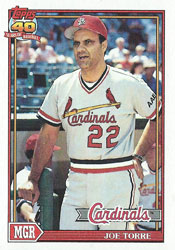
Cardinals coach George Kissell was the most influential mentor in Joe Torre’s transformation from all-star player to manager.

joe_torre3Torre, who won four World Series titles and six American League pennants as Yankees manager, earned election to the National Baseball Hall of Fame on Dec. 9, 2013.

The path toward that achievement began when Torre, then a catcher and first baseman, was traded by the Braves to the Cardinals in March 1969 and connected with Kissell.

In his book “Chasing the Dream,” Torre credited Kissell with creating the foundation for his managing career and teaching him a style that helped Torre earn a World Series championship in his first season (1996) with the Yankees.

Torre also said he learned from Red Schoendienst, who managed the Cardinals during Torre’s playing tenure with St. Louis (1969-74).

Successful skippers

Torre, who managed the Mets, Braves, Cardinals, Yankees and Dodgers, joined another former Cardinals manager, Tony La Russa, and fellow manager Bobby Cox in being elected by the Expansion Era committee. La Russa (second at 2,821), Cox (fourth at 2,504) and Torre (fifth at 2,326) rank in the top five in career wins for managers. Connie Mack (3,731) is first and John McGraw (2,763) is third.

A candidate needed 12 of the votes from the 16-member committee. Hall of Fame managers Whitey Herzog and Tom Lasorda were on the committee.

According to Hall of Fame rules, a candidate must have been a big-league manager for 10 or more years and have been retired for at least five years before he is eligible for election. However, if the retired manager is 65 or older, he becomes eligible just six months after retiring.

Cardinals classics

Torre was 20 when he debuted in the majors with the Braves in 1960. “Warren Spahn and Lew Burdette took me under their wings,” Torre recalled to Cardinals Yearbook in 2014. “They were like big brothers to me. They took me to the movies the first time we came to St. Louis.”

A five-time all-star with the Braves, Torre was traded to the Cardinals for first baseman Orlando Cepeda on March 17, 1969.

Kissell was a coach on Schoendienst’s staff during Torre’s six seasons as a Cardinals player. He converted Torre into a third baseman with St. Louis.

When Tim McCarver, the catcher for three pennant-winning Cardinals clubs in the 1960s, returned to St. Louis to play in 1973 and 1974, he, Torre and Kissell spent much time together.

In his book, Torre said, “Timmy and I were almost always the first ones at the ballpark … Kissell always was there early, too. The three of us would spend hours talking about baseball. Looking back on it, that’s when I started to get the foundation for my managing career.”

Torre said he and McCarver “talked a lot about managing in those days” and discussed the possibility of operating as co-managers of a team.

“I learned more baseball from George Kissell than from anyone else in my life,” Torre said. “He used to have a great saying: The most important word in the baseball dictionary is why. And that’s pretty much what Timmy, George and I would do. We’d constantly ask ourselves why things had happened in games. Sometimes (Bob Gibson) and (Dal Maxvill) would sit in, too. They were very stimulating and enlightening sessions.”

McCarver, in his book “Few and Chosen,” said of Torre, “I came to know Joe as a man of intelligence, grace and compassion. His knowledge of baseball and his unique people skills made him a good bet to succeed as a manager.”

Lessons learned

Torre cited specific examples of how he was helped by Kissell.

“George showed me how to create runs by stealing bases and moving runners,” Torre related. “He taught me that while running to first base you should run through the bag and not to it. He taught me that outfielders should reposition themselves according to the count on the hitter and not just plant themselves in the same spot.

“And he taught me an unorthodox defense with a runner on third when it’s time to bring the infield in: With a right-handed hitter, and with the count in his favor, you leave your third baseman back at normal depth. That puts pressure on the runner and third-base coach in whether to decide to break for home on a ground ball.”

In an interview with Stan McNeal of Cardinals Magazine, Torre said Kissell “put in the most time with me and I learned the most baseball from him. There were a lot of things I never thought to think about until I associated with Kissell.”

Schoendienst, Torre’s only manager in St. Louis, was “perfect” for the Cardinals, Torre said. Schoendienst’s style helped Torre in his first season with the Yankees.

“As a manager, sometimes you assume a lot _ that your players know what they are supposed to do and that they understand your moves,” Torre said in his book. “Red was able to take that approach because he had such a smart, seasoned bunch. Luckily so did I with the (1996) Yankees. It was the first year that kind of approach worked for me. The Yankees’ professionalism really made me think back to those classy Cardinal teams.”

Schoendienst “was definitely an influence for me,” Torre told Cardinals Magazine.

In his 2014 interview with Cardinals Yearbook, Torre said Schoendienst “basically trusted the players. He knew what he wanted from them, and it was only to go out and do the best you can and not beat yourself. I took a great many things from his philosophy going forward. I was a little different from other managers. I didn’t try to micromanage everything. i trusted my players to go out there and hopefully be in a position to want the same things I wanted.”

When Torre managed the Cardinals from 1990-95, Kissell was a Cardinals instructor and Torre had him coordinate the team’s spring training.

“He questioned everything,” Torre said. “He had a favorite line: ‘Joe, who wrote the book?’ And I’d say, ‘Nobody, George. Nobody wrote the book.’ That was George’s way of reminding me that I could make any move I wanted as a manager as long as I had the right reasons for it _ whether it was unpopular or unorthodox. That style helped me in the 1996 World Series. I surprised some people with moves like benching Wade Boggs against a right-handed pitcher, letting my pitcher bat in the ninth inning and putting the potential winning run on base intentionally.”

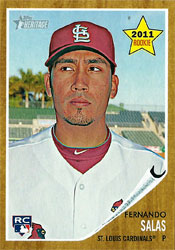
In 2011, Fernando Salas was the coolest and calmest Cardinal amid the chaos of a bullpen collapse.

fernando_salasWithout the poise Salas displayed in effectively filling the closer role for most of the 2011 season, the Cardinals never would have been in position to make their late-season run for the wild-card playoff berth that put them on the path to a World Series championship.

When the Cardinals traded third baseman David Freese and Salas to the Angels for center fielder Peter Bourjos and outfield prospect Randal Grichuk on Nov. 22, 2013, Freese, hitting hero of the 2011 World Series, deservedly received countless fond farewells.

Salas virtually was ignored.

Often overlooked is that Salas was “the stabilizing force” in the Cardinals’ 2011 season, according to teammate Lance Berkman.

S.O.S. for Salas

Sid Monge, a former big-league reliever who became a pitching coach in the Cardinals’ minor-league system, had seen Salas pitch in the Mexican League and recommended St. Louis sign him in 2007.

After making his big-league debut with St. Louis in 2010, Salas gave up just one run during the Cardinals’ entire spring training camp in 2011, but failed to make the Opening Day roster. He reported to Memphis and earned two saves in three scoreless relief appearances for the Class AAA club.

Meanwhile, Ryan Franklin, the Cardinals’ veteran closer, was blowing leads at an alarming rate. Desperate, the Cardinals turned to Mitchell Boggs and then Eduardo Sanchez as the closer and called up Salas to bolster the bullpen.

When neither Boggs nor Sanchez could hold down the job, the Cardinals tried Salas.

Unflappable, the spring training reject blossomed as the closer, earning 16 saves in his first 18 chances.

Berkman, the Cardinals’ veteran right fielder, told Derrick Goold of the St. Louis Post-Dispatch that Salas is “the single stabilizing force on this team.”

“He’s stepped up and been a consistent performer in the back of the bullpen,” Berkman said. “… Consequently, everybody else has settled into a good role. Now we have a pretty solid group. But the key is him.”

Wrote Joe Strauss of the Post-Dispatch: “Salas has become an unexpected answer to a ninth-inning riddle that once jeopardized an entire season.”

Mixing a changeup with his fastball, Salas, who turned 26 on May 30, 2011, was 3-0 with 11 saves and a 1.88 ERA on June 7 that season.

Strong, silent type

Cardinals manager Tony La Russa told the Post-Dispatch that Salas had “a good coolness to him.”

“He’s got great guts,” La Russa said.

Added pitching coach Dave Duncan: “He hasn’t been in any situation yet where it’s like he’s emotionally affected by it.”

Said general manager John Mozeliak: “The one thing about him is that he’s always remained calm and cool. That quality serves him well.”

Salas’ skills were best illustrated in a May 19, 2011, game against the Astros. Brought in to protect a two-run lead, Salas faced former Cardinals prospect Brett Wallace with one on and one out in the ninth.

After throwing three consecutive pitches outside the strike zone, Salas was in danger of walking Wallace and putting the tying run on base. He got Wallace to foul off three pitches and then struck him out swinging on an off-speed offering. The Cardinals won, 4-2. Boxscore

“My favorite pitch of the whole game was that 3-and-2 off-speed pitch,” La Russa said to the Post-Dispatch. “… It’s one of those that if you miss a little bit all kinds of bad things can happen. One of the things Fernando can do is control his off-speed stuff.”

Said Mozeliak: “Over the last three years, his ability to pitch has evolved. He has shown the ability to get big outs. It’s not something you can trace on a radar gun. It’s a credit to him.”

Using teammate and fellow Mexican Jaime Garcia as an interpreter, Salas said simply, “I feel really good. I’m basically down for whatever they want me to do.”

The Cardinals utilized Salas as the closer until power pitcher Jason Motte took over the role in the last month. Still, Salas helped down the stretch, posting a 2.19 ERA with one save in 12 September appearances.

Salas finished the 2011 season with 24 saves and a 2.28 ERA in 68 games. He struck out 75 batters in 75 innings and yielded only 50 hits.

Right-handed batters hit .164 (25-for-152) against Salas in 2011. With runners in scoring position, all batters hit .203 (13-for-64) off him.

Though he couldn’t repeat that success _ he was 1-4 with a 4.30 ERA in 2012 and 0-3 with a 4.50 ERA in 2013, with no saves in either season _  Salas’ rescue of the Cardinals in 2011 should be better appreciated.

Previously: Roger Craig, Ron Taylor: great relief for Cardinals

(Updated March 6, 2022)

David Freese always will belong to an exclusive Cardinals club: starting third basemen for World Series champions.

david_freese3The feat is so rare that only one Cardinals third baseman, Whitey Kurowski, has done it more than once for St. Louis.

The list:

LES BELL, 1926

_ Season performance: Bell, 24, had 189 hits, 33 doubles, 14 triples, 17 home runs, 100 RBI and batted .325 for the 1926 Cardinals. He became the first Cardinals third baseman to achieve 100 RBI in a season. Bell’s 301 total bases in 1926 ranked second in the National League behind teammate Jim Bottomley (305).

_ World Series performance: In Game 6, with the Cardinals facing elimination, Bell had three hits and four RBI in St. Louis’ 10-2 victory at Yankee Stadium. Bell hit a two-run single off Bob Shawkey in the first inning and a two-run home run off 19-game winner Urban Shocker in the Cardinals’ five-run seventh. In seven games, Bell had six RBI and batted .259 (7-for-27). Boxscore

SPARKY ADAMS, 1931

_ Season performance: Just 5 feet 5 and 150 pounds, Adams, 37, led the National League in doubles (46), scored 97 runs, had 16 steals and batted .293 for the 1931 Cardinals. He also led National League third basemen in fielding percentage (.963) and in double plays turned (29).

_ World Series performance: Hobbled by a leg injury, Adams was limited to four at-bats and a single in the seven-game Series versus the Athletics. Andy High, 33, was the primary replacement for Adams. In Game 7, High, batting leadoff, had three of the Cardinals’ five hits and scored twice in a 4-2 St. Louis victory. Boxscore

PEPPER MARTIN, 1934

_ Season performance: Martin, 30, led the National League in stolen bases (23) and batted .289 with 25 doubles and 11 triples for the 1934 Cardinals.

_ World Series performance: He hit .355 (11-for-31) in the seven games against the Tigers and scored eight runs. In Game 7, an 11-0 St. Louis victory, Martin batted leadoff and scored three times. Boxscore

WHITEY KUROWSKI, 1942, 1944, 1946

_ Season performances: Kurowski, 24, hit .254 as a rookie in 1942, .270 with 20 home runs in 1944 and .301 with 89 RBI in 1946.

_ World Series performances: His only World Series home run, a two-run shot off Red Ruffing in the ninth inning, snapped a 2-2 tie and carried the Cardinals to a 4-2 victory in the decisive Game 5 at Yankee Stadium. Boxscore

Kurowski had five hits in six games in the 1944 Series versus the Browns. He scored five runs and had eight hits, including four in the Cardinals’ 12-3 Game 4 triumph, against the Red Sox in 1946. Boxscore

KEN BOYER, 1964

_ Season performance: Boyer, 33, earned the National League Most Valuable Player Award, batting .295 with 30 doubles, 10 triples, 24 home runs and a league-leading 119 RBI for the 1964 Cardinals.

_ World Series performance: His sixth-inning grand slam off Al Downing in Game 4 lifted the Cardinals to a 4-3 victory at Yankee Stadium, tying the Series. He had two home runs and six RBI in the seven games. Boxscore

Ken Boyer’s younger brother, Clete Boyer, was the Yankees’ third baseman in that World Series. Recalling his brother’s grand slam that kept the Yankees from taking a three games-to-one advantage, Clete told Dave Anderson of the New York Times, “When he hit that homer, I loved it. In my heart, I think I was pulling for him that year because it was his first Series.”

MIKE SHANNON, 1967

_ Season performance: In his first season as a third baseman after converting from outfielder, Shannon, 28, produced 77 RBI (second on the team, behind Orlando Cepeda) and committed 29 errors (second-most among National League third basemen. Only Richie Allen of the Phillies had more, with 35).

_ World Series performance: Shannon had five hits in seven games, including a two-run home run off Gary Bell in the Cardinals’ 5-2 victory over the Red Sox in Game 3. Boxscore

KEN OBERKFELL, 1982

_ Season performance: Oberkfell, 26, led National League third basemen in fielding percentage (.972) and ranked third in assists (304). He also hit .289 with 136 hits in 137 games.

_ World Series performance: He had seven hits in seven games versus the Brewers and batted .292.

SCOTT ROLEN, 2006

_ Season performance: Rolen, 31, won his seventh Gold Glove Award and batted .296 with 48 doubles, 22 home runs and 95 RBI.

_ World Series performance: He hit safely in all five games against the Tigers and batted .421 (8-for-19) with three doubles and a Game 1 home run off Justin Verlander. Boxscore

DAVID FREESE, 2011

_ Season performance: Freese, 28, led National League third basemen in double plays turned (23) and batted .297 with 99 hits in 97 games.

_ World Series performance: His two-run, two-out triple off Neftali Feliz in the ninth tied the score at 7-7 and his walkoff home run against Mark Lowe leading off the 11th lifted the Cardinals to an epic 10-9 victory in Game 6. Freese hit .348 (8-for-23) for the Series with seven RBI. Boxscore


Playing a position primarily reserved for run producers, first baseman Tino Martinez failed too often to deliver for the Cardinals.

tino_martinez2That was the primary reason the Cardinals traded Martinez to the Rays.

On Nov. 21, 2003, the Cardinals dealt Martinez, a Tampa native, to the Rays for minor-league pitcher Evan Rust and a player to be named. A month later, the Rays sent minor-league first baseman John-Paul Davis to the Cardinals, completing the trade.

To sweeten the deal, the Cardinals agreed to pay most of Martinez’s $7.5 million salary for 2004, MLB.com reported.

By moving Martinez, the Cardinals were able to switch a more reliable run producer, Albert Pujols, from left field to first base in 2004.

Power outage

The 2003 Cardinals, the only St. Louis team from 2000 through 2006 to miss qualifying for the National League playoffs, stranded 1,217 runners, three fewer than the Phillies, the league leader in that category.

Martinez shouldered a good deal of the blame for those missed opportunities. He batted .210 (29-for-138) with runners in scoring position in 2003. That was far below his career average of .278 with runners in scoring position.

Martinez, who turned 36 three weeks after the trade, also produced a paltry .429 slugging percentage in 2003. Only Sean Casey (.408) of the Reds and Robert Fick (.418) of the Braves had lower slugging percentages in 2003 among National League first basemen with at least 400 at-bats.

“I wasn’t happy with the way I played in St. Louis,” Martinez said to MLB.com. “I didn’t play up to my capability.”

Said Cardinals manager Tony La Russa to the St. Louis Post-Dispatch: “I thought he competed, but he wasn’t as productive as he’s been.”

Martinez, who topped 100 RBI in a season five times with the Yankees, had become a free agent and signed with the Cardinals in December 2001 as the replacement at first base for Mark McGwire, who retired.

In 2002, Martinez produced 25 doubles, 21 home runs and 75 RBI in 150 games for St. Louis, but he batted .246 (33-for-134) with runners in scoring position.

The next season, his home run and RBI totals dropped to 15 and 69 while his .210 batting average with runners in scoring position was far less than utility players such as Bo Hart (.274) and Kerry Robinson (.292).

In his two seasons with St. Louis, Martinez batted .267 with 36 home runs and 144 RBI. His .434 slugging percentage as a Cardinal was disappointing when compared with his career mark of .471.

Rocky road

“I don’t think we view Tino’s time here as a disaster or a mistake,” Cardinals general manager Walt Jocketty told the Post-Dispatch. “… For some reason, he got a bad rap from people.”

La Russa touted Martinez as one of the team leaders, along with catcher Mike Matheny and pitcher Woody Williams, who held the players together in 2002 after the sudden death of teammate Darryl Kile. “It bothers me to see a stain on this guy,” La Russa said to Joe Strauss of the Post-Dispatch.

There were reports Martinez had become a disgruntled clubhouse presence in 2003 as his performance waned and the pressure increased.

Wrote Strauss: “Initially projected as protection for Pujols, Martinez became frustrated over his varied place in the batting order and decreased playing time against left-handed pitching.”

The Cardinals entered September 2003 in first place in the National League Central Division. They stumbled and finished in third. It didn’t go unnoticed that Martinez batted .217 (13-for-60) in September.

After the trade, Post-Dispatch columnist Bryan Burwell described Martinez’s attitude in the clubhouse as being like an “annoying pebble.”

Wrote Burwell: “And now that Martinez is gone, you have to wonder if he is the only pebble that was lodged in the Cardinals’ shoes. Does the absence of his negative presence mean that the clubhouse troubles are gone with him? Or does it mean that there are still a few more folks who need to go?”

With second baseman Fernando Vina departed for free agency, the Cardinals reportedly were looking to sign veterans Kenny Lofton to replace Pujols in left field and Roberto Alomar to replace Vina.

“One of the things we are trying to do is improve our table-setters at the top of the lineup,” La Russa said to MLB.com.

Instead, the Cardinals reacquired Ray Lankford to play left field and, late in spring training, signed Red Sox reject Tony Womack to play second base.

Those moves helped the Cardinals to a pennant-winning season in 2004.

Previously: Tino Martinez, Mike Matheny and the Cards’ Easter brawl

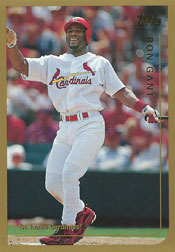
In 1998, the Cardinals were so eager to unload outfielder Ron Gant and reliever Jeff Brantley that they paid the Phillies $6 million to take the underperforming malcontents off their hands.

ron_gantGant and Brantley responded with a series of toxic salvos. Brantley ripped pitching coach Dave Duncan and Cardinals fans. Gant accused manager Tony La Russa of being unethical, immoral and a racist.

The attacks proved baseless. The accusers looked classless.

What both players were attempting to camouflage was their skills had eroded from the days when they were all-stars.

Seeking a transformation after failing to qualify for the postseason in 1997 and 1998, the Cardinals made a flurry of transactions on Nov. 19, 1998. They signed two free agents _ outfielder Eric Davis and reliever Scott Radinsky _ and traded Gant, Brantley and pitcher Cliff Politte to the Phillies for pitchers Ricky Bottalico and Garrett Stephenson.

To seal the deal, the Cardinals agreed to pay $5 million of the $11 million Gant was due on the last two years of his contract and $1 million of Brantley’s $2.8 million contract for 1999.

True grit

Though they hit 223 home runs, the 1998 Cardinals finished in third place in the National League Central Division, 19 games behind the champion Astros. Gant hit 26 home runs in 121 games, but struck out 92 times in 383 at-bats and hit .240. Brantley, expected to be the closer, produced 14 saves, but also had eight blown save chances, gave up 12 home runs in 50.2 innings and posted an 0-5 record and 4.44 ERA.

On the eve of the trade, Cardinals general manager Walt Jocketty told St. Louis Post-Dispatch columnist Bernie Miklasz, “We want more guys who are gritty and hard-nosed.”

Eric Davis had survived colon cancer surgery and Scott Radinsky had fought Hodgkin’s disease. “They’re very strong-willed and competitive and they’re battlers,” Jocketty said to Post-Dispatch reporter Rick Hummel. “That’s the type of people you want to bring to this club.”

After the trade, Brantley told Hummel that when he reported to spring training with the 1998 Cardinals “my arm still hurt.” Brantley had shoulder surgery in 1997 while with the Reds.

Boos for Brantley

Brantley said he was mishandled by Duncan and mistreated by the fans.

“My relationship with Duncan was absolutely terrible,” Brantley said to Hummel. “Whether it was my fault or his fault, I don’t know.”

Said Duncan: “All I can say is that it was not an ideal working relationship. It wasn’t because I didn’t try to make it work.”

Regarding the booing he received, Brantley said, “It’s kind of sorry to take a guy coming off major arm surgery and make him a scapegoat for your ballclub. … I’m not very happy the way I was treated. I was treated grossly unfairly in that ballpark.”

In a parting shot, Brantley said of Gant: “He’ll be glad to get a new place without all the head games and mind games.”

Big whiff

Gant, however, was uncomplaining when interviewed by Hummel about the trade. “There were times I didn’t do my job because of my injuries,” said Gant, slowed by a right hamstring injury in 1998. “… I would have liked to have been with the Cardinals. I had a great time here.”

Said La Russa of Gant: “He would have flashes where you saw what he could do and he could dominate a game and then he would swing and miss a lot where it was tough for him to help.”

A month after the trade, Gant sparked controversy when he told Philadelphia media that Mark McGwire, who hit 70 home runs that year, hampered others in the Cardinals lineup by batting third in the order.

Responding on a St. Louis radio show, La Russa said of Gant, “It was whiff, whiff, whiff. I really hope he goes to Philly and whiffs for them like he whiffed for us. And we’ll see what excuses he makes.”

La Russa also commented on Brantley’s earlier criticism of Duncan. Said La Russa: “Duncan went to bat for him a hundred times.”

“What really ticks me off is that these are the two guys that we, as an organization, worked harder for than anyone else,” La Russa said.

Getting personal

Gant waited to respond until he reported to Phillies spring training camp in February. He told the Philadelphia Inquirer that La Russa has “no morals or values. That’s just the type of person (La Russa) is. Anybody who treats (shortstop) Ozzie Smith like he’s a kid coming up from the minors has no ethics or morals to him.”

In an interview with Hummel, La Russa responded: “You can say I’m a stupid manager. But unethical? Immoral? That’s very strong stuff. That’s like lying, cheating and stealing. Did I do all those things to Ozzie Smith?”

Gant continued his attack in subsequent interviews. “I have nothing against St. Louis,” Gant told reporters. “It’s just the person I was playing under. He didn’t get along with Rickey Henderson. Royce Clayton didn’t like him. Ozzie Smith, he treated like he was the worst person on earth.”

Asked whether there was significance in that Gant and the players he mentioned are black, Gant replied. “Yeah, there is.”

A stunned La Russa responded: “He’s getting lower than cheap.”

Several black players, including former Cardinals outfielder Brian Jordan, defended La Russa and angrily discounted Gant’s accusations. Dave Stewart, a black pitcher who played for La Russa, said, “To call Tony a racist is off base.”

Wrote Miklasz: “Gant continues to embarrass himself by blaming someone else for his failure to earn the $15 million paid to him by the Cardinals over the past three seasons … In my 20 years as a sportswriter, I have never seen a baseball manager protect a player the way Tony La Russa covered for Gant.”

Fade away

Soon after that, Gant issued a half-hearted apology: “All I can say is I apologize to my fans and the families involved. … I apologize to anybody who might have been hurt.”

In May, just before the Phillies played the Cardinals for the first time in 1999, Gant, asked about the controversy, told the Post-Dispatch: “I’ve been told not to comment on that anymore. That whole situation is over. We both said things that we regret.”

By then, though, Gant was being booed regularly by Phillies fans. He entered that series against the Cardinals with a .223 batting average. In July 2000, the Phillies traded Gant to the Angels. He bounced from there to the Rockies, Athletics and Padres before playing his final season in 2003.

Brantley pitched in 10 games for the 1999 Phillies, posting a 1-2 record and 5.19 ERA. He had a 5.86 ERA for the 2000 Phillies and a 5.14 ERA for the 2001 Rangers before retiring as a player.