Feeds:
Posts
Comments

(Updated Jan. 8, 2014)

Frank Thomas spent his 19-year big-league career in the American League, which is fortunate for the Cardinals, because they were limited to facing him in interleague competition.

frank_thomasIn 12 games against the Cardinals from 1997-2000, the White Sox slugger punished St. Louis pitching. His .372 career batting mark versus the Cardinals (16-for-43) is his highest against any opponent whom he has 50 at-bats against.

Thomas, a first baseman and designated hitter for the White Sox, Athletics and Blue Jays from 1990-2008, was elected to the National Baseball Hall of Fame by the Baseball Writers Association of America on Jan. 8, 2014.

A two-time winner of the American League Most Valuable Player Award, Thomas hit .301 with 521 home runs and 1,704 RBI in his big-league career. He won an American League batting title (with .347 in 1997) and four times topped the league in on-base percentage.

Thomas’ last game against the Cardinals was one of the best of his career. He tied a career-high with six RBI in a 15-7 White Sox victory on July 15, 2000. Boxscore

It was one of only two times Thomas achieved six RBI in a game. He first did it on May 15, 1996, against the Brewers. Boxscore

Thomas got his six RBI against the Cardinals on two swings: a three-run home run in the first inning off Darryl Kile and a three-run double in the seventh off Mike Matthews.

The performance showed how Thomas had emerged as a White Sox leader.

In 1999, Thomas had feuded with White Sox manager Jerry Manuel. The two also got into a shouting match during spring training in 2000, according to the St. Louis Post-Dispatch.

“Manuel essentially challenged Thomas to take an active role in the club, to be a teammate to the young players,” the Post-Dispatch reported.

Thomas rose to that challenge in what was a contentious Cardinals-White Sox series in July 2000. Three Cardinals batters (Fernando Tatis twice and Fernando Vina once) were hit by pitches in the July 14 game against the White Sox. Boxscore

The next day, Tatis and teammate Eduardo Perez were hit by pitches and so, too, were Magglio Ordonez and Jose Valentin of the White Sox. It was after Valentin was plunked that Thomas hit his bases-clearing double, capping his six-RBI performance, and sending a message to his teammates.

“Being the leader has definitely been my role,” Thomas said. “I had to embrace that. It’s been a challenging year for me … Maybe I was down for a while and wasn’t motivated. I said to myself I was going to give my best, day in and day out, and be the best possible teammate I can be.”

Previously: As player, Robin Ventura was tough on Cardinals

(Updated June 16, 2023)

Tom Glavine was at the center of some of the biggest postseason highs and lows for the Cardinals during Tony La Russa’s era as manager.

tom_glavineGlavine was elected to the National Baseball Hall of Fame by the Baseball Writers Association of America on Jan. 8, 2014.

In a big-league career for the Braves and Mets from 1987-2008, the left-handed pitcher had a 305-203 record, won two Cy Young awards, led the National League in wins five times and posted double-digit wins 14 years in a row (1989-2002).

Glavine dominated the Cardinals. His 20-6 career record against St. Louis in the regular season represented a .769 winning percentage, Glavine’s highest versus any National League foe.

From September 2000 to September 2008, Glavine allowed one regular-season home run to a Cardinal. It was hit on May 18, 2004, by Mike Matheny. Boxscore

In the postseason, Glavine was 2-3 against the Cardinals. His most memorable playoff performances versus St. Louis occurred in the National League Championship Series of 1996 and 2006.

Big hit in big game

Glavine was the starting and losing pitcher for the Braves in Game 3 of the 1996 NL Championship Series. Donovan Osborne started for St. Louis and was the winner in a 3-2 Cardinals victory. Boxscore

Game 7 was a rematch of Osborne vs. Glavine _ and Glavine delivered with his arm and his bat.

In the first inning, the Braves were ahead, 3-0, and had the bases loaded with two outs and Glavine at bat. Andy Benes was warming up in the bullpen and ready to relieve, but La Russa stuck with Osborne.

Said La Russa to the St. Louis Post-Dispatch: “I second-guess myself as much as anybody, but there’s no way I’d get Osborne out with the bottom of the lineup up.”

Glavine lined an Osborne pitch to left field. Ron Gant attempted a diving catch but missed. The ball got past Gant and into the corner. Glavine raced to third with a three-run triple, giving the Braves a 6-0 lead and deflating the Cardinals.

“That base hit was a big base hit in the ballgame,” Glavine said. “If St. Louis gets out of it trailing only 3-0, they’re still in the ballgame.”

Said Gant: “It was one of those plays that was do or die. If you let it drop, they’re going to score a couple runs anyway. Just go all out. See if you can get to it. An inch away, I think.”

Glavine shut out the Cardinals on three hits for seven innings before he was relieved and the Braves coasted to a 15-0 victory, winning the pennant and advancing to the World Series against the Yankees.

“I don’t think we expected to be as dominant as we were,” Glavine said. Boxscore

Old Man River

Ten years later, Glavine, 40, was pitching for the Mets against the Cardinals in the 2006 NL Championship Series. He was superb in Game 1, keeping the Cardinals off balance with a mix of changeups and fastballs on the outside corner. Glavine pitched seven scoreless innings, limiting St. Louis to four hits, and got the win in a 2-0 Mets victory. Boxscore

In his book, “Baseball for Brain Surgeons and Other Fans,” broadcaster and former Cardinals catcher Tim McCarver said, “Glavine is so consistent that he can throw two inches off the plate and get strike calls. When hitters move toward the plate to be able to reach those pitches that are being called strikes, he comes inside enough to keep them honest.

“In the absence of velocity, Glavine relies on a controlled fastball and, for deception, a circle change. He’s like a golfer who never gets much distance on his drives but is always in the fairway.”

With the best-of-seven series squared at 2-2, Glavine was paired against his Game 1 counterpart, Jeff Weaver, in the pivotal Game 5. It would be Glavine’s 35th postseason start, a major league record.

Glavine cruised through the first three innings. The Mets led, 2-0, as the Cardinals came to bat in the bottom of the fourth.

With one out, Albert Pujols crushed a home run off Glavine and snapped the Cardinals out of their funk.

Wrote Post-Dispatch columnist Bernie Miklasz: “The Cardinals began taking pitches. They started to stroke the ball to the opposite field.”

The Cardinals tied the score in the fourth and went ahead, 3-2, in the fifth, knocking Glavine out of the game. The Cardinals went on to a 4-2 victory. Boxscore

Under the headline “Cardinals Put Mets’ Aging Artist on Canvas,” Miklasz observed, “The more intelligent the Cardinals’ approach, the more Glavine gave way. By the end of his start, the classy future Hall of Famer was like one of those old barges on the Mississippi River, stalled on a sandbar.”

It was only the second time Glavine had lost a postseason game in which he was given a lead of two runs.

Inspired, the Cardinals dispatched the Mets in seven games and went on to defeat the Tigers in five to earn their first World Series championship in 24 years.

(Updated Jan. 8, 2014)

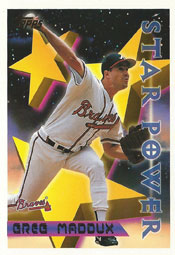
Greg Maddux lost to the Cardinals more than he did against any other club.

greg_madduxThat doesn’t diminish the career accomplishments of Maddux, who was elected to the National Baseball Hall of Fame by the Baseball Writers Association of America on Jan. 8, 2014.

Rather it’s a tribute to the Cardinals for often solving a pitcher who dominated the sport throughout the 1990s.

The Cardinals beat Maddux 22 times _ 20 in the regular season and twice in the postseason. The Phillies came closest to matching St. Louis, beating Maddux 20 times in the regular season and once in the postseason.

Maddux, who pitched for the Cubs, Braves, Dodgers and Padres from 1986-2008, was 26-20 with a 2.84 ERA versus the Cardinals in the regular season and 1-2 in the postseason.

The right-hander had the most regular-season wins in his career against the Mets (35) and Giants (31).

In his 23 seasons in the big leagues, Maddux was 355-227 in the regular season. He won four consecutive Cy Young awards (1992-95), 18 Gold Glove awards and led the National League in ERA four times. He posted at least 15 wins in 17 consecutive seasons (1988-2006).

Several players who spent at least parts of their careers with the Cardinals hit well against Maddux. Among the best: Pedro Guerrero, .405 (17-for-42); Albert Pujols, .341 (14-for-41); Vince Coleman, .328 (20-for-61); Jose Oquendo, .317 (13-for-41); Edgar Renteria, .314 (16-for-51) and Scott Rolen, .314 (22-for-70).

Power vs. pitching

Ray Lankford hit four career home runs against Maddux (three as a Cardinal; one as a Padre) and Pujols hit three homers (all as a Cardinal) versus Maddux.

One of those home runs by Pujols came in a game when the Cardinals hit three off Maddux.

On July 9, 2004, Renteria, Pujols and Jim Edmonds each hit a solo homer against Maddux in a 6-1 Cardinals victory over the Cubs at St. Louis. Maddux yielded four runs and eight hits in six innings.

“I tip my hat to Renteria and Edmonds,” Maddux said to the Chicago Sun-Times. “I didn’t think they were bad pitches. Pujols, I left that up. It’s not surprising he hit it out.”

Bernie Miklasz, columnist for the St. Louis Post-Dispatch, credited Cardinals manager Tony La Russa for the rare rout of Maddux that night.

Wrote Miklasz: “La Russa protested after home plate umpire Derryl Cousins gave Cubs starter Greg Maddux a strike zone so large you could have driven the team bus through it. La Russa got ejected, which, according to the Chicago Sun-Times, prompted laughter from Cubs manager Dusty Baker. It might have been a coincidence, but the strike zone narrowed and the Cardinals teed off on Maddux.” Boxscore

Fast and effective

The best game Maddux pitched against the Cardinals was a two-hit shutout on Aug. 20, 1995, in a 1-0 Braves victory at St. Louis.

“That’s probably the best I’ve ever thrown,” Maddux told the Post-Dispatch. “That’s as good as I can throw the ball.”

Brian Jordan singled in the fifth and Danny Sheaffer doubled in the sixth for the lone St. Louis hits. It was the quickest big-league game of the 1995 season, finishing in 1:50.

“That happened so fast I don’t even think my wife made it in time,” Jordan said. “She usually doesn’t get here until the later innings.” Boxscore

Previously: Near no-hitter by Alan Benes became crushing loss

(Updated Oct. 21, 2018)

As a rookie with the 1995 Cardinals, David Bell hit a magical home run and became friends with John Mabry.

david_bellThe former gave him a special lifetime memory.

The latter helped him reunite with the Cardinals.

Bell and Mabry were Cardinals teammates from 1995-98. Both also played for the Mariners in 1999 and 2000.

Their friendship helped lead to the decision by Bell to join the Cardinals as assistant hitting coach in 2014 when Mabry was the club’s hitting coach. In 2013, Bell was third base coach for the Cubs.

On Nov. 3, 2014, Bell was promoted to bench coach of the Cardinals, replacing Mike Aldrete, who resigned to join the Athletics staff. After the 2017 season, Bell left the Cardinals for a front office position, vice president of player development, with the Giants. On Oct. 21, 2018, Bell was chosen to be manager of the Reds.

Good genes

Bell, whose grandfather, Gus, and father, Buddy, were all-star players in the major leagues, made his big-league debut with the 1995 Indians, appearing in two games before being sent back to the minor leagues. Bell’s best positions were third base and second base, but the 1995 Indians had stellar players at those spots, with Jim Thome at third and Carlos Baerga at second.

On July 27, 1995, the Cardinals traded pitcher Ken Hill to the Indians for Bell, pitcher Rick Heiserman and minor-league catcher Pepe McNeal.

“I like David Bell,” Cardinals general manager Walt Jocketty told the St. Louis Post-Dispatch. “He’s a guy who has a chance to be a very good major league player for a long time.

“If, as a scout, you graded out his tools, you’d say he has a little below average speed, that he was an above average hitter with above average power and above average defensively. But he’s the type of player you know is going to get the job done. He’s been around the game for a while and it shows. He’s a character type of player who’s got a winning attitude.”

Asked about his son’s reaction to the trade, Buddy Bell, bench coach for the 1995 Indians, said, “He’s a little nervous. The first time you get traded, you never know what to expect. But he was getting impatient. He felt that no matter what he did at (Class AAA), it wouldn’t be enough to move him up there (to the Indians).”

Said David Bell: “It’s a nice break for me.”

David Bell was born and raised in Cincinnati. His grandfather Gus Bell had been a standout outfielder for the Reds from 1953-61, four times achieving more than 100 RBI in a season. David’s father Buddy Bell was a premier third baseman. He earned six consecutive Gold Glove awards in the American League from 1979-84. Buddy also played for the Reds from 1985-88.

David was the given name of both Gus Bell and Buddy Bell. David Bell was close to both his grandfather and father. On May 7, 1995, four days after David Bell made his major-league debut with the Indians, Gus Bell died.

Hometown home run

In late August 1995, just before the Cardinals went to Cincinnati for the first time since acquiring Bell, Mike Eisenbath of the Post-Dispatch wrote, “David, Gus and Buddy are so much alike. Quiet. Hard-working. Unassuming. Fundamentally sound afield, solid with a little pop in their bats. Respected. By his very nature, David seemed destined to follow Dad and Grandpa.”

On Aug. 30, 1995, playing in Cincinnati before a Riverfront Stadium crowd that included his grandmother, mother and several other family members and friends, Bell came to bat for the Cardinals in the sixth inning against Reds starter Mark Portugal. The score was tied at 2-2 and Ray Lankford was on first base for St. Louis.

Bell hit a Portugal pitch over the left-center field fence for his first big-league home run.

The ball caromed off a wall behind the fence and bounced back onto the field. Reds outfielder Darren Lewis retrieved the ball and threw it into the outfield seats.

Alerted to the significance of the home run, Lewis got another ball and tossed it into the stands in exchange for the ball Bell hit.

The Cardinals won, 4-3. Bell, 22, told the Post-Dispatch he would give the ball to his mother.

“It’s something I’ll remember,” Bell said. Boxscore

Postseason success

Used mostly as a utility infielder, Bell hit .225 with four home runs in four seasons with the Cardinals. In April 1998, the Cardinals, looking to send Bell to the minor leagues, placed him on waivers. He was claimed by the Indians.

Bell played 12 years (1995-2006) in the major leagues for the Indians, Cardinals, Mariners, Giants, Phillies and Brewers. He had a career .257 batting average, with 1,239 hits in 1,403 games.

In 1999, Bell had 31 doubles, 21 home runs and 78 RBI as the second baseman for the Mariners.

Three years later, Bell was the third baseman for the 2002 National League champion Giants. He had 29 doubles, 20 home runs and 73 RBI that year. In the National League Championship Series against the Cardinals, Bell batted .412 and hit a Game 1 home run off Matt Morris. Bell also hit .304 in the 2002 World Series against the Angels.

For pure drama, though, his first home run as a Cardinal is hard to top.

Previously: Buddy Bell almost joined Ozzie Smith in Cardinals’ infield

(Updated April 5, 2025)

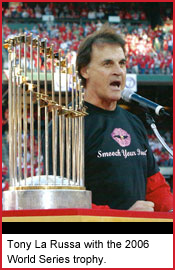
Winning the 2006 World Series championship with the Cardinals sealed for Tony La Russa his eventual election to the National Baseball Hall of Fame.

tony_larussa12By joining Sparky Anderson as managers to win World Series titles in both the National League and American League, La Russa elevated himself into a special class.

La Russa and managers Joe Torre and Bobby Cox were elected to the Hall of Fame on Dec. 9, 2013. Each received 16 unanimous votes from the Expansion Era committee. Whitey Herzog, who, like La Russa and Torre, managed the Cardinals, was one of the voters.

La Russa (2,902), Cox (2,504) and Torre (2,326) rank second, fourth and fifth in career wins for managers. Connie Mack is No. 1 (3,731) and John McGraw (2,763) ranks third.

Herzog, Torre and La Russa managed St. Louis from 1980-2011, giving the Cardinals the distinction of having been led by Hall of Fame managers for 31 consecutive years.

High expectations

The Cardinals fired Torre in June 1995 and, after Mike Jorgensen finished that season as interim manager, La Russa joined the Cardinals in October 1995 after resigning as Athletics manager.

La Russa had won a World Series title and three consecutive American League pennants with the Athletics. In his first 10 seasons in St. Louis, he led the Cardinals into the National League playoffs six times and won a pennant in 2004, but the expectation was he would win a World Series title with the Cardinals.

Doing so with the 2006 Cardinals _ a club that won just 83 regular-season games and ranked fifth in the league in pitching and sixth in both batting and defense _ capped La Russa’s reputation for managerial excellence.

The 2006 World Series championship, achieved in five games against the Tigers, was the Cardinals’ first in 24 years (when Herzog led St. Louis against the Brewers in 1982).

Here is what a couple of St. Louis Post-Dispatch columnists wrote of La Russa after the 2006 championship:

_  Jeff Gordon: “If this is the worst team to ever win a World Series championship, as some will argue, then La Russa’s managerial performance ranks as his greatest effort. … By winning the World Series, La Russa has cemented his place in baseball history.”

_ Rick Hummel: “His reputation here this year has been enhanced by his ability to guide a talented yet flawed club through injury, illness and overzealous expectations.”

Classic Cardinal

Four Cardinals players in the Hall of Fame _ Stan Musial, Red Schoendienst, Bob Gibson and Lou Brock _ were on hand to witness the clinching of the 2006 World Series championship in Game 5 at St. Louis. All four “applaud La Russa as an equal,” Hummel wrote.

In a 2014 interview with Cardinals Yearbook, La Russa said, “Winning that Series, and how we did it, was one of the best moments I can recall. What added to it was winning it at home … It contributed something significant to a franchise that is so incredibly steeped in history. For me, the topper was having Bob Gibson walk by in the clubhouse afterward, shake my hand and say, ‘You’re officially in the club.’ That’s the standard the Cardinals have.”

La Russa capped his career with another World Series title with the Cardinals in 2011. That was another exceptional achievement _ La Russa became the first Cardinals manager to win two World Series crowns since Hall of Famer Billy Southworth did it in the 1940s _ but by then his reputation as being of Hall of Fame caliber already was secured because of what he accomplished in 2006.

Mike Shannon, the club broadcaster who played for Cardinals teams that won two World Series titles and three pennants in the 1960s, provided the Post-Dispatch with the most concise and astute analysis of La Russa after the 2006 World Series. “There’s no doubt he’s going into the Hall of Fame as a manager,” Shannon said in October 2006. “… The people who really understand the game know his worth, his greatness. His value and his greatness will be appreciated more in his absence than in his presence.”


(Updated April 5, 2025)

In the span of 21 years, from August 1990 to October 2011, the Cardinals had two fulltime managers: Joe Torre and Tony La Russa.

larussa_torreBoth entered the National Baseball Hall of Fame together.

Torre managed the Cardinals from August 1990 until June 1995 and, after Mike Jorgensen filled in for three months as interim manager, was replaced by La Russa after the 1995 season.

Torre, La Russa and fellow manager Bobby Cox were elected to the Hall of Fame on Dec. 9, 2013, by the Expansion Era committee. A candidate needed 12 of the votes from the 16-member committee that included Hall of Fame manager Whitey Herzog, who preceded Torre as Cardinals manager.

With Herzog, Torre and La Russa, the Cardinals have the distinction of being led by Hall of Fame managers for 31 consecutive years (1980-2011).

In regular-season head-to-head competition, La Russa had a 15-11 record versus Torre. In the only time they faced one another in the postseason, Torre was 3-0 against La Russa.

Mutual respect

Though their managing styles and personalities differed, La Russa and Torre had a respect and fondness for one another.

In May 2008, when Torre was in his first season as Dodgers manager, he told Joe Strauss of the St. Louis Post-Dispatch he had accepted La Russa’s request to appear in an Animal Rescue Foundation calendar.

“He’s always been very open and congenial,” Torre said. “I’ve had dinner with him on occasions. I’ve worked his charity. I enjoy Tony a great deal. … He’s had great success. The players play hard for him.”

Said La Russa of Torre: “He’s always been a class act, somebody you have a great deal of respect for.”

Asked about differences between the two, Torre replied, “The fact that he’s smarter than I am. He used that ability to gain an edge with technology at times. … And I think he probably controls the game more than I do.”

In a 2014 interview with Cardinals Yearbook, Torre also said of La Russa, “He’s got a heart. He doesn’t let you in until he trusts who you are, but you know that once you’re in the door, it’s straightforward.”

Clash of the titans

Twice, La Russa and Torre were within a win of facing one another in a World Series, but each saw his team falter.

In 1996, when Torre led the Yankees to an American League pennant, La Russa and the Cardinals won three of the first four games against the Braves in the National League Championship Series. The Braves rallied and won the last three games to reach the World Series versus the Yankees.

In 2004, when La Russa and the Cardinals won the National League pennant, Torre and the Yankees beat the Red Sox in three of the first four games of the American League Championship Series. The Red Sox won the last three games and got to the World Series against the Cardinals.

Asked in 2009 by Post-Dispatch writer Rick Hummel about a potential World Series matchup with La Russa, Torre replied, “We came close in ’96 and, of course, in ’04. La Russa messed it up in ’96 and I messed it up in ’04.”

La Russa and Torre first faced one another in June 2003 when the Cardinals played at Yankee Stadium. The Yankees swept the three-game series, outscoring the Cardinals, 23-8.

Afterward, La Russa told the Post-Dispatch, “I really don’t think the Yankees or Yankee fans think we’re all that good.”

Wrote Post-Dispatch columnist Bernie Miklasz: “The anticipated clash of the titans never really materialized. Both franchises qualify as baseball royalty, but only the Yankees played up to their heritage.”

Two years later, in June 2005, the Yankees entered a three-game series at St. Louis a game below .500, having lost nine of their last 11. Media speculation in New York was Torre’s job might be in jeopardy, even though he had won four World Series titles and six American League pennants with the Yankees.

When the Cardinals won the opener, 8-1, an embarrassed Torre told Miklasz, “We were too nonchalant. I was very surprised at how we let them (the Cardinals) run us off the field. We weren’t ready to play.” Boxscore

The Cardinals won two of the three games in that series. La Russa came to Torre’s defense, telling Miklasz, “He’s got more rings than anybody whose managed over the last 10 years. There isn’t anything different about his managing.”

Postseason duel

Torre stayed with the Yankees through the 2007 season before joining the Dodgers in 2008. The move to the National League guaranteed La Russa and Torre would face one another.

La Russa and the Cardinals won four of six against Torre and the Dodgers in the 2008 regular season and five of seven in the 2009 regular season.

In the 2009 National League Division Series, Torre and the Dodgers swept the Cardinals. “Torre warrants praise for winning the duel of future Hall of Fame managers,” Miklasz wrote.

The last season La Russa and Torre faced one another was 2010. The Cardinals won four of seven regular-season games that year against the Dodgers.

La Russa ranks second in career wins for managers at 2,902 and Torre is fifth at 2,326.