Feeds:
Posts
Comments

After sitting out the 2003 baseball season, Ray Lankford worked on his hitting with the help of outfielders Carlos Beltran of the Royals and Moises Alou of the Cubs. At 36, Lankford was plotting a comeback to the big leagues.
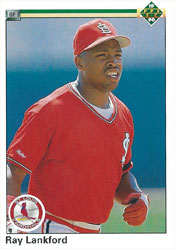
ray_lankford5Cardinals general manager Walt Jocketty, who traded Lankford to the Padres in August 2001, was looking for a left-handed batter to bolster the bench in 2004. He called Lankford and liked what he heard.

“A couple weeks ago, I was asking anybody if they’d seen or heard from Ray,” Jocketty said to the St. Louis Post-Dispatch. “He’d just dropped out of sight. I got a call from his agent and was told (Lankford) missed playing. I talked to (Lankford) a while and got the sense he had a desire to come back home to St. Louis. I think he’s highly motivated.

“He’s had a year away from the game. Sometimes that will change a guy’s outlook toward things to the positive.”

On Jan. 9, 2004, the Cardinals signed Lankford to a minor-league contract and invited him to spring training as a non-roster player with no guarantee of earning a job.

Lankford, a prominent part of the Cardinals’ lineup from 1990-2001, was grateful for the opportunity. He hit .224 in 81 games for the 2002 Padres. “Weight issues and complications from knee surgery conspired to sap his productivity,” the Post-Dispatch reported.

Be a man

When Lankford was dealt to the Padres for pitcher Woody Williams on Aug. 2, 2001, his attitude toward the Cardinals, particularly manager Tony La Russa, was negative. “Lankford had voiced displeasure over what he termed La Russa’s lack of communication about his limited playing time,” wrote Rick Hummel of the Post-Dispatch. “La Russa wondered if Lankford’s dedication had waned in the midst of a multiyear deal that paid him $35.5 million over five years.”

Said La Russa: “Ray got comfortable more than anything else.”

In the Jan. 21, 2004, Post-Dispatch, in a story headlined “Lankford is eager to show he still has something left,” Hummel asked, “Will we see a different Lankford from the one who left the Cardinals bitter at manager Tony La Russa?”

Lankford responded, “I’ve moved on. What’s in the past is in the past. Kids hold grudges. Grown men move forward. I’m moving forward. I’m sure Tony’s doing the same thing. I want to win. He wants to win.

“I’m going to camp with eyes wide open and try to make the team. I’ve never been in a situation where I had to try to make a team.”

Back in business

The improbable turned into the remarkable. Lankford made the team and was named the 2004 Cardinals’ Opening Day left fielder.

He hit .280 in April and remained the Cardinals’ starter for the first three months of the season in an outfield with Jim Edmonds in center and Reggie Sanders in right. Lankford’s batting average through June was .266.

In July, though, he developed a sore right wrist and it hurt his swing. Lankford batted .154 in July and the Cardinals placed him on the disabled list on July 25. Three weeks later, they acquired slugger Larry Walker from the Rockies.

Walker took over the right field job, with Sanders moving to left. Lankford sat out all of August. When he returned in September, he was ineffective, hitting .083 in a reserve role.

Still, his surprise contributions in the first half of the season helped the Cardinals start strong on their way to a 105-57 record and first-place finish in the National League Central Division.

Lankford played more games in left field (66) and made more starts at that position (43) than anyone else on the 2004 Cardinals. In 92 games, he batted .255 with six home runs.

(Updated Dec. 20, 2019)

Dick Groat and Roger Maris, players who helped the Cardinals win World Series championships in the 1960s, might never have played for St. Louis if the Pirates and Athletics had completed a proposed trade involving them.

maris_groatIn December 1959, the Pirates were close to dealing Groat to the Athletics for Maris but backed off at the last moment. Spurned, the Athletics turned to the Yankees and traded Maris to New York.

The decisions worked out well for the Pirates and Yankees _ and, eventually, for the Cardinals.

Groat, the Pirates’ shortstop, won the 1960 National League Most Valuable Player Award and helped the Pirates win the pennant and World Series championship, their first since 1925. Maris, the Yankees’ right fielder, won the 1960 American League Most Valuable Player Award and helped the Yankees win their 10th pennant in 12 seasons under manager Casey Stengel.

Two years later, in December 1962, the Pirates traded Groat to the Cardinals and he helped them win the 1964 World Series title, their first in 18 years. In December 1966, Maris was dealt by the Yankees to the Cardinals and he helped them win consecutive pennants and the 1967 World Series championship.

If Groat had been traded for Maris in December 1959, the chances of both landing with the Cardinals likely would have been diminished.

Pirates wanted power

Pirates general manager Joe L. Brown went to the 1959 baseball winter meetings determined to trade for a slugger. He told The Sporting News he made offers for Tigers outfielder Al Kaline, Indians outfielder Rocky Colavito, Senators third baseman Harmon Killebrew and Maris, an outfielder for the Athletics.

“Cleveland turned us down quickly for Colavito, but Detroit, Kansas City and Washington considered our propositions,” Brown said.

The Athletics wanted a shortstop because their starter, Joe DeMaestri, was considering retirement. If the Pirates would deal Groat, the Athletics were willing to send them Maris. Brown and Athletics general manager Parke Carroll agreed to make the trade.

Interviewed for the book “Roger Maris: Baseball’s Reluctant Hero,” Groat recalled, “I heard it was cut-and-dried.”

George Weiss, general manager of the Yankees, told The Sporting News in January 1960 that the Pirates came close to completing the deal for Maris.

The proposed deal was for the Athletics to send Maris, DeMaestri and catcher Hal Smith to the Pirates for Groat, center fielder Bill Virdon, pitcher Ron Kline and catcher Hank Foiles, The Sporting News reported. According to the Pittsburgh Press, the deal was Groat, Kline, outfielder Roman Mejias and pitcher Dick Hall to the Athletics for Maris, Smith and pitcher Ned Garver.

Under the headline “Swap Groat? Very Thought Jars Bucs Fans,” The Sporting News wrote, “The shocker developed when Dick Groat’s name bobbed up in discussions with several American League teams, notably the Senators and Athletics … Word from Kansas City has revealed that Groat’s name also was bandied about when the Pirates sought outfielder Roger Maris.”

Pirates manager balks

According to the Maris biography by co-authors Tom Clavin and Danny Peary, Brown and Pirates manager Danny Murtaugh stepped out of the room during a break in the talks with the Athletics.

Said Groat: “When they got out in the hallway, Danny said, ‘I don’t want to trade Groat.’ And they called it off.”

In a slightly different version, Brown told The Sporting News, “I believe we could have completed the deal for Maris, but the more I thought it over I felt perhaps we were giving up too much.”

“If we had gone through with this trade,” Brown added, “it would have been Page One in Pittsburgh and Kansas City.”

Wrote The Sporting News: “Chances are that thoughts of operating next season without Groat were the factor in casting the negative vote in Brown’s scheme. Brown and his aides probably couldn’t have visualized a Pirates team without the steadiness of Groat and thus backed out on the trade talk.”

On Dec. 11, 1959, the Athletics swapped Maris, DeMaestri and first baseman Kent Hadley to the Yankees for outfielders Hank Bauer and Norm Siebern, pitcher Don Larsen and first baseman Marv Throneberry.

“Had I gone to Kansas City, I’d have been buried for my career,” a grateful Groat told the Maris biographers.

Groat was the 1960 National League batting leader at .325 and paced the Pirates in hits (186).

Maris was the 1960 American League RBI leader with 112. He slugged 39 home runs and topped the league in slugging percentage (.581).

Previously: Cardinals nearly traded Bob Gibson to Senators

(Updated April 5, 2018)

The lineup of luminaries who participated in the first event held at San Francisco’s Candlestick Park included Stan Musial, Willie Mays and Richard Nixon. The story of the day, though, wasn’t created by ballplayers or politicians. Instead, the wind, sweeping across San Francisco Bay and swirling throughout the $15 million stadium, produced the most attention.

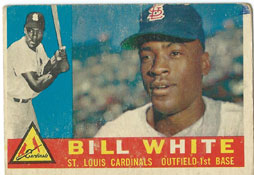
bill_white2Candlestick Park was dedicated on April 12, 1960, when the Cardinals played the Giants in the National League season opener for both clubs. Video

After two years at Seals Stadium in San Francisco’s Mission District, the Giants played at Candlestick Park from 1960 through 1999 before moving into a ballpark in the China Basin section of San Francisco in 2000.

Tricky winds and Tricky Dick

Vice President Nixon took part in the Candlestick Park dedication ceremonies before the start of the Cardinals-Giants game and called the facility “the finest baseball park in America,” the Associated Press reported. “It is truly a magnificent stadium,” Nixon said.

The sun shined brightly that Tuesday afternoon, but those among the 42,269 seated in the shade, especially in the lower level underneath the overhang of the upper deck, were chilled blue by the wind which relentlessly rolled in from left field.

Ray Haywood of the Oakland Tribune wrote, “Although Candlestick Park undoubtedly is the Taj Mahal of baseball _ a beautiful, commodious creation in steel and concrete _ it might not be a fit place either for shirtsleeves or right-handed hitters aiming for the left field fence. A spring wind, eager and brisk from the north, put the air brakes on everything hit toward left and boosted balls hit to right.”

Wrote Art Rosenbaum in The Sporting News: “It was like a Sierra winter day, warm in the sunshine but freezing under the trees. The coffee sales at Candlestick more than doubled the pre-game estimate of concessions experts.”

Musial, playing first base for the Cardinals, told the Oakland Tribune, “This wind will force teams to change their style of play. Right-handed power will be neutralized and clubs will have to go more for running and stealing bases.”

Future and former Cardinals

Bill White, the Cardinals’ center fielder, got the first hit in Candlestick Park, a two-out single in the first inning off Sam Jones. A year earlier, White and Jones were traded for one another.

Orlando Cepeda of the Giants hit a two-run triple in the bottom of the first off Larry Jackson, giving San Francisco a 2-0 lead. Cepeda’s sinking line drive darted wickedly in the wind and eluded White about 15 feet from the center field fence. “I should have had it, wind or not,” White said.

In the third, Cepeda increased the San Francisco lead to 3-0 with a single, scoring Mays from third.

Leon Wagner, traded by the Giants to the Cardinals four months earlier, hit the first Candlestick Park home run on a curve from Jones in the fifth. In the book “The Original San Francisco Giants,” Wagner recalled, “He threw me one of his long, hooking curveballs, the ones that broke about eight feet, and I just waited on it and hit it into the bay … I had the breeze blowing with me at Candlestick. I just had to get it up in the wind.”

Jones threw 121 pitches and finished with a three-hitter (the Wagner homer and two singles by White) in the Giants’ 3-1 victory. Boxscore

It was Jones’ fifth consecutive win against St. Louis since his trade to the Giants.

“I was more impressed with Jones than the wind,” Cardinals manager Solly Hemus said. “Sam was as good out there today as I’ve ever seen him.”

Musial went hitless in three at-bats. Mays and Willie McCovey each was 1-for-3 (each hit a double) with a walk apiece.

White works wonders in wind

One more wind story from that game:

In the eighth, with McCovey on first and no outs, Cepeda crushed a pitch into center field. White, still burning from failing to catch the Cepeda rocket in the first, raced after the ball as the wind pushed it away from him. White tracked it, grabbed it, crashed into the fence, 420 feet from home plate, and rolled on the ground without dropping the ball.

“That ball was my best shot,” Cepeda said. “I just can’t hit it any better.”

Said Wagner, who watched from left field: “If it hadn’t been for the wind, it would have gone 700 feet.”


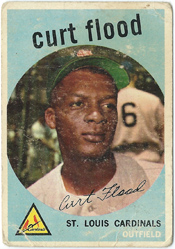
An email exchange among members of the Society for American Baseball Research offered a statistic about Curt Flood that surprised me.

curt_flood5In 1958, his rookie season with the Cardinals, Flood attempted 14 stolen bases and was caught 12 times.

Flood had speed. Even if some of the failed steal attempts were botched hit-and-run plays, he should have been successful more than twice in 14 tries in 1958.

In a March 5, 1958, article headlined “Flood Can Run _ Cards Hoping For Great Jump, Too,” The Sporting News reported Johnny Temple, Flood’s manager in the 1957 winter league in Venezuela, told Cardinals general manager Bing Devine that Flood “is one of the best I’ve seen in baserunning.”

But that speed didn’t transform him into a top base stealer.

Flood, 20, was caught stealing in his first attempt of 1958, was successful on his second and then had just one steal in his last 12 tries. He was unsuccessful in his last eight consecutive steal attempts.

Flood’s two steals in 1958 came against the Pirates and the battery of pitcher Bob Friend and catcher Danny Kravitz on May 24 Boxscore and against the Reds and the battery of pitcher Don Newcombe and catcher Ed Bailey on June 18. Boxscore

Bailey also nailed Flood twice that season (both times with Brooks Lawrence pitching).

Four other catchers also twice threw out Flood attempting to steal in 1958: Joe Pignatano of the Dodgers, John Roseboro of the Dodgers and Carl Sawatski of the Phillies. Don Drysdale was the pitcher who teamed with Roseboro on both plays.

Other catchers who caught Flood trying to steal in 1958: Del Crandall of the Braves, Joe Lonnett and Stan Lopata, both of the Phillies and Sammy Taylor of the Cubs.

Flood never developed into an exceptional base stealer. In 12 seasons with the Cardinals, Flood had 88 steals and was caught 72 times. That’s a success rate of 55 percent.

By comparison, his teammate, Lou Brock, had 888 steals in 1,173 attempts during his 16 Cardinals seasons. That’s a success rate of 75 percent.

In 1963, Flood had a single-season career high of 17 steals for the Cardinals. He was caught 12 times that year.

His most successful single-season rate was when he had 14 steals in 21 attempts for the 1966 Cardinals. That’s a success rate of 66 percent.

Previously: George Crowe: mentor to Curt Flood

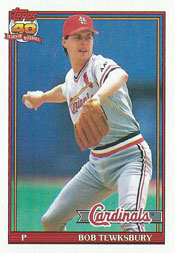
In 1988, Bob Tewksbury was a soft-tossing pitcher with a history of elbow and shoulder ailments. When the Cardinals signed him to a minor-league contract as a free agent in December that year, they had no idea they were acquiring an ace.

bob_tewksbury2After stints with the Yankees and Cubs, Tewksbury had arthroscopic surgery in July 1988 to repair damaged cartilage in his right shoulder. Still aching, Tewksbury, 28, said he had considered retiring from baseball that winter. His wife convinced him to continue playing.

His signing by the Cardinals received little mention outside of a line of agate type in the transactions listings. He was assigned to Class AAA Louisville and placed in the starting rotation.

Displaying sharp control and an array of breaking pitches, Tewksbury was 5-1 in his first 10 starts for Louisville. In May 1989, Ted Simmons, the Cardinals’ director of player development, told the St. Louis Post-Dispatch that Tewksbury was the minor-league pitcher most ready to join the Cardinals.

Others in the Cardinals organization didn’t agree. Tewksbury remained at Louisville. By mid-August, he was 11-4 with a 2.47 ERA in 24 starts.

Low velocity

Surprised by the Cardinals’ lack of interest, Vahe Gregorian of the Post-Dispatch wrote, “Maybe it’s because his fastball would bounce off a thin plane of glass. Maybe it’s because no one is certain he’s recovered from having the goop scooped out of his right shoulder last year.”

Tewksbury’s fastball usually was recorded at no better than 85 mph.

“I don’t know if he can make some kind of difference here (in St. Louis),” Cardinals general manager Dal Maxvill said. “He’s performed decently down there, but I don’t know that he could come here and replace somebody in our rotation. He’s not a velocity guy, so it’s difficult to project what he’d do here.”

Said Tewksbury: “I’m the type of pitcher you have to see more than once to appreciate. I’m not going to impress you the first time you see me because I don’t throw hard. But I know how to pitch and now I just need to get over that hump.”

Cardinals manager Whitey Herzog never had seen Tewksbury pitch, but seemed unenthused when asked about Tewksbury in mid-August. “My people tell me he would have to be perfect to come up here,” Herzog said. “I don’t want to sound like I’m down on the guy, but no other teams have expressed an interest in him either. There’s just such a big difference between Triple A and the big leagues.”

Tewksbury finished the minor-league season at Louisville with a 13-5 record and 2.43 ERA in 28 starts. He was promoted to the Cardinals in September. Said Herzog: “I don’t know if Tewksbury can pitch up here … but we ought to take a look.”

Take that, Whitey

On Sept. 5, 1989, Tewksbury made his Cardinals debut, pitching an inning of scoreless relief against the Expos at St. Louis. “He was exactly what we’d heard about him,” Herzog said. “He throws a lot of breaking balls.” Boxscore

After two more relief appearances, Tewksbury was given a start against the Pirates in a game that had been rescheduled because of a rainout. “I don’t really expect too much out of him,” Herzog said.

Undeterred, Tewksbury limited the Pirates to a run in 4.2 innings before he was lifted with the score tied at 1-1. The Pirates won, 4-3, but Tewksbury impressed.

“Tewksbury did his job,” Herzog said.

Said Tewksbury: ” I was satisfied. I wanted to keep us in the game and I did that.” Boxscore

Five days later, Tewksbury pitched a four-hit shutout, earning his first Cardinals win, in a 5-0 St. Louis victory over the Expos at Montreal. Tewksbury also produced his first big-league hit and RBI with a sixth-inning single off Andy McGaffigan that scored Todd Zeile from third.

“Tewksbury befuddled the Expos with a variety of off-speed pitches,” reported the Post-Dispatch.

Said Herzog: “He did a hell of a job tonight. He got his breaking ball over all the time. He throws a curve and a slider and not too many guys do that.” Boxscore

In seven games for the 1989 Cardinals, Tewksbury was 1-0 with a 3.30 ERA.

Less than a year after contemplating retirement, Tewksbury had established he was a big-league talent. “The one thing that’s gotten me this far is perseverance,” he said.

Tewksbury posted double-digit wins in each of the next five seasons for St. Louis. He was named an all-star in 1992 and led the National League in winning percentage that season at .762 with a 16-5 record.

In the six seasons he pitched for the Cardinals (1989-94), Tewksbury was 67-46 with a 3.48 ERA in 154 games.

“Tewksbury doesn’t have the greatest fastball in the world, but he knows how to use it,” catcher Tom Pagnozzi told Cardinals Yearbook in 1993. “He just jams a lot of guys when he’s throwing 83 mph to 86 mph. It looks faster because nobody gets a good swing at it.”

Mark Ellis nearly lost a leg when injured playing against the Cardinals.

Less than two years later, a healthy Ellis has joined the Cardinals as a reserve infielder and mentor to second baseman Kolten Wong.

mark_ellisEllis, 36, a free-agent second baseman, signed a one-year contract with the Cardinals on Dec. 16, 2013. In 11 big-league seasons with the Athletics, Rockies and Dodgers, Ellis has a .265 batting average and 1,311 hits. He ranks third in fielding percentage among active major-league second basemen at .9907, behind Placido Polanco (.9927) and Dustin Pedroia (.9909).

On May 18, 2012, Ellis was playing second base for the Dodgers against the Cardinals at Los Angeles. In the seventh inning, with the score tied at 4-4, Tyler Greene was the baserunner at first for the Cardinals when Shane Robinson grounded to shortstop.

Dee Gordon fielded the ball and tossed it to Ellis, covering second. Greene slid into Ellis, who landed hard on his lower left leg.

Ellis remained in the game and lined out leading off the bottom of the seventh. When the pain and swelling in his leg increased, Ellis was replaced before the start of the eighth. The Dodgers won, 6-5. Boxscore

Dodgers manager Don Mattingly called the play “clean” and “a good, hard slide,” reported Joe Strauss of the St. Louis Post-Dispatch.

Greene said he wasn’t trying to hurt Ellis. “There’s nothing going on there,” Greene said. “You’re trying to break up the double play. I don’t think he anticipated me being there as soon as I was. The way he came off the bag into the baseline he almost went right in front of it. I think he mistimed it.”

The next day, before the Cardinals played the Dodgers, Ellis told trainer Sue Falsone the leg still was causing pain. After an examination, Falsone and the Dodgers medical staff got Ellis to a hospital.

Doctors determined Ellis needed an emergency fasciotomy. Surgeons cut a six-inch incision into Ellis’ left calf to drain blood and fluid, the Los Angeles Times reported.

Mattingly said he was told by the team’s physician, Dr. Neal ElAttrache, that Ellis might have required amputation of the leg had he not undergone the urgent fasciotomy, MLB.com reported.

“Doc said that if that thing goes another six or seven hours (Ellis) has a chance to lose a leg,” Mattingly said.

Ellis spent five days in the hospital. When the swelling went down, Ellis was diagnosed with a sprained medial collateral ligament, according to the Orange County Register.

On July 4, 2012, Ellis returned to the Dodgers’ lineup and resumed being the everyday second baseman. He played 110 games in 2012 and produced 107 hits. In 910.1 innings at second base that season, Ellis committed only three errors.

Previously: How Cardinals pursued trade for Don Mattingly