Feeds:
Posts
Comments

(Updated Sept. 13, 2025)

On the first swing of his first at-bat as a grandfather, Stan Musial had fans and teammates shouting, “Oh, baby!”

A few hours after his first grandchild was born, Musial, 42, hit the first pitch he saw from Cubs starter Glen Hobbie for a two-run home run atop the pavilion roof in right field at Busch Stadium in St. Louis.
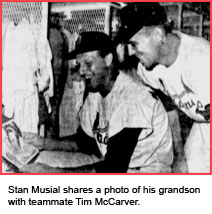
stan_musial_mccarverSharon Musial, wife of Stan’s son, Dick, gave birth to a son, Jeffrey, on Sept. 10, 1963, at Fort Riley Kan., where Dick, 23, was stationed as an Army lieutenant.

Musial and his wife, Lil, had waited until 1:30 a.m. on Sept. 10 before heading to bed. In his book “Stan Musial: The Man’s Own Story,” Musial said, “Lil and I awakened with a start at exactly the same time _ 4:40 a.m. _ and got up, troubled. As she brewed coffee, I paced the floor. Suddenly, the phone rang. Son Dick was calling from Fort Riley, Kan. Sharon had given birth to a boy. When? Just two minutes after Lil and I woke up.”

In a story headlined “Grandpa Musial Shuffles to Plate _ Celebrates by Swatting Homer,” The Sporting News reported, “The Man took a nap later in the morning so he could be better rested for the night game coming up.”

When he arrived at the ballpark, Musial said, he handed out cigars in the clubhouse. The Cardinals were honoring former St. Louis-area major leaguers that night and the old-timers gave Musial a ribbing.

“Hey, Gramp, you belong with us,” retired outfielders Joe Medwick and Terry Moore said to Musial.

With a laugh, Musial replied, “Next year.”

Musial, batting third and playing left field, came up in the first inning with Dick Groat on first and one out. He hit Hobbie’s first pitch for his 11th home run of the season and 474th of his 22-year big-league career. The homer came fewer than 16 hours after the grandchild was born.

“The remarkable Stan Musial set another major league record: Most home runs by a new grandfather, 1,” the Associated Press reported.

Said Musial: “That one was for Jeffrey Stanton Musial.”

In the book “Few and Chosen,” Cardinals catcher Tim McCarver said Musial “probably was the greatest low-ball hitter ever. Even in his 40s, there was no more devastating a low-ball hitter than Stan. Throw him a pitch down in the strike zone, even below the zone, and he would leave his feet.”

Musial’s home run overshadowed the performance that night of Bob Gibson, who hit a three-run homer off Hobbie and pitched a shutout in the Cardinals’ 8-0 victory, their 13th win in 14 games. Boxscore

Gibson and Musial were two of six future Hall of Fame members who played in the game. The Cubs started the other four: right fielder Lou Brock, left fielder Billy Williams, third baseman Ron Santo and first baseman Ernie Banks.


Tony La Russa brought out the evil twin in Dusty Baker.

dusty_baker2On Sept. 3, 2003, the Cardinals and Cubs played the fourth game of an intense five-game series at Chicago’s Wrigley Field. La Russa, the Cardinals’ manager, and Baker, the Cubs’ manager, engaged in a shouting match that added a memorable but ugly chapter to the rivalry between the franchises.

In the second inning, Cubs starter Matt Clement hit Cardinals pitcher Dan Haren with a pitch. An inning later, Haren hit Clement. That prompted the theatrics from the managers.

Baker rushed onto the field, confronted the umpires, then pointed angrily at the visitors’ dugout, where La Russa stood, glaring.

“Even back in the dugout, Baker kept pointing and yelling as La Russa smirked,” wrote Chicago Sun-Times columnist Jay Mariotti.

“Baker hollered, ‘I’ll (mess) you up,’ at La Russa,” wrote St. Louis Post-Dispatch columnist Bernie Miklasz.

“TV cameras caught Baker telling La Russa he’d gladly take him on any time and La Russa telling him to bring it on,” reported Mike Kiley of the Sun-Times.

“The two managers yelled at each other from across the field,” wrote Joe Strauss of the Post-Dispatch. “Baker at one point flipped an obscene gesture at La Russa.”

Wrote Miklasz: “A rumpus with an opposing manager makes La Russa’s blood surge and raises his competitiveness to maximum-testosterone level.” Video

Cardinals fold after feud

The teams hardly needed motivation. The day before, they split a gritty doubleheader. The Cubs won the opener in 15 innings. The Cardinals won the second game, 2-0, behind Matt Morris. Cubs pitcher Kerry Wood twice knocked down Morris with pitches and dusted him with a third, prompting La Russa to say Wood “likes to scare people. I’ve heard he likes to hit people.”

Baker and Wood objected to La Russa’s remarks.

After the La Russa-Baker macho match that followed Haren and Clement being hit by pitches, the intensity was raised to a fever pitch.

The Cardinals, who entered the Sept, 3 game in first place in the National League Central, a half-game ahead of the Astros and 1.5 games ahead of the Cubs, led, 6-0, in the sixth, but the Cubs scored three in the sixth, three in the seventh and two in the eighth and won, 8-7. Boxscore

Wrote Miklasz: “La Russa was nearly inconsolable.”

Said La Russa: “As far as bad losses go, it’s tied for first with any that I can remember. There’s been some savage losses, but this is right there with the worst of them.”

A defiant Baker told the Post-Dispatch: “Nobody intimidates me but my dad and Bob Gibson and a bully I had in elementary school. And I grew bigger than him, so he couldn’t bully me.”

Mariotti suggested the Cubs change their logo because “a cuddly little cub doesn’t fit the image any more when Dusty Baker is threatening to kick Tony La Russa’s butt.”

Beware the Gemini

The next day, La Russa and Baker met on the field before the game and had what was described by Strauss as “a decidedly serious conversation” for about five minutes.

Said La Russa to the Post-Dispatch: “I explained to him that the Cardinals and my players come first with me and I recognized that the Cubs and his players come first with him. If we both have that understanding, I think it’s easy for us to maintain a respect and friendship with each other.”

Baker, in comments to both the Sun-Times and Post-Dispatch, revealed there is a bad Dusty that tries to overtake the good one.

“I’m not proud of myself when I display that kind of action because I don’t really like that person when he comes out,” Baker said. “And he rarely comes out unless he’s provoked to come out.

“I’m a Gemini and I’ve definitely got an evil twin. I don’t like that twin. That’s the mean side. He’s got to run his course, then go back in there for a while. Everybody has a side they don’t like. I can get even hotter.”

Previously: Dusty Baker ended playing career with Tony La Russa at helm

Bob Forsch might have spent his entire playing career with the Cardinals if management had given him the opportunity. Instead, informed he wasn’t wanted, Forsch took the chance to extend his career with the Astros.

bob_forsch6On Aug. 31, 1988, the Cardinals traded Forsch to the Astros for utility player Denny Walling.

Forsch was 9-4 with a 3.73 ERA for the 1988 Cardinals. A fan favorite, he ranked second among all Cardinals pitchers in career games started (401) and third in career wins (163).

In his book “Tales from the Cardinals Dugout,” Forsch said general manager Dal Maxvill called him while the team was in Atlanta and said he planned to trade him to the Astros.

Under baseball rules, Forsch, 38, could have blocked a trade because he was a player with five years of service with one team and 10 years in the majors.

The second-place Astros, chasing the Dodgers in the National League West, were pressing for a decision before midnight on Aug. 31, the last date a player could be acquired and still be eligible for the postseason.

Encouraging him to accept the trade, Maxvill told Forsch he wasn’t in the Cardinals’ plans for 1989. Forsch said he wasn’t ready to quit. When the Astros sweetened the deal by guaranteeing Forsch a contract for 1989, he agreed to the trade.

Maxvill played hardball

“It was better than what I was offered here,” Forsch said to Rick Hummel of the St. Louis Post-Dispatch. “Maxvill made it pretty clear that I wouldn’t have a job here.

“I would have liked to have pitched here some more, but it didn’t look like it was going to work out … Maybe the decision would be easier if I felt they wanted me here.”

In his book, Forsch said manager Whitey Herzog told him he would have a chance to earn a spot with the Cardinals in 1989.

“(But) Dal told me, ‘Well, if you stay here (and reject the trade) you’re not going to pitch again,’ ” Forsch said. “When I heard that, I was a little shocked, to say the least.”

Maxvill said Forsch would be offered a job in the Cardinals organization if he didn’t pitch in 1989.

“Forschie has been great for the Cardinals for a lot of years,” Maxvill said. “He was a great teacher and a great person. We’re sorry to lose him, but I was happy to accommodate him and hopefully he’ll pitch next year.”

Tributes from teammates

A consistent winner and classy competitor, Forsch pitched two no-hitters and appeared in three World Series for the Cardinals. The right-hander produced 10 double-digit win seasons and was 163-127 in 15 years (1974-88) with the Cardinals.

Kevin Horrigan, sports editor of the Post-Dispatch, suggested the Cardinals should retire Forsch’s uniform number 31, but they didn’t. Shortstop Ozzie Smith called Forsch “the consummate professional.” Center fielder Willie McGee said Forsch is “a great person, a great leader and one of the best competitors I have ever played with in any place and at any level.”

Forsch said having former Cardinals coach Hal Lanier as Astros manager “made a lot of difference” in his decision to accept the trade. “I knew Hal real well and really liked him,” Forsch said.

Also, Ken Forsch, Bob’s older brother, pitched for the Astros from 1970-80.

Two days after Bob was dealt to the Astros, the Cardinals were in Houston to begin a three-game series.

When Cardinals broadcaster Jack Buck entered the Astros clubhouse, Forsch asked, “How do I look in blue?”

Replied Buck: “Like your brother.”

Previously: Forsch vs. Forsch: Bob had edge in brotherly matchup

(Updated Sept. 7, 2019)

In comparing playing styles and careers, Carlos Beltran and Chris Duncan had little in common. Yet both prospered for the Cardinals as power producers from the No. 2 spot in the batting order.

chris_duncan2In 2013, Beltran, a switch-hitter in his 16th season, had 19 home runs while batting second in 83 games.

Beltran topped the 18 hit by Duncan from the No. 2 spot in 57 games for the 2006 Cardinals. Duncan, a left-handed batter, was a rookie who spent most of the first three months in the minors before sticking with St. Louis in July 2006.

Beltran had 24 home runs overall for the 2013 Cardinals. He hit 19 from the No. 2 spot, three from the No. 3 position and two from the cleanup spot in the batting order.

When batting No. 2, Beltran often benefitted from the high on-base percentage (.392) of leadoff batter Matt Carpenter. With Carpenter on base frequently, opponents often had to pitch to, rather than around, Beltran.

Protected by Pujols

In 2006, Duncan benefitted from batting directly in front of Albert Pujols. Because Pujols was having a sensational season (49 home runs, 137 RBI), opponents preferred taking their chances pitching to Duncan rather than Pujols.

“Duncan has aggressively jumped on the strikes he’s seeing when used as the No. 2 hitter in (manager Tony) La Russa’s lineup, batting before Pujols,” Bernie Miklasz, columnist for the St. Louis Post-Dispatch, wrote in July 2006.

Duncan batted .290 (62-for-214) from the No. 2 spot in 2006. Almost 30 percent of his hits from that spot were home runs. He had an on-base percentage of .368 (20 points higher than his career average) while batting second that year.

On July 24, 2006, Joe Strauss of the Post-Dispatch wrote, “La Russa agrees that Duncan’s recent breakout has provided a new look to the lineup’s No. 2 spot, which has bounced among 10 players since Juan Encarnacion opened the season in the role.”

Mentored by McRae

Duncan credited Cardinals hitting coach Hal McRae for instructing him on “hitting out, not hitting up” and encouraging line drives rather than high drives.

“He’s trying to work with me on staying in the (strike) zone longer and becoming a better overall hitter,” Duncan said. “If you stay through the zone more, the home runs will come.”

Duncan hit .361 from the No. 2 spot in August 2006. He was integral in the Cardinals’ successful push toward the National League Central title.

Wrote Miklasz on Aug. 21, 2006: “Where would the Cardinals be without Chris Duncan? Left field was a crater until he filled it. The No. 2 hole in the lineup was a weak spot until he stepped in.”

Duncan finished the 2006 season with 22 home runs overall. In addition to the 18 from the No. 2 spot, Duncan hit two from the seventh position and one each from the third and ninth spots.

The next year, Duncan hit 21 homers, nine from the No. 2 position. He spent five years in the majors before his career was cut short by injuries.


Whitey Herzog managed the Cardinals with a bold, creative style, which partly explains why he largely was successful. What elevated Herzog to Hall of Fame quality is he got his players to buy into that style.

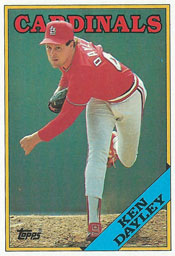
ken_dayleyA striking example of that occurred on Aug. 28, 1988, in a Sunday afternoon game between the Cardinals and Reds at Cincinnati.

Ken Dayley was one strike away from completing a three-inning save when Herzog abruptly pulled the reliever before he was finished pitching to the batter, Chris Sabo.

Dayley didn’t complain nor did anyone else with the Cardinals, which is testament to the trust and respect Herzog had with his players at that time.

Bob Forsch, in his last appearance as a Cardinal, started that game and pitched six innings. With the Cardinals ahead, 5-3, Forsch was relieved by Dayley after yielding a leadoff single to Sabo in the seventh.

Dayley held the Reds scoreless in the seventh and eighth.

In the ninth, Dayley retired the first two batters before Barry Larkin singled. Up next was Sabo.

A right-handed batter, Sabo, a rookie, presented a challenging matchup for the left-handed Dayley. The previous night, Sabo had four hits against the Cardinals, including three singles off left-handed pitching.

Cardinals closer Todd Worrell, a right-hander, was warming in the bullpen, but Herzog stayed with Dayley because Kal Daniels, a left-handed batter, was due up after Sabo. Herzog wasn’t figuring on Sabo hitting a home run. Dayley was unscored on in his last seven games.

Dayley got the count to 2-and-2 on Sabo. On the next pitch, Sabo drilled a line drive down the left-field line.

Worrell, who was in the left-field bullpen, told the St. Louis Post-Dispatch, “When it passed me, it was about three feet fair.”

Wrote the Associated Press: “Sabo’s liner flirted with the left-field foul screen … but the ball hooked at the last second.”

“It wasn’t foul by much, maybe two feet,” Cardinals left fielder Tom Lawless said.

Said Worrell: “You could slide a newspaper between the ball and the foul pole.”

Herzog immediately went to the mound and lifted Dayley for Worrell. The closer threw one pitch, a slider, which Sabo swung and missed by a foot, sealing the Cardinals’ 5-3 victory. Boxscore

“I’ll bet that was the easiest save he ever had,” Herzog said.

Said Dayley: “Whitey had seen enough. I don’t mind setting the table for him, but I’ll be damned if I’m going to feed him.”

Previously: Whiteyball: Willie McGee at shortstop; Ricky Horton in right

Kolten Wong is a native Hawaiian who bats left-handed and rates as a prized player for the Cardinals.

In 1977, the same description fit for Joe DeSa.

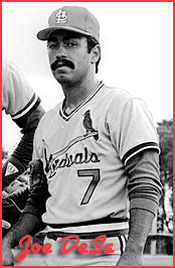
joe_desaWong, a second baseman and the 2011 first-round Cardinals draft choice, made his major-league debut with St. Louis on Aug. 16, 2013. He became the first native Hawaiian to play for the Cardinals since DeSa debuted with them in 1980.

DeSa, 17, was selected by St. Louis in the third round of the 1977 draft. A left-handed batter, he had been a high school standout in Honolulu.

DeSa, 5 feet 11, 170 pounds, entered the Cardinals’ minor-league system with a reputation as a line-drive hitter and smooth-fielding first baseman.

That reputation proved accurate.

In 1979, with the Cardinals’ Class AA Arkansas club, DeSa hit .317 with 32 doubles, 13 home runs and 86 RBI. He had 147 hits in 130 games.

In a 1979 interview with Larry Harnly of The State Journal-Register of Springfield, Ill., Cardinals manager Ken Boyer said of DeSa, “He’s about as good a looking hitter as you will see.”

No room at first

Though DeSa was performing to expectations, his path to the majors was blocked by Keith Hernandez, the Cardinals’ regular first baseman and 1979 National League batting champion.

DeSa was promoted to the Cardinals’ Class AAA Springfield (Ill.) team in 1980. The Cardinals’ 1980 media guide described DeSa as “a line-drive hitter with some power.”

He hit .293 with 25 doubles in 123 games for Springfield and was rated the best defensive first baseman in the league.

In September 1980, the Cardinals, far out of contention, called up DeSa.

After going hitless in his first five big-league at-bats, DeSa got hits in the last three games he played for St. Louis. His first was a pinch-hit single against the Expos’ Bill Gullickson on Sept. 30, 1980. Boxscore

In seven games for the 1980 Cardinals, DeSa batted .273 (3-for-11).

Those would be the only games he’d play for St. Louis.

Tony time

DeSa, converting from first base to the outfield, played the next three seasons for Cardinals Class AAA clubs. Then he became a minor-league free agent and signed with the White Sox.

In 1985, DeSa returned to the big leagues, appearing in 28 games for the White Sox, managed by Tony La Russa, and batting .182 (8-for-44) with two home runs.

DeSa spent the 1986 season with Buffalo, the Class AAA club of the White Sox, and was named the Bisons’ most valuable player. He hit 17 home runs and had 83 RBI.

After the season, DeSa became a minor-league free agent again, signed with the Royals and went to Puerto Rico to play winter league ball.

On Dec. 20, 1986, DeSa, 27, was killed in a car accident in Puerto Rico. He left behind a wife, Margarita, and a year-old son, Joe.

White Sox players collected more than $3,000 for his funeral expenses, The Sporting News reported. The Bisons established a memorial fund and raised nearly $7,000. The Class AAA club also established the annual Joe DeSa Most Inspirational Player Award. It still is presented to a Buffalo player near the end of each season.

On Aug. 16, 1987, the White Sox presented DeSa’s wife and son with a check for $120,000 in a ceremony honoring DeSa before a Pacific Coast League game between Portland and Hawaii in Honolulu.

Previously: Warren Spahn and his Cardinals connection