Feeds:
Posts
Comments

(Updated Nov. 25, 2024)

Using a combination of fastballs and sliders with control and confidence, Bob Gibson capped the most successful stretch of starts ever experienced by a Cardinals pitcher.
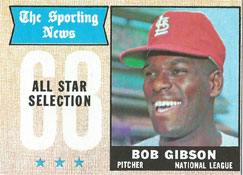
bob_gibson15On Aug. 19, 1968, Gibson got his 15th consecutive win, pitching a two-hitter in the Cardinals’ 2-0 victory over the Phillies at Philadelphia.

During the 15-game winning streak, from June 2 through Aug. 19, Gibson made 16 starts, with one no-decision. Ten of the 15 wins were shutouts. His ERA in that 16-start stretch was 0.68 in 146 innings, with 124 strikeouts. He pitched nine innings or more 16 games in a row.

“I haven’t seen anybody that good during the time I’ve been in the majors,” Cardinals outfielder Roger Maris said to The Sporting News.

Looking back on Gibson’s 1968 season, Cardinals catcher Tim McCarver told Cardinals Yearbook in 2018, “It got to a point where I could sense the helplessness when hitters came to bat … There were many times when I could feel a hitter’s legs buckle as one of Bob’s vicious sliders whizzed across the plate.”

Slip sliding away

Using only fastballs and sliders against the Phillies for his 15th win in a row, Gibson struck out 11, including Dick Allen four times and Bill White three times.

“He had great control of his slider,” McCarver said to the Associated Press. “The last strike on Rich Allen in the ninth broke a foot.”

Gibson credited the development of his slider with making him a dominant pitcher.

“My slider was nasty,” Gibson said in a conversation for the book “Sixty Feet, Six Inches.” “They could look for it and couldn’t hit it.

“Actually, I had two sliders … My main slider was my hardest one, and it would just break abruptly and mostly downward. And I had one where I’d twist my wrist a little more and give it a bigger break. That one didn’t have the speed or suddenness of the first one … but if I got it where I was supposed to get it, a right-handed batter wasn’t going to do anything with it.”

In his bid for the 15th consecutive win, Gibson held the Phillies hitless for five innings. In the sixth, with one out, pitcher John Boozer singled to center.

The Phillies’ only other hit came in the eighth when Johnny Callison, batting for Boozer, singled to right with two outs. Boxscore

Confidence equals control

The 15th consecutive win gave Gibson a season record of 18-5 with a 0.99 ERA in 234.2 innings. The shutout, his 10th, tied the Cardinals’ single-season record established by Mort Cooper in 1944.

“Of all the reasons behind his brilliance, I start with his command,” McCarver told Cardinals Yearbook. “Gibson threw hard and featured the best slider I’ve ever caught by a right-hander. His pitches exploded with movement a few feet from the plate. What made them even more effective was his ability to throw them where he wanted. He could consistently hit a target no wider than two baseballs.”

In discussing his slider with Cardinals Yearbook writer Stan McNeal, Gibson said, “I had pinpoint control in 1968 … If I wanted to throw it outside, I’d start it in the middle of the plate and I knew it was going to be outside … That was an unbelievable feeling. It really was. Hitters were at a disadvantage because I knew where the ball was going and I could throw it there in any count. Most pitchers would get to a 3-and-2 count and throw a fastball because they could control it, but I’d throw a slider because I could control it as well as the fastball. Sometimes it would break out of the strike zone, but they’d swing anyway.”

Gibson’s consecutive win streak ended in his next start, Aug. 24, at home against the Pirates. The Cardinals led, 4-0, after six. Willie Stargell hit a three-run home run off Gibson in the seventh. The Pirates scored a run in the eighth and two more in the ninth to win, 6-4, overcoming a 15-strikeout performance by Gibson. Three of the Pirates’ six runs were unearned. Boxscore

Gibson finished the 1968 season with a 22-9 record, and 1.12 ERA, pitching 13 shutouts and 28 complete games. In Game 1 of the 1968 World Series, he struck out 17 Tigers batters.

In a 2018 interview with Joe Schuster of Cardinals Yearbook, Willie Horton recalled how he became the 17th strikeout victim: “On the last pitch, he had me set up for a slider, so I was looking for a ball off the edge of the plate, maybe even six inches outside. I set up for a pitch out there, so if it broke I would have hit it, but it just stayed in on me and I couldn’t do anything with it. I learned later he had a backdoor slider. I can’t think of another right-handed pitcher who would try to throw a backdoor slider, because you can make so many mistakes with it. He had one _ and that shows how great he was.”

On Oct. 28, 1968, Gibson was named unanimous winner of the National League Cy Young Award. Two weeks later, on Nov. 13, he was named recipient of the NL Most Valuable Player Award.

In the book “Late Innings,” Gibson told author Roger Angell, “I was never that good again … I’d like to think I’d really perfected my pitching to that point.”

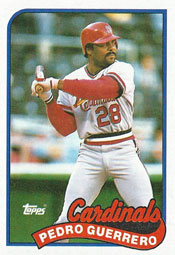
In the summer of 1988, some looked at Pedro Guerrero and saw a first baseman who was a defensive liability, a star diminished by injuries and a perceived lack of desire.

lana_turnerWhitey Herzog looked at Guerrero and saw Lana Turner.

On Aug. 16, 1988, the Cardinals, desperate to bolster a pop-gun attack, traded pitcher John Tudor to the Dodgers for Guerrero.

Because Guerrero had tendinitis in both knees and had spent most of June and July on the disabled list while recovering from a pinched nerve in his neck, some questioned whether the Cardinals had acquired damaged goods.

Responding to Rick Hummel of the St. Louis Post-Dispatch about those concerns, Herzog, the Cardinals’ manager, said of Guerrero, “His lower body isn’t the best in the world. His upper body looks like Charlie Atlas and his lower body probably looks like Lana Turner.”

Fortunately for the Cardinals, Guerrero could hit better than Turner, the long-legged actress of the 1940s and ’50s who played sultry roles in films such as “The Postman Always Rings Twice” and “Peyton Place.”

At the time of the trade, critics, such as columnist Scott Ostler of the Los Angeles Times, saw Guerrero as a one-dimensional player.

pedro_guerreroWrote Ostler: “When Guerrero isn’t hitting home runs and doubles _ which he hasn’t been doing much of lately _ he hurts you more ways than he helps you. Defense, for instance … The most you can say is that Guerrero sometimes makes the routine plays.”

The next Jack Clark

The Cardinals, though, needed a run-producer and they saw Guerrero as one of their best options. “He’s one of the few hitters in baseball who fits our need,” Herzog said. “He’s an impact player, like Jack Clark.”

St. Louis had tried to replace Clark _ who, as a free agent, departed the Cardinals for the Yankees after the 1987 season _ with Bob Horner, but that didn’t work. With the Cardinals out of contention by August 1988, management devised a plan for how to boost the team’s offense.

They decided to pursue during the impending off-season a pair of players who appeared headed toward free agency: Guerrero and Tim Raines of the Expos.

Guerrero was eligible to become a free agent after the 1988 season and the Dodgers expressed little interest in keeping him. Meanwhile, it widely was anticipated an arbitrator would declare Raines a free agent after ruling that team owners had colluded to limit offers to him when he first became eligible for free agency in November 1986.

Two factors caused the Cardinals to change those plans. First, word leaked that Raines was preparing to accept a three-year contract extension from the Expos. Also, there was speculation the Dodgers might trade Guerrero to the Phillies if they could get left-handed pitcher Don Carman in return.

Dodgers want Tudor

Concerned they might miss out on both Guerrero and Raines, the Cardinals pursued trade talks with the Dodgers. Seeking a left-handed starter to replace the injured Fernando Valenzuela, the Dodgers wanted Tudor, who was the National League leader in ERA at 2.29.

Cardinals general manager Dal Maxvill asked Herzog who he would want in return.

Said Herzog: “There’s only one guy I’d consider trading (Tudor) for.”

Guerrero.

The Cardinals agreed to a deal under one condition: Guerrero would have to accept a contract extension and relinquish his right to become a free agent that winter. Guerrero agreed and got an extension for three seasons at $6.2 million, including a $400,000 bonus, the Los Angeles Times reported.

“Basically, it’s a premier pitcher for a premier hitter,” Herzog said to the Associated Press.

Guerrero, 32, batted .298, with a .374 on-base percentage, in 59 games for the 1988 Dodgers.

Maxvill called Guerrero “an everyday player with outstanding run-producing potential.”

Said Cardinals pitcher Bob Forsch: “If he comes over and wants to play, he can help.”

Guerrero told the Associated Press, “I never thought I’d be a Cardinal. But now I’m here and I’m very happy … I always wanted a chance to play for Whitey.”

Tudor, 34, was going from an also-ran to a contender. He was a key starter for the Cardinals’ pennant-winning teams in 1985 and 1987. “I’ve enjoyed my time here,” Tudor said. “The people have been great to me and, as far as I’m concerned, there are no better fans in the world.”

Tudor was 4-3 with a 2.41 ERA in nine starts for the 1988 Dodgers, who won the World Series championship that year. Injured most of 1989, Tudor became a free agent after that season and returned to the Cardinals in 1990.

Guerrero hit .268 with five home runs and 30 RBI in 44 games for the 1988 Cardinals. He was outstanding in 1989, hitting .311 with 42 doubles and 117 RBI for St. Louis. His on-base percentage that season was .391.

As a Cardinal from 1988 to 1992, Guererro produced 505 hits in 500 games, posting a .282 batting average and .348 on-base percentage, with 44 home runs.

Previously: Redbirds ripoff: How Bob Horner replaced Jack Clark

Playing in lineups with the likes of Hank Aaron, Eddie Mathews, Roberto Clemente and Willie Stargell, shortstop Johnny Logan was a batter the Cardinals learned to respect.

johnny_loganIn 1957, when Logan was the starting shortstop for the World Series champion Braves, he reached base in seven consecutive plate appearances against the Cardinals over two games at St. Louis.

During a 13-year major-league career (1951-63), Logan batted .282 against the Cardinals and had 209 hits in 209 games versus them. He hit especially well at St. Louis, posting a .309 batting average there in 102 games while playing for the Braves and Pirates.

On May 10, 1957, Logan, batting sixth, went 4-for-4 with a walk and five RBI in the Braves’ 10-5 victory over the Cardinals. In his first two at-bats, Logan produced a two-run double and a RBI-single against starter Sam Jones.

In the fifth, Logan drew a walk from Lloyd Merritt. Logan followed that with a solo home run off Hoyt Wilhelm in the seventh and finished with a RBI-single off Jim Davis in the ninth. Boxscore

The next day, May 11, Logan, in his first two at-bats, had a RBI-double and a single off starter Lindy McDaniel. Logan had reached base in each of his first seven plate appearances of the series.

In the sixth, Willard Schmidt got Logan on a fly out. Logan doubled off Schmidt in the eighth _ his eighth time on base in nine plate appearances since the series began. Boxscore

A month later, the Braves acquired second baseman Red Schoendienst from the Giants. The former Cardinal paired with Logan to form an effective keystone combination.

“The first thing I did when we got Red was give (general manager) John Quinn a big kiss,” Logan told The Milwaukee Journal. “We had the best pitching in the league and a lot of power, but we (had) needed a second baseman.”

Logan remained the Braves’ starting shortstop through 1960 until he was replaced by Roy McMillan. In June 1961, the Braves traded Logan to the Pirates for outfielder Gino Cimoli.

Logan primarily was a utility player and pinch-hitter for Pittsburgh. One of his last big hits came against the Cardinals.

On July 16, 1962, Logan started at third base for the Pirates at Pittsburgh. In the sixth inning, with the Cardinals ahead, 2-1, the Pirates loaded the bases with two outs against starter Ray Sadecki.

Logan, homerless as a Pirate, stepped to the plate and delivered a grand slam, the last home run of his big-league career, leading Pittsburgh to a 5-2 victory. It also was Logan’s first extra-base hit of the season. Boxscore

“I’ve been saving this for a long time to show how much I appreciate the Pirates staying with me,” Logan said to The Sporting News. “I’m 35, all right, but I’m not over the hill yet.”

Previously: Hank Aaron and the home run that wasn’t vs. Cardinals

(Updated Feb. 13, 2014)

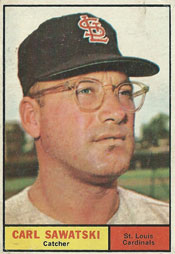
Carl Sawatski had one special skill as a ballplayer. He could hit with power against right-handed pitching. In 11 big-league seasons, Sawatski hit 58 home runs _ all against right-handers.

carl_sawatskiIn 1961, Sawatski delivered four home runs as a pinch-hitter for the Cardinals. No St. Louis pinch-hitter has slugged that many homers in a season since.

Like Sawatski, George Crowe also hit four pinch-hit home runs in a season for the Cardinals. Crowe did it twice, in 1959 and again in 1960.

When Sawatski, a catcher who batted left-handed, was acquired by the Cardinals from the Phillies in December 1959 for outfielder Bobby Gene Smith and pitcher Bill Smith, a headline in The Sporting News declared, “Sawatski to Supply Power Behind Platter.”

Said Cardinals manager Solly Hemus: “We got Sawatski for his bat. He’s not outstanding with the glove, but he’s improving.”

A backup to catcher Hal Smith, Sawatski hit .229 with six home runs (one as a pinch-hitter) in 78 games for the 1960 Cardinals.

The next season, Sawatski, 33, produced the kind of hitting the Cardinals expected. As a pinch-hitter, Sawatski hit .282 (11-for-39) with four home runs and 14 RBI for the 1961 Cardinals. Overall, he batted .299 with 10 homers.

Sawatski’s four pinch-hit homers were one behind the 1961 National League leader, Jerry Lynch of the Reds, and two behind the big-league record holder, Johnny Frederick of the 1932 Dodgers.

(Dave Hansen of the 2000 Dodgers and Craig Wilson of the 2001 Pirates now share the major-league record for pinch-hit home runs in a season. Each hit seven.)

A look at Sawatski’s four pinch-hit home runs in 1961:

Denting Drysdale

_ April 19, Dodgers 7, Cardinals 2, at Los Angeles: With the Dodgers ahead, 3-0, Sawatski, pinch-hitting for Hal Smith, led off the third inning with a home run off starter Don Drysdale. It was one of four homers Sawatski hit against the Hall of Fame pitcher in his career. Boxscore

Cubs crusher

_ June 5, Cardinals 10, Cubs 8, at St. Louis: Pinch-hitting in the seventh for shortstop Alex Grammas, Sawatski hit a two-run home run off reliever Joe Schaffernoth, giving the Cardinals a 6-5 lead and sparking a six-run Cardinals inning. Boxscore

Happy hooker

_ June 20, Reds 4, Cardinals 3, at Cincinnati: In the seventh inning, Sawatski, pinch-hitting for second baseman Bob Lillis, erased a 2-0 Reds lead with a three-run home run off starter Jay Hook. It was one of three homers Sawatski hit off Hook in his career. But the Reds scored a run in the bottom of the ninth, tying the score, and won with a run in the 11th. Boxscore

Doing it all

_ Aug. 6, Cardinals 3, Phillies 2, at St. Louis: In the seventh, with the Phillies ahead, 2-0, Sawatski, pinch-hitting for catcher Chris Cannizzaro, hit a two-run home run with two outs off starter Jim Owens. Sawatski stayed in the game at catcher. In the ninth, he hit the game-winning single off Jack Baldschun with one out and the bases loaded. Boxscore

After the 1961 season, the Cardinals needed to decide which of their players to expose to the expansion draft being conducted by the Mets and Colt .45s.

Wrote The Sporting News, “Catcher Carl Sawatski, who was believed to be on the fence at one time because of his defensive shortcomings, was regarded as a sure bet to stay among the untouchables. The Birds need (Sawatski’s) big bat, especially as a weapon for coming off the bench.”

Sawatski hit one pinch-hit home run in 16 at-bats for the 1962 Cardinals and was homerless in 31 pinch-hit at-bats for St. Louis in 1963, his final season in the big leagues.

Previously: Pure-hitting Jerry Lynch savored Cardinals pitching

A timely talk with the Cardinals’ general manager helped Stan Musial determine how to inform his teammates and fans he would end his major-league playing career after the 1963 season.

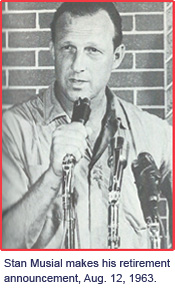
stan_musial27On Aug. 12, 1963, Musial surprised many with a tearful announcement of his retirement plans at a Cardinals team picnic.

Privately, the Cardinals’ all-time greatest player had reached his decision on July 25 at Milwaukee. That day, Musial, 42, had driven in the winning run for the Cardinals with a single against another 42-year-old, Braves pitcher Warren Spahn. Boxscore

Though Musial wasn’t hitting at the level he had when he won seven National League batting championships, he still was effective, ranking among the top five on the club in RBI. But his fading fielding skills in the outfield convinced him it was time to quit playing.

In his book “Stan Musial: The Man’s Own Story,” Musial said, “I noticed that I really had difficulty untracking to get started after a fly ball.”

From Milwaukee, the Cardinals went to Chicago for a series against the Cubs. General manager Bing Devine joined the team there and invited Musial to breakfast in his hotel suite. Musial suspected Devine wanted to know his plans for 1964.

“The words came hard because it’s not easy to quit,” Musial said in his book.

Musial said to Devine, “After this year, Bing, I’ll have had it.”

“Devine seemed relieved, as relieved as I was when I got the words out,” Musial said.

Musial told Devine he wanted to make the announcement in St. Louis and he wanted his teammates to hear it first. Devine suggested Musial use the team picnic on Aug. 12 as the venue and Musial agreed.

The picnic, on a rainy Monday, was at Grant’s Farm, the estate of Cardinals owner Gussie Busch. Players, their families, team officials and a small group of reporters attended. Busch was out of town for a family wedding.

Only Musial, his family and Devine knew what he planned to say at the gathering. Many anticipated Musial would wait until after the season to reveal his plans.

Musial was “choked with emotion,” the Associated Press reported, as he stood before a battery of microphones and said 1963 would be the last of his 22 seasons as a player.

“Baseball has been my life,” Musial said. “I have loved St. Louis and this ballclub and I have had fun all these years.

“I’ve had the best job in the world. The thrill of putting on a major-league uniform, hitting, fielding and playing ball is greater than any other job I could ever have.”

Musial acknowledged he would become a grandfather for the first time in September 1963. His son, Dick, and daughter-in-law Sharon were expecting their first child.

In an effort to lighten the mood after the emotional retirement announcement, The Sporting News reported, Musial turned to his wife, Lil, and said, “I don’t think you want to kiss an old, retired ballplayer.”

Replied Lil: “I don’t think you want to kiss an old grandmother.”

Cardinals manager Tony La Russa took a gamble that triggered one of the rarest plays in baseball.

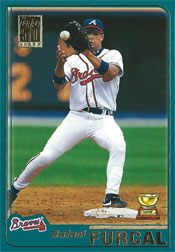
rafael_furcal3On Aug. 10, 2003, the Braves faced the Cardinals in a Sunday night game at St. Louis before a national television audience on ESPN. In the fifth inning, with runners on first and second, no outs and pitcher Woody Williams batting, La Russa called for the hit-and-run. Williams lined the ball to shortstop Rafael Furcal, who turned an unassisted triple play.

Only 15 unassisted triple plays have been achieved in the major leagues. The Cardinals never have converted one. They twice have been the victims.

The Cardinals first hit into an unassisted triple play at Pittsburgh on May 7, 1925. The Cardinals had Jimmy Cooney on second base and Rogers Hornsby on first, with no outs in the ninth, when cleanup batter Jim Bottomley hit a liner to shortstop Glenn Wright, who caught the ball, “leaped on second base after the catch” to double up Cooney and tagged out Hornsby, who was racing toward second and couldn’t stop in time to elude Wright, The Sporting News reported. Boxscore

Furcal turned a similar play against the Cardinals.

With the score 1-1, Mike Matheny was on second and Orlando Palmeiro was on first, with no outs, when Williams came to bat against starter Horacio Ramirez.

Squaring to bunt, Williams saw two pitches, one a strike and the other a ball. Confident of Williams’ ability to handle the bat, La Russa removed the bunt sign and called for the hit-and-run. “More guts than brains,” La Russa told MLB.com. “I’ve been accused of that many times.”

As Ramirez unleashed his pitch, Matheny and Palmeiro took off running. Williams lined the ball on a path toward left-center field. “I thought it got through,” Ramirez told the Atlanta Journal-Constitution.

One-man show

Furcal leaped and snared the ball. With Matheny almost at third, Furcal could have flipped the ball to second baseman Marcus Giles, who was positioned to receive the toss at second base.

“When Giles asked me, ‘Give me the ball, give me the ball,’ I said, ‘No. I got a chance to make it myself.’ ” Furcal said to the St. Louis Post-Dispatch.

Said Giles: ” I could tell by the look in his eyes that he wasn’t giving it up. It was pretty cool.”

Furcal stepped on second to double up Matheny for the second out.

Palmeiro, steaming toward second, had crossed the bag, applied the brakes, turned and began to retreat. Furcal caught him easily and applied the tag, completing the 12th unassisted big-league triple play. Video

“And so, the worst thing that could have happened for the Cardinals, did happen,” ESPN broadcaster Jon Miller said in summarizing the play.

Good instincts

Miller’s broadcast partner, Hall of Fame second baseman Joe Morgan, praised an “excellent job by Furcal not to take off for second base” when Furcal saw Palmeiro break from first on the pitch. Furcal held his ground until Ramirez delivered his pitch and was positioned to field the line drive, Morgan told viewers.

“You could see it developing, just like that,” Braves manager Bobby Cox said to the Associated Press.

Said Furcal: “I thought the play had a real flow.” Boxscore

(Eight years later, the Cardinals acquired Furcal from the Dodgers and he was their starting shortstop when they won the 2011 World Series title. Three days after winning the title, La Russa retired. Matheny replaced him and opened the 2012 season with Furcal as his shortstop.)

It was the second unassisted triple play turned by the Braves. The other was achieved by shortstop Ernie Padgett on Oct. 6, 1923, in the season finale against the Phillies at Boston.

Since Furcal’s feat, there have been three unassisted triple plays in the major leagues. Those were turned by Rockies shortstop Troy Tulowitzki on April 29, 2007; Indians second baseman Asdrubal Cabrera on May 12, 2008; and Phillies second baseman Eric Bruntlett on Aug. 23, 2009. Complete list

Previously: Rafael Furcal cost Rick Ankiel Rookie of the Year Award