Feeds:
Posts
Comments

(Updated July 24, 2018)

In 1973, Rick Wise was the winning pitcher in the All-Star Game. No Cardinals pitcher has won an All-Star Game since.

rick_wise2Dizzy Dean (1936) and Steve Carlton (1969) join Wise as the only Cardinals pitchers with All-Star Game wins.

National League manager Sparky Anderson wanted the Dodgers’ Don Sutton to be his starting pitcher in the 1973 All-Star Game at Kansas City, but after consulting with Walter Alston, the Dodgers’ manager, Anderson determined Sutton wasn’t ready.

“Sutton is the guy I’d like to open with, but he’s been pitching a lot,” Anderson said to the Associated Press.

Wise, 11-5 with a 3.10 ERA for the 1973 Cardinals entering the July 24, 1973, All-Star Game, was Anderson’s backup choice to oppose Catfish Hunter.

“It’s a great honor for me,” Wise said.

Wise had been named an all-star in 1971 while with the Phillies, but didn’t appear in the game. Seven months later, Wise was traded to the Cardinals for Carlton. The Phillies got the best of that deal. Carlton built a career that earned him election to the National Baseball Hall of Fame.

However, in July 1973, Wise was on the all-star team; Carlton wasn’t.

Wise retired the American League all-stars in order in the first, striking out Bert Campaneris and getting Rod Carew and John Mayberry on ground outs.

In the second, Reggie Jackson led off against Wise with what the Associated Press described as a “booming double off the center field wall.” Amos Otis followed with a single, scoring Jackson and giving the American League a 1-0 lead.

Wise retired the next three batters _ Bobby Murcer, Carlton Fisk and Brooks Robinson _ on fly outs.

Scheduled to lead off the third, Wise was lifted for pinch-hitter Darrell Evans, who walked, sparking a two-run inning against Bert Blyleven, who had relieved Hunter.

Staked to a 2-1 lead, the bullpen of Claude Osteen, Sutton, Wayne Twitchell, Dave Giusti, Tom Seaver and Jim Brewer pitched shutout relief and the National League won, 7-1. Wise’s pitching line: 2 innings, 2 hits, 1 run, 0 walks and 1 strikeout. Boxscore

Wise won just five of his last 12 decisions and finished the 1973 season at 16-12. He was traded to the Red Sox three months after his all-star start and helped them win the 1975 pennant. He never was named to another all-star team.

Since 1973, only two Cardinals pitchers have started All-Star Games. Chris Carpenter had a no-decision in the 2005 game, which was won by the American League, 7-5. Adam Wainwright had a no-decision in the 2014 game, which was won by the American League, 5-3.

Previously: Steve Carlton vs. Nolan Ryan: fateful 1971 finale of aces

After 10 seasons wearing Kansas City Royals blue, Dan Quisenberry was startled when he put on his St. Louis Cardinals jersey, walked by a mirror and glimpsed how he looked in red.

dan_quisenberry“It’s pretty bright red,” Quisenberry said to the St. Louis Post-Dispatch. “My eyes are going to have to adjust.”

In July 1988, Quisenberry joined the Cardinals 10 days after being released by the Royals.

Departing Kansas City was emotional for Quisenberry, who earned 238 saves for the Royals. Quisenberry, who threw a sinker with a submarine delivery, was the closer on the Royals’ World Series championship team in 1985 and led the American League in saves five times.

In 1986, Quisenberry was signed to what the Royals called a lifetime contract. By 1988, the Royals were phasing out Quisenberry, 35, and grooming younger pitchers such as Steve Farr and Jeff Montgomery for the closer job. When Quisenberry was released on July 4, 1988, his season record was 0-1 with a 3.55 ERA in 20 games.

With tears welling, Quisenberry told Bob Nightengale of the Kansas City Star and Times, “After all of these years, it’s hard not to be emotional … It wasn’t a happy ending and it wasn’t very picturesque.”

Said Royals general manager John Schuerholz to the Associated Press: “The bottom line is effectiveness. It was purely and simply a baseball decision. His effectiveness was just not what it had been.”

Reunited with Whitey

Cardinals manager Whitey Herzog was the Royals’ manager in 1979, Quisenberry’s rookie season with Kansas City. Herzog and Cardinals general manager Dal Maxvill reached out to Quisenberry and signed him on July 14, 1988.

“A lot of it is being close to my home (in Leawood, Kan.),” Quisenberry told the Post-Dispatch. “One of the other reasons is that Whitey is the manager. I have the utmost respect for Whitey. He’s a real straight shooter.”

Quisenberry also was a friend of Cardinals coach Nick Leyva. They were college baseball teammates at La Verne in California.

Pitching primarily in middle relief, Quisenberry was 2-0 with a 6.16 ERA in 33 games for the 1988 Cardinals. St. Louis brought him back in 1989 and Quisenberry was 3-1 with six saves and a 2.64 ERA in 63 appearances.

Hit man

Because of the designated hitter rule in the American League, Quisenberry never batted in a big-league game with the Royals. He got his lone big-league hit on July 6, 1989, when he delivered a RBI-single against Tim Belcher of the Dodgers at St. Louis. Boxscore

Players in the Cardinals’ dugout “went into hysterics” after Quisenberry reached first base, the Post-Dispatch reported.

Cardinals fans gave Quisenberry a standing ovation as he stood on first.

”That was embarrassing,” Quisenberry said. ”I was hoping they’d stop. The cordial thing is to tip your hat, but I stuttered. It was a stutter tip.”

In the eighth, Quisenberry batted against Ricky Horton and struck out on three breaking pitches.

”I learned I’m a dead-red fastball hitter,” Quisenberry quipped. ”I probably should go back to Triple-A to learn how to hit the curveball.”

(Updated April 5, 2026)

Bill White and Curt Flood each approached his final at-bat of the 1963 season needing a hit to reach 200 for the year. Each delivered, enabling the Cardinals to have three players get 200 hits in a season for the first time in franchise history.

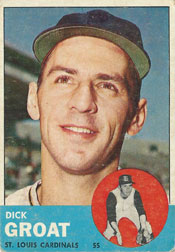
dick_groatWhite and Flood joined Dick Groat as Cardinals who reached 200 hits in 1963. Groat, who finished with 201, got his 200th hit in the penultimate game of the season.

According to the book “The Curt Flood Story: The Man Behind the Myth,” Flood approached Groat in 1963 after Groat was acquired by the Cardinals from the Pirates and said to him, “I got to learn to hit to the opposite field. You show me.”

“Groat and I would go out to the ballpark for long periods of time and he would help me to learn how to hit to right field,” Flood said. “That Groat, he could hit .300 with a strand of barbed wire.”

On Sept. 28, 1963, Groat entered the next-to-last game of the season with 199 hits. He tripled against the Reds’ Joe Nuxhall in the first inning for hit No. 200 and got his final hit of the season, a double off Nuxhall, in the sixth. Groat became the first Cardinals player to achieve 200 hits in a season since Stan Musial (with 200) in 1953. Boxscore

(In the 2005 book “Cardinals Where Have You Gone?” Groat was asked by writer Rob Rains to explain his hitting success in 1963. “I was hitting in front of Stan Musial all year,” Groat replied.)

White and Flood each had 198 hits entering the season finale, Sept. 29, 1963, against the Reds at St. Louis, but the spotlight was focused on Musial, who was playing the final game of his illustrious career.

In the sixth, Flood doubled against Jim Maloney and scored on Musial’s single, the 3,630th and final hit of Stan’s career. White also singled in the inning. So Flood and White each had 199 hits.

When Flood grounded out in the seventh and White grounded out in the eighth, it appeared both would fall short of achieving 200, but the Reds scored twice in the ninth, tying the score, 2-2, and the game went to extra innings.

In the 13th, White singled against Joey Jay for hit No. 200. In the 14th, Flood singled off Jay, becoming the third Cardinal that year with 200 hits. The single moved baserunner Ernie Broglio from first to second. Dal Maxvill followed Flood with a double, driving in Broglio with the game-winning run. Boxscore

The 1963 season was the only time Groat and White reached 200 hits in a season. Flood did it one more time, getting 211 hits for the 1964 Cardinals.


Tony La Russa had lots of time to think about his faltering Cardinals club during the 1998 all-star break. The Cardinals manager used that time off to devise a batting order that surprised players and fans, creating a controversy that lingered throughout La Russa’s tenure in St. Louis.

todd_stottlemyreIn July 1998, La Russa chose to bat the pitcher eighth rather than ninth in the order.

In an article for the St. Louis Post-Dispatch, reporter Rick Hummel referred to the decision as “The Great Experiment.”

Intelligent innovation or egotistical folly? La Russa’s move was labeled both.

Even with an offense powered by the record-setting home run pace of Mark McGwire, the bullpen-poor, error-prone 1998 Cardinals entered the all-star break having lost 10 of their last 12 games.

In their first game after the break, July 9 vs. the Astros at St. Louis, La Russa posted a batting order that had pitcher Todd Stottlemyre batting eighth and rookie second baseman Placido Polanco batting ninth.

Stottlemyre became the first major-league pitcher to bat anywhere but ninth in the order since the Phillies’ Steve Carlton on June 1, 1979, at Cincinnati.

(In that game, Phillies manager Danny Ozark batted Carlton eighth and shortstop Bud Harrelson ninth. Carlton went 0-for-3 and hit into a double play; Harrelson, who entered the game hitless in five at-bats that season, was 1-for-3 with a single. The Reds won, 4-2. Boxscore)

The Phillies had been shut out in their previous three games, so the move of Carlton to the eighth spot was a gimmick. Ozark never tried it again.

La Russa was committed to the strategy. He batted his pitcher eighth in each of the last 77 games of the 1998 season.

In the 1960s, Cardinals pitcher Bob Gibson had asked manager Red Schoendienst to bat him eighth and to move shortstop Dal Maxvill to the ninth spot. Schoendienst didn’t do it. “If he had,” Maxvill said to Hummel, “I would have been so ticked off I wouldn’t have talked to him for the rest of my life. I don’t think he would want to show me up.”

La Russa informed Hummel he sought the advice of Schoendienst, then a St. Louis consultant, and Cardinals instructor George Kissell before deciding to bat the pitcher eighth in 1998. “They said it was OK,” La Russa said.

In explaining his decision, La Russa told the Post-Dispatch, “I don’t see how it doesn’t make sense for the ninth-place hitter to be a legitimate hitter. This gives us a better shot to score runs. It’s an extra guy on base in front of Ray (Lankford), Mark (McGwire) and Brian (Jordan). The more guys who are on base, the less they’ll be able to pitch around Mark. I don’t have a problem with it.”

Cardinals’ first game with pitcher batting eighth

Polanco, appearing in his third big-league game, was 0-for-2 from the ninth spot on July 9, 1998, before Willie McGee pinch-hit for him in the seventh. Stottlemyre was 1-for-2. The pitcher led off the third with a single and scored on Royce Clayton’s double. Still, the Cardinals made four errors and grounded into three double plays. Houston won, 5-4. Boxscore

Said Stottlemyre: “I stink whether I hit eighth or ninth. I take my swings. I take my seat. And I get ready to pitch.”

The more La Russa continued to bat the pitcher eighth, the more the criticism grew.

“I think the National League is investigating the Cardinals and Tony,” catcher Tom Pagnozzi said after batting ninth for the first time.

Said La Russa: “It would be nice if it would become a non-issue.”

La Russa legacy?

According to the book “Cardinals Journal” (2006, Emmis Books), the 1998 Cardinals scored 4.98 runs per game with the pitcher batting ninth and 4.96 runs per game with the pitcher batting eighth.

From 1998 to 2011 (his last season as manager), La Russa batted the pitcher eighth 432 times. He batted Cardinals pitchers eighth in the last 56 games of 2007 and in 153 games in 2008.

(Until La Russa, the manager who had batted the pitcher eighth the most times in a season was Lou Boudreau of the 1957 Athletics. He batted the pitcher eighth for the first 56 games that season. Boudreau was fired in August that year.)

La Russa batted Cardinals pitchers eighth 55 times in 2009, 77 times in 2010 and 14 times in 2011.

Previously: Tony La Russa: Proud pupil of mentor Paul Richards

In 1988, the defending National League champion Cardinals staggered into the all-star break after experiencing a humiliating loss during a series that exposed multiple flaws and severely tested their resolve.

chris_speierThe 1988 Cardinals ended their first half of the season with three games at San Francisco. Mike LaCoss pitched a four-hitter in the opener, a 1-0 Giants win. Terry Mulholland pitched a five-hitter in the finale and the Giants won, 2-1.

It was the middle game of the set that sent the Cardinals reeling.

The Giants beat them, 21-2, on Saturday afternoon, July 9, 1988, at Candlestick Park.

Summarizing the Cardinals’ performance, Rick Hummel of the St. Louis Post-Dispatch wrote, “Their defense was less than airtight and their hitting was poor, but, most strikingly, their pitching was colossally bad.”

The 21 runs allowed were the most a Cardinals team had surrendered in 63 years, according to the Post-Dispatch. The Pirates defeated the Cardinals, 24-6, on June 22, 1925, at St. Louis. Boxscore

The 21 runs also were the most scored by the Giants since they moved to San Francisco from New York in 1958. The previous high was 19.

Two unlikely Giants standouts in the blowout win were infielders Chris Speier and Ernest Riles.

Speier, 38, filling in at second base for ailing all-star Robby Thompson, hit for the cycle and had five RBI. He had two doubles, a triple, a home run and a single. It was the only five-hit game in Speier’s 19-year major-league career.

The oldest big-league player to hit for the cycle was Cy Williams, 39, of the 1927 Phillies, the Post-Dispatch reported. Like Speier, Honus Wagner of the 1912 Pirates was 38 when he hit for the cycle.

Speier entered the game with a .191 batting average. “I hadn’t been doing much the last month and a half,” Speier said to the Associated Press. “I had a long talk with my wife and I just decided to relax and have some fun.”

Riles had been acquired by the Giants a month earlier in a trade that sent outfielder Jeffrey Leonard to the Brewers. Riles, who entered the game in the sixth inning as a replacement for shortstop Jose Uribe, hit a three-run home run in the seventh. It was the 10,000th home run in Giants history and the first for Riles as a Giant.

The ball hit off the facing of the upper deck and caromed back onto the field. Disgusted, Cardinals right fielder Tom Brunansky picked up the historic ball and heaved into the stands. After the game, Brunansky sought a closed-door meeting with Cardinals manager Whitey Herzog.

“This was pathetic,” Brunansky told the Post-Dispatch. “I was embarrassed.”

Shortstop Ozzie Smith said, “Anybody who is proud of this shouldn’t be here.”

Cardinals starting pitcher John Tudor entered the game with a 1.72 ERA. The Giants knocked him out with five runs in two innings.

“You don’t figure to lose a game by that much with John Tudor pitching,” Herzog said. “His location was bad, but even then it shouldn’t have been that bad.”

Relievers Bob Forsch and Steve Peters each gave up eight runs.

“It was ugly,” Forsch told the Post-Dispatch. “Ugly for me.”

Said Peters: “It’s the worst embarrassment I ever had.”

The Giants ended up with 20 hits and six walks.

Herzog, keeping a sense of humor, told the Associated Press, “I wish we were playing a doubleheader today. We would have had them (the Giants) tired out for the second game.” Boxscore

(Updated Jan. 12, 2022)

The 1963 Cardinals infield established an all-star standard that went unmatched for 53 years.
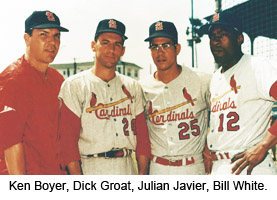
allstar_infieldFor the first time in major-league history, the National League’s All-Star Game starting infield was composed of players from the same team. They were the Cardinals unit of first baseman Bill White, second baseman Julian Javier, shortstop Dick Groat and third baseman Ken Boyer.

The Giants’ Alvin Dark, who managed the 1963 National League all-star team, told The Sporting News, “When you’ve got an infield that starts with Bill White at first base and runs through Julian Javier, Dick Groat and Ken Boyer, you’ve got power and class.”

In 2016, fans selected an all-Cubs starting NL all-star infield of first baseman Anthony Rizzo, second baseman Ben Zobrist, shortstop Addison Russell and third baseman Kris Bryant.

Fans have voted for the all-star starters each year since 1970. In 1963, the starters were selected in voting by players, managers and coaches in each league.

White, Groat, Boyer and Pirates second baseman Bill Mazeroski were voted the starters for the 1963 NL team, but Mazeroski withdrew after he pulled a muscle in his right leg.

Cubs second baseman Ken Hubbs had finished second to Mazeroski in the voting, but Dark picked Javier to replace Mazeroski as the starting second baseman.

United Press International wrote, “Usually, all-star managers in picking reserves for their squad stick mighty close to the way the players themselves voted earlier in choosing the starting lineup.”

Said Dark to the Associated Press: “I feel this is the strongest squad we have.”

Javier “doesn’t have any shortcomings,” Groat told the St. Louis Post-Dispatch. “He runs well, has good range, fine hands and pivots well.”

Here were the top two vote-getters for each NL infield position:

First base: Bill White, 220 votes; Orlando Cepeda, Giants, 38 votes.

Second base: Bill Mazeroski, 227 votes; Ken Hubbs, 14 votes.

Shortstop: Dick Groat, 238 votes; Maury Wills, Dodgers, 25 votes.

Third base: Ken Boyer, 186 votes; Ron Santo, Cubs, 52 votes.

The other starting position players for the 1963 NL all-stars were Giants catcher Ed Bailey and outfielders Hank Aaron of the Braves, Willie Mays of the Giants and Tommy Davis of the Dodgers.

The Cardinals’ Stan Musial, 42, was chosen by Dark as an outfield reserve. It would be a record 24th and final All-Star Game for Musial, who retired after the season.

Best Cardinals infield

In his book “Stan Musial: The Man’s Own Story,” Musial said, “That infield was the strength of the 1963 Cardinals, all right … Marty Marion said the Cardinals’ 1946 infield was a bit better. I’m not so sure, though we did have a good one in ’46. I played first base then, Red Schoendienst second, Marion short and George Kurowski third. That far back, Red hadn’t yet come into his own as a hitter.”

In a 2011 interview, I asked White if the 1963 Cardinals infield was the best he’d seen. White’s response:

“It was a good infield. It probably was not the best. Ken Boyer might have been the best third baseman I’d seen or played with. Groat had mobility problems. He understood how to play the hitters, but he had very little range and he didn’t have that real good arm. Javier was a pretty good second baseman. He made a great double play and he could go way out to center field for pop-ups because Curt Flood played a deep center field.

“It was a good infield, the best infield that I was on, but I’m not sure it was the best ever. It might have been the best Cardinals infield.”

Branch Rickey said the 1963 Cardinals infield was comparable to the 1952 Dodgers infield of first baseman Gil Hodges, second baseman Jackie Robinson, shortstop Pee Wee Reese and third baseman Billy Cox. “I’d still give that Brooklyn infield the edge defensively,” Rickey told The Sporting News in June 1963, “but this Cardinals infield has more offensively and might even get to be better.”

White, Groat aid NL win

White and Groat contributed significantly to the NL’s 5-3 victory over the American League on July 9, 1963, at Cleveland. They and Javier played the entire game. Santo replaced Boyer in the sixth.

In the second, Groat’s single off starter Ken McBride of the Angels drove in Mays from second, giving the NL a 1-0 lead.

With the NL ahead 4-3 in the eighth, White led off against imposing Red Sox reliever Dick Radatz, nicknamed “The Monster,” and singled to center.

Taking his lead off first base, White watched Radatz pitch to Mays and detected a flaw in the pitcher’s motion, he told The Sporting News. As Mays struck out, White swiped second. White ran on his own, Dark said.

Radatz “came set and started his left leg forward a couple of pitches in a way that showed just when he definitely was going to the plate, not to first base,” White told the Post-Dispatch.

Santo singled to center, scoring White and boosting the NL’s advantage to 5-3.

With Dodgers ace Don Drysdale pitching the ninth, the Orioles’ Brooks Robinson singled with one out. The next batter, Bobby Richardson of the Yankees, hit a grounder to White. The Cardinals’ first baseman threw to Groat covering second and Groat’s return throw to White nipped Richardson for a game-ending first-to-short-to-first double play. Boxscore

The NL turned three double plays. White took part in all three and Groat helped turn two. White and Groat each went 1-for-4; Javier and Boyer each was hitless.

(Musial, pinch-hitting for Bailey in the fifth, faced Jim Bunning and lined out to Al Kaline in right field. “I got out in front of the pitch just a fraction or I’d have hit it out of there,” Musial said.)

Groat and Boyer both were elected starters again in 1964, but White and Javier were replaced by Cepeda and the Mets’ Ron Hunt.