Feeds:
Posts
Comments

(Updated Sept. 20, 2023)

On the misplay that cost him his perfect fielding streak, Curt Flood gave errors to teammate Lou Brock and the official scorer, but his opinions didn’t count.
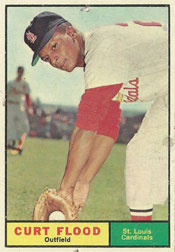
curt_flood4Instead, it was Flood who was deemed to have erred on a routine play that ended a stretch of record-setting perfection.

From September 1965 to June 1967, Flood, the Cardinals’ center fielder, flawlessly handled 555 chances and established a National League record for successive errorless games at 226.

“I think Curt was second only to Willie Mays playing the outfield,” pitcher Bob Gibson said to Cardinals Magazine. “Curt didn’t have a really strong arm, so second baseman Julian Javier used to go halfway out to the outfield for the relay, but as far as going and getting the ball, there weren’t too many guys better than Curt.”

On June 4, 1967, Flood’s streak was intact when the Cubs faced the Cardinals at St. Louis.

In the fifth inning, with the score tied at 2-2, Cubs pitcher Rich Nye led off and hit a routine fly to left-center field. According to The Sporting News, “Brock got under the ball and was virtually stationary when Flood moved over.”

Brock, the left fielder, and Flood both called for the ball. As the ball descended, both outfielders again called out, informing the other he would make the catch, the Associated Press reported.

Neither outfielder yielded. As Brock and Flood both reached for the ball, they bumped elbows and shoulders. The ball “bounced in and out of Brock’s glove” and fell to the ground, The Sporting News reported.

Nye reached second base safely on the misplay, moved to third on Don Kessinger’s sacrifice bunt and scored on a Glenn Beckert sacrifice fly, giving Chicago a 3-2 lead.

The official scorer, Neal Russo of the St. Louis Post-Dispatch, charged Flood with an error because “Brock easily would have caught the ball if Flood had not bumped him,” The Sporting News reported.

Flood, described by the Associated Press as “upset and disappointed” at being charged with the error, said Brock should have backed away. Flood implied Russo should have given the error to Brock.

“The center fielder is supposed to go after every ball he can get to,” Flood said to the Associated Press. “If he calls, the other player is supposed to leave it.”

Flood told The Sporting News, “The center fielder is the captain of the outfield and is supposed to get every ball (he calls).”

Russo said it was “difficult to see the streak end short of an out-and-out error of physical commission,” but, he told The Sporting News, “based on many similar plays that I have scored and seen scored, the error belonged to Flood.”

(The error was the first for Flood since Sept. 2, 1965, when the Cubs’ Harvey Kuenn singled and advanced to second after Flood mishandled the ball.)

Flood and Brock used their bats in helping the Cardinals rally from the deficit created by their misplay.

In the sixth, Julian Javier singled, moved to third on Flood’s single and scored the tying run on Orlando Cepeda’s sacrifice fly. The Cardinals broke the tie in the eighth. Brock’s single scored Dave Ricketts from second base and St. Louis won, 4-3. Boxscore

In 2013, another Cardinals center fielder, Jon Jay, broke Flood’s mark. Jay’s errorless streak reached 245 games before he made an error on July 30, 2013, against the Pirates in Pittsburgh. Fielding a single, Jay fumbled the ball, allowing the runner to advance to second. Before that, his last error was Aug. 24, 2011.
(Updated June 28, 2022)

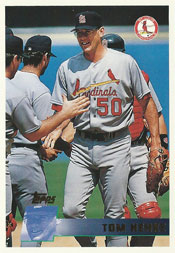
Tom Henke was a consistently dominant closer for the 1995 Cardinals, converting his first 22 save chances.

tom_henkeSigned by the Cardinals on Dec. 12, 1994, after 13 years with the Rangers and Blue Jays, Henke, 37, was a model of effectiveness amid the chaos of a 1995 season in which the Cardinals traded popular first baseman Todd Zeile to the rival Cubs, fired manager Joe Torre and finished 62-81, 22.5 games behind the division-leading Reds.

“Henke has dominated with a mix of fastballs and forkballs,” Mike Eisenbath noted in the St. Louis Post-Dispatch. “As the hitters have begun waiting for that forkball, he has adjusted with an occasional sidearm delivery.”

A right-hander, Henke converted his 22nd consecutive save chance on July 22 in a 5-4 Cardinals victory over the Phillies at Philadelphia. Henke worked a perfect 11th, retiring Mickey Morandini, Jim Eisenreich and Lenny Dykstra on fly outs to left, center and right. Boxscore

Henke’s streak ended in his next appearance, July 25, against the Mets at St. Louis. Brought in to protect a 7-6 Cardinals lead in the ninth, Henke blew the save chance when he yielded a two-out, RBI-single to Carl Everett. The Cardinals won, 8-7, in 11. Boxscore

“I’ll start it over tomorrow,” Henke said to St. Louis writer Rick Hummel of the streak. “If somebody had told me at the beginning of the year I’d save 22 in a row before I’d blow my first one, I’d take that in a heartbeat.”

It was a rare misstep for Henke. He converted 36 of 38 save opportunities for the 1995 Cardinals. Henke had a 0.96 ERA in the 36 games he saved, yielding four runs in 37.1 innings.

Overall, Henke struck out 48 in 54.1 innings in 1995 and finished with a 1.82 ERA. Opponents batted .153 (9-for-59) against him with runners in scoring position. Henke yielded only two home runs (hit by Howard Johnson of the Mets and Jason Bates of the Rockies).

Soon after the season, Henke decided to retire. “I’ve always admired guys who have gone out at the top of their game,” Henke said to Hummel. “Sometimes you have to look at what’s the most important thing in life. I’d like to see my kids grow up.”

Previously: Braves fans’ behavior recalls Dodgers’ forfeit to Cardinals

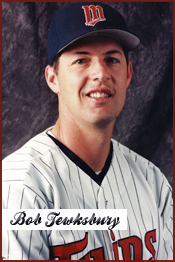
In a season when Mark McGwire pummeled pitchers with his home run power, Bob Tewksbury used lollipop pitches to keep the Cardinals slugger from hitting the ball out of the infield.

bob_tewksburyIn 1998, Tewksbury, the former Cardinal, was with the Twins in what would be the last of his 13 major-league seasons. McGwire was in his first full year with the Cardinals and headed toward a record-breaking season in which he would hit 70 home runs.

On June 28, 1998, Tewksbury got the start against the Cardinals at the Hubert H. Humphrey Metrodome in Minneapolis.

McGwire entered the game with 36 home runs and a .313 batting average.

When McGwire came to bat in the first inning, Tewksbury lobbed a pitch toward the plate. McGwire watched it float out of the strike zone for ball one. Tewksbury followed with another lob, a pitch accurately described by Dan Barreiro of the Minneapolis Star Tribune as a lollipop. Rather than give it a lick, McGwire swung and dribbled a grounder to first base.

As he headed toward the dugout, McGwire shared a laugh with first-base coach Dave McKay, the Associated Press reported.

“It was all of 44 (mph),” Tewksbury told the St. Louis Post-Dispatch. “… My son (Griffin) calls it The Dominator. (Manager) Tom Kelly calls it The Entertainment Pitch. The hitters probably call it some other things.”

Said McGwire: “It was awesome. I loved it. I tell you what, I’ll swing at it every time if it’s in the strike zone.”

When McGwire came to bat again, in the fourth, Tewksbury got two quick strikes on the slugger before he floated the lob pitch. McGwire swung and popped out near first base.

“The first time it was funny,” Cardinals manager Tony La Russa said. “He kept getting outs with it _ and then it wasn’t funny.”

Said Tewksbury: “I can’t throw the ball by him, but I can throw it slower. I was excited to face McGwire. I couldn’t wait to face him. It was a thrill. He’s one of the best ever to play the game.”

In the sixth, McGwire singled off a Tewksbury curve. “I didn’t want to get crazy with it,” Tewksbury said about why he didn’t try the lob to McGwire again. “He’d hit it in the upper deck.”

When Ray Lankford came up in the same inning, Tewksbury delivered two lobs. Lankford watched one and grounded out on the other, ending the inning.

In 6.1 innings, Tewksbury yielded two runs on seven hits, walked none and struck out two. He threw five lobs _ three to McGwire and two to Lankford _ and recorded three outs with those floaters. The Twins won, 3-2. Boxscore

“From the variance of slowest pitch to fastest in the league, I can probably go farther than anybody,” Tewksbury said. “I can throw 44 (mph) and I can throw 83 (mph).”

Previously: Think Lance Lynn is a surprise? Check out Luis Arroyo

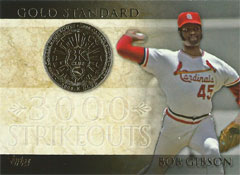
Bob Gibson once squandered a 6-0 first-inning lead and was lifted before he could get three outs.

bob_gibson14The night of April 16, 1962, was cold and windy at Philadelphia. Game time temperature was 36 degrees. Only 3,895 came to see the Cardinals play the Phillies at Connie Mack Stadium that Monday night.

The pitching pairings were Gibson, making his first start of the season, against Cal McLish, making his first appearance for the Phillies after being acquired from the White Sox.

The first five Cardinals batters reached base, four on walks from McLish. The fourth walk was issued to Ken Boyer with the bases loaded. Bill White produced a run-scoring double and Doug Clemens hit a three-run double before McLish was replaced by Dallas Green. Gibson singled, driving in the sixth run of the inning.

In the bottom half of the inning, Phillies leadoff batter Tony Taylor walked and advanced to second on a wild pitch. Johnny Callison also walked.

After Tony Gonzalez struck out and Wes Covington flied out, Billy Klaus singled, scoring Taylor, and Frank Torre walked, loading the bases. Clay Dalrymple knocked in two more with a single, cutting the Cardinals’ lead to 6-3. After a walk to Ruben Amaro loaded the bases, Cardinals manager Johnny Keane replaced Gibson with Ernie Broglio.

Roy Sievers, batting for Green, walked, scoring Torre with the Phillies’ fourth run. Taylor singled, driving in two and tying the score at 6-6. All six runs were charged to Gibson.

When Callison made the third out, on a pop-up to the catcher, it ended a first inning that included nine walks and took 54 shivering minutes to play.

Gibson’s pitching line: 0.2 innings, two hits, six runs, four walks, one strikeout.

In his book “Stranger to the Game,” Gibson said, “I was roughed up for six runs in the first inning. After that our pitching coach, Howie Pollet, made me throw more pitches and simulate game conditions in the bullpen (before starts), which seemed to help.”

The Phillies wouldn’t score again that night. Broglio pitched 8.1 innings in relief and scattered five hits and four walks.

In the third, Cardinals catcher Gene Oliver broke the 6-6 tie with a home run off Don Ferrarese, who, two weeks later, would be traded to St. Louis.

The Cardinals won, 12-6. Broglio’s win was his first in relief since 1960. Boxscore

“We’ve been going slow with him (Broglio) because of his bad arm last year,” Keane said. “He and (Ray) Sadecki were behind in training and we were using them in long relief.”

In his next start, April 22, 1962, at Chicago, Gibson gave up four runs in eight innings and took the loss in a 5-1 Chicago victory, but limited the Cubs to four hits and struck out nine. Boxscore He finished the 1962 season with a 15-13 record and 2.85 ERA.

Previously: Bob Gibson vs. Sandy Koufax: a grand game for Charlie James

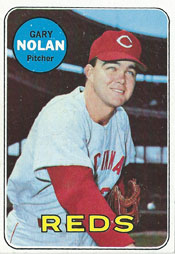
Only one teenager has struck out 10 or more Cardinals in a game. Gary Nolan, a Reds rookie, was 19 when he struck out 12 Cardinals in seven innings on July 19, 1967, at Cincinnati.

gary_nolan“Every major-league club probably has a kid in the minors with as much ability as Nolan has, but what the other kids don’t have is Nolan’s makeup _ heart _ or whatever you want to call it,” Phillies manager Gene Mauch told The Sporting News.

Nolan had an 8-2 record and 2.29 ERA entering his start against the Cardinals.

Through seven innings, Nolan held the Cardinals scoreless and limited them to four singles, walking none.

His 12 strikeouts came in the first six innings. Five Cardinals _ Roger Maris, Tim McCarver, Mike Shannon, Dal Maxvill and Larry Jaster _ each struck out twice. Lou Brock and Orlando Cepeda struck out once apiece.

The Reds led, 2-0, as Maxvill opened the Cardinals’ eighth against Nolan. Maxvill, who entered the game with a .210 batting average, doubled to right. According to the Associated Press, Nolan told Reds manager Dave Bristol the bicep in his right arm had tightened.

“The pitch Maxvill hit was up and you could tell Gary didn’t have much on it,” Bristol said.

Bristol lifted Nolan, citing the arm problem, and the umpires allowed reliever Ted Abernathy to take as many warmup pitches as he needed. (Cardinals manager Red Schoendienst told the Associated Press he wasn’t convinced Nolan’s arm had tightened and implied the Reds had used the injury as an excuse to give Abernathy extra time to loosen.)

“I just didn’t want to take any chances,” Bristol said. “It was a muscle in his arm and he was tired.”

Said Nolan: “I wasn’t tired, but my arm tightened up.”

Nolan’s departure benefitted the Cardinals. Alex Johnson, the first batter Abernathy faced, doubled to center, scoring Maxvill. Two outs later, Maris singled, driving in the tying run.

The Cardinals won, 3-2, in 12 innings when Gerry Arrigo walked Bobby Tolan with the bases loaded. Boxscore

The victory sparked a run of 10 wins in 13 games for the Cardinals and vaulted them 4.5 games ahead of the second-place Cubs.

Six days after facing the Cardinals, Nolan made his next start against the Braves and held them to a run in eight innings. Nolan finished the 1967 season with a 14-8 record and 2.58 ERA, striking out 206 in 226.2 innings.

Previously: Cardinals vs. Reds: rich tradition of July 4 showdowns

In 1993, when the Cardinals made their first regular-season visit to Miami, several fans of the expansion Marlins switched their allegiance to St. Louis for one game.

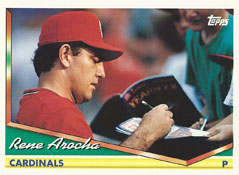
rene_arocha2Cardinals pitcher Rene Arocha, a Cuban defector who settled in Miami, had the support of the South Florida Cuban community when he started against the Marlins on June 23, 1993.

Arocha was a Cardinals rookie in 1993. Two years earlier, on July 10, 1991, while with the Cuban national baseball team, Arocha defected to the United States. He walked out of Miami International Airport and into a waiting car, becoming the first member of Cuban president Fidel Castro’s baseball team to defect, the Sun-Sentinel of Fort Lauderdale reported.

Miami became Arocha’s adopted hometown. The Cardinals won a lottery among major-league teams for the right to sign the Havana native.

A right-hander, Arocha was 5-2 with a 3.05 ERA as he prepared to face the Marlins. He had been on the 15-day disabled list in April after breaking a finger on his glove hand. “If he doesn’t get hurt (again), he’ll win 15,” Cardinals broadcaster Mike Shannon told the Sun-Sentinel. “If he’s lucky, he’ll win 20.”

Rick Hummel of the St. Louis Post-Dispatch wrote that Arocha’s start at Miami was “one of the major happenings of the expansion Florida Marlins’ first season.”

Said Cardinals infielder Jose Oquendo: “The Cubans think that Miami is Cuba.”

Arocha partnered with a Miami radio station and Nike to buy 500 general admission tickets, the New York Times reported. “The Cubans here want to see me pitch,” Arocha told Hummel. “They would be disappointed if I didn’t … The fans, and probably myself, want to win here more than someplace else.”

As anticipation built toward game time at Joe Robbie Stadium, so did Arocha’s anxiety and adrenalin. Cardinals manager Joe Torre and pitching coach Joe Coleman tried to calm him.

“They just told me to concentrate on the job I had to do in the game,” Arocha said. “When I got to the mound, I felt very emotional. I was trying to throw the ball harder than normal.”

Arocha yielded singles to three of the first four batters he faced. “He was pumped up,” Torre said. “He did get a little out of whack trying to throw the ball too hard a few times.”

The Marlins led, 1-0, after an inning. Arocha changed the momentum in the second in a most unexpected way. After the Cardinals scored a run to tie, they had the bases loaded with one out and Arocha at the plate. Arocha, hitless in his first 19 major-league at-bats, drilled a two-run single to center off starter Ryan Bowen, giving St. Louis a 3-1 lead.

“I couldn’t believe it when the ball went into the outfield,” Arocha said of his first big-league hit. “This means more than my first major-league win. I knew what it felt like to win, but I didn’t know what it would feel like to have a base hit.”

Arocha pitched 5.1 innings, yielding six hits and three runs, walking two and striking out two. As he departed, he received a standing ovation from the crowd of 37,936.

“That was a very warm feeling,” Arocha said. “I got a great response from the people that I know were behind me.”

Said Cardinals catcher Erik Pappas: “I was surprised how loud the crowd was. It sounded like they were more for him than they were for the Marlins.”

The Cardinals received 3.2 innings of scoreless relief from Paul Kilgus, Rob Murphy, Mike Perez and Lee Smith, winning, 4-3, and boosting Arocha’s record to 6-2. Boxscore He would finish the season 11-8.

Marlins first baseman and Cuba native Orestes Destrade said of Arocha: “He’s surprised a few of his critics who said he couldn’t pitch at the major-league level.”

Previously: First Rockies lineup had prominent Cardinals connection