Feeds:
Posts
Comments

(Updated Nov. 28, 2024)

Displaying a gold standard for consistency and durability at his position, Ozzie Smith holds the National League record for most games played at shortstop.
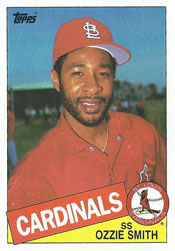
ozzie_smith6On May 22, 1993, when the Cardinals took the field at Pittsburgh’s Three Rivers Stadium against the Pirates, Smith set the National League record for most games played at shortstop, with 2,223. Smith broke the mark of 2,222 held for eight years by Larry Bowa. Before Bowa, the National League record had been held for more than 50 years by Rabbit Maranville. Boxscore

“It’s a record that’s been there a long time,” Smith told Rick Hummel of the St. Louis Post-Dispatch. “You have no idea when you start out that you’ll be able to achieve it. It’s an honor.”

Smith achieved the record by overcoming a serious shoulder injury in 1985. Smith chose to let the injury heal naturally rather than undergo surgery. Remarkably, he led National League shortstops in games played in 1985, with 158.

“I had a torn rotator cuff (in 1985),” Smith told Hummel in May 1993. “People don’t talk about that much. I’m proud of (overcoming) that. I thought Mother Nature was the best way to handle it.

“For a while, I knew that I was going to have only one long throw a day. You had to kind of position yourself so you could get the ball over there, but at the same time not make it so far that you were going to hurt yourself for the rest of the day. I battled around that pretty well.”

Thomas Boswell wrote in the Washington Post, “He rehabilitated himself so quickly he never missed a game. Most fans, and even foes, didn’t know he was ever hurt … He positions himself to avoid long throws and has developed the quickest release since Joe Namath faced a blitz.”

Smith also topped National League shortstops in games played in 1980 (158), strike-shortened 1981 (110), 1987 (158) and 1989 (153).

Smith played in the major leagues from 1978-96 for two National League clubs: Padres (four years) and Cardinals (15 years).

He finished his career with 2,511 games played at shortstop, ranking him fourth in big-league history. The three ahead of him played either exclusively or primarily in the American League.

The top 10 in big-league games played at shortstop:

_ 1. Omar Vizquel, 2,709 games. Vizquel performed in the major leagues from 1989-2012. Four of those years were spent in the National League (with the Giants).

_ 2. Derek Jeter, 2,674. Of the shortstops in the top 10, Jeter is the only one who played even one game for the Yankees.

_ 3. Luis Aparicio, 2,581. In 18 seasons in the big leagues, all in the American League (with the White Sox, Orioles and Red Sox), Aparicio never played a position other than shortstop.

_ 4. Ozzie Smith, 2,511. Like Aparicio, Smith never played a position other than shortstop in the majors. He won a Gold Glove Award in 13 consecutive years (1980-92) and led National League shortstops in fielding percentage eight times.

_ 5. Cal Ripken, 2,302. He spent his entire big-league career with the Orioles (1981-2001). Ripken led American League shortstops in fielding percentage four times. After shifting to third base, he led the league in fielding percentage at the hot corner in 1998.

_ 6. Jimmy Rollins, 2,227. After 15 seasons with the Phillies, for whom he won four Gold Glove awards, Rollins finished with a year each for the Dodgers and White Sox.

_ 7. Larry Bowa, 2,222. Bowa played his whole career in the National League, with the Phillies, Cubs and Mets (1970-85).

_ 8. Luke Appling, 2,218. He spent his entire big-league career (1930-50) with the White Sox. When he retired, Appling held the major-league record for most games played at shortstop.

_ 9. Dave Concepcion, 2,178. Concepcion played his entire career with the Reds (1970-88).

_ 10. Rabbit Maranville, 2,153. A National League shortstop from 1912-35, Maranville was the starter for the 1928 Cardinals pennant winners. He also played for the Braves, Pirates, Dodgers and Cubs.
 

(Updated June 16, 2023)

As a Cardinals rookie, Dick Hughes delivered a dominant strikeout performance against the Reds that stands out for its artistry and drama.

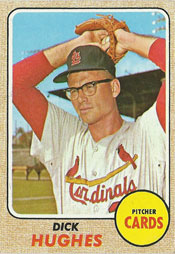
dick_hughesOn May 30, 1967, Hughes was perfect for seven innings against the Reds at Cincinnati. Then a string of bad breaks and bizarre plays occurred. Hughes struck out 13 in eight innings but took the loss in the Reds’ 2-1 victory.

A right-hander, Hughes spent nine seasons (1958-66) in the minor leagues. His vision was 20-75 in one eye; 20-300 in the other, according to The Sporting News.

In 1966, Hughes turned around his career by developing a slider and a no-windup delivery. He got his first call to the big leagues with the Cardinals in September 1966.

Hughes, 29, opened the 1967 season in the Cardinals bullpen. He joined the starting rotation in May, swapping roles with Al Jackson.

Five days after pitching a two-hit shutout in the Cardinals’ 5-0 victory over the Braves in Atlanta Boxscore, Hughes was paired against Reds ace Jim Maloney at Cincinnati’s Crosley Field.

The start of the game was delayed 1 hour, 35 minutes by rain. Unfazed, Hughes retired the first 18 batters. Then play was halted another 55 minutes by rain.

Hughes retired the Reds in order in the seventh, keeping his bid for a perfect game intact, but the second delay had been damaging.

“My slider was not going where I wanted it to and, after the rain stopped the game (a second time), I began relying on my fastball.” Hughes said to the Associated Press.

Said Cardinals manager Red Schoendienst: “The delay in the game by rain took a little of the edge off Hughes.”

With the Cardinals ahead 1-0, Tony Perez, leading off the eighth for Cincinnati, swung at a 3-and-2 fastball and lofted a high fly to center. The ball hit off the wall at cozy Crosley for a 380-foot triple “that would have been an easy out in any other park,” The Sporting News reported.

With the perfect game bid ended, Hughes focused on trying to preserve the lead. After he struck out Deron Johnson for the first out, Vada Pinson batted. “Pinson tried to duck from a high pitch, which he later confessed he never saw and, presto, he had a bloop, score-tying double to short left,” The Sporting News reported.

Pinson’s fluke double plated Chico Ruiz, who ran for Perez, tying the score at 1-1.

Trying to set up a double play, Hughes issued an intentional walk to Johnny Edwards, but Leo Cardenas followed with a single, scoring Pinson and giving the Reds a 2-1 lead. Edwards advanced to third on the play, but Cardenas was thrown out at second, trying to stretch the single into a double.

Maloney was due up next. Rather than lift him for a pinch-hitter and turn to a closer in the ninth, manager Dave Bristol opted to let Maloney bat and he ended the inning with a fly out.

Fortunately for the Cardinals, Maloney was tiring. Orlando Cepeda opened the ninth with a single. Tim McCarver followed with another single, sending Cepeda to third.

Bristol lifted Maloney and brought in Don Nottebart to face Phil Gagliano, subbing for third baseman Mike Shannon, who had a viral infection.

Gagliano swung at Nottebart’s first pitch and grounded sharply to Cardenas at shortstop. Cepeda should have raced for home. Instead, he hesitated. Cardenas fielded the grounder and flipped to second baseman Tommy Helms, forcing McCarver. Though McCarver slid hard into him, Helms relayed a throw to first baseman Deron Johnson, completing the double play.

(In his book, “Baseball for Brain Surgeons and Other Fans,” McCarver recalled, “I hit Helms so hard on that play that I was concerned enough to call him after the game. In my entire career, that was the only time I called an opposing player to find out if he was OK.”)

On Helms’ throw, Cepeda broke for home. Johnson spotted him and fired the ball to catcher Johnny Edwards, who tagged out Cepeda.

Triple play. Game over.

“Something, eh?” an astonished Bristol said to the Associated Press. “First time I ever threw my cap into the stands.

“I sent Nottebart in to pitch, hoping he would throw a low ball for a grounder. He sure did.” Boxscore

Hughes finished with a pitching line of eight innings, three hits, two runs, one walk and 13 strikeouts. Hughes held Pete Rose hitless, stopping Rose’s 25-game hit streak.

“If it hadn’t rained, we never would have got a hit off Hughes,” Chico Ruiz said. “Hughes was just great.”

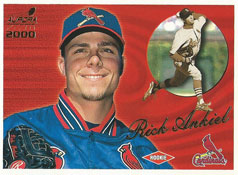
As a Cardinals rookie, Rick Ankiel struck out 11 batters in a game four times, twice doing it before his 21st birthday.

rick_ankiel3Here is a look at those performances:

_ Cardinals 7, Marlins 6, at St. Louis, May 25, 2000: Ankiel earned his fourth win of the season, striking out 11 in 6.2 innings.

The effort was controversial because Ankiel threw 121 pitches. Scott Boras, Ankiel’s agent, said he believed the Cardinals had agreed to limit Ankiel to 100 pitches a game.

Ankiel, who was averaging 4.25 walks per game, didn’t yield a walk to the Marlins. He struck out the side (Preston Wilson, Derrek Lee and Alex Gonzalez) in the second inning and did it again (Danny Bautista, Cliff Floyd and Wilson) in the fourth. Boxscore

_ Indians 3, Cardinals 2, at St. Louis, June 4, 2000: Six of the Indians’ first seven outs were on strikeouts. Ankiel struck out 11 in five innings and walked none, but was lifted after reaching 98 pitches.

“I had a lot of strikeouts, but I really wasn’t going that well,” Ankiel said to the St. Louis Post-Dispatch.

Ankiel struck out the side (Alex Ramirez, Jolbert Cabrera and Jim Brower) in the second and did it again (Sandy Alomar, Richie Sexson and Ramirez) in the fourth. Boxscore

_ Cardinals 12, Astros 1, at Houston, July 21, 2000: Two days after turning 21, Ankiel struck out 11 in seven innings and improved his record to 7-5. Ankiel struck out Craig Biggio twice and Lance Berkman once.

“He’s got an electric arm,” said Astros slugger Jeff Bagwell.

Said Cardinals manager Tony La Russa: “Sometimes it’s hard to remember how young he is. With him, it’s all about command. His stuff is so good.” Boxscore

_ Cardinals 9, Pirates 5, at Pittsburgh, Sept. 13, 2000: In the last game the Cardinals would play at Three Rivers Stadium before the Pirates moved into PNC Park, Ankiel struck out 11 in 6.2 innings, earning his ninth win of the season.

Ankiel struck out the side (John Wehner, Mike Benjamin and Adrian Brown) in the second.

“The ball explodes out of his hand,” said Pirates manager Gene Lamont. “He’s going to be one of the best pitchers we’ve seen in a long time.”

Said La Russa: “I’d love for him to get the Rookie of the Year (Award) because those nine wins do not reflect how well he’s pitched. He’s learning to pitch. He’s not just out there throwing.” Boxscore

Less than a month later, Oct. 3, 2000, Ankiel, a surprise starter in Game 1 of the National League Division Series against the Braves, walked six and threw five wild pitches in 2.2 innings, triggering the downward spiral that led to the end of his pitching career. Boxscore

(Updated Feb. 26, 2022)

In 1973, the Cardinals had such a dreadful start that general manager Bing Devine was asked almost daily whether he’d fire manager Red Schoendienst.

“I’m tired of hearing that question,” Devine said to The Sporting News. “I’ll be gone before Red.”

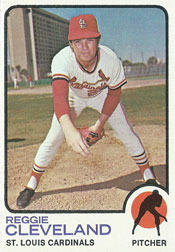
reggie_cleveland2The 1973 Cardinals lost their first five games and 12 of their first 13. Their 1-12 record ranked among the worst in big-league history, recalling the 0-13 start of the 1920 Tigers, the 1-12 record of the 1962 expansion Mets and the 1-15 mark of the 1969 Indians.

Nerves were raw; tension was high. After Cardinals starter Reggie Cleveland gave up a key two-run, two-out double to Bill Robinson in an April 22 loss to the Phillies, Schoendienst groused, “That’s why he’s a .500 pitcher.” Boxscore

The Cardinals’ skid extended into May. After the Giants beat the Cardinals, 9-7, on May 8 (Bob Gibson yielded four home runs, two to Bobby Bonds and one each to Willie McCovey and Dave Kingman), St. Louis had a 5-20 record, the worst in the major leagues, and was in last place in the National League East. Boxscore

The Cardinals were 1-7 in one-run decisions and 0-4 in extra-inning games.

After shoring up the bullpen by calling up left-handers Al Hrabosky and Rich Folkers from the minors and acquiring veteran junkball specialist Orlando Pena from the Orioles, as well as replacing Ray Busse at shortstop with Mike Tyson, the Cardinals began to stabilize, then thrive.

Regarding the replacement of Busse with Tyson, teammate Joe Torre told the New York Daily News, “Before Mike stepped in at shortstop, we were losing a lot of games early because of our infield. Routine ground balls were going straight into the outfield. We needed someone to hold the defense together.”

Years later, in an interview with Cardinals Magazine, Tyson credited Schoendienst and coach George Kissell.

“Red always put me in a good position,” Tyson said. “I didn’t have a particularly strong arm, but my range was good and I got rid of the ball quickly.”

As for Kissell, Tyson said, “George always had my back. Every day after practice in spring training he’d get a bucket of balls and he’d hit me grounder after grounder.”

From the low point of the 5-20 record, the Cardinals won 56 of their next 81 games, boosting their record to 61-50 by Aug. 5 and securing first place in the division, five games ahead of the second-place Cubs.

From there, the streaky Cardinals reverted to their early-season form.

Gibson injured his knee running the bases against the Mets and was sidelined from Aug. 4 to Sept. 29. From Aug. 6 to Aug. 18, St. Louis lost eight in a row and 11 of 12, falling to 62-61.

Overall, the Cardinals lost 31 of their last 51 games and finished in second place at 81-81, 1.5 games behind the Mets.

The 1968 Cardinals were stocked with players known for producing high drama. Bob Gibson. Lou Brock. Roger Maris. Orlando Cepeda. It was a supporting cast member, though, who delivered a storybook home run.

julian_javier3On May, 15, 1968, second baseman Julian Javier visited Mark Sandusky, 6, of McKeesport, Pa., at Children’s Hospital in Pittsburgh. The youngster’s legs had been crushed in a car accident that killed his sister. Javier often visited children in hospitals, The Sporting News reported.

Javier presented the boy with an autographed ball. “I want you to get better,” Javier told him, according to The Sporting News. “When you do, let me know and I’ll send you a bat to go along with the ball.”

Javier’s visit impressed the boy, who asked the Cardinals’ second baseman to hit a home run for him that night against the Pirates, the Associated Press reported.

“I’ll try,” Javier told the boy with a smile, according to The Sporting News, “but wouldn’t you settle for a couple of singles?”

“You’d better use a heavier bat,” the 6-year-old replied.

Javier, who hadn’t hit a homer that season, did the improbable.

Like a scene from “The Natural,” Javier hit Steve Blass’ first pitch of the fourth inning into the light tower next to the left-field scoreboard at Forbes Field, according to the Associated Press.

“I wasn’t thinking about it (during the at-bat),” Javier said. “But when I was running around the bases I thought, ‘Look what I did.’ ”

The run backed the four-hit pitching of Steve Carlton and carried the Cardinals to a 1-0 victory. Boxscore

In its lead paragraph to its story about the game, the Associated Press wrote, “Julian Javier will never be mistaken for Babe Ruth, but the slender St. Louis Cardinal is the Sultan of Swat today in the starry eyes of a McKeesport, Pa., youngster.”

Javier wouldn’t hit another home run until three months later, Aug, 28, 1968, also at Pittsburgh, against Roy Face. Javier finished the season with four homers.

In a 13-year major-league career, Javier hit 78 regular-season home runs.

The Cardinals-Rockies rivalry, known for its high-scoring games, began, improbably, with a shutout.

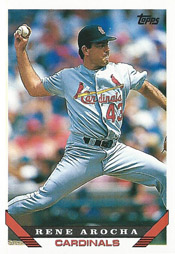
rene_arochaThe Rockies, a National League expansion team, faced the Cardinals for the first time on April 20, 1993, at St. Louis. The Cardinals won, 5-0, on a combined shutout by Rene Arocha and Omar Olivares.

There was a strong Cardinals connection to the first Rockies team that faced St. Louis. Don Baylor, the Rockies’ manager, had been the hitting coach on manager Joe Torre’s staff with the 1992 Cardinals. Rockies first baseman Andres Galarraga and starting pitcher Bryn Smith had played for the 1992 Cardinals. Center fielder Alex Cole had been in the Cardinals’ minor-league system.

Galarraga, who broke his wrist in the Cardinals’ second game in 1992 and finished with a .243 batting average and 39 RBI, signed with the Rockies as a free agent. He entered the Rockies’ first game against the Cardinals with a .422 batting mark and 14 RBI after 11 games.

Before facing the Cardinals, Galarraga told the St. Louis Post-Dispatch, “I’ve always been able to hit, even since I was a little boy in Venezuela. After the injury, I tried too hard when I came back. It got worse. I was swinging at bad pitches.”

Said Baylor: “He’s hitting the ball to right field more. That’s what he has to do to be successful.”

The starting lineups in the first Rockies-Cardinals game:

ROCKIES

1. Eric Young, second base

2. Alex Cole, center field

3. Dante Bichette, right field

4. Andres Galarraga, first base

5. Charlie Hayes, third base

6. Jerald Clark, left field

7. Joe Girardi, catcher

8. Freddie Benavides, shortstop

9. Bryn Smith, pitcher

CARDINALS

1. Geronimo Pena, second base

2. Ozzie Smith, shortstop

3. Gregg Jefferies, first base

4. Ray Lankford, center field

5. Mark Whiten, right field

6. Todd Zeile, third base

7. Brian Jordan, right field

8. Hector Villanueva, catcher

9. Rene Arocha, pitcher

On a chilly Tuesday night before 30,516 at Busch Stadium, the Cardinals scored three in the first and two in the fourth against Smith.

Arocha, a rookie, was cruising through 5.2 innings until a line drive by Bichette struck the pitcher’s gloved hand, fracturing a finger. Olivares relieved and retired the 10 batters he faced. So dominant were Arocha and Olivares that Cardinals outfielders handled just one fly out. Boxscore

The win was the only one Arocha earned against the Rockies in four big-league seasons. The Cardinals won seven of 12 games against the expansion Rockies.

Previously: Revisiting the Gregg Jefferies deal: Cardinals’ good gamble