Feeds:
Posts
Comments

(Updated June 27, 2020)

When Lukasz Musial settled in Pennsylvania after leaving his native Poland, he enjoyed following the exploits of Babe Ruth, a symbol of all that was possible in America.

babe_ruthLike his father, young Stan Musial also became a fan of Ruth. He remained an admirer, even though his first encounter with Ruth left him somewhat astonished.

Imagine the significance to Musial when he broke one of Ruth’s most prominent records.

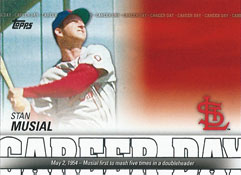
On May 8, 1963, Musial, 42, hit a home run off former teammate Bob Miller of the Dodgers, giving him 1,357 career extra-base hits and surpassing the record of 1,356 held by Ruth. Boxscore

In the 1964 book “Stan Musial: The Man’s Own Story,” Musial said, “I’m proud to have more extra-base hits than any player … but, to me, Ruth is still champ. After all, let’s face it, I went to bat some 2,500 more times than the No. 1 slugger.”

Musial was 20 and playing for the Cardinals’ farm club at Rochester, N.Y., in 1941 when he met Ruth, who came to town to put on a batting practice exhibition. In his autobiography, Musial offered a compelling description of that encounter, with help from the book’s contributor, St. Louis journalist Bob Broeg:

“The Babe was 47 then, heavy-bellied and out of competition for six years,” Musial recalled. “His timing was way off, but finally he connected with a pitch … and lifted it far out of the ballpark. I got a big thrill out of watching (him) demonstrate why my father thought there was only one Bambino. Pop was so right.

“I confess, though, that I was awed _ and maybe a little disillusioned _ when Ruth sat on our bench during the game, pulled out a pint of whiskey from his pocket and emptied it.”

Twenty-two years later, shortly after Musial broke Ruth’s extra-base hits record, a memo sheet posted on the Cardinals’ clubhouse bulletin board asked players whether they had participated in Babe Ruth League baseball. On the bottom of the sheet, The Sporting News reported, Musial wrote, “I played with Babe Ruth.”

In his book, Musial opened a chapter with this paragraph: “I believe Babe Ruth was the greatest who ever played because he was an outstanding pitcher and good outfielder who best combined the abilities to hit for great power and high average. Imagine, while hitting 714 homers, he struck out more than 1,300 times and still averaged .342 for his career.”

A couple of weeks after Musial set the extra-base hits mark, he was profiled in The Saturday Evening Post. “I’ll hit until I’m 50,” Musial said.

Asked by the publication for a set of guidelines he’d recommend a young player to follow in seeking a long big-league career, Musial offered six tips:

_ Keep your weight down.

_ Run a mile a day.

_ Get eight hours of sleep regularly.

_ If you must smoke, try lightweight cigars. They cut down on inhaling.

_ Take vitamins as recommended by a doctor.

_ Make it a point to bat .300.

The extra-base hits category (total of doubles, triples and home runs hit) is one of the most underrated in baseball. Musial eventually was surpassed by two others. The top seven in career extra-base hits are:

_ Hank Aaron, 1,477

_ Barry Bonds, 1,440

_ Stan Musial, 1,377

_ Babe Ruth, 1,356

_ Albert Pujols 1,333

_ Willie Mays, 1,323

_ Alex Rodriguez, 1,275

Previously: Total bases tell story of a total player: Stan Musial

(Updated April 3, 2018)

Curt Flood slugged two home runs against Dodgers ace Sandy Koufax. The first was part of a rare feat. The second was the last home run hit against Koufax.

sandy_koufaxOn Aug. 17, 1958, Flood and Gene Freese led off a game for the Cardinals against the Dodgers at the Los Angeles Coliseum with back-to-back home runs against Koufax.

Cardinals manager Fred Hutchinson stacked five right-handed batters among the top six in his order against the left-hander. The Coliseum, the Dodgers’ home in their first season after moving from Brooklyn, enticed right-handed batters to pull pitches to a left field fence 251 feet from home plate. A 42-foot screen was erected atop the fence, but batters weren’t deterred.

Flood, in his first season with St. Louis, opened the game by hitting a home run over the left-field screen. Freese, an infielder acquired by the Cardinals from the Pirates in a June trade, followed with a home run to the same spot.

The Cardinals scored four in the first against Koufax and he was lifted with one out in the second. Koufax faced 10 batters, yielded four hits and two walks and took the loss in a game won by the Cardinals, 12-7. Boxscore

“After going five straight games without coming close to a homer, Curt Flood and Gene Freese helped the Cards find the combination again at Los Angeles’ chummy left field fence in the Coliseum,” The Sporting News reported.

Eight years later, on Sept. 29, 1966, at St. Louis, in what would be his last appearance against the Cardinals, Koufax and Flood faced one another for the final time.

Koufax entered the game with 294 strikeouts, needing six more to become the first big-league pitcher to achieve 300 in a season three times. In the fourth inning, Koufax fanned Flood for strikeout No. 300 and got a standing ovation from the St. Louis crowd.

Seeking his 26th win of the season, Koufax and the Dodgers were ahead, 2-0, before Flood led off the seventh with a home run.

It would be the last home run hit against Koufax, who would retire after the season. (Koufax yielded 204 home runs in 12 big-league seasons, plus two in the 1963 World Series.)

In the ninth, Koufax struck out the first two batters, Lou Brock and Jerry Buchek, before Flood doubled to center.

“I got a little tired near the end and made a mistake with Flood,” Koufax said to United Press International. “Imagine, after eight or nine years in the league, I still don’t know how to pitch to Flood.”

Flood hit .296 [32-for-108] in his career against Koufax.

What happened next sparked much debate. Dodgers manager Walter Alston went to the mound and, according to United Press International and the Los Angeles Times, ordered Koufax to intentionally walk Orlando Cepeda, putting the potential go-ahead run on base.

“I didn’t argue,” Koufax said, “but I doubt that we would have done it if we were playing at home.”

Said Alston to the St. Louis Post-Dispatch: “I kind of stuck my neck out a little.”

Cepeda had five career home runs against Koufax. Alston preferred to take his chances with Mike Shannon, one of the top home run and RBI producers on the 1966 Cardinals.

Said Alston: “I went to the mound to Koufax after Curt Flood doubled and said, ‘Sandy, I think I’d rather have you pitch to the other guy (Shannon).’ Sandy agreed.”

Shannon flied out to center fielder Willie Davis, ending the game, a 2-1 Dodgers victory. Boxscore

“How about Alston putting that winning run on base?” said Cardinals manager Red Schoendienst. “I guess you can get away with it when you have Sandy Koufax on the mound.”

Morris McLemore, sports editor of the Miami News, wrote, “In a situation like that, baseball is the most exciting game ever devised, for the final decision was made of drama, great skill and chance-taking in almost equal proportion.”

Koufax finished with a four-hitter and 13 strikeouts.

“I thought I had a better curve ball than I have had at any other time this season,” Koufax said.

Not even a word from Bob Gibson could prevent Rick Camp from surrendering the hit that propelled the Cardinals to their first National League pennant in 14 years.

rick_campThe Cardinals completed a three-game sweep of the best-of-five 1982 National League Championship Series, beating Camp and the Braves, 6-2, in Game 3 at Atlanta. The victory vaulted them into the World Series for the first time since 1968, when Gibson was their ace.

Camp is remembered most for the home run he hit with two outs in the bottom of the 18th inning of a July 4, 1985, game against the Mets, tying the score 11-11. The Mets won, 16-13, in 19 innings and Camp was the losing pitcher. Boxscore

In Cardinals history, Camp is better recalled for his second-inning woes in the deciding game of the playoff series.

After Camp retired the Cardinals in order in the first, Keith Hernandez led off the second with a single and Darrell Porter walked. Camp thought he struck out Porter on a pitch instead ruled a checked swing.

George Hendrick singled, scoring Hernandez and advancing Porter to third, and St. Louis led, 1-0.

As Willie McGee approached the plate, Gibson, a Braves pitching coach for manager Joe Torre, went to the mound to talk with Camp. Torre split the pitching coach duties between Gibson and former catcher Rube Walker. “Rube teaches them how to pitch,” Torre told The Sporting News. “Gibby teaches them how to win.”

On Camp’s first pitch after Gibson’s visit, McGee tripled to right-center, scoring Porter and Hendrick.

“I made a bad pitch,” Camp told the Rome (Ga.) News-Tribune. “It was a fastball belt high, a fastball that was up, and that’s what broke it open.”

After the next batter, Ozzie Smith, singled to center, scoring McGee and giving the Cardinals a 4-0 lead, Torre lifted Camp for Pascual Perez. Boxscore

“From the beginning, in the bullpen, I didn’t have anything,” Camp said. “I thought maybe I would work it out in the first two or three innings.”

Instead, Camp faced eight batters, yielding four runs, four hits and a walk. Video

In a nine-year career with the Braves (1976-85), Camp made 28 appearances against the Cardinals, posting a 4-4 record and 4.25 ERA.

The 1954 Cardinals had the worst bullpen ERA (5.46) in franchise history.

So desperate for relief were they that Harvey Haddix, who led the club in games started (35) and wins (18), also ranked second in saves, with four in eight relief appearances.

Haddix was the starting and losing pitcher in the Cardinals’ season opener, a 13-4 loss to the Cubs on April 13, 1954, at St. Louis. Boxscore Two days later, in the Cardinals’ second game of the season, versus the Braves at Milwaukee, Haddix again was the losing pitcher _ this time, in relief. Boxscore He worked as long in his relief stint, 2.1 innings, as he did in his start.

Haddix didn’t pitch in the Cardinals’ third game of the season, but he was one of the few on the staff who didn’t. On April 17, 1954, the Cubs defeated the Cardinals, 23-13, at Chicago. Five Cardinals relievers combined to give up 16 runs in seven innings in relief of starter Gerry Staley. The game took 3 hours, 43 minutes to play _ the longest nine-inning game in National League history at that time. Boxscore

In The Sporting News, Bob Broeg wrote that the Cardinals’ start to the season was a “humorless first week when their pitching … was cuffed incredibly.”

After 10 games, manager Eddie Stanky said of his bullpen, “I don’t know what I’m going to do, but I know this _ I’m not going with what I’ve got.”

A look at the relievers who were the most prominent members of the infamous 1954 Cardinals bullpen:

_ Al Brazle. The side-arming left-hander was the Cardinals’ closer. He had been effective in the previous two years, saving 16 for St. Louis in 1952 and 18 in 1953, but he had just eight saves and a 4.16 ERA in 1954. He was far better on the road (2.27 ERA) than he was at home (5.55 ERA). Brazle, 40, was released after the season and never appeared in the big leagues again.

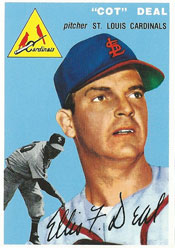
_ Cot Deal. A right-hander, Deal, 31, yielded 85 hits, including 14 home runs, in 71.2 innings. He had more walks (36) than strikeouts (25) and an ERA of 6.28. Left-handed batters hit .341 against him. Deal never pitched in the big leagues after 1954, but he went on to coach for 15 years in the majors, including on the staff of manager Johnny Keane’s 1965 Yankees.

_ Joe Presko. Primarily a Cardinals starter from 1951-53, the right-hander had an 8.61 ERA in 31 relief appearances for the 1954 Cardinals. He lost four relief decisions in a span from May 28 to June 17. Presko surrendered 59 hits in 38.2 innngs of relief. After the season, Presko, 25, was acquired by the Tigers.

_ Royce Lint. A 33-year-old rookie, Lint pitched two scoreless innings of relief in the Cardinals’ season opener, but the left-hander finished his lone big-league season with a 5.19 ERA in 26 relief appearances.

_ Stu Miller. Though The Sporting News would name this right-hander the National League Fireman of the Year with the 1961 Giants and the American League Fireman of the Year with the 1963 Orioles, Miller, 26, wasn’t an effective reliever for the 1954 Cardinals. He had a 5.96 ERA in 15 relief appearances, walking 16 in 25.2 innings.

Three pitchers on the 1954 Cardinals were used as both starters and relievers. They were:

_ Gerry Staley. He pitched in 48 games, 20 starts and 28 relief stints. He had a 3.77 ERA and three saves as a reliever.

_ Brooks Lawrence. The rookie pitched in 35 games, 18 starts and 17 relief appearances. He was 6-4 with a 3.25 ERA as a reliever.

_ Tom Poholsky. He pitched in 25 games, 13 starts and 12 relief stints. He had a 5.30 ERA as a reliever, yielding five home runs in 18.2 innings.

Previously: Bobby Shantz: First Cardinals pitcher to win Gold Glove

Entering the 2003 season, some were concerned Woody Williams no longer was effective. The Cardinals pitcher was 36, his spring training ERA was 14.54 and he had been limited to 17 starts in 2002 because of two stints on the disabled list.

woody_williams3In the St. Louis Post-Dispatch, Joe Strauss asked whether an aging, fragile Williams would be treated by the Cardinals like “a pricey piece of red-and-white pitching porcelain.”

Instead, Williams opened 2003 like a staff pillar, posting three wins without allowing a run in his first three starts.

Here’s what Williams achieved:

_ Cardinals 7, Brewers 0, April 2, 2003, at St. Louis: Williams held Milwaukee to two hits in 6.2 innings. The Brewers were hitless until Eric Young tripled with two outs in the sixth. Milwaukee’s only other hit off Williams was a single by Jeffrey Hammonds in the seventh.

“I picture doing that every game,” Williams said. “That’s what I strive to do _ not a no-hitter, but every inning I pitch I want to get a zero.”

Mike Matheny backed Williams’ effort with a three-hit, two-RBI performance. Boxscore

_ Cardinals 3, Astros 0, April 12, 2003, at Houston: After skipping his second scheduled start at Colorado because of neck stiffness, Williams showed no signs of a problem against the Astros, pitching six scoreless innings and extending his streak to 12.2.

A Houston native, Williams improved his career record versus the Astros to 6-2. “I worked ahead and threw good pitches when I needed to,” Williams said.

In the first inning, Houston threatened when Geoff Blum singled and Jeff Bagwell doubled. Lance Berkman followed with a groundball to first baseman Tino Martinez, who threw to the plate to nail Blum. “That’s a veteran Gold Glove play to come up with that throw,” Cardinals manager Tony La Russa said.

“The play Tino made was huge,” said Williams. “It stopped the momentum.”

_ Cardinals 6, Diamondbacks 3, April 18, 2003, at St. Louis: Williams yielded three hits in seven scoreless innings. Arizona was hitless until Lyle Overbay singled with one out in the fifth. The Diamondbacks scored their runs in the ninth off Russ Springer.

Williams’ scoreless innings streak was at 19.2. “If he ever comes out there and doesn’t have real good stuff and real good location, we’re all going to pass out,” La Russa said. Boxscore

_ Braves 4, Cardinals 3, April 24, 2003, at Atlanta: Williams kept the Braves scoreless for 5.1 innings before the streak ended at 25 when Julio Franco scored from third on a Johnny Estrada single. Boxscore

Williams rewarded the 2003 Cardinals by producing 18 wins in 220.2 innings, both single-season career highs for him.

Previously: Deal for Woody Williams sparked 2001 Cardinals

(Updated June 11, 2024)

Desperate for a power-hitting right fielder and feeling the sting of the defection of free-agent Jack Clark, the Cardinals stunned nearly everyone when they traded second baseman Tommy Herr, a stalwart of their three pennant-winning teams of the 1980s, to the defending World Series champion Twins in 1988.

tom_herrAs he departed, Herr said he hoped to return to the Cardinals as their manager.

When he arrived in Minnesota, Herr told the Minneapolis Star-Tribune, “I tried to take the trade like a man, but when the plane left St. Louis I cried like a baby for a half hour.”

Surprise move

On April 22, 1988, Herr was dealt to Minnesota for outfielder Tom Brunansky. The trade was announced after the Mets beat St. Louis, 4-0, dropping the Cardinals’ record to 4-11.

Joe Durso of the New York Times wrote, “It stunned Herr and his teammates as they came into the locker room. Herr was asked to step into manager Whitey Herzog’s office, where he received the news from Herzog and Dal Maxvill, the Cardinals’ general manager.”

Said Herr: “Sure, I’m shocked. I’ve loved my years as a Cardinal and it’s hard to say goodbye.”

Acknowledging it was difficult to inform Herr of the trade, Herzog told the St. Louis Post-Dispatch, “Tommy always knew he was my type of player from day one. It was tough.”

Herr played 10 seasons (1979-88) with the Cardinals, batting .274 with 1,021 hits in 1,029 games. He was the starting second baseman on the pennant-winning clubs of 1982, 1985 and 1987. He was an all-star in 1985 when he placed third in the National League in both RBI (110) and doubles (38). Herr ranked among the top three second basemen in the league in fielding percentage six times.

“It’s not an easy thing trading a great ballplayer and a fine gentleman,” Maxvill said to the Associated Press.

Mets third baseman Howard Johnson told the Post-Dispatch, “I think the Cardinals have dealt themselves a blow. A guy like Tommy Herr is a pretty valuable part of your ballclub.”

Three factors prompted the trade:

Factor No. 1

The Cardinals’ top run producer, Clark, signed with the Yankees after the 1987 season. Jim Lindeman, the 1988 Opening Day right fielder, was headed to the disabled list because of back spasms. The Cardinals were averaging 2.8 runs per game. Brunansky, who hit 20 or more home runs in six consecutive seasons (1982-87) for the Twins, provided a much-needed power source.

“The deciding factor was our (poor) run production,” Maxvill said to the Associated Press. “Brunansky can help.”

Cardinals pitcher John Tudor told the Post-Dispatch, “It was kind of pleasant to see that they’re trading to win instead of sitting on their attendance.”

Factor No. 2

The Cardinals feared Herr would depart for free agency. Herr was in the final season of a four-year contract. After losing reliever Bruce Sutter and Clark to free agency, the Cardinals were determined to get value in return for Herr before he could depart.

Herzog told the Minneapolis Star-Tribune, “We just can’t keep losing players like that. It was something we felt had to be done right now.”

“I could see the writing on the wall,” Herr said to the Post-Dispatch, “but I didn’t think it would happen this soon.”

Said Mets first baseman Keith Hernandez, who played with Herr on the 1982 World Series champion Cardinals: “If they had Clark, Tommy Herr’s on the team.”

Herzog told the Post-Dispatch, “If they’d tell me they were going to re-sign him, then who knows what we’d do?”

Regarding whether the Cardinals ever did have interest in re-signing him before he became eligible for free agency, Herr said, “I knew I’d find out sooner or later what the thinking was here. It was sooner rather than later.”

Factor No. 3

The Cardinals had a replacement for Herr. Luis Alicea, a first-round selection of the Cardinals in the 1986 draft, was promoted from Class AAA Louisville to replace Herr at second base.

“We think we have a fine young man who is ready to be an everyday player here in Alicea,” Maxvill said to United Press International.

Timely chat

Twins general manager Andy MacPhail told the Minneapolis Star-Tribune he made a social phone call to Maxvill on April 21. “At the time, I didn’t think there was any chance of a trade,” MacPhail said.

As the conversation evolved, MacPhail mentioned the Twins needed a left-handed batter for the top of their order.

“He made it clear he couldn’t trade Willie McGee or Vince Coleman,” MacPhail said.

Herr, a switch-hitter, fit the need.

MacPhail said Maxvill asked about third baseman Gary Gaetti and outfielder Kirby Puckett. “I told him I wouldn’t trade Gaetti and that my house would be burned to the ground if I traded Puckett,” MacPhail said.

Familiar foe

The Twins had defeated the Cardinals in a seven-game World Series in October 1987. Six months later, they were swapping position starters.

“I will miss Tom Brunansky,” Gaetti said. “It’s like a cold shower and a slap in the face at the same time.”

Minneapolis Star-Tribune columnist Sid Hartman reported, “Twins officials maintain Brunansky’s speed is down from last year, that he hasn’t covered the ground in right field as well and that his arm is not as strong.”

Herzog told the Post-Dispatch, “To tell you the truth, the only time I’ve ever seen Brunansky play in person was in the World Series, but over the last 10 years he’s always had pretty good bat potential and he’s had good power statistics. He’s always been a good outfielder with a good throwing arm.”

Minneapolis Star-Tribune columnist Dan Barreiro wrote, “Brunansky had his limitations, we all know how streaky he could be, but he still was a hitter with power numbers.”

For Brunansky, the trade was the chance for a new adventure. “It’s going to be exciting,” he said.

For Herr, the trade took him away from his professional roots and a place he had hoped to grow his career. “I’m proud of the accomplishments I’ve had here,” Herr said before leaving. “I wanted to play my whole career here. That dream has gone. It’s been a good time. Maybe I’ll be back and manage this ballclub.”

Years later, when asked about Herzog, Herr told Cardinals Magazine, “Whitey had a profound effect on me. He was the guy who gave me my shot as a regular … The confidence he showed in me really put me over the top.”