Feeds:
Posts
Comments

On their way to a World Series championship, the 1980 Phillies got sidetracked by a Cardinals rookie pitcher whom Dallas Green, Philadelphia’s tough, savvy manager, called “the mystery man.”

al_olmsteadAl Olmsted, a left-hander and St. Louis native, baffled the Phillies with his screwball during a pair of September starts.

Another rookie left-hander, John Martin, who pitched for three minor league teams in 1980, joined Olmsted in the Cardinals’ starting rotation in September and impressed general manager Whitey Herzog as a pitcher “just wild enough to be good.”

With John Gast and Tyler Lyons, the 2013 Cardinals became the first St. Louis team to use two rookie left-handed starting pitchers in the same season since Olmsted and Martin in 1980.

Olmsted was chosen by the Cardinals in the 13th round of the 1975 amateur draft out of Hazelwood East High School in suburban St. Louis.

After a muscle tear in his left arm decreased his velocity, Olmsted developed a screwball. In 1980, he was 13-9 with a 2.93 ERA in 25 regular-season games combined for Class AA Arkansas and Class AAA Springfield (Ill.). Olmsted also earned two wins in Springfield’s four-game sweep of Denver in the American Association championship series.

The Cardinals rewarded him with a promotion to the big leagues that September.

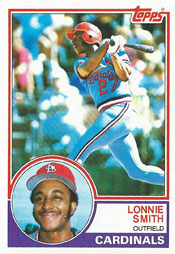
On Sept. 12, 1980, Olmsted, 23, made his major-league debut, starting against the Phillies in the second game of a doubleheader at Philadelphia. Facing a lineup that included Pete Rose, Mike Schmidt, Greg Luzinski and Lonnie Smith, Olmsted held the Phillies scoreless for 9.1 innings before he was relieved by Jim Kaat.

The Cardinals scored five runs in the 11th and won, 5-0. Boxscore Olmsted didn’t get the decision but proved he belonged in the majors.

“I wasn’t as nervous as I thought I’d be,” Olmsted said to United Press International. “I just wanted to go out there and throw strikes and not embarrass myself. I wasn’t really awed by anybody. My job was to make good pitches and have them hit the ball at somebody.”

Eleven days later, Sept. 23, Olmsted started against the Phillies again, this time at St. Louis. He was pitching on two days’ rest as a substitute for Bob Forsch, who left the team to attend the funeral of his mother.

Olmsted shut out the Phillies for the first six innings, extending his scoreless streak against them to 15.1 innings. He went 8.1 innings, yielding three runs and earning the win in the Cardinals’ 6-3 victory. Boxscore

The loss was a crusher for the Phillies, who fell a half-game behind the Expos in the National League East. The Phillies were 82-68 with 12 to play. Two of their last four losses in a 10-game stretch were in games started by Olmsted.

“(Olmsted) doesn’t throw that many strikes, but he gets us out,” Green said. “He’s a mystery man. But you’ve got to give him credit. He’s figured out how to do it and 82 other pitchers haven’t.”

Said Pete Rose: “(Olmsted) knows what he’s doing. He knows he’s not going to blow a fastball by anybody. Pitchers with slow stuff like that usually give us a lot of trouble.”

Red Schoendienst, the Cardinals’ interim manager, compared Olmsted with Fred Norman, the former Cardinal who went on to become a fixture in the Reds’ rotation, and said Olmsted “gets the ball where he wants it.”

Said Olmsted: “I hope I’m not a mystery man forever.”

Olmsted made five starts for the 1980 Cardinals and posted a record of 1-1 with a 2.86 ERA.

Like Olmsted, Martin spent most of the 1980 season in the minor leagues. A 27th-round choice of the Tigers out of Eastern Michigan in the 1978 draft, Martin was pitching for Class AAA Evansville when Detroit traded him and outfielder Al Greene to the Cardinals for outfielder Jim Lentine on June 2, 1980.

The Cardinals assigned Martin to Springfield and he broke his foot. After he healed, he was sent to Arkansas. He had a 3-3 record and 4.15 ERA in 25 games combined for Evansville, Springfield and Arkansas when he received a surprise promotion to the Cardinals.

Martin’s big-league debut with St. Louis was as unexpected as his call-up. On Aug. 27, in a game against the Astros at St. Louis, Cardinals starter John Fulgham was lifted after one inning when his shoulder stiffened. Martin relieved, limited the Astros to a run in seven innings and earned the win in a 10-2 Cardinals victory.

Martin made 109 pitches and retired 13 in a row during one stretch. Boxscore

“It caught me off guard,” Martin said to the Associated Press of being called into the game in the second inning. “It didn’t give me time to think about it.”

Said Cardinals catcher Terry Kennedy: “He never really gave them anything good to hit. I think he can compete here. I liked his aggressiveness.”

Martin, 24, made his first start on Sept. 6, in the second game of a doubleheader at Houston, yielded a grand slam to former Cardinals outfielder Jose Cruz and took the loss in the Astros’ 6-4 victory. Boxscore

In the season finale, Oct. 5 at St. Louis, Martin pitched his first complete game and got the win in the Cardinals’ 3-2 triumph over the Mets. Martin pitched a seven-hitter and retired the last 10 batters in a row. Boxscore

Herzog said of Martin, “He’s got a good arm. He’s just wild enough to be good.”

In nine games, including five starts, for the 1980 Cardinals, Martin was 2-3 with a 4.29 ERA.

After the 1980 season, the Cardinals traded Olmsted to the Padres in a package for pitchers Rollie Fingers and Bob Shirley and catcher Gene Tenace. After spending the 1981 season at Class AAA Hawaii, Olmsted came back to the Cardinals in the Ozzie Smith trade. He pitched his final season (1982) in the Cardinals’ farm system.

Martin was 17-14 in four seasons with the Cardinals before he was sent back to the Tigers in August 1983.

(Updated May 26, 2019)

In the time it takes to circle the bases, Ted Simmons experienced the high of hitting an improbable home run and the low of being ejected.

The incident symbolized the frustrations of the 1978 Cardinals.

ted_simmons16On May 27, 1978, the Cardinals, who’d lost 13 of their last 14 games, faced the first-place Cubs in St. Louis. Frustrated by the strike zone of Paul Runge, Simmons jawed with the plate umpire.

“(Simmons) seemed to be uptight through most of the game,” Runge said to the Associated Press. “Before the seventh inning, I was joking with him and telling him to relax. There was something working on him.”

In the ninth, the Cubs called in closer Bruce Sutter to protect a 2-1 lead. Simmons, who doubled and tripled in the game, was first to bat.

Sutter got ahead on the count 0-and-2. On his next pitch, “I tried to bounce it up there,” Sutter said to the Chicago Tribune, but the pitch was up in the strike zone. Batting left-handed, Simmons crushed it for a 400-foot home run, tying the score.

As he stepped on the plate after rounding the bases, Simmons tipped his batting helmet in Runge’s direction and, according to the ump, said, “Take that.”

Runge ejected Simmons.

“He definitely showed me up, but he didn’t cuss me,” Runge said. “It was a perfect opportunity for him and he took the opportunity.”

Simmons told the Tribune, “I didn’t say a word.”

Cubs manager Herman Franks said he was surprised Simmons got tossed. “I always thought as long as you didn’t swear you couldn’t get thrown out of a ballgame,” Franks said. “It ain’t so anymore.”

The Cubs scored in the 11th and won, 3-2, sending the Cardinals to their 14th loss in 15 games. The Cardinals filed a protest with the National League, arguing Simmons shouldn’t have been ejected.

“I think this has been happening, or brewing, over a long period of time, but unless you call an umpire a name, he (Simmons) shouldn’t be kicked out,” Cardinals manager Ken Boyer said. “We think very strongly that umpires ought to be fined, suspended or reprimanded, just like players.

“The only job (Runge) had was to see if (Simmons) touched the plate. I don’t think that the average fan knew they were having words before. Teddy never once turned around.” Boxscore

Three decades later, in an interview with the San Diego Union-Tribune, Rick Hummel of the St. Louis Post-Dispatch said the ejection of Simmons remained memorable.

“Teddy was not in agreement with Paul Runge’s strike zone,” Hummel recalled. “They had a little debate about balls and strikes. Then Teddy hits a home run to tie the game and as Teddy steps on home plate he is ejected. That’s one of my favorites. Home run and gone.”


(Updated Nov. 28, 2024)

Displaying a gold standard for consistency and durability at his position, Ozzie Smith holds the National League record for most games played at shortstop.

ozzie_smith6On May 22, 1993, when the Cardinals took the field at Pittsburgh’s Three Rivers Stadium against the Pirates, Smith set the National League record for most games played at shortstop, with 2,223. Smith broke the mark of 2,222 held for eight years by Larry Bowa. Before Bowa, the National League record had been held for more than 50 years by Rabbit Maranville. Boxscore

“It’s a record that’s been there a long time,” Smith told Rick Hummel of the St. Louis Post-Dispatch. “You have no idea when you start out that you’ll be able to achieve it. It’s an honor.”

Smith achieved the record by overcoming a serious shoulder injury in 1985. Smith chose to let the injury heal naturally rather than undergo surgery. Remarkably, he led National League shortstops in games played in 1985, with 158.

“I had a torn rotator cuff (in 1985),” Smith told Hummel in May 1993. “People don’t talk about that much. I’m proud of (overcoming) that. I thought Mother Nature was the best way to handle it.

“For a while, I knew that I was going to have only one long throw a day. You had to kind of position yourself so you could get the ball over there, but at the same time not make it so far that you were going to hurt yourself for the rest of the day. I battled around that pretty well.”

Thomas Boswell wrote in the Washington Post, “He rehabilitated himself so quickly he never missed a game. Most fans, and even foes, didn’t know he was ever hurt … He positions himself to avoid long throws and has developed the quickest release since Joe Namath faced a blitz.”

Smith also topped National League shortstops in games played in 1980 (158), strike-shortened 1981 (110), 1987 (158) and 1989 (153).

Smith played in the major leagues from 1978-96 for two National League clubs: Padres (four years) and Cardinals (15 years).

He finished his career with 2,511 games played at shortstop, ranking him fourth in big-league history. The three ahead of him played either exclusively or primarily in the American League.

The top 10 in big-league games played at shortstop:

_ 1. Omar Vizquel, 2,709 games. Vizquel performed in the major leagues from 1989-2012. Four of those years were spent in the National League (with the Giants).

_ 2. Derek Jeter, 2,674. Of the shortstops in the top 10, Jeter is the only one who played even one game for the Yankees.

_ 3. Luis Aparicio, 2,581. In 18 seasons in the big leagues, all in the American League (with the White Sox, Orioles and Red Sox), Aparicio never played a position other than shortstop.

_ 4. Ozzie Smith, 2,511. Like Aparicio, Smith never played a position other than shortstop in the majors. He won a Gold Glove Award in 13 consecutive years (1980-92) and led National League shortstops in fielding percentage eight times.

_ 5. Cal Ripken, 2,302. He spent his entire big-league career with the Orioles (1981-2001). Ripken led American League shortstops in fielding percentage four times. After shifting to third base, he led the league in fielding percentage at the hot corner in 1998.

_ 6. Jimmy Rollins, 2,227. After 15 seasons with the Phillies, for whom he won four Gold Glove awards, Rollins finished with a year each for the Dodgers and White Sox.

_ 7. Larry Bowa, 2,222. Bowa played his whole career in the National League, with the Phillies, Cubs and Mets (1970-85).

_ 8. Luke Appling, 2,218. He spent his entire big-league career (1930-50) with the White Sox. When he retired, Appling held the major-league record for most games played at shortstop.

_ 9. Dave Concepcion, 2,178. Concepcion played his entire career with the Reds (1970-88).

_ 10. Rabbit Maranville, 2,153. A National League shortstop from 1912-35, Maranville was the starter for the 1928 Cardinals pennant winners. He also played for the Braves, Pirates, Dodgers and Cubs.


(Updated June 16, 2023)

As a Cardinals rookie, Dick Hughes delivered a dominant strikeout performance against the Reds that stands out for its artistry and drama.

dick_hughesOn May 30, 1967, Hughes was perfect for seven innings against the Reds at Cincinnati. Then a string of bad breaks and bizarre plays occurred. Hughes struck out 13 in eight innings but took the loss in the Reds’ 2-1 victory.

A right-hander, Hughes spent nine years in the minors. His vision was 20-75 in one eye; 20-300 in the other, according to The Sporting News.

In 1966, Hughes turned around his career by developing a slider and a no-windup delivery. He got his first call to the big leagues with the Cardinals in September 1966.

Hughes, 29, began the 1967 season in the Cardinals bullpen. He became a starter in May, swapping roles with Al Jackson.

Five days after pitching a two-hit shutout in the Cardinals’ 5-0 victory over the Braves in Atlanta Boxscore, Hughes was paired against Reds ace Jim Maloney at Cincinnati’s Crosley Field.

The start of the game was delayed 1 hour, 35 minutes by rain. Unfazed, Hughes retired the first 18 batters. Then play was halted another 55 minutes by rain.

Hughes retired the Reds in order in the seventh, keeping his bid for a perfect game intact, but the second delay had been damaging.

“My slider was not going where I wanted it to and, after the rain stopped the game (a second time), I began relying on my fastball.” Hughes said to the Associated Press.

Cardinals manager Red Schoendienst confirmed, “The delay in the game by rain took a little of the edge off Hughes.”

With the Cardinals ahead 1-0, Tony Perez, leading off the eighth for Cincinnati, swung at a 3-and-2 fastball and lofted a high fly to center. The ball hit off the wall at cozy Crosley for a 380-foot triple “that would have been an easy out in any other park,” The Sporting News reported.

With the perfect game bid ended, Hughes focused on trying to preserve the lead. After he fanned Deron Johnson for the first out, Vada Pinson batted. “Pinson tried to duck from a high pitch, which he later confessed he never saw and, presto, he had a bloop, score-tying double to short left,” The Sporting News reported.

Pinson’s fluke double plated Chico Ruiz, who ran for Perez, tying the score at 1-1.

Trying to set up a double play, Hughes issued an intentional walk to Johnny Edwards, but Leo Cardenas followed with a single, scoring Pinson and giving the Reds a 2-1 lead. Edwards advanced to third on the play, but Cardenas was thrown out at second, trying to stretch the single into a double.

Jim Maloney was due up next. Rather than lift him for a pinch-hitter and turn to a closer in the ninth, manager Dave Bristol opted to let Maloney bat and he ended the inning with a fly out.

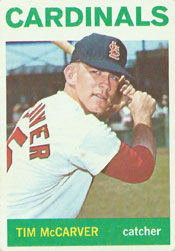
Maloney was tiring. Orlando Cepeda opened the ninth with a single. Tim McCarver followed with another single, sending Cepeda to third.

Bristol lifted Maloney and brought in Don Nottebart to face Phil Gagliano, subbing for third baseman Mike Shannon, who had a viral infection.

Gagliano swung at Nottebart’s first pitch and grounded sharply to Cardenas at shortstop. Cepeda should have raced for home. Instead, he hesitated. Cardenas fielded the grounder and flipped to second baseman Tommy Helms, forcing McCarver. Though McCarver slid hard into him, Helms relayed a throw to first baseman Deron Johnson, completing the double play.

(In his book, “Baseball for Brain Surgeons and Other Fans,” McCarver recalled, “I hit Helms so hard on that play that I was concerned enough to call him after the game. In my entire career, that was the only time I called an opposing player to find out if he was OK.”)

On Helms’ throw, Cepeda broke for home. Deron Johnson spotted him and fired the ball to catcher Johnny Edwards, who tagged out Cepeda.

Triple play. Game over.

“Something, eh?” an astonished Dave Bristol said to the Associated Press. “First time I ever threw my cap into the stands.

“I sent Nottebart in to pitch, hoping he would throw a low ball for a grounder. He sure did.” Boxscore

Hughes finished with a pitching line of eight innings, three hits, two runs, one walk and 13 strikeouts. He held Pete Rose hitless, stopping a 25-game hit streak.

“If it hadn’t rained, we never would have got a hit off Hughes,” Chico Ruiz said. “Hughes was just great.”

As a Cardinals rookie, Rick Ankiel struck out 11 batters in a game four times, twice doing it before his 21st birthday.

rick_ankiel3Here is a look at those performances:

_ Cardinals 7, Marlins 6, at St. Louis, May 25, 2000: Ankiel earned his fourth win of the season, striking out 11 in 6.2 innings.

The effort was controversial because Ankiel threw 121 pitches. Scott Boras, Ankiel’s agent, said he believed the Cardinals had agreed to limit Ankiel to 100 pitches a game.

Ankiel, who was averaging 4.25 walks per game, didn’t yield a walk to the Marlins. He struck out the side (Preston Wilson, Derrek Lee and Alex Gonzalez) in the second inning and did it again (Danny Bautista, Cliff Floyd and Wilson) in the fourth. Boxscore

_ Indians 3, Cardinals 2, at St. Louis, June 4, 2000: Six of the Indians’ first seven outs were on strikeouts. Ankiel struck out 11 in five innings and walked none, but was lifted after reaching 98 pitches.

“I had a lot of strikeouts, but I really wasn’t going that well,” Ankiel said to the St. Louis Post-Dispatch.

Ankiel struck out the side (Alex Ramirez, Jolbert Cabrera and Jim Brower) in the second and did it again (Sandy Alomar, Richie Sexson and Ramirez) in the fourth. Boxscore

_ Cardinals 12, Astros 1, at Houston, July 21, 2000: Two days after turning 21, Ankiel struck out 11 in seven innings and improved his record to 7-5. Ankiel struck out Craig Biggio twice and Lance Berkman once.

“He’s got an electric arm,” said Astros slugger Jeff Bagwell.

Said Cardinals manager Tony La Russa: “Sometimes it’s hard to remember how young he is. With him, it’s all about command. His stuff is so good.” Boxscore

_ Cardinals 9, Pirates 5, at Pittsburgh, Sept. 13, 2000: In the last game the Cardinals would play at Three Rivers Stadium before the Pirates moved into PNC Park, Ankiel struck out 11 in 6.2 innings, earning his ninth win of the season.

Ankiel struck out the side (John Wehner, Mike Benjamin and Adrian Brown) in the second.

“The ball explodes out of his hand,” said Pirates manager Gene Lamont. “He’s going to be one of the best pitchers we’ve seen in a long time.”

Said La Russa: “I’d love for him to get the Rookie of the Year (Award) because those nine wins do not reflect how well he’s pitched. He’s learning to pitch. He’s not just out there throwing.” Boxscore

Less than a month later, Oct. 3, 2000, Ankiel, a surprise starter in Game 1 of the National League Division Series against the Braves, walked six and threw five wild pitches in 2.2 innings, triggering the downward spiral that led to the end of his pitching career. Boxscore

(Updated Feb. 26, 2022)

In 1973, the Cardinals had such a dreadful start that general manager Bing Devine was asked almost daily whether he’d fire manager Red Schoendienst.

“I’m tired of hearing that question,” Devine said to The Sporting News. “I’ll be gone before Red.”

reggie_cleveland2The 1973 Cardinals lost their first five games and 12 of their first 13. Their 1-12 record ranked among the worst in big-league history, recalling the 0-13 start of the 1920 Tigers, the 1-12 record of the 1962 expansion Mets and the 1-15 mark of the 1969 Indians.

Nerves were raw; tension was high. After Cardinals starter Reggie Cleveland gave up a key two-run, two-out double to Bill Robinson in an April 22 loss to the Phillies, Schoendienst groused, “That’s why he’s a .500 pitcher.” Boxscore

The Cardinals’ skid extended into May. After the Giants beat the Cardinals, 9-7, on May 8 (Bob Gibson yielded four home runs, two to Bobby Bonds and one each to Willie McCovey and Dave Kingman), St. Louis had a 5-20 record, the worst in the major leagues, and was in last place in the National League East. Boxscore

The Cardinals were 1-7 in one-run decisions and 0-4 in extra-inning games.

After shoring up the bullpen by calling up left-handers Al Hrabosky and Rich Folkers from the minors and acquiring veteran junkball specialist Orlando Pena from the Orioles, as well as replacing Ray Busse at shortstop with Mike Tyson, the Cardinals began to stabilize, then thrive.

Regarding the replacement of Busse with Tyson, teammate Joe Torre told the New York Daily News, “Before Mike stepped in at shortstop, we were losing a lot of games early because of our infield. Routine ground balls were going straight into the outfield. We needed someone to hold the defense together.”

Years later, in an interview with Cardinals Magazine, Tyson credited Schoendienst and coach George Kissell.

“Red always put me in a good position,” Tyson said. “I didn’t have a particularly strong arm, but my range was good and I got rid of the ball quickly.”

As for Kissell, Tyson said, “George always had my back. Every day after practice in spring training he’d get a bucket of balls and he’d hit me grounder after grounder.”

From the low point of the 5-20 record, the Cardinals won 56 of their next 81 games, boosting their record to 61-50 by Aug. 5 and securing first place in the division, five games ahead of the second-place Cubs.

From there, the streaky Cardinals reverted to their early-season form.

Gibson injured his knee running the bases against the Mets and was sidelined from Aug. 4 to Sept. 29. From Aug. 6 to Aug. 18, St. Louis lost eight in a row and 11 of 12, falling to 62-61.

Overall, the Cardinals lost 31 of their last 51 games and finished in second place at 81-81, 1.5 games behind the Mets.