Feeds:
Posts
Comments

(Updated Dec. 27, 2024)

In 2003, Cardinals shortstop Edgar Renteria won both a Gold Glove Award and a Silver Slugger Award for the second season in a row.

edgar_renteria4The cumulative production numbers put up by Renteria in 2003 were unprecedented for a Cardinals shortstop: .330 batting average, 194 hits, 47 doubles, 13 home runs, 100 RBI and 34 stolen bases. The hits, doubles and RBI were single-season career highs for Renteria, who spent 16 years in the major leagues.

He was the first National League shortstop with 100 RBI since Hubie Brooks of the 1985 Expos.

“It’s not easy for a guy who is not a power hitter to get 100 RBI _ and I’m not a power hitter,” Renteria said to the St. Louis Post-Dispatch in September 2003.

Renteria came within six hits of joining Honus Wagner as the only National League shortstops to achieve 200 hits and 100 RBI in a season. Wagner had 201 hits and 109 RBI for the 1908 Pirates.

“To hit .330 with 100 RBI, a bunch of stolen bases and great defense _ what a year he’s had,” Cardinals manager Tony La Russa said to the Post-Dispatch in the final weekend of the 2003 season.

On Sept. 27, 2003, in the Cardinals’ next-to-last game of the season, Renteria got his 100th RBI when his fielder’s choice grounder to short scored Albert Pujols from third with the deciding run in St. Louis’ 3-2 victory over the Diamondbacks at Phoenix. Boxscore

Renteria twice drove in five runs in a game in 2003.

On April 13, in the Cardinals’ 11-8 victory over the Astros at Houston, Renteria hit a pair of home runs against Roy Oswalt and had five RBI. Boxscore

On Sept. 18, Renteria was 4-for-4 with two doubles and five RBI in the Cardinals’ 13-0 victory over the Brewers at St. Louis. Boxscore

Renteria hit .492 (30-for-61) with 17 RBI against the Brewers in 2003.

In his report card on the Cardinals’ 2003 season, Joe Strauss of the Post-Dispatch wrote, “Edgar Renteria compiled one of the best offensive seasons of the last 20 years by a National League shortstop while committing fewer errors (16) than during last year’s Gold Glove season (19).”

Looking back on his time with the Cardinals, pitcher Woody Williams said to Stan McNeal of Cardinals Magazine in 2024, “Edgar Renteria … had such a desire to win. He wasn’t a big talker, but I appreciated the way he carried himself and loved being around him. He was a pro all the time.”
(Updated March 15, 2023)

In March 1988, the NFL approved the move of the St. Louis football Cardinals to Arizona, leaving the St. Louis baseball Cardinals as the sole tenant of Busch Memorial Stadium for the first time since it opened in 1966.

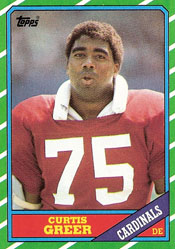
curtis_greerThe departure of the football Cardinals ended 28 years of NFL existence in St. Louis, but it was a boon to the baseball Cardinals, who benefitted from improvements to Busch Memorial Stadium.

In April 1988, when the defending National League champion Cardinals opened their baseball season a month after the football Cardinals left St. Louis, 1,000 seats and 10 luxury suites were added to Busch Memorial Stadium, increasing seating capacity for baseball to 54,224.

A year later, among the upgrades made to the stadium for the 1989 Cardinals baseball season were a 65,000-watt sound system, seven new concession areas and remodeling of 11 others.

In 1992, the baseball Cardinals installed a spongier and darker artificial playing surface. Four years later, they went to a natural grass surface at Busch Memorial Stadium for the first time since 1969.

Bill Bidwill, owner of the football Cardinals, asked the NFL on Jan. 15, 1988, for permission to move to Phoenix because he believed Busch Memorial Stadium limited his revenue opportunities and he didn’t have hope a football stadium would be built in St. Louis. The NFL wanted Bidwill to relocate the team to Baltimore because it intended to place an expansion franchise in Phoenix.

Bidwill preferred Arizona. Sun Devil Stadium in Phoenix offered 73,000 seats (20,000 more than Busch Memorial Stadium did for football). Bidwill stood to gain $2.5 million from luxury suite seats. He also was optimistic of having a domed stadium built in downtown Phoenix.

On March 15, 1988, NFL owners voted 26-0, with two abstentions, to approve the move. Abstaining were Raiders owner Al Davis and Dolphins owner Joe Robbie.

(Davis, in a legal battle with the league, told the New York Times, “It’s all a sham. They vote any way they want and allow anyone they want to move.” Robbie told the St. Louis Post-Dispatch he abstained out of loyalty to his friend Joe Foss, who headed a group seeking an expansion franchise in Phoenix. “A man who forgets his friends doesn’t deserve friends,” Robbie said.)

Cardinals defensive lineman Curtis Greer said Bidwill had given St. Louis the chance to build a stadium and keep the team.

”I would think that you’ve got to appreciate Mr. Bidwill’s patience in trying to give the city of St. Louis time to get a new stadium,” Greer said to the Post-Dispatch. ”I think it was about 3 1/2 years since he first talked of moving. He took the route of being courteous and following the guidelines of the league. I think you’ve got to admire a guy like that.”

St. Louis mayor Vincent Schoemehl ripped the NFL for permitting the move. Schoemehl told the Post-Dispatch that “communities have a right to be treated better” by the NFL.

“This is a reflection on them (the NFL) and not us,” Schoemehl said. “I think our code of conduct in this city is frankly superior to theirs.”

Regarding the NFL commissioner, Schoemehl added, “I find it hard to hold Pete Rozelle in high regard.”

Seven years later, St. Louis regained a NFL franchise when the Rams moved there from Los Angeles. The Rams played their first four home games of the 1995 season at Busch Memorial Stadium before relocating to a domed stadium built for the franchise in downtown St. Louis.

After the 2015 season, the Rams returned to Los Angeles.

Previously: Football Cardinals finally got it right with Don Coryell

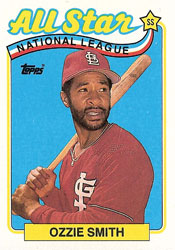
The shortstop position was a model of stability when Ozzie Smith was on the Cardinals roster.

ozzie_smith5Smith played for the Cardinals for 15 seasons (1982-96). He was their starting shortstop on Opening Day in 13 of those years.

The exceptions: 1996, when first-year manager Tony La Russa went with newcomer Royce Clayton, and 1989, when Smith opened the season on the disabled list because of a pulled muscle in his left side.

If not for that injury, Smith would have made 14 consecutive Opening Day starts at shortstop for St. Louis.

The only player other than Smith to start at shortstop for the Cardinals from 1982 to 1995 was Jose Oquendo, who shifted from second base as the substitute for Smith in 1989.

On March 30, less than a week before the Cardinals’ 1989 regular-season opener, Smith was injured stealing third base in an exhibition game against the Blue Jays at Dunedin, Fla. The initial prognosis was he would be sidelined until May 1. Smith was placed on the disabled for the first time since 1984.

Manager Whitey Herzog decided to move Oquendo from second base to shortstop and place utilityman Tim Jones at second base. Asked why he opted for Oquendo rather than Jones at shortstop, Herzog told the St. Louis Post-Dispatch, “Jones can play it. I just think that Oquendo probably is as good a shortstop as there is in the National League.”

The Cardinals opened the 1989 season on April 3 at New York against the Mets. Oquendo, batting sixth, went 0-for-4, striking out twice against starter Dwight Gooden and once against Don Aase. The Mets won, 8-4. Boxscore

Oquendo, who had hit .384 (28-for-73) in spring training, appeared to be pressing. He went hitless in his first 13 at-bats.

The Cardinals stayed with the starting middle infield duo of Oquendo and Jones for the first seven games. Oquendo batted .167 and made one error. Jones hit .200 and fielded flawlessly.

Smith returned to the lineup on April 15, in the Cardinals’ second home game, against the Mets. Batting second, behind Vince Coleman, Smith was 2-for-5. His 10th-inning single moved Coleman from second to third _ “I can’t run into an out,” Coleman explained in why he agreed with third-base coach Rich Hacker’s stop sign _ and positioned Coleman to score the game-winning run on Pedro Guerrero’s one-out single.

Appearing comfortable with Smith in the lineup, Coleman swiped three bases in the Cardinals’ 3-2 victory. “I know he (Smith) is going to sacrifice himself so I can steal,” Coleman told the Post-Dispatch. Boxscore

With Smith at shortstop, Oquendo went back to second base and Jones to the bench.

Smith started in 152 games in 1989, leading National League shortstops in assists (483) and winning his 10th consecutive Gold Glove Award.

Previously: Buddy Bell almost joined Ozzie Smith in Cardinals’ infield

Imagine the Cardinals opening a season with a starting shortstop who had a career batting average of .217, more than twice as many strikeouts (68) as walks (29) and a reputation as an erratic fielder.

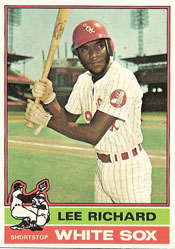
lee_richardThat’s precisely what the Cardinals did when they selected Lee “Bee Bee” Richard as their Opening Day shortstop in 1976.

Richard, a speedster, was acquired on Dec. 12, 1975, by the Cardinals from the White Sox for outfielder Buddy Bradford and pitcher Greg Terlecky. The Cardinals projected him as a backup to shortstop Don Kessinger, who joined St. Louis two months earlier in a trade with the Cubs.

Nicknamed “Bee Bee” as a hard-throwing high school pitcher in Louisiana, Richard attended Southern University and converted to shortstop.

Scouts were enamored with his speed and strong throwing arm. Richard was a first-round choice of the White Sox in the June 1970 amateur draft. He was the first shortstop selected. “We were fearful he might be picked by the time our turn came,” White Sox general manager Ed Short said to The Sporting News.

After watching Richard in a workout, White Sox coach Luke Appling, a Hall of Fame shortstop, said, “He’s got good hands. He’ll be a good one.”

Richard, 22, made his big-league debut on April 7, 1971, as the starting shortstop and leadoff batter for the White Sox in their season opener against the Athletics at Oakland. He singled twice against Catfish Hunter, drove in a run and was caught stealing by catcher Dave Duncan. Boxscore

Richard, however, wasn’t ready to be a big-league regular. He committed 26 errors in 68 games at shortstop in 1971. “I know some people told me I’d have been better off if I’d go down to the minors,” Richard said.

Undeterred, White Sox manager Chuck Tanner said, “He’s going to be a great shortstop … Give him a couple of years.”

Richard, who spent four seasons with the White Sox, was dubbed “The Juggler” by broadcaster Harry Caray because of poor fielding. The White Sox also tried him at center field, third base, second base, right field and designated hitter.

During a game in which Richard committed a pair of errors, the Washington Post reported, Caray told listeners, “Richard just picked up a hot dog wrapper. It’s the first thing he’s picked up all night.”

On April 9, 1976, the Cardinals opened their season at home against the Cubs and manager Red Schoendienst posted this batting order:

1. Lou Brock, left field.

2. Lee Richard, shortstop.

3. Bake McBride, center field.

4. Ted Simmons, catcher.

5. Reggie Smith, right field.

6. Keith Hernandez, first base.

7. Hector Cruz, third base.

8. Mike Tyson, second base.

9. Lynn McGlothen, pitcher.

After McGlothen retired the first two batters, Bill Madlock grounded to Richard, who booted the ball for an error on his first chance as a Cardinal. The next two batters reached before McGlothen worked out of the bases loaded jam.

Richard produced a single in four at-bats and St. Louis won, 5-0. Boxscore

Kessinger got the start at shortstop in the next game and remained the starter until the Cardinals called up rookie Garry Templeton in August.

In 13 games, six as a starter, at shortstop for the Cardinals, Richard committed four errors. By July 15, Richard’s batting average dropped to .059. Used primarily as a reserve infielder, Richard appeared in 66 games for the 1976 Cardinals, batted .176 and stole one base.

The Cardinals released him after the season and he never appeared in the major leagues again.

(Updated Nov. 27, 2018)

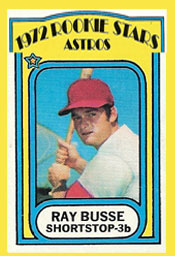
In 1973, the Cardinals lost a gamble when they selected Ray Busse as their starting shortstop.

ray_busseBusse was a top prospect in the Astros system when he hit .271 with 13 home runs in 92 games for Class AAA Oklahoma City in 1971. Bob Kennedy, the Cardinals’ director of player development, rated Busse the best shortstop in the minor leagues that year, The Sporting News reported.

Misfortune struck in 1972. Busse’s father committed suicide. Busse suffered a shoulder injury. Limited to 70 games, Busse hit .207 and committed 27 errors for Oklahoma City in 1972.

Cardinals general manager Bing Devine went to baseball’s winter meetings in November 1972 determined to find  “a shortstop with some sting in his bat,” The Sporting News reported. The Cardinals were seeking a replacement for Dal Maxvill, who they traded to the Athletics in August 1972.

Harry Walker, who joined the Cardinals as a hitting instructor after managing the Astros, recommended Busse. So did Kennedy.

On Nov. 28, 1972, the Cardinals dealt catcher Skip Jutze and infielder Milt Ramirez to the Astros for Busse and infielder Bobby Fenwick.

“Walker considers Busse a good gamble because of his age (24) and his batting potential,” Devine told The Sporting News.

Said Kennedy: “He (Busse) has a fine arm, good range and could become a good hitter.”

Busse went to spring training in competition with Mick Kelleher, Mike Tyson, Dwain Anderson and Ed Crosby for the starting shortstop position and “quickly took charge of the shortstop sweepstakes,” The Sporting News reported.

In his first spring training at-bat for the Cardinals, Busse singled in a run. Soon after, he hit a three-run home run against the Mets’ Ray Sadecki. Busse completed spring training as the Cardinals’ leader in RBI (11) and hit .254.

Though he ended spring training in an 0-for-18 slump, the Cardinals named him their starting shortstop. “He’s done a real fine job,” Cardinals manager Red Schoendienst told Larry Harnly of The State Journal-Register of Springfield, Ill. “He’s done everything expected of him … If you make a mistake on Busse, he’ll hit that ball.”

The Cardinals opened the 1973 regular season on April 6 at Pittsburgh with an all-rookie left side of the infield (Ken Reitz was at third base).

It was a disaster for Busse from the beginning.

Busse made an error on the first ball hit to him _ a grounder by Pirates leadoff batter Rennie Stennett in the first inning. Busse went 1-for-4, made two errors and the Pirates won, 7-5. Boxscore

The Cardinals lost 20 of their first 25 games. Busse took much of the blame.

On May 14, 1973, fans booed Busse and Reitz throughout a 10-5 Phillies victory at St. Louis. The loss dropped the Cardinals’ record to 8-23. Busse was batting .143 with 21 strikeouts in 24 games and he had committed 11 errors. Boxscore

After the game, Reitz shrugged off the boos when approached by reporters. Busse responded to the booing by saying, “Often I wonder what we come to the ballpark for. When you’re down, it’s pretty easy for somebody to get down on you, but that’s when you need them (the fans) the most.”

Busse never appeared in another game for the Cardinals. Schoendienst named Tyson the starting shortstop. Busse remained on the bench until the Cardinals traded him back to the Astros for infielder Stan Papi on June 8, 1973.

Asked by The Sporting News whether he had been given a fair shot by the Cardinals, Busse replied, “No, but that’s nobody’s fault but my own.”

Astros manager Leo Durocher said, “We’re tickled to get him back.”

Busse never recovered. He hit .059 in 15 games for the Astros in 1973 and .206 in 19 games for them in 1974, his last season in the major leagues.


In 1943, the defending World Series champion Cardinals shifted their spring training site from Florida to Illinois. Compared with where other big-league clubs had to go, the Cardinals considered themselves fortunate.

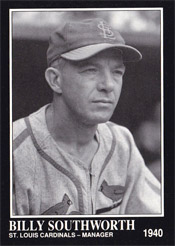
billy_southworth2With the United States pouring resources into its fight against Germany and Japan in World War II, big-league baseball offered to help conserve by placing travel restrictions on where clubs could train in the spring.

Clubs were ordered to choose sites north of the Potomac and Ohio rivers and east of the Mississippi River.

The Browns of the American League selected Cape Girardeau, Mo., located 135 miles south of St. Louis. (Because Cape Girardeau is on the west bank of the Mississippi, the Browns technically were in violation of the rules, but baseball officials allowed it.)

The Cardinals picked Cairo, Ill., the southernmost spring training site of all 16 major league clubs. Cairo, then a town of 14,000, is located where the Ohio River flows into the Mississippi. It is 40 miles south of Cape Girardeau.

“We’re going farther south than any other big-league training outfit,” Cardinals owner Sam Breadon said to The Sporting News. “We’ll be only a short distance from Tennessee and the weather down there is always from 12 to 15 degrees warmer than it is in St. Louis.”

Here is where the big-league teams trained in 1943:

NATIONAL LEAGUE

CLUB……………1943 TRAINING SITE……………1942 TRAINING SITE

Braves…………..Wallingford, Conn……………………..Sanford, Fla.

Cardinals……….Cairo, Ill……………………………………St. Petersburg, Fla.

Cubs………………French Lick, Ind……………………….Catalina Island, Calif.

Dodgers…………Bear Mountain, N.Y…………………..Havana, Cuba

Giants……………Lakewood, N.J………………………….Miami, Fla.

Phillies…………..Swarthmore, Pa……………………….Miami Beach, Fla.

Pirates……………Muncie, Ind…………………………….San Bernardino, Calif.

Reds………………Bloomington, Ind…………………….Tampa, Fla.

AMERICAN LEAGUE

CLUB……………1943 TRAINING SITE……………1942 TRAINING SITE

Athletics…………Wilmington, Del………………………..Anaheim, Calif.

Browns…………..Cape Girardeau, Mo…………………..DeLand, Fla.

Indians…………..West Lafayette, Ind……………………Clearwater, Fla.

Red Sox………….Medford, Mass………………………….Sarasota, Fla.

Senators…………College Park, Md………………………Orlando, Fla.

Tigers……………..Evansville, Ind…………………………Lakeland, Fla.

White Sox………..French Lick, Ind………………………Pasadena, Calif.

Yankees……………Asbury Park, N.J…………………….St. Petersburg, Fla.

The Cardinals didn’t report to Cairo, Ill., until mid-March, at least two weeks later than they usually went to St. Petersburg. They trained outdoors on a large field and indoors in a high school gym.

According to The Sporting News, the field drained well, “usable the day after a heavy rainfall,” and the gym was like “a steam room” because the Cardinals kept the temperature above 80.

Cardinals manager Billy Southworth projected a positive attitude, telling The Sporting News after the first week of workouts, “Let us have three days outdoors out of every five and we’ll be in thoroughly satisfactory condition for the pennant race. And let us have warm weather through most of the last two weeks and we’ll be in as good condition as we could attain anywhere in the country.”

The Cardinals’ Cairo spring didn’t hurt. They repeated as National League champions in 1943. They trained again in Cairo in 1944 and 1945 (winning a World Series title in 1944) before returning to St. Petersburg in 1946.

Previously: How Mort Cooper pitched 2 straight 1-hitters for Cardinals