Feeds:
Posts
Comments

(Updated on Oct. 26, 2024)

Mike Matheny helped recruit Chris Carpenter to the Cardinals.
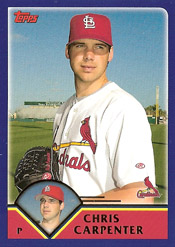
chris_carpenter8After becoming a free agent, Carpenter, 27, left the Blue Jays for a one-year incentive-laden contract with St. Louis on Dec. 13, 2002.

Carpenter had undergone shoulder surgery in September 2002 and the Cardinals were gambling he would recover and be able to pitch for them in the second half of the 2003 season as “a potential swing man,” the St. Louis Post-Dispatch reported.

Matheny, the Cardinals’ starting catcher from 2000-2004, had been Carpenter’s teammate with the Blue Jays in 1999. Before signing with the Cardinals, Carpenter went to St. Louis at the club’s request to have a magnetic resonance imaging test on his shoulder. While in the city, he met with Matheny, who urged him to accept the Cardinals’ deal, the Post-Dispatch reported.

Carpenter also spoke with two other former Blue Jays teammates, pitchers Woody Williams (a Cardinal from 2001-2004) and Pat Hentgen (a Cardinal in 2000). Like Matheny, they endorsed the Cardinals as the right fit for Carpenter.

“They all said it was the best city, the best fans, the best organization,” Carpenter told Joe Strauss of the Post-Dispatch in December 2002. “It wasn’t a financial decision at all. It was because it was the best situation.”

The Cardinals were interested in acquiring Carpenter in July 2002 before they traded for Chuck Finley of the Indians. Soon after that, Carpenter was sidelined for the season because of the shoulder problems.

The Sporting News quoted a big-league scout as saying Carpenter was “a steal” for the Cardinals.

Carpenter didn’t return to form as quickly as the Cardinals expected. He didn’t pitch for them in 2003 _  he made eight minor-league starts totaling 18.2 innings that year _ but the move paid off in the long term.

As a Cardinal, Carpenter had a 95-44 regular-season record and a 10-4 postseason mark, including 3-0 in World Series games. He won the National League Cy Young Award in 2005 and had the best ERA in the league in 2009.

Regarding his win against the Rangers in Game 7 of the 2011 World Series, Carpenter told Stan McNeal of Cardinals Magazine, “Without pitching coach Dave Duncan, I’m not sure how we win Game 7.”

Starting against the Rangers for the third time in 10 days, Carpenter gave up two runs in the first inning and still was struggling in the second before Duncan came to the mound for a visit.

“He told me to establish my breaking ball because they were all over my hard stuff,” Carpenter recalled to McNeal. “I started throwing breaking balls, they stopped sitting on my other stuff, and I ended up pitching into the seventh. We took the lead and ended up winning our second ring in six seasons.” Boxscore
(Updated Aug. 3, 2022)

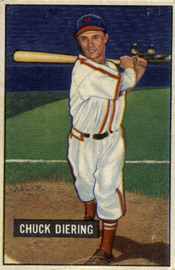
On the brink of being sent to the minor leagues for the third time in four seasons, Chuck Diering delivered on a make-or-break opportunity and soon found himself playing regularly in a Cardinals outfield with Stan Musial and Enos Slaughter.

chuck_diering

A St. Louis native, Diering played five seasons for the Cardinals.

In 1949, Diering began the season with the Cardinals but seldom was used, going hitless with a walk in three plate appearances. The Cardinals were planning to send him back to Class AAA Rochester by May 20. Diering had played there in 1946 and most of 1948 after breaking into the majors with the Cardinals in 1947.

Diering’s fortunes changed on May 8, 1949, as the Cardinals prepared to face left-hander Joe Hatten of the Dodgers at Brooklyn. Cardinals manager Eddie Dyer had opened the season with Stan Musial as his center fielder. But, wrote Bob Broeg in The Sporting News, “Dyer didn’t like the idea of subjecting Musial to the daily wear and tear of center field, and the valuable slugger made it plain he would prefer not playing there game after game.”

So Dyer was looking for a right-handed batter to play center against left-handed pitching, with the thought he could move Musial to right and keep Slaughter in left. Dyer decided to give Diering a chance against Hatten and the Dodgers.

Batting leadoff and playing center field, Diering responded with a 2-for-4 performance, with two RBI and a walk that Sunday at Brooklyn. Boxscore

Impressed, the Cardinals opted to keep Diering. By June, Diering regularly was starting in center field. On June 16, his seventh-inning single off Hatten snapped a 2-2 tie and propelled the Cardinals to a 6-2 victory over the Dodgers at St. Louis. Boxscore Three days later, against the Phillies, Diering’s fifth-inning single off Ken Heintzelman tied the score 2-2 and his two-out single off Robin Roberts in the ninth drove in the winning run in the Cardinals’ 6-5 victory at St. Louis. Boxscore

“Six weeks have brought a happy change in the career of Chuck Diering, who expected to eat Rochester restaurant food again this summer and instead has been enjoying home cooking as much as St. Louis fans have liked his clutch hitting and sensational center fielding,” Broeg wrote.

Diering continued his stellar play throughout the summer. On Aug. 19, his batting average was .281. He also impressed with his ability to chase down drives to the gaps. A headline in The Sporting News referred to him as “Deerfoot Diering.” Broeg reported that Diering “almost has made the fans forget Terry Moore with his brilliant center field play.”

Moore, a four-time all-star and starting center fielder for the Cardinals’ World Series championship clubs of 1942 and 1946, was a coach for the 1949 Cardinals. Diering credited Dyer and his coaching staff for his transformation into a Cardinals starter in 1949.

“I’ve had a lot of help,” Diering told The Sporting News. “Dyer persuaded me to choke my grip at bat. Tony Kaufmann made me lay off high pitches. Buzzy Wares encouraged me to try a preliminary swing or two to loosen my tense shoulder muscles and Terry Moore goes over the pitchers with me every day, showing how each is different and how they’ll try to pitch to me.”

Said Dyer: “We want to handle him just right because the kid really has done a job of helping solve a big problem. He has become a valuable man in this club’s success.”

The 1949 National League pennant race went down to the last day of the season, with the Dodgers (97-57) winning the title by a game over the Cardinals (96-58).

Diering finished the year with a .263 batting average, 21 doubles and eight triples in 131 games. His fielding percentage of .987 led all National League center fielders. He also ranked in the top five among NL center fielders in putouts (295) and assists (seven).

At spring training in 1950, Diering impressed Yankees center fielder Joe DiMaggio, who told the St. Louis Post-Dispatch, “Pretty good kid they got out there in center field.”

Yankees manager Casey Stengel said Diering “gets a fast jump on a ball, all right.”

Diering split playing time in center with Bill Howerton and Harry Walker in 1950. He primarily was a bench player for the Cardinals in 1951.

On Dec. 11, 1951, the Cardinals traded Diering and pitcher Max Lanier to the Giants for Eddie Stanky, who became player-manager.

Diering completed his big-league career with the Orioles in 1956. The Cardinals signed him to play for their minor-league club at Omaha, managed by Johnny Keane, in 1957.

After the season, he returned to St. Louis and purchased an automobile dealership in nearby Alton, Ill.

Diering batted .252 in five seasons with the Cardinals and .249 overall in a nine-year major-league career.

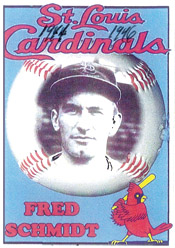
The National League Rookie of the Year Award didn’t exist in 1944. If it had, Cardinals pitcher Freddy Schmidt would have been a good candidate.

Schmidt contributed seven wins and five saves to the 1944 World Series championship club.

freddy_schmidtThe 1944 Cardinals dominated the National League with a 105-49 record, finishing 14.5 games ahead of the runner-up Pirates.
Discovered by the Cardinals when he attended one of their tryout camps in his hometown of Hartford, Conn., Schmidt joined the organization with Class D Shelby of the North Carolina State League in 1937.

It was the first of seven consecutive seasons in the Cardinals’ minor-league system for Schmidt. He was a 19-game winner for Class B Allentown in 1942 and was 13-10 for Class AA Rochester in 1943.

At 28, Schmidt made the Cardinals’ Opening Day roster in 1944. Initially used in relief, Schmidt earned the confidence of manager Billy Southworth and was given occasional starts.

His first big-league start was an eye-opener to the degree of difficulty in the major leagues. Starting for the Cardinals in the second game of a doubleheader on June 4, 1944, at Philadelphia, Schmidt held the Phillies to an unearned run and four hits in seven innings, but was the losing pitcher. His counterpart, Bill Lee, shut out the Cardinals on two hits and the Phillies won, 1-0. Boxscore

Schmidt earned his first big-league win in his next appearance, a relief stint on June 14, 1944, against the Cubs at St. Louis, when the Cardinals scored three in the bottom of the eighth and won, 10-9. Boxscore

In August, Southworth used Schmidt as a starter more frequently _ and the rookie responded, pitching a pair of shutouts in an 11-day stretch.

On Aug. 16, 1944, at St. Louis, Schmidt pitched a five-hitter in the Cardinals’ 5-0 victory over the Giants. The win was the Cardinals’ fifth in a row and enabled them to achieve their 80th victory on the earliest date in National League history. Boxscore

Schmidt used his arm and his bat to lead the Cardinals to a 4-0 victory over the Pirates in a cold drizzle on Aug. 25, 1944, at St. Louis. Schmidt pitched a six-hitter and struck out nine. He also produced two singles and two RBI. Pirates manager Frankie Frisch twice ordered intentional walks to the Cardinals’ No. 8 batter, Marty Marion, and Schmidt foiled the strategy each time with a RBI-single, the Associated Press reported. Boxscore

Schmidt finished the regular season with a 7-3 record, five saves and a 3.15 ERA in 37 games, including nine starts.

In his lone appearance in the 1944 World Series, Schmidt pitched 3.1 innings of scoreless, one-hit relief in Game 3, a 6-2 victory for the Browns. Boxscore

Two months later, Dec. 8, 1944, Schmidt was drafted into the Army.

Schmidt rejoined the Cardinals in 1946 and was 1-0 with a 3.29 ERA in 16 relief appearances, helping St. Louis to its fourth pennant of the decade.

After appearing in two games for St. Louis in 1947, Schmidt and outfielder Harry Walker were traded to the Phillies for outfielder Ron Northey on May 3. In September, after he posted a 5-8 record for Philadelphia, the Phillies placed him on waivers and Schmidt was claimed by the Cubs. He pitched in one game for Chicago _ and never appeared in the big leagues again.

Schmidt had a career major-league record of 13-11, 8-3 as a Cardinal.

Previously: Danny Litwhiler: perfect fit for champion Cardinals

(Updated Aug. 6, 2019)

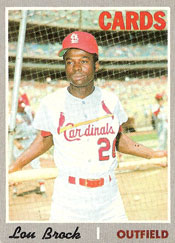
Lou Brock stole home twice in his major-league career. Both occurred on the front end of double steals.

Brock did it first with the Cubs on May 24, 1964, against the Reds at Cincinnati. He repeated the feat with the Cardinals on Aug. 6, 1970, against the Mets at St. Louis.
Mets pitcher Tom Seaver had won nine consecutive decisions entering his Aug. 6, 1970, start against the Cardinals at Busch Memorial Stadium. Brock led off the Cardinals’ first inning with a double and moved to third on an infield out. Joe Hague walked and Richie Allen struck out.

When Hague took off from first on a steal attempt, catcher Jerry Grote threw to second. Second baseman Wayne Garrett took Grote’s throw and Hague stopped. Garrett fired the ball to first baseman Art Shamsky. As Shamsky moved toward Hague, Brock broke for home. Shamsky, a left-handed thrower, turned around and made a high toss to Grote. Brock easily beat the throw and Hague went on to second base on a successful double steal.

“Once (Shamsky) makes a total commitment for the other runner (Hague), there’s no way he can make the play home,” Brock said to the St. Louis Post-Dispatch. ‘It’s too tough to throw accurately with something on the ball when you’re running in another direction.”

The thefts came against a battery that was good at guarding against steals. Grote threw out 39 percent of the baserunners attempting to steal against him in 1970. Seaver pitched in 37 games in 1970 and yielded only 14 stolen bases.

Brock’s steal of home gave the Cardinals a 1-0 lead and propelled them to a 3-0 victory.

Asked about the play, Mets manager Gil Hodges told the Associated Press, “When you can’t execute properly, that’s what costs you.” Boxscore

Less than a month before he was traded by the Cubs to the Cardinals, Brock stole home for the first time in the big leagues. In the opener of a doubleheader on May 24, 1964, at Crosley Field, Brock singled against Reds starter Jim O’Toole with one out in the first. A single by Billy Williams advanced Brock to third. Brock and Williams then executed a double steal. The thefts were two of only 10 allowed by O’Toole in 30 games for the Reds in 1964. The catcher, Hal Smith, a former Cardinal, threw out five of 12 baserunners (42 percent) attempting to steal in 1964. Boxscore

Brock is the all-time National League leader in steals and ranks second in major-league history to Rickey Henderson. Brock had 50 steals with the Cubs and 888 with the Cardinals. In 1974, when Brock swiped a career-high 118 for the Cardinals, he had 112 steals of second and six of third.

He only once attempted to steal home in 1974. On Sept. 6, 1974, after Brock drove in a run with a fifth-inning triple, Mets pitcher Jerry Koosman, attempting a pickoff, threw to third baseman Wayne Garrett, catching Brock with too big a lead. Brock broke for home and Garrett’s peg to catcher Duffy Dyer was in time to nail Brock.

“I didn’t think Koosman would throw over there,” Brock said.

Three innings later, Brock singled against former teammate Harry Parker and stole second and third on successive pitches. The steals were Brock’s 100th and 101st of the season.

Said Parker: “It’s like trying to keep water from going over the dam. You know what’s coming, but you’re powerless.” Boxscore

Previously: Hot leadoff hitting helped Lou Brock earn steals record

(Updated Dec. 27, 2015)

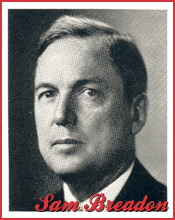
Sam Breadon was principal owner of the Cardinals from 1920 through 1947.

Born July 26, 1876, in New York City, Breadon, nearly penniless, went to St. Louis in 1902 to join a friend in the garage business. Backed by customers impressed by his work and demeanor, Breadon started his own automobile and garage business in 1903 and soon became successful. He also became a fan of the local National League baseball club, the Cardinals.
In 1917, Breadon paid $2,000 to become an investor in the Cardinals. Three years later, he rose to principal owner and president of the franchise.

Though he was tight-fisted with finances and sometimes displayed a cold demeanor (“The fear of poverty haunted him all through his years, even after he could write a check for seven figures,” The Sporting News surmised), Breadon was, by most accounts, an effective and savvy executive.

Here are five more facts about Breadon:

1. The Cardinals won nine National League pennants and six World Series titles while Breadon was their principal owner. To put that in perspective, the National League won eight World Series titles between 1926-46. The Cardinals won six of those. (The others were the 1933 Giants and 1940 Reds.)

In his obituary in May 1949, The Sporting News wrote of Breadon, “His name was synonymous with baseball success.”

2. In May 1925, Breadon boldly elevated second baseman Rogers Hornsby to player-manager, replacing Branch Rickey, who returned to the front office. A year later, Hornsby led the Cardinals to their first pennant and first World Series championship. Rickey, meanwhile, began building the franchise-controlled farm system that would supply the Cardinals with top talent for decades. (By 1939, Breadon owned 16 farm teams outright and had working agreements with 12 others.)

Though he traded Hornsby to the Giants (for Frankie Frisch) after the World Series when Hornsby demanded a three-year contract rather than the one-year deal offered, Breadon’s promotion of Hornsby to manager created a culture change, with long-term implications.

“It gave us our first pennant, it made our players pennant-conscious and it enabled Rickey to move into the front office, where he had a much better opportunity to develop and exercise his talents,” Breadon said to The Sporting News.

3. Shortly after gaining control of the Cardinals, Breadon made a deal that solidified the financial foundation of the franchise. The Cardinals had been playing their home games at dilapidated Robison Field. Breadon convinced Phil Ball, owner of the St. Louis Browns of the American League, to take in the Cardinals as a tenant at Sportsman’s Park.

That enabled Breadon to demolish Robison Field and sell most of the property to the city for $200,000 (the city planned to build a high school on the site) and sell the rest of the land for $75,000 to a trolley company for a loop that would provide access to the school.

“It was the most important move I ever made on the Cardinals,” Breadon told The Sporting News. “… It gave us money to clean up our debts, and something more to work with. Without it, we never could have purchased the minor-league clubs, which were the beginning of our farm system.”

4. Breadon pinched pennies, but his generosity also quietly helped several former Cardinals.

For years, Breadon sent a monthly check to Grover Cleveland Alexander, the Cardinals’ hero of the 1926 World Series, when the pitcher was in financial trouble, The Sporting News reported.

Though ace pitcher Mort Cooper had bolted the Cardinals because of a contract dispute in 1945, prompting them to trade him, Breadon came to Cooper’s aid when Cooper was arrested and charged with passing bad checks in 1948. Breadon bailed Cooper out of jail, covered the reimbursements on the bad checks and sent Cooper monthly payments to help him get out of a financial hole, The Sporting News reported.

5. In 1939, Breadon prevented Rickey from dealing Marty Marion to the Cubs. At the time, Marion and Bobby Sturgeon were shortstops in the Cardinals’ farm system. According to The Sporting News, Rickey thought Sturgeon was the better prospect and wanted to offer Marion to the Cubs for cash.

“No,” Breadon responded, “if we sell one of them, we’ll sell Sturgeon.”

In a compromise (at this point in their working relationship, Breadon and Rickey often were clashing), the Cubs were allowed to make a choice between the two shortstops. To Breadon’s relief, Chicago chose Sturgeon. Marion, who would earn the nickname “Mr. Shortstop” because of his stellar fielding, would join the Cardinals in 1940 and help them to four pennants and three World Series titles.

“He’s the best ever,” Billy Southworth, who managed the Cardinals to three consecutive pennants (1942-44), said of Marion to The Sporting News. “He anticipates plays perfectly, can go to his right or left equally as well and has a truly great arm. Some of the things he does have to be seen to be believed.”


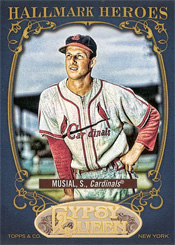
Stan Musial achieved many remarkable feats in his Cardinals career. One of the most unheralded was his success at stealing home. Musial did it four times within four years.

Musial had 78 stolen bases in a 22-year Cardinals career. His single-season high was nine in 1943, his second full year in the big leagues.

In the book “Musial: From Stash to Stan the Man,” author James N. Giglio said Musial “became a terror in taking the extra base or in flustering the pitcher by threatening to steal.”

Giglio described how, in a 1942 game at Pittsburgh, Musial tripled and scored the tying run when he faked a steal of home, causing the pitcher, Luke Hamlin, to balk.

That alertness and hustle paid off for Musial and the Cardinals on May 24, 1950, at the Polo Grounds in New York. In the eighth inning, with the Cardinals ahead, 1-0, Musial singled and advanced to second when Johnny Lindell reached on an error.

With Enos Slaughter at the plate, pitcher Monty Kennedy unleashed a wild pitch. The ball “dropped right in front of the plate but the daring Musial made it to third,” United Press reported, while Lindell held at first.

Slaughter popped out and Marty Marion came to the plate. When Kennedy made a pickoff throw to first, Musial broke from third and streaked home with a steal, extending the Cardinals’ lead to 2-0.

An Associated Press photo of the play shows Giants catcher Wes Westrum straddling the plate, his arms extended as he awaits the throw from first baseman Tookie Gilbert, while Musial slides toward the dish.

“It’s that old Cardinal Gashouse spirit,” St. Louis manager Eddie Dyer said. “You can laugh all you want to, boys, but it still wins ballgames.” Boxscore

Musial stole home again on Sept. 18, 1951, at St. Louis. Musial was on third and Slaughter on first with two outs in the sixth when they executed a double steal, with Musial racing home with the final run of a 7-1 Cardinals victory over the Dodgers. Boxscore

In 1953, Musial had a season total of three stolen bases _ two were steals of home and both came against the Phillies.

On July 24, 1953, at Philadelphia, Bob Miller issued a walk to Musial, who advanced to second on an error and to third on a wild pitch. With two outs, Musial took off for the plate. An Associated Press photo shows catcher Stan Lopata tagging Musial on his right knee while Musial’s left foot is across the plate. Phillies manager Steve O’Neill protested, but the photo is evidence umpire Bill Jackowski made the correct call.

The sixth-inning steal of home tied the score 1-1, but the Phillies scored in the ninth and won, 2-1. Boxscore

Two months later, Sept. 13, 1953, at St. Louis, Musial stole home again versus the Phillies. In the first inning, Musial was on third and Ray Jablonski on first when the pair executed a double steal, igniting the offense in a 17-3 Cardinals triumph. Boxscore

Previously: No one hit more triples and as many home runs as Stan Musial