Feeds:
Posts
Comments

(Updated Nov. 30, 2024)

As he prepared to enter the last season of his distinguished playing career, Stan Musial was feeling, at 42, like an athlete approaching his peak rather than one facing the end.
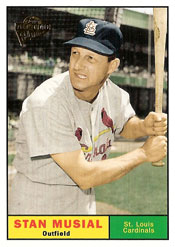
stan_musial21On the morning of Jan. 3, 1963, Musial impressed himself and his trainer by completing a vigorous workout _ his first day of conditioning in advance of spring training. That afternoon, he signed his contract for the 1963 season at a figure that for the first time in three years wasn’t a pay cut.

The reason Musial was heading into his 22nd major-league season in 1963 was because he had produced spectacularly in 1962.

After three consecutive seasons of finishing with batting averages below .290, the seven-time National League batting champion had indicated 1962 would be his last year as a player. He changed his mind, however, after batting .330 with a .416 on-base percentage in 135 games in 1962. Those numbers returned Musial to elite status. He placed third in the league in batting and first among left-handed batters. Musial also ranked second in the league in on-base percentage.

Inspired, Musial wanted to return for the 1963 season _ and the Cardinals welcomed him. (General manager Bing Devine and manager Johnny Keane encouraged Musial to return; Branch Rickey, 81, a senior advisor to owner Gussie Busch, said Musial should retire.)

“I felt like I did in the old days,” Musial said to The Sporting News of his 1962 performance. “I knew I was going to hit. I knew I was going to play every day. Yes, my biggest thrill was the overall season. I couldn’t wait for the next game. I really hated to see last season end and I can’t wait for the next one to start.”

Dressed in a black suit with a black tie and a white shirt, Musial arrived at the boardroom of the Anheuser-Busch headquarters in St. Louis for the official contract signing. He accepted the Cardinals’ offer of an estimated $65,000 to $70,000, the same amount he played for in 1962.

(The Sporting News reported Musial signed for $65,000. The Associated Press wrote two versions of the story, reporting the figure as $65,000 in one and $70,000 in the other. United Press International reported the amount as $70,000. All three news organizations reported the figure was the same as Musial had earned in 1962.)

That ended a string of three consecutive years of pay reductions for Musial.

In 1959, Musial was earning $100,000 a year from the ballclub. After he hit .255 in 1959, Musial asked for and received a $20,000 pay cut, to $80,000, for the 1960 season, according to The Sporting News.

Though Musial boosted his average by 20 points, his salary was cut again after he hit .275 in 1960 and it was reduced yet again despite improving to .288 in 1961, The Sporting News reported.

(The Associated Press reported Musial’s salary for 1963 increased his career earnings with the Cardinals to $1.25 million, “the most any player has earned in salary in baseball history.”)

In addition to his stellar 1962 performance, another reason Musial was confident he could contribute significantly to the Cardinals in 1963 was he felt physically fit.

At 10 a.m. on Jan. 3, 1963, Musial went to the St. Louis University gymnasium, climbed onto a scale and was pleased to see it showed him at 184 pounds, just four above his targeted playing weight for the regular season.

Under the watch of Cardinals trainer Bob Bauman, Musial pushed himself through a workout that began with a quarter-mile run, followed by 40 minutes of calisthenics. He finished with a one-mile run, plus a sprint around the gym.

“That was one of the most strenuous opening day workouts Stan has ever gone through,” Bauman said to The Sporting News. “He really looks good and should be in excellent playing condition by the time he reports in Florida.”

Said Musial: “I never felt better … Last spring, I was in much better shape than I had been in five years _ and I aim to be in even better shape than last year … I should be able to play at least 100 games.

“I’ll play as long as I feel I’m helping the club. I’ll settle for anything about .300.”

Musial would play in 124 games (94 as a starter in left field) in 1963 but he batted .255 and his fielding and throwing skills had eroded. In August 1963, three months before he turned 43, he announced he would retire from playing at the end of that season.

In his book “Stan Musial: The Man’s Own Story,” Musial said, “I wasn’t a .330 hitter … in 1963, but I’m very glad I played one more year … I had the satisfaction of reaching that point where, without anyone else having to tell me, I realized my liabilities were about to outweigh my assets as a ballplayer.”

In the 1982 book “Voices From Cooperstown,” Musial told author Anthony J. Connor, “I didn’t begin to think of this game of baseball as work until I got to be about 40. Those last couple of years it was much harder to get in shape and stay in shape. My reflexes wouldn’t bounce back like they used to, and I had a much harder time getting loose.

“The ball looked smaller, especially at night, and I had a harder time generating that good, quick swing, or that burst of speed in the field. Mentally, my concentration wasn’t quite as sharp. You should concentrate intensely on every single pitch, but after age 40, my mind would occasionally wander. I’d swing at balls for no reason and then wonder why I had.”
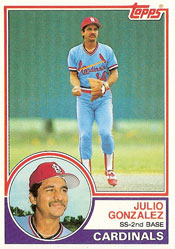
 

Julio Gonzalez gave the Cardinals an Easter treat.

A reserve infielder, Gonzalez hit a ninth-inning triple, igniting a winning streak that put the Cardinals on the path to the 1982 National League pennant and World Series title.

julio_gonzalezAfter winning their season opener at Houston, beating Nolan Ryan, the Cardinals erased most of the good vibes from that victory by losing their next three.
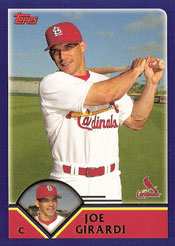
On April 11, 1982, a chilly, gray Easter Sunday in St. Louis, the Cardinals were looking to get back on track against the Pirates.

The Cardinals led 5-1 after seven innings, but the Pirates scored four in the eighth to tie and a run in the ninth to take a 6-5 lead.

After reliever Enrique Romo retired the first two batters, George Hendrick and Darrell Porter, in the bottom of the ninth, it appeared the Cardinals would lose their fourth in a row.

When Manager Whitey Herzog sent Orlando Sanchez, a third-string catcher, to bat for center fielder David Green, it seemed more desperation than inspiration.

Sanchez, though, coaxed a walk.

That brought up Gonzalez, who had entered in the top of the ninth to play third base after Mike Ramsey was lifted for a pinch-hitter in the eighth.

With one unlikely swing, Gonzalez turned around the Cardinals’ season.

Swinging at a high slider, he tripled to left, scoring pinch-runner Gene Roof with the tying run. Then, he scored the game-winner when Dane Iorg followed an Ozzie Smith walk with a single to left, lifting the Cardinals to a 7-6 victory. Boxscore

“Gonzalez’s hit was our biggest of the season,” Iorg said to the St. Louis Post-Dispatch. “It was something we needed badly.”

Inspired, the Cardinals rolled to a 12-game winning streak that put their record at 13-3. That early-season surge helped propel them to their first postseason appearance in 14 years.

Despite his Easter heroics, Gonzalez rarely played after that, but he did finish with a flourish.

On Oct. 3, 1982, in the Cardinals’ regular-season finale against the Cubs at Wrigley Field, Gonzalez entered in the third inning as a replacement for second baseman Tommy Herr. Gonzalez went 4-for-5 and led off the 14th inning with a home run, giving the Cardinals a 5-4 victory. Boxscore

It would be the last at-bat of his Cardinals career.

Gonzalez didn’t play in the 1982 postseason. He was released in December after batting .241 in 42 games for the 1982 Cardinals. The Tigers signed him and he played in 12 games for them in 1983, ending his big-league career after seven seasons.

(Updated Dec. 17, 2019)

Joe Girardi and Mike Matheny have much in common. Both attended Big Ten Conference schools (Northwestern for Girardi; Michigan for Matheny). Both were catchers who played in the World Series for franchises they later managed (Yankees for Girardi; Cardinals for Matheny). Both were teammates for one season, with the 2003 Cardinals.

joe_girardiOn Dec. 17, 2002, Girardi, a free agent, signed with the Cardinals to be the backup to Matheny. Because of injuries, Girardi was limited to 16 games played for the Cardinals in 2003, the last of his 15 seasons as a big-league player.
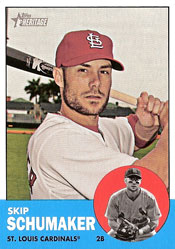
Six months before joining the Cardinals, Girardi had helped them during one of their saddest days.

On June 22, 2002, before the Cardinals and Cubs were to play a Saturday afternoon game at a packed Wrigley Field, the teams learned St. Louis pitcher Darryl Kile had been found dead in his hotel room. After officials agreed to call off the game, it was decided Girardi, the Cubs’ catcher, should inform the crowd.

Displaying his leadership skills, Girardi stood on the field, faced the fans and informed them through the public-address system that a “tragedy in the Cardinals’ family” had occurred, that the game would not be played and the spectators should show respect and “pray for the Cardinals’ family.”

Joe Strauss of the St. Louis Post-Dispatch wrote, “Girardi’s statements helped turn what some club officials feared might be an unseemly response by a disappointed crowd into one of quiet sympathy.”

Helping to recruit Girardi to the Cardinals was first baseman Tino Martinez, who had played with Girardi for four seasons with the Yankees. “Tino told me St. Louis would be a great place to play,” Girardi said to the Associated Press.

Girardi, 38, acccepted a one-year, $750,000 contract from the Cardinals. Strauss wrote Girardi “is considered a solid complement to Matheny.” (The Cardinals also had catcher Eli Marrero, but planned to play him primarily in the outfield in 2003.)

At spring training, Girardi indicated he was picking up the vibe of a championship club.

“To me, this is very similar to the feel in New York,” said Girardi, who played for three World Series-winning Yankees clubs (1996, 1998 and 1999). “They (the Cardinals) expect to win. Anything short of a World Series is considered a failure. Guys were here early before they had to report, working out. It’s just a good group and you can see that.”

Girardi was hitting .375 in 27 at-bats for St. Louis in 2003 spring training games, but after a March 20 exhibition against the Orioles he complained of pain in his side and stiffness in his neck. Medical tests showed he had an enlarged disc. The Post-Dispatch reported he would miss four to six weeks of the regular season “after undergoing a procedure to alleviate potentially career-ending pressure on his spine caused by a herniated disc.”

Wrote Strauss: “When Girardi left camp with his family, those he left behind were unsure when, or if, he would return to uniform.”

The Cardinals signed Chris Widger, who had been released by the Yankees, to replace Girardi. After missing the first 61 games of the season, Girardi was activated June 10, 2003. He made his Cardinals debut June 11 at Fenway Park and went 0-for-4 against Pedro Martinez and John Burkett. Boxscore

Three days later, at Yankee Stadium, Girardi got his first Cardinals hit, a single off rookie Jason Anderson. Boxscore

On July 1, 2003, Girardi returned to the disabled list, suffering back spasms unrelated to his disc problem. He wasn’t activated by the Cardinals until two months later. “It hasn’t been the season I had in mind,” Girardi said. “I was really looking forward to contributing to a championship team.”

On Sept. 28 at Phoenix, in the Cardinals’ last game of the 2003 season, Girardi came to bat for the final time as a big-league player. He led off the ninth inning with a single against Edgar Gonzalez. It was Girardi’s 1,100th hit in the majors. (Girardi batted .130, 3-for-23, for the 2003 Cardinals.)

Unable to overome injuries to players such as outfielder J.D. Drew, pitchers Matt Morris and Jason Isringhausen, second baseman Fernando Vina and Girardi, the 2003 Cardinals finished third in the National League Central, five games behind the first-place Cubs. “This team doesn’t need heart,” Girardi said to Dan O’Neill of the Post-Dispatch. “It needs health.”

Girardi sat out the 2004 season. The Cardinals, with Matheny and rookie Yadier Molina catching, won the pennant for the first time in 17 years and went to the 2004 World Series.

In 2005, Girardi became a coach for Yankees manager Joe Torre and the next year he became manager of the Marlins. In 2008, Girardi replaced Torre as Yankees manager. The next year, Girardi managed the Yankees to the 2009 World Series championship.

Girardi was Yankees manager for 10 seasons until he was fired on Oct. 26, 2017.

After the 2019 season, Girardi was hired to manage the Phillies in 2020 and Matheny, fired by the Cardinals in July 2018, was hired to manage the Royals.

(Updated Jan. 22, 2019)

Skip Schumaker’s most important hit during eight seasons with the Cardinals occurred during one of the greatest at-bats in one of the classic games in franchise history.

skip_schumakerChris Carpenter pitched a gem against the Phillies in the decisive Game 5 of the 2011 National League Division Series, but the effort could have been wasted if Schumaker hadn’t driven in the run that led to a 1-0 Cardinals victory.
Schumaker’s first-inning RBI-double off Phillies ace Roy Halladay was the defining achievement of his Cardinals career.

Rally Squirrel

In 2011, Schumaker was the Cardinals’ second baseman. In Game 4 of the National League Division Series at St. Louis, Schumaker singled in each of his first two at-bats. In his third at-bat, in the fifth inning, a squirrel ran across the plate, distracting pitcher Roy Oswalt as he unleashed a pitch. Oswalt asked umpire Angel Hernandez to nullify the pitch, ruled a ball, but Hernandez denied the request. “I was wondering what size of animal it needed to be for it not to be a pitch,” Oswalt said. (The Cardinals went on to win, 5-3, preventing the Phillies from clinching the series that night. Thus was born the Rally Squirrel, which became a part of Cardinals lore. Said Phillies manager Charlie Manuel: “Being from the South and being a squirrel hunter, if I had a gun there, might have did something. I’m a pretty good shot.”) Boxscore and MLB video

Schumaker subsequently flied out to center in that squirrelly at-bat. He was lifted before the start of the next inning with what the Cardinals described as a hamstring cramp caused by dehydration.

Before Game 5 at Philadelphia, doctors cleared Schumaker to play. Manager Tony La Russa opted to start Nick Punto at second base and Schumaker in center field in place of the slumping Jon Jay. Schumaker hadn’t started in center in eight weeks, but he had a career .364 batting mark versus Halladay and La Russa wanted Schumaker second in the order, behind Rafael Furcal.

The decision paid immediate dividends.

Epic at-bat

Furcal led off the game with a triple and Schumaker followed with an at-bat the St. Louis Post-Dispatch described as “epic.” With the count 0-and-2, Schumaker fouled off five two-strike pitches. On the 10th pitch of the at-bat, Schumaker pulled a curveball into the right-field corner for a run-producing double. MLB video

“That was a good at-bat,” Halladay said. “I threw him two or three pitches that were good pitches and he just kept fouling them off.”

Said Schumaker to ESPN.com: “I was happy just to put the barrel of the bat on the ball.” Asked whether he was fortunate to foul off a couple of Halladay’s toughest pitches, Schumaker said, “Yeah, probably seven of the 10.” MLB video

Halladay stopped the Cardinals the remainder of the game, but Carpenter was better. He shut out the Phillies on three hits. The Cardinals advanced to the National League Championship Series against the Brewers. Boxscore

Schumaker wouldn’t play in the Milwaukee series. In his second at-bat against Halladay, Schumaker strained a muscle in his side and left the game after he flied out. Schumaker returned for the World Series against the Rangers, started three games in center and appeared in three others. He had two hits in 11 at-bats.

Skip six

Schumaker’s most memorable regular-season performance occurred on July 26, 2008, when he had six singles in seven at-bats in the Cardinals’ 10-8 victory in 14 innings against the Mets at New York. He keyed the winning rally with a one-out single off Aaron Heilman. One out later, Albert Pujols launched a two-run home run. Boxscore

Batting in the leadoff spot and playing left field, Schumaker became the first Cardinal in 73 years to produce six hits in a game. Until then, the feat was last achieved by rookie Terry Moore on Sept. 5, 1935, against the Braves at St. Louis. Batting leadoff and playing center field, Moore was 6-for-6, with five singles and a double. Boxscore

Schumaker and Pujols (who was 5-for-8) became the first Cardinals pair since 1930 to each have five hits in a game. Charlie Gelbert and Taylor Douthit each had five hits against the Cubs on May 16, 1930, at St. Louis. Boxscore

Schumaker had two other feats of note for the Cardinals.

On the last day of the 2007 season, Schumaker was 5-for-5 (four singles and a double) against the Pirates at Pittsburgh. Boxscore

Three years later, on Aug. 9, 2010, during a heated series against the Reds at Cincinnati, Schumaker hit a grand slam, the only one of his career, against Mike Leake in a 7-3 Cardinals victory. Boxscore

(Updated Jan. 6, 2016)

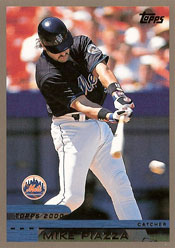
The performance of catcher Mike Piazza against the Cardinals in the 2000 postseason led to his only World Series appearance in a 16-year major-league playing career. It also may have helped his case in getting elected to the National Baseball Hall of Fame.

mike_piazzaPiazza was elected to the Hall of Fame on Jan. 6, 2016. He enhanced his credentials with a standout National League Championship Series for the Mets against the Cardinals. By hitting .412 (7-for-17) with two home runs, three doubles, five walks, four RBI and seven runs scored in the five-game series versus St. Louis, Piazza carried the Mets to their first pennant in 14 years.
[Piazza deserves election to the Hall of Fame, but so does former Cardinals catcher Ted Simmons. Simmons has more hits (2,472) and more RBI (1,389) than Piazza (2,127 hits; 1,335 RBI). Although Simmons had 1,769 more at-bats than Piazza, the point is Simmons is in the same class as Piazza as an overall hitter among catchers. Plus, Piazza wasn’t as good as Simmons on defense. For example, Piazza allowed the most stolen bases of any National League catcher in a season 10 times during his career.]

Tough on Cardinals

Piazza, who played for the Dodgers, Marlins, Mets, Padres and Athletics, hit .331 (112-for-338) with 24 home runs and 65 RBI in 97 regular-season games against the Cardinals in his career.

Cardinals pitching was just the tonic he needed entering the 2000 National League Championship Series. Although he had hit well overall during the 2000 regular season (.324 batting average, 38 home runs, 113 RBI), Piazza had slumped throughout September. His regular-season batting average was .218 after Aug. 27. In the National League Division Series against the Giants, he hit .214.

[Piazza hit .348 (8-for-23) against the Cardinals during the 2000 regular season. On May 27, 2000, in a 12-8 Mets victory at St. Louis, Piazza reached bases in all six of his plate appearances on a home run, single and four walks. Boxscore]

Pacing the Mets

In the first inning of the first game of the National League Championship Series, Piazza established the tone for the Mets. He laced a double down the third-base line off a Darryl Kile curve, driving in the first run and moving Edgardo Alfonzo to third. Alfonzo then scored on a Robin Ventura sacrifice fly, giving the Mets a 2-0 lead on their way to a 6-2 victory at St. Louis.

A headline in the St. Louis Post-Dispatch the next morning read, “Piazza’s MVP Effort Gets Mets Off To Fast Start.”

“We’re a pretty good team,” said Mets manager Bobby Valentine. “And when Mike’s hitting we’re a real good team.”

Said Piazza: “We were able to take the crowd out of the game early, which is big. They’ve got an electric crowd.” Boxscore

In Game 2, a 6-5 Mets victory, Piazza homered off reliever Britt Reames (after nearly being called out on a too-close-to-take 0-and-2 pitch), walked three times and scored twice. Boxscore

Piazza was a central figure in the Cardinals’ lone win of the series, an 8-2 victory in Game 3 at New York. After St. Louis scored twice in the top of the first, Cardinals starter Andy Benes yielded singles to the first two Mets batters in the bottom half of the inning, bringing Piazza to the plate with runners on first and third and no out.

To the Cardinals’ great relief, Piazza hit a weak grounder that third baseman Fernando Tatis scooped on a short hop and turned into a double play. Though a run scored, the Cardinals had gained the momentum by surviving the threat.

“That was key for all of us,” Cardinals catcher Carlos Hernandez said to the Post-Dispatch. “Everybody knows Piazza. He’s a real good hitter. When he got that groundball, I thought it was over. Everybody, when Piazza gets to bat, expects him to hit the ball out of the park.”

Said Piazza: “It was a tough, two-strike pitch, tough to lay off of it.” Boxscore

Sweet dreams

Piazza battered the Cardinals in Game 4 (home run, double, two RBI, three runs and a walk) and in Game 5 (two runs, double and a walk). In the locker room, celebrating the only pennant clinching he’d experience, Piazza told the Post-Dispatch, “It’s like a dream. I hope nobody pinches me. I don’t want to wake up from this.”

Six years later, the Cardinals gained a measure of revenge against both Piazza and the Mets. In 2006, Piazza was with the Padres, who were overwhelming favorites against the Cardinals in the National League Division Series. This time, Piazza hit .100 (1-for-10) in four games against the Cardinals. (Batting against St. Louis for the final time in his career, Piazza, pinch-hitting for Russell Branyan in the eighth inning of Game 4, grounded into a double play against reliever Josh Kinney. Boxscore)

After eliminating the Padres, the Cardinals beat the Mets in a seven-game National League Championship Series before winning the World Series title against the Tigers.

Previously: 2011 Cardinals are first to have top 3 in hitting into double plays

(Updated Jan. 23, 2019)

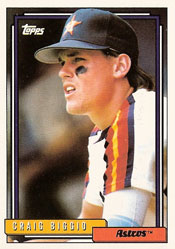
Craig Biggio, a Hall of Famer who spent his career with the Astros, rejected a chance to become a Cardinal in his prime.

craig_biggioBiggio was recruited aggressively by the Cardinals when he became a free agent after the 1995 season. At age 30, he had a chance to be their second baseman at the start of the Tony La Russa era and become part of a franchise that would reach the postseason nine times in La Russa’s 16 seasons as Cardinals manager.

Instead, Biggio remained with the Astros and continued to torment Cardinals pitching.

Biggio had regular-season career bests of 280 hits and 131 RBI against the Cardinals in 20 years (1988-2007) with the Astros. Versus St. Louis in the regular season, he batted .298 with a .378 on-base percentage, 22 home runs, 58 doubles and 31 stolen bases. In the postseason (the National League Championship Series of 2004 and 2005), Biggio hit .250 against the Cardinals.

After the 1995 season, Biggio weighed offers from the Cardinals, Rockies, Padres and Astros. La Russa, who had just been named Cardinals manager, and general manager Walt Jocketty met with Biggio, his wife and agent Barry Axelrod in California in an effort to convince the player to become a Cardinal.

“We were received well,” Jocketty told the St. Louis Post-Dispatch for a story published Dec. 5, 1995. “He likes Tony a lot and would enjoy playing for him. It’s important for him to go to a place where the team is going to be competitive. I think he would enjoy playing here. He’s a guy who would be very important to our program.”

Four days later, Post-Dispatch columnist Bernie Miklasz wrote “Craig Biggio would own this town” if he signed with St. Louis.

The Cardinals offered Biggio a five-year, $25 million contract, the Associated Press reported, but Biggio took the Astros’ four-year, $22 million deal. “I consider myself a loyal person,” Biggio said. “… I want to win in an Astros uniform.”

Twelve years later, when Biggio was finishing his playing career in 2007 with 3,060 hits, La Russa told MLB.com, “Walt and I put a full-court press on Craig (in 1995). I thought we put together a charge that had a chance, but I know … his teammates were also talking to him. He made a smart decision to stay there.”

Biggio told St. Louis writer Rick Hummel in 2007 that a few years earlier La Russa had told him, “I’m still ticked at you for not signing with us.”

“Tony said it in a good way,” Biggio said, “but I was their guy. But I never wanted to leave Houston.”

Biggio, who played most of his career as a second baseman, faced the Cardinals for the first time on Aug. 17, 1988, when he entered the game at Busch Stadium II in the ninth inning as a catcher. Boxscore

In 108 regular-season games at Busch Stadium II (which was the Cardinals’ home through 2005), Biggio batted .314 with 30 doubles, 11 home runs and 60 RBI.

Biggio faced the Cardinals for the final time during a September 2007 weekend series at Busch Stadium III. Before the middle game of the series on Sept. 22, 2007, Jocketty presented Biggio with a check for $3,053 (his hits total at the time) during an on-field ceremony. (Biggio donated the money to a charity.) Cardinals fans gave Biggio an ovation during and after the presentation, MLB.com reported.

“I’ve always said the Cardinals fans are the classiest fans in the game because they appreciate a good play,” Biggio said to the Post-Dispatch.

In remarks to reporters, La Russa called Biggio “the perfect pro.”

“He’s tied for first among guys you respect for all the years I’ve been here,” said La Russa.

Alyson Footer of MLB.com wrote, “Craig Biggio always appreciated the city of St. Louis, the Cardinals organization and Cardinals fans, and during an on-field pregame presentation on Saturday the admiration was reciprocated.”

Biggio appeared in the game that night as a pinch-hitter in the ninth inning and singled against Tyler Johnson. Boxscore

The next day, Sept. 23, 2007, Biggio, playing second base, went 1-for-4 in his final game against the Cardinals. The hit was a seventh-inning single off Russ Springer. When Biggio batted again in the eighth, he received a standing ovation that he acknowledged with a tip of his batting helmet. After flying out to right field, he was removed from the game. Boxscore

In a 2011 interview with the New York Times, Biggio said he “absolutely” could have played another two or three years longer than he did, but he wanted more time with his wife and three children. “I couldn’t look my family in the eyes anymore and justify (playing),” Biggio said. “It was time to go.”

Previously: Lance Berkman and his greatest games as a Cardinal