Feeds:
Posts
Comments

Imagine if Robert Griffin III said during his dazzling 2012 rookie season as Washington Redskins quarterback he was going to pursue a second career as a shortstop in the St. Louis Cardinals organization in 2013.
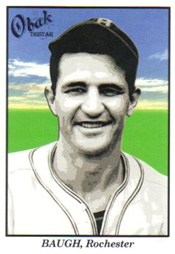
sammy_baughIn the 1930s, a Redskins rookie quarterback who, like Griffin, became a marquee player in the NFL did just that.

Sammy Baugh, who awed the nation by making the passing attack an integral part of professional football during his rookie season in 1937, played shortstop in the Cardinals’ farm system in 1938.

Though he gave up the pursuit of a baseball career after one season and never played in a major-league game for the Cardinals, Baugh intrigued St. Louis executive Branch Rickey, who was obsessed with the notion of transforming a high-caliber football player into a major-league baseball standout.

Rickey was convinced Baugh was the ideal prospect for such an experiment.

At Texas Christian University, Baugh was a two-time all-America quarterback and a hard-hitting third baseman. It was because of his throws from third base that a Texas sportswriter dubbed him “Slingin’ ” Sammy Baugh, a nickname that lasted throughout his NFL career.

Though selected by the Redskins in the first round of the 1937 NFL draft, Baugh signed with the Cardinals after leaving Texas Christian that spring, with the intention of beginning a professional baseball career in 1938.

During his rookie season with the 1937 Redskins, Baugh established an NFL record for completions (81) and led all quarterbacks in passing yards (1,127). In the NFL championship game against the Bears, Baugh passed for 335 yards, including touchdown tosses of 55, 78 and 33 yards, in the Redskins’ 28-21 victory.

Baugh’s passing increased the popularity of the NFL and was the catalyst for making the aerial attack a permanent part of offensive game plans. Bears coach George Halas called the rookie the greatest passer he’d ever seen.

Though he had developed into the starting quarterback for the 1937 NFL champions, Baugh was committed to reporting to the baseball Cardinals for spring training in 1938.

In its Nov. 18, 1937, edition, The Sporting News published a report from Sid Keener, sports editor of the St. Louis Star-Times, explaining why Rickey was so high on Baugh’s baseball potential. Wrote Keener:

The Cardinals executive is positively a crank on the subject. He cannot understand why a triple threat footballer _ a gridder who has mastered the art of passing, kicking and carrying the ball _ is unable to show equal ability on the baseball diamond. He does not subscribe to the general belief that the two sports are wide apart in athletic technique.

When Rickey received notice of Baugh’s baseball promise some time ago, the Cardinals official was in high glee. ‘Sign Baugh,’ was the message Rickey flashed to his staff of scouts and secret agents. Ray Dean, a baseball promoter of wide experience, made the successful snatch. Baugh accepted the club’s terms and will receive a thorough training under the direction of (Cardinals manager) Frankie Frisch next spring.

Rickey is determined to score on his hobby … Rickey is almost a fanatic on the subject. He believes Baugh will come through for him.

Baugh reported early to the Cardinals’ spring training camp. He soon impressed Frisch with his fielding and throwing. He also displayed raw power in batting practice. Frisch indicated he would open the regular season with Baugh as the starting third baseman.

Wrote Jeff Moshier of The Evening Independent: Frankie is convinced that Slingin’ Sammy is a ballplayer, destined to be one of the stars of the pastime.

“When Baugh came to camp, he was a better ballplayer than I was when I joined the Giants from Fordham,” Frisch said.

Henry McLemore of the British United Press wrote: When the National League season opens three weeks from now, Baugh will be at third for the Cardinals. That’s not a guess on my part either. That comes straight from Frankie Frisch … and is seconded by (outfielder) Joe Medwick.

“He’s a cinch to get the job,” Frisch said. “He can’t miss. And I’m just as surprised as you are. When he came to camp, I thought he was just a football player who could do us good only as a publicity gag.”

Said Medwick: “You can’t get one (ground ball) by him, even with a .44. And what an arm. No wonder he can whip that football around.”

As spring training progressed, Frisch had a change of heart. The 1938 Cardinals opened the season with Pepper Martin at third and Don Gutteridge at shortstop.

When camp broke, Baugh, 24, was sent to Columbus of the American Association.

Wrote the Associated Press: Baugh showed much promise with the Cardinals this spring and at one time appeared to have the inside track on the third base job. Frankie Frisch … has requested that Baugh be used at shortstop by Columbus.

In 16 games at shortstop for Columbus manager Burt Shotton, Baugh batted .220 and committed six errors (.928 fielding percentage). In mid-May, Columbus returned Baugh to the Cardinals.

The Cardinals sent him to Rochester of the International League. It was there that the standout quarterback met a standout shortstop, Marty Marion.

Marion, who would receive the 1944 National League Most Valuable Player Award and would start at shortstop on four Cardinals pennant winners, played 108 games at shortstop for manager Ray Blades at Rochester. He hit .249 with 15 doubles and had a fielding percentage of .967 (14 errors).

Baugh got into 30 games at shortstop for Rochester. He hit .183 and committed five errors (.943 fielding percentage).

Convinced he never would supplant Marion and that his future was with football, Baugh returned fulltime to the Redskins for the 1938 NFL season. He went on to lead the NFL in passing six times. In a 1947 game against the Chicago Cardinals, Baugh threw six touchdown passes.

In 1963, Baugh was inducted as a member of the inaugural class to the Pro Football Hall of Fame in Canton, Ohio _ a mere 120 miles from where he made his professional baseball debut with the Columbus Red Birds 25 years earlier.

Previously: How Marty Marion won MVP Award by one point
(Updated Jan. 18, 2020)

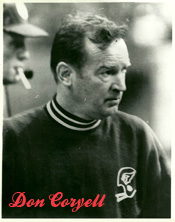
Don Coryell was the best coaching hire in St. Louis Cardinals football history.

don_coryellOn Jan. 18, 1973, the football Cardinals, responding to an unsolicited letter, hired Coryell to be their head coach.

An innovator known for producing winning college teams and high-powered offenses, Coryell overcame his lack of NFL experience and transformed the Cardinals into a championship-caliber club.

In five seasons (1973-77) under Coryell, the Cardinals posted a 42-27-1 record and twice qualified for the playoffs. Those were the Cardinals’ first playoff berths since 1948 and their first division titles since moving from Chicago to St. Louis in 1960.

Few predicted such success in January 1973. The Cardinals had finished the 1972 season with their second consecutive 4-9-1 record under head coach Bob Hollway. They ranked 23rd in scoring in the 26-team NFL.

Coryell, 48, had a 104-19-2 record in 12 years at San Diego State. He had developed future NFL players such as quarterbacks Dennis Shaw of the Bills, Don Horn of the Broncos and Brian Sipe of the Browns, and receivers Isaac Curtis of the Bengals and Gary Garrison of the Chargers.

Outside of the San Diego area, Coryell was “an unfamiliar name to most,” according to The Sporting News.

In the book “Big Red: The Story of the Football Cardinals,” author Bob Burnes said reporters at the St. Louis press conference announcing Coryell’s hiring asked, “Don who?”

Seeking a challenge, Coryell had written a letter to Cardinals owner Bill Bidwill, inquiring about the job after Hollway was fired. “People told me that, if I wanted a college coach, there was this guy at San Diego State,” Bidwill said.

Coryell received a three-year contract from the Cardinals. The only other candidate considered for the position was former Packers quarterback Bart Starr, United Press International reported.

“I wanted someone who could put the offense back into the Cardinals,” Bidwill said. “(Coryell) has always had this. He comes to us very highly recommended from many sources. He has a consistent record of winning seasons.”

Said Coryell: “I believe in a wide-open style of play. I like to throw the ball. I believe in attacking the defense.”

One reason Coryell was confident he could succeed was the presence of quarterback Jim Hart on the Cardinals’ roster. Hollway had soured on Hart and had tried Gary Cuozzo and Tim Van Galder at quarterback in 1972.

“(Hart) can throw long and he can throw the deep sideline pattern,” Coryell said. “If he can do that, I know he can throw the short stuff. I want a quarterback who can explode the ball, particularly against the zone defense.”

Years later, Hart told the St. Louis Post-Dispatch, “After the first meeting we had with him, and he started talking about how he liked to throw the ball … It was like, ‘Whoa, you got us, pal.’ ”

“I believe in the passing game,” Coryell said. “I’m not a coach who builds on defense. If you’re playing a team with more talent, the only way to win is by throwing the ball well.”

After a 4-9-1 record in 1973, St. Louis was 10-4 and won a division championship in Coryell’s second season, 1974. Hart thrived in an offense with running backs Jim Otis and Terry Metcalf; receivers Mel Gray, Earl Thomas, Jackie Smith and J.V. Cain (Ike Harris and Pat Tilley later contributed significantly); and linemen Dan Dierdorf, Conrad Dobler and Tom Banks.

The Cardinals were 11-3 and won a second consecutive division title in 1975. They won seven times in the last minute of a game that season, earning the nickname “Cardiac Cardinals.”

Winning championships with flair, the football Cardinals began to rank in popularity with the baseball Cardinals, who went without a championship in the 1970s, and Coryell began to emerge as an iconic coach.

A 10-4 finish in 1976 was followed by a 7-7 record in 1977. Coryell and Bidwill feuded over control of the draft and personnel decisions. Disenchanted, Coryell went back to San Diego to coach the Chargers and led them to the NFL playoffs in four consecutive seasons.

Previously: 1987: year of the Smiths, Ozzie and J.T., for Cardinals

(Updated Jan. 1, 2018)

Erik Pappas can speak authoritatively about the highs and lows of being a professional baseball player.

erik_pappasA Cardinals catcher in 1993 and 1994, Pappas started his St. Louis career with a flourish (a 16-game hitting streak) and ended it in a slump (0-for-33).

A baseball and football standout at Mount Carmel High School in Chicago, Pappas was named Illinois prep baseball player of the year in 1984. The Angels selected him in the first round in the June 1984 draft, ahead of Mark McGwire, Greg Maddux and Tom Glavine.

Pappas never advanced out of the Angels’ farm system. (“They gave up on me real quick … I never felt wanted with the Angels,” he later told the St. Louis Post-Dispatch.) The Cubs signed him and he made his big-league debut with them in 1991, playing in seven games before returning to the minors.

After stints in the minor-league systems of the Royals and White Sox, the Cardinals signed Pappas on the recommendation of their Class AAA Louisville manager, Jack Krol, and invited the catcher to spring training in 1993.

The Cardinals committed that spring to the catching tandem of Tom Pagnozzi and Hector Villanueva. Pappas hit .250 in nine spring training games and was sent to Louisville to open the season.

Determined to show the Cardinals he belonged, Pappas hit .338 with four home runs in 21 games for Louisville. When Pagnozzi tore cartilage in his left knee in May, Pappas, 27, was promoted to St. Louis.

The Cardinals were planning to return Pappas to Louisville after Pagnozzi recovered, but Pappas changed those plans with his 16-game hitting streak from May 14 through June 5. It was the longest hitting streak by a Cardinals catcher since Ted Simmons had a 19-game stretch in 1975.

Five times Pappas kept the streak alive by producing a hit in his last at-bat. He did that on June 2, 1993, when he hit a RBI-double off the Dodgers’ Todd Worrell in the seventh inning at St. Louis, giving the Cardinals a 5-3 lead.

In the ninth, the Dodgers scored a run off closer Lee Smith and had Eric Davis on first base with two outs. Davis was riding a streak of 34 consecutive successful stolen base attempts. Pappas was 0-for-8 in runners caught attempting to steal.

“Pap comes out to me and says, ‘Don’t worry about Davis.’ I said, ‘Bull,’ ” Smith told the Post-Dispatch.

As expected, Davis broke for second. Pappas’ throw arrived at the second base bag before Davis did. Davis was out, the streak was broken and the game was over, a 5-4 Cardinals victory preserved. Boxscore

“That was unreal,” Cardinals first baseman Gregg Jefferies said. “Everybody in the stadium knew (Davis) was going and Pap makes a great throw.”

Pappas’ hitting streak was snapped by Reds pitchers Jose Rijo and Greg Cadaret on June 6, 1993. Boxscore A week later, June 14, Pirates center fielder Andy Van Slyke broke his right collarbone while helping Pappas get his only big-league home run.

In the fourth inning at St. Louis, Pappas drove a Denny Neagle pitch to deep center. The ball glanced off Van Slyke’s glove and skimmed into a flower bed for a two-run home run as Van Slyke slammed into the wall, breaking the collarbone. Boxscore

A couple of days later, Pagnozzi came off the disabled list and Villanueva was sent to Louisville.

Pappas completed the 1993 season with a .276 batting average, 12 doubles and 28 RBI in 82 games for St. Louis. He started 53 games at catcher and also made 10 starts in right field and one at first base. He caught 41 percent of the baserunners who attemped to steal against him. The Cardinals were 29-24 in games Pappas started at catcher.

The Cardinals committed to opening the 1994 season with Pagnozzi and Pappas as their catchers, but Pagnozzi again tore cartilage in his left knee while reaching for a pitch in spring training. Cardinals manager Joe Torre declared Pappas the Opening Day starter and selected Terry McGriff to be his backup.

Pappas hit safely in each of the Cardinals’ first four games of the 1994 season. Then he went hitless in 33 at-bats. He caught just one of 16 baserunners attempting to steal.

On May 5, Pagnozzi came off the disabled list. After 15 games started at catcher and with his batting average at .091 (4-for-44), Pappas was demoted to Louisville.

“I got an opportunity to start and I didn’t take advantage of it,” Pappas said. “I cut my own throat … I was hoping to have a career here.”

Said Torre: “If he’s going to find his (batting) stroke, he’s got to find it as a regular player … I told him, ‘Go get straightened out and we’ll see what happens. We’ll see you in September, or sooner, if something happens.’ We just couldn’t get anything to relax him.”

Pappas never played in another major-league game, but he did spend one more day with the Cardinals.

When it became certain the players would go out on strike in August 1994, the Cardinals called up Pappas from Louisville for their final game on Aug. 11 at Miami. They did this, St. Louis journalist Rick Hummel reported, “because (Pappas) makes $140,000 on a major-league contract. If the strike would last the rest of the season, the Cardinals would save about $40,000 in Pappas’ salary.”

Pappas didn’t play in his one-night stand, the strike did last the rest of the season and the Cardinals avoided paying Pappas $40,000.

“It’s a business, simple as that,” Pappas said.

In 2013, Pappas rejoined the Cardinals’ organization as a minor-league hitting coach. He coached the Peoria Chiefs in 2013 and the Springfield (Mo.) Cardinals in 2014 and 2015. Pappas joined the Orioles’ organization in 2016 as a hitting coach for their Class A affiliate, the Frederick (Md.) Keys.

Previously: Cardinals rookie pitchers tested Joe Torre in 1994

(Updated April 5, 2026)

Manager Whitey Herzog bluntly opposed the notion of the Cardinals signing Bob Horner to replace Jack Clark. Too bad management didn’t listen.

bob_hornerDesperate to fill a hole in their lineup because of the surprise departure of Clark to the Yankees as a free agent, the Cardinals took a chance on Horner, signing him to a one-year, $950,000 contract on Jan. 14, 1988, despite Herzog’s warnings Horner “can’t hit and can’t field.”

The move turned out to be one of the Cardinals’ biggest personnel flops. Plagued by a damaged left shoulder, Horner, playing first base and batting cleanup for the 1988 Cardinals, lacked Clark’s pop, hitting three home runs in 60 games. By mid-June that year, he was through as a major-league player.

Jumpin’ Jack

Clark, the slugger who powered the Cardinals to two National League pennants in three years, indicated after the 1987 World Series he hoped to stay with St. Louis, but as talks dragged on he became miffed by the club’s negotiating tactics. Though the Cardinals eventually offered him more money than the Yankees did, he signed a two-year, $3.5 million contract with New York on Jan. 6, 1988.

“If they (the Cardinals) had made the same offer earlier, it would have been done,” Clark said to the Associated Press, “but it was too late … I just had enough of it. All I kept hearing was that I was a one-dimensional player … I didn’t like the abuse I was getting. Things just broke down to the point where it was time for a change. It wasn’t about money. I was offered more money by St. Louis.”

(In the 2005 book “Cardinals Where Have You Gone?” Clark told writer Rob Rains, “Looking back on it, I should have stayed a Cardinal. I was very happy here.”)

Without Clark, the Cardinals lacked run production. In 1987, they averaged 5.3 runs per game with Clark in the lineup and 3.6 per game when he wasn’t playing.

Cardinals general manager Dal Maxvill tried luring free-agent Gary Gaetti to replace Clark, but Gaetti, a third baseman, didn’t want to switch to first base, so he re-signed with the Twins. (Seven years later, the Cardinals did sign Gaetti and he played third base for them from 1996-98.)

Maxvill also approached the Dodgers about slugger Mike Marshall, but when they asked for infielder Jose Oquendo and reliever Ken Dayley in return, the talks ended, Maxvill told Rick Hummel of the St. Louis Post-Dispatch.

Buyer beware

Horner, 30, wanted to return to the majors after playing for the Yakult Swallows of the Japanese Central League in 1987. He rejected Yakult’s offer of a multi-year contract after he hit .327 with 31 home runs in 93 games for them.

In nine seasons with the Braves before his year in Japan, Horner compiled a .278 batting mark and averaged 24 home runs a year.

To Maxvill, who’d been a Braves coach from 1982-84, Horner became the best available replacement for Clark. When Hummel called Herzog to seek his reaction, Herzog replied, “I don’t like Horner. Of his lifetime homers, about 70 percent were hit in Atlanta. He never could hit in St. Louis. He can’t hit and he can’t field.”

“I just don’t think Horner is the answer,” Herzog said. “I don’t know what he’d hit in our ballpark. He’s a fly ball hitter. He never did hit much on the road.”

Horner had hit 142, or 66 percent, of his big-league homers in Atlanta. Though he had a .325 career batting mark in 118 at-bats at St. Louis’ Busch Stadium, he had hit just five home runs there.

The combination of Herzog’s resistance and Horner’s demand of a multi-year contract cooled the Cardinals’ interest. Horner had offers from the Braves and Rangers, but the Junction City, Kan., native preferred St. Louis. Concerned the opportunity would slip away, Horner called Maxvill and said he’d take a one-year contract. Maxvill said that was fine but a deal needed Herzog’s buy-in.

Horner called Herzog and told him he wanted to be a Cardinal, that he could help the club and would sign for less than what Clark had wanted. Herzog gave his approval. The deal was announced the next day.

“It’s been a dream of mine to play for the Cardinals,” Horner said to United Press International. “What an absolute fit for me.”

Asked how he felt about Herzog’s initial remarks about him, Horner said, “No player wants to hear comments like that in the paper about him. After talking to Whitey last night, I was very convinced he wanted me on the St. Louis Cardinals.”

Said Maxvill: “Whitey has been consulted all along, is in complete agreement and is enthusiastic about Bob being with us.”

Herzog still had concerns. He explained to Hummel that Cardinals pitchers facing Horner at Busch Stadium were instructed to give him pitches away so he’d be more likely to hit to the deep outfield gaps rather than pull balls over the wall. “He’s got a good home run swing, but will he be able to hit the ball out of the park in right-center and left-center?” Herzog asked.

A decade later, in his book “You’re Missin’ a Great Game,” Herzog said, “Horner had been a 30-dinger guy for the Braves, but that was in their old Launching Pad ballpark. It didn’t take a genius to see that Busch, with its deep power alleys and humid air, was too big for him.”

Low energy

The Cardinals opened the 1988 season on April 4 at Cincinnati. Herzog recalled the poor impression Horner made that day.

“I called him Buddha,” Herzog said. “He was a little on the portly side and spent a lot of quality time slouched in his chair in the clubhouse … I had a rule that everybody took infield before the game, but I didn’t see Horner out at first base, so I went to the clubhouse to find him.

“There he sat, in one of his deep trances. I said, ‘Hey, Bob, what the hell are you doing? You’re supposed to be taking infield.’ He looks up at me, blinks like an old frog on a lily pad and says, ‘I’m tired.’ A hundred-and-sixty-two games left to play and the man is gassed.”

Horner went homerless in 31 games at St. Louis in 1988. His three homers that season all were solo shots on the road.

In 60 games for the Cardinals, Horner batted .257 with 33 RBI before his left shoulder gave out. He appeared in his final big-league game, June 16, 1988, producing a pinch-hit, RBI-double in a Cardinals victory at Pittsburgh. Boxscore

Horner underwent two shoulder surgeries that summer. The Cardinals started 10 players at first base. In August, they solidified the position by acquiring Pedro Guerrero from the Dodgers for pitcher John Tudor.

After the season, Horner wasn’t offered a contract by the Cardinals. The Orioles invited him to spring training, but on March, 9, 1989, Horner, saying shoulder weakness limited his ability to play, announced his retirement.

(Updated Oct. 9, 2022)

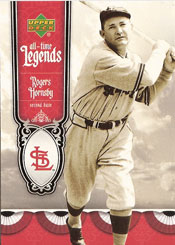
On Jan. 5, 1963, Rogers Hornsby, 66, died in a Chicago hospital from heart problems.

rogers_hornsby4Hornsby had entered the hospital Dec. 9, 1962, for cataract surgery. Five days later, he suffered a stroke. Hornsby appeared to be recovering until blood clots developed in his left leg and left arm. He died because the blood supply was cut off to his heart muscles.
In an obituary, The Sporting News called Hornsby “the game’s most formidable right-handed hitter.”

Stan Musial, when preparing for his 22nd and last Cardinals season in 1963, was quoted by United Press International as calling Hornsby the “greatest hitter of all time.”

The late Giants manager John McGraw had said Hornsby was “the best pivotman I have ever seen on a double play (and) a better hitter than Babe Ruth.”

Hornsby, a second baseman, played 13 years (1915-26 and 1933) for the Cardinals. He also played for the Giants, Braves, Cubs and Browns in a career that lasted until 1937. With the Cardinals, Hornsby batted .359 with 2,110 hits, 1,072 RBI, 3,342 total bases and a .427 on-base percentage. As player-manager, he led them to their first National League pennant and first World Series title in 1926.

Some of the records established by Hornsby as a Cardinal still exist today:

_ He’s the only National League player to twice (1922 and 1925) win the Triple Crown for leading the league in batting average, home runs and RBI.

_ His .424 batting average for the 1924 Cardinals is the highest single-season mark in the big leagues since 1901.

_ His slugging percentage of .756 for the 1925 Cardinals is the highest single-season mark for a right-handed batter in major-league history.

_ His on-base percentage of .507 for the 1924 Cardinals is the highest single-season mark for a right-handed batter in major-league history.

_ His 450 total bases for the 1922 Cardinals are the most for a right-handed batter in the big leagues and the most for a National League batter. Only Ruth had more, with 457 total bases in 1921.

_ From 1921 through 1925 with the Cardinals, Hornsby had a combined batting average of .402, the highest for a five-year stretch in major-league history.

_ His 250 hits for the 1922 Cardinals rate as the franchise’s single-season record.

_ His 102 extra-base hits in 1922 are the single-season high for a Cardinals right-handed batter. Musial had 103 in 1948.

A .358 career hitter (second only to Ty Cobb’s .367), Hornsby won seven National League batting championships, including six in a row with the Cardinals: .370 in 1920, .397 in 1921, .401 in 1922, .384 in 1923, .424 in 1924 and .403 in 1925. Hornsby also led the National League in on-base percentage and slugging percentage in each of those six years.

“If Rogers Hornsby, for at least the peak of his career, wasn’t the best hitter in baseball history, he’ll do until the real thing comes along,” Bob Broeg wrote in The Sporting News in 1973.

Some might say Albert Pujols was “the real thing” who came along for the Cardinals. Though Pujols was a better slugger than Hornsby (469 home runs as a Cardinal to 193 for “The Rajah”), Hornsby was the better hitter.

“My eyes are as good as they ever were,” Hornsby said when he turned 50 in 1946. “If my legs were OK, I could still hit .350.”

(Updated Sept. 20, 2023)

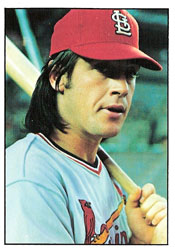
In 1973, the year he turned 24, Ted Simmons achieved an ironman feat that remains largely unappreciated and mostly unmatched.

ted_simmons15Simmons caught a staggering total of 1,352.2 innings for the 1973 Cardinals. To put the achievement in perspective, consider:

_ Hall of Fame catchers such as Johnny Bench, Yogi Berra, Roy Campanella and Ivan Rodriguez never caught that many innings in a season.

_ The only Hall of Fame catchers who topped Simmons’ 1973 total were Carlton Fisk, who caught 1,355.2 innings for the Red Sox in 1978, and Gary Carter, who caught 1,353.2 innings for the Expos in 1982, according to baseball-reference.com.

_ Yadier Molina, a multiple Gold Glove Award winner, caught a career-high 1,218.1 innings for the 2016 Cardinals. That’s 134.1 innings, or the equivalent of 15 games, fewer than what Simmons did for the 1973 Cardinals. Simmons’ 1,352.2-inning total is a franchise record. The next closest is Tim McCarver, who caught 1,261.1 innings for the 1966 Cardinals.

Randy Hundley holds the major-league record for most innings caught in a season. He caught 1,385 innings _ 32.1 more than Simmons _ for the 1968 Cubs.

Playing primarily on the punishing artificial surface of Busch Memorial Stadium, Simmons appeared in 161 of the Cardinals’ 162 games in 1973. He caught in 152 of those games.

“He’s about as strong a human being as I’ve ever seen,” Simmons’ teammate, Joe Torre, a former catcher, said to The Sporting News. “He’s so durable. That’s tough, catching every day in August and September.”

Looking back at Simmons’ endurance, teammate Mike Tyson said to Cardinals Magazine, “How’d he do it? He was a beast.”

Cardinals reliever Al Hrabosky told the Baseball Hall of Fame Yearbook, “His best attributes were his strong will to win and dedication to being out there every day.”

Shortstop Dal Maxvill said to Cardinals Magazine, “He wanted to be in the lineup every day. He was strong, he was young and he was a real gamer. He would take a foul ball off the shoulder _ chest protectors didn’t have flaps then _ and you could see he was in pain.”

Getting it done

Simmons played in every inning of the Cardinals’ first 91 games in 1973 before being held out of a July 18 night game against the Giants at St. Louis, The Sporting News reported. Although Simmons spent that day serving military reserve duty, he asked to be in the lineup that night, but manager Red Schoendienst decided to rest him.

Simmons established single-season career highs in 1973 for defensive chances (975), putouts (888) and plate appearances (690).

“There were days I felt terrible and I did wonderful, and days I felt wonderful and did terrible,” Simmons told Cardinals Magazine. “I realized fairly quickly there wasn’t any connection. Besides, it wasn’t going to do me any good to worry about it because I was going to play no matter if I felt good, bad or indifferent.”

Though playing the most demanding position on the field without hardly a rest, Simmons excelled on defense and offense.

He caught 50 runners attempting to steal in 1973. Only the Phillies’ Bob Boone, who threw out 54, had a higher total among National League catchers that year. Simmons ranked third in the league in percentage of runners caught attempting to steal (44 percent). Only Bench and Boone did better.

“He’s still not the smoothest catcher, but he gets the job done,” Torre said after the 1973 season. “He’s throwing better and catching better.”

Doing it all

Batting primarily in the cleanup position, Simmons led the 1973 Cardinals in batting average (.310), RBI (91), doubles (36), total bases (271) and slugging percentage (.438). He also tied with Torre for the team lead in home runs (13).

Impressively consistent, Simmons, a switch-hitter, hit .310 against right-handed pitching and .311 against left-handed pitching in 1973. “That was a great shot in the arm _ batting over .300 from both sides,” Simmons said. He struck out just 47 times in 619 at-bats.

“He doesn’t often look bad at the plate,” Cardinals coach Vern Benson said. “He’s so good at adjusting with one or two strikes.”

Rather than wane under the toll, Simmons grew more productive as the season progressed. After hitting .212 with no homers in April, Simmons batted .272 in May, .333 in June, .314 in July, .295 in August and a stunning .391 (43-for-110) in September when the Cardinals challenged the Mets for the division title.

In an interview with the Baseball Hall of Fame magazine, “Memories and Dreams,” McCarver, who had returned to the Cardinals in 1973 as a utility player, recalled, “That year, Ted Simmons hit more balls hard than anybody I’ve ever seen in the course of a season. Honestly, I felt he could have gotten 350 hits that year.”

Dal Maxvill said to Cardinals Magazine, “Ted has said he learned a lot about hitting from his teammates. By watching Matty Alou from the left side, he learned how to get his hands into a position that led to countless line drives to right field. (From) Joe Torre, Ted says he developed an approach to fight off inside fastballs from the right side.”

Will to win

On a hot, humid Labor Day at Pittsburgh on Sept. 3, 1973, Simmons caught all 22 innings of a doubleheader (the first game went 13 innings) and produced three hits in each game, helping the Cardinals split.

“This is the closest I’ve ever been to a division title,” Simmons said to the Associated Press, “and I’m at the point where I’m willing to sacrifice everything to get there.”

The next night, Simmons made what Schoendienst called the “play of the game” when he stretched for a relay throw from second baseman Ted Sizemore and tagged out Richie Zisk at the plate, preserving a 4-2 Cardinals victory that moved them two games ahead of the second-place Pirates. Boxscore

Simmons had a 19-game hitting streak from Aug. 19 through Sept. 8. He hit safely in 36 of the 1973 Cardinals’ last 39 games.

Asked how he was able to perform so well in the season’s final four weeks when it would have been natural to weaken, Simmons said, “It was the thought of the $25,000 (that went to the World Series winners) and the Series ring.”