Feeds:
Posts
Comments

(Updated April 18, 2021)

On May 3, 1941, in his first major-league start, Hank Gornicki pitched a one-hit shutout for the Cardinals against the Phillies at Philadelphia.
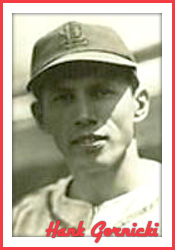
It was the only start Gornicki ever made for the Cardinals. Less than a month later, he was returned to the minor leagues. Before the season ended, he was shipped to the Cubs.

A right-hander, Gornicki was a 30-year-old rookie with the 1941 Cardinals. He pitched with success in the Cardinals’ farm system for six years, posting double-figure win totals each season, before earning a spot with the big-league club.

At the time, his claim to fame was being dubbed the “wood chopper of the Great Smokies” because he kept fit during the off-seasons by cutting down trees on his father’s property in North Carolina.

After two relief appearances with the 1941 Cardinals, manager Billy Southworth gave Gornicki the start against the Phillies because Southworth decided the rookie should be given the chance, The Sporting News reported.

Before the game, Cardinals coach Mike Gonzalez “told visitors to the St. Louis bench that he didn’t think Gornicki had a good enough fastball to last nine innings,” the Philadelphia Inquirer reported.

According to the St. Louis Star-Times, “Southworth was afraid to use him without keeping a veteran warmed up for emergency duty. Out of the corner of his eye, Gornicki could see Bill McGee toiling in the bullpen through most of the game, but Bill might as well have spent the afternoon at a movie.”

On a chilly Saturday afternoon at Shibe Park, Gornicki held the Phillies hitless until Stan Benjamin lined a single to center with two outs in the sixth.

Gornicki finished with five strikeouts and five walks in pitching the Cardinals to a 6-0 victory. He also contributed a RBI-single in the seventh. Boxscore

“He pumped the ball overhand with fine speed and a very sharp-breaking curve,” the St. Louis Globe-Democrat reported.

According to the Philadelphia Inquirer, Gornicki “has a fine curveball, a good fastball and perfect poise on the mound. His only apparent weakness was his tendency to get the count to 3-and-2. With a good-hitting club, this might prove fatal.”

The victory was the eighth in a row for the pitching-rich Cardinals and it improved their record to 13-3.

Though Gornicki dazzled in his start, Southworth returned him to the bullpen because the Cardinals already had quality starters such as Lon Warneke, Ernie White, Mort Cooper, Max Lanier, Harry Gumpert and Howie Krist.

As Fred Lieb of The Sporting News wrote, “Like the old lady in the shoe, Billy Southworth had so many good young pitchers he didn’t know what to do.”

Gornicki didn’t appear in another game for almost two weeks. He pitched less than an inning in relief on May 15 against the Braves. Soon after that, he was sent to Rochester of the International League.

With Rochester, Gornicki was 12-9 with a 2.83 ERA in 26 games. On Sept. 2, the Cardinals sent Gornicki to the Cubs in a cash transaction. He appeared once in relief for the Cubs before baseball commissioner Judge Kenesaw Mountain Landis voided the deal, saying it had violated the waiver rule. The Reds had claimed Gornicki on waivers before the Cardinals had sent him to the Cubs.

Returned to the Cardinals, Gornicki was in no-man’s land, unwanted and unsure of where he belonged. In December, the Cardinals dealt him to the Pirates.

Gornicki spent three seasons (1942, 1943 and 1946) with the Pirates in a stint that was interrupted by two years of military service during World War II. He posted a big-league career record of 15-19 with a 3.38 ERA in 79 games, including 33 starts.
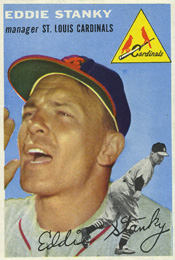
The actions of manager Eddie Stanky caused the Cardinals to forfeit a home game to the Phillies. When the Busch Stadium public address announcer declared the umpires had awarded the Phillies a victory, Cardinals fans cheered to show their displeasure with Stanky.

On July 18, 1954, the Cardinals forfeited a brawl-marred game to the Phillies because umpires ruled the combative Stanky, nicknamed “The Brat,” intentionally used stalling tactics in an attempt to avoid a loss.

After being suspended by National League president Warren Giles, Stanky issued an emotional public apology.

Pressure mounts

Booed with increasing regularity by Cardinals fans because his team was mired in sixth place in the eight-team league, Stanky was dealing with a series of setbacks and strains.

On July 17, a Saturday afternoon when the temperature reached 100 degrees, the first-place Giants built a 9-0 lead after three innings against the Cardinals at St. Louis. The Cardinals fought back impressively, scoring five runs in the sixth, three in the seventh and one in the eighth, tying the score, but the Giants won, 10-9, with a run in the 11th, dropping the Cardinals 17 games out of first with a 41-44 record. Boxscore

The next day, Sunday, July 18, the Phillies were in St. Louis for a doubleheader with the Cardinals.

Amid growing speculation about Stanky’s job security, club owner Gussie Busch issued a vote of confidence, saying, “I know there are many loyal Cardinal fans all over the country who are impatient and unhappy with the present standing … but I think it is altogether too simple and too easy to blame the manager every time something goes wrong or doesn’t work out exactly as it should.”

Adding to the drama was the matchup between Stanky and his Phillies counterpart. Three days earlier, the Phillies fired manager Steve O’Neill and replaced him with Terry Moore, the ex-Cardinals outfielder. When Stanky became Cardinals manager in 1952, Moore was on his coaching staff. Stanky fired him after the season. Moore reacted by ripping Stanky, telling reporters, “When he loses a ballgame, he acts more like a 9-year-old boy than a manager. The job is too big for him. Stanky is temperamentally unsuited for the job of manager.”

It was under this backdrop _ the booing by Cardinals fans, the speculation about his job status and the sight of Moore managing against him _ that Stanky approached the first game of the July 18 doubleheader.

Snap, crackle, pop

It didn’t unfold as Stanky hoped. The game was delayed 1 hour and 18 minutes by rain in the seventh. The Cardinals led 8-7 after eight. The Phillies scored three in the ninth for a 10-8 lead. The Cardinals rallied, tying the score in the bottom half of the inning on a two-out, two-run single by Solly Hemus, but the Phillies scored in the 10th, the Cardinals stranded Wally Moon on third with one out in the bottom half of the inning, and Philadelphia won, 11-10. Boxscore

In consecutive games, the Cardinals had scored 19 total runs _ and lost each by a run in extra innings.

Because of the rain delay and extra inning in the opener, the second game of the doubleheader didn’t begin until after 6 p.m. The Cardinals and umpires mistakenly thought a league rule prohibited ballpark lights from being turned on for a Sunday game beginning after 6. (The rule had been erased before the 1954 season.)

When the Phillies took an 8-1 lead, Stanky began making a series of deliberate pitching changes in an effort to prevent the game from being completed in the mandatory five innings before darkness arrived.

Each Cardinals reliever appeared to work slowly and issue pitches outside the strike zone. Tensions built as the game inched into the top of the fifth and darkness approached.

At that point, Cardinals catcher Sal Yvars and Phillies first baseman Earl Torgeson, who had a long-running feud, began fighting one another on the field. Moore raced toward the pair and grabbed Yvars. Stanky bolted toward the combatants and tackled Moore. The benches emptied and fighting continued until police broke up the melee.

When Stanky went to the mound to make another pitching change, umpire Babe Pinelli declared a forfeit in favor of the Phillies.

Wakeup call

Giles backed his umpires, saying, “The tactics employed in the game were palpably designed to delay the game.”

Stanky disagreed, telling the Associated Press: “My pitchers have been wild and ineffective all season, not only during this game.”

The next day, Giles suspended Stanky for five days and fined him $100. Yvars was suspended for three days and Torgeson for two.

Humbled, Stanky apologized for his actions and read a statement. Some excerpts:

“I called this press conference because of the impression I received Sunday when I heard the St. Louis people applaud Pinelli’s decision, forfeiting the game to the Phillies. I know in my heart indirectly that I have embarrassed and hurt the St. Louis people, baseball nationally, my reputation as a baseball man … and Gussie Busch and the Cardinals’ front office.

“… My spirit and desire to win could never be broken. However, my human and public relations will be improved. This affair Sunday has opened my eyes.”

Said Cardinals general manager Dick Meyer: “It takes a tremendous amount of fortitude to make the type of statement Eddie made unsolicited.”

Some were skeptical. “He said the same thing in 1952 right after he got the job, but the reform didn’t last long,” Moore said.

Stanky survived the season, but was fired in May 1955 after the Cardinals got off to a 17-19 start. Moore returned to the Cardinals in 1956 as a coach for manager Fred Hutchinson.


Fired up by the antics of manager Tommy Lasorda, fans at Dodger Stadium threw a barrage of souvenir baseballs and other items onto the field, prompting umpires to forfeit the game to the Cardinals.

On Aug. 10, 1995, a crowd of 53,361 packed Dodger Stadium for a Ball Night promotion and to see popular rookie starting pitcher Hideo Nomo face the Cardinals.
Tension began to build in the eighth inning. With the Cardinals ahead 2-1, the Dodgers had two on with two outs and Eric Karros at the plate. Karros was called out on strikes, argued the call and was ejected by plate umpire Jim Quick. Fans threw baseballs onto the field in protest.

After the Cardinals were retired in their half of the ninth, Raul Mondesi led off the bottom half of the inning. Mondesi took a pitch from Tom Henke and headed toward first base, thinking it was ball four, but Quick ruled the pitch a strike.

Mondesi eventually struck out, argued with Quick and was ejected. Lasorda rushed onto the field, jawed with Quick and was ejected as well.

With that, a hailstorm of baseballs was unleashed from the stands. Quick stopped play and a forfeit was declared, giving the victory to the Cardinals. Video

“We felt … the situation was getting out of hand,” Quick said to the St. Louis Post-Dispatch. Boxscore

(It was the first forfeit in the National League in 41 years. That game involved the Cardinals, too. On July 18, 1954, umpires forfeited to the Phillies the second game of a doubleheader at St. Louis because they believed Cardinals manager Eddie Stanky intentionally was using stall tactics.)

First-base umpire Bob Davidson called the decision to forfeit the Dodger Stadium game to the Cardinals “100 percent correct” and criticized Lasorda.

“This whole thing was Tom Lasorda’s fault,” Davidson said to the Associated Press. “He instigated the crowd, waving his arms. He has himself to blame, absolutely. He knows he’s to blame.”

Said Lasorda: “How did I instigate it? I was talking to Jim Quick. All I was asking was why he threw my players out. We didn’t throw the balls.”

Cardinals catcher Tom Pagnozzi told the Post-Dispatch, “Lasorda provoked the whole thing.”

Lasorda told the Los Angeles Times, “I’m disappointed in the ones who threw the balls, not the good fans.”

Cardinals players said they felt they were in danger because objects other than baseballs were thrown at them.

“I wasn’t too worried until a bottle of Southern Comfort flew out of the stands and hit me,” Cardinals right fielder John Mabry said to Bob Nightengale of The Sporting News. “I got hit by a rum bottle, too.”

Said St. Louis center fielder Brian Jordan: “I’m not going to stand out there and get busted in the head with a ball. The umpires made a good decision.”

Los Angeles Times columnist Mike Downey wrote, “Here, where fans are best known for leaving early, if this is the way people intend to behave, then please, leave early.”

Cardinals coach Bob Gibson said to Nightengale, “Dodgers fans used to be among the best in baseball. I’m afraid you can’t say that anymore.”

Said Quick: “I hope everybody has learned a lesson from this. I’ve been in the game 28 years and I’ve never been involved in a forfeit. This is very disappointing.”

Previously: Stayin’ alive: Baseball, drugs, rock n’ roll at Comiskey

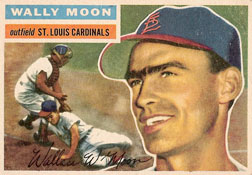
In 1954, Cardinals center fielder Wally Moon batted .304 with 18 stolen bases, had an on-base percentage of .371 and won the National League Rookie of the Year Award.

A left-handed batter, Moon had most of his at-bats from the leadoff or No. 2 spots in the order.
He was part of a 1954 Cardinals team that led the National League in steals (with 63) after having just 18 as a team in 1953.

At 24, Moon took over for Enos Slaughter, who was traded to the Yankees just before the start of the 1954 season. Moon played center field and was flanked by Stan Musial in right and Rip Repulski in left.

Cardinals manager Eddie Stanky, looking for speed and a more aggressive style of play, promised to buy a suit for every St. Louis player who would steal 10 or more bases in 1954.

(According to The Sporting News, National League president Warren Giles later ordered Stanky to stop offering incentives to players for individual performances. Replied Stanky: “I respect authority and I’ll respect Mr. Giles’ wishes, though … I do feel I must live up to the promise to give the prizes for 10 or more stolen bases.”)

Moon was the only Cardinal to reach the goal. With nine steals, third baseman Ray Jablonski fell one short.

On May 25, 1954, Moon swiped four bases in the Cardinals’ 9-4 victory over the Cubs at St. Louis. The National League single-game record at the time was five by first baseman Dan McGann of the 1904 Giants.

With ex-Cardinal Walker Cooper, 39, catching for the Cubs, Moon stole second in the first inning, second in the fourth, and second and third in the fifth. Jim Willis’ pitch on Moon’s steal of third was wild and Moon continued home. Willis was so steamed that he plunked the next batter, Alex Grammas, with a pitch.

In the seventh, Moon flied out. If he had reached base, Stanky said, Moon would have gotten the signal to attempt to steal because Stanky was aware of the record. Boxscore

“I would have given Moon every chance to get that fifth steal,” Stanky told The Sporting News. “He’s a nervy youngster and when he says he’ll have another go at it, I’m sure that he will.”

Moon told reporters he expected to “take another crack one of these days” at the record, but the most steals he ever got in a game after that was two.

Two weeks after his four-steal performance, Moon was reckless rather than savvy on the bases in a game against the Phillies at St. Louis on June 6, 1954.

With the score tied 6-6 in the bottom of the sixth, the Cardinals loaded the bases with two outs and Jablonski at the plate. Moon tried to steal home, but pitcher Bob Miller’s delivery to catcher Smoky Burgess was on time to retire Moon and end the inning.

Stanky, coaching at third, was booed. The fired-up Phillies scored five in the seventh and went on to win, 11-8. Boxscore

Afterward, Stanky told St. Louis writer Bob Broeg, “When things go wrong on the field, it’s my fault. I gave the sign,” but Moon told Broeg he had run on his own.

Moon’s 18 steals in 1954 were the single-season high of his 12-year major-league career. He finished with 89 career steals in the big leagues.

With 17 of 24 votes from the Baseball Writers Association of America, Moon won the Rookie of the Year Award against top-flight competition. The Cubs’ Ernie Banks placed second in the voting (four votes) and the Braves’ Hank Aaron finished fourth (one vote).

Moon had 193 hits in 151 games for the 1954 Cardinals, with 12 home runs, 29 doubles, 71 walks, 76 RBI and 106 runs scored.

(Updated May 24, 2025)

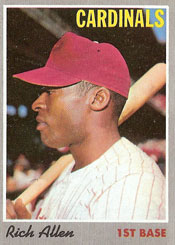
In an era when hitting 30 home runs in a season was an extraordinary feat for a Cardinal, Dick Allen captivated St. Louis fans with his power.

Allen, in his lone season with St. Louis in 1970, was the first player to hit at least 30 homers in his first year with the Cardinals.

Allen was acquired for his power in the October 1969 trade that sent center fielder Curt Flood and catcher Tim McCarver from the Cardinals to the Phillies. Flood refused to report and launched a court challenge against baseball.

Dubbed by syndicated columnist Jim Murray as “the bad boy of baseball,” Allen was suspended by the Phillies during the 1969 season after he failed to show for a doubleheader. He also reported late for games. Murray wrote, “When someone pointed out to his former manager, Gene Mauch, that Richie was a loner, Mauch retorted bitterly, ‘Yeah. He’s fallen in with the wrong crowd.’ ”

Sports Illustrated noted, “He is known as a man who hits a baseball even harder than he hits the bottle.”

Allen was on good behavior from the start with the 1970 Cardinals.

In St. Louis’ Opening Day game, a 7-2 victory over the Expos on April 8, 1970, at Montreal, Allen hit a home run and two doubles, driving in three. Boxscore

He hit 10 home runs in May and nine in July. His jaw-dropping blast at the Reds’ new Riverfront Stadium on July 27 caromed off the facing of the upper deck in left field. Boxscore

Allen ended July with 30 home runs. He became the eighth Cardinal to hit 30 and the first since Ken Boyer in 1960.

“He’s better than any power hitter we’ve had on this club,” Cardinals pitcher Bob Gibson said to the Philadelphia Daily News.

Allen used bats weighing 40 ounces. Jerry Risch, a Cardinals bat boy in 1970, recalled to Cardinals Yearbook in 2004, “He could swing it like a straw, too. No effort … At that time, players used a more moderate bat, ounce-wise, like 34. So 40 ounces was a lot.”

Allen started all but one game of the Cardinals’ first 118, playing mostly at first base. (He also played at third base and in left field.) With 33 home runs, he was on pace to hit 45, according to The Sporting News. The Cardinals’ record was 43 by Johnny Mize in 1940.

However, on Aug. 14, in the second game of a doubleheader against the Giants, Allen pulled a hamstring in his right leg while swiping second base. Boxscore 

He appeared in only five games (three as a pinch-hitter) after the injury.

After at-bats as a pinch-hitter on Aug. 23 and Aug. 25, Allen made his first start in more than three weeks on Sept. 8, the Cardinals’ final appearance of the season at Philadelphia. Batting fourth and playing first base, Allen was 2-for-3 with a walk. In his final at-bat of the game, he hit a home run, his last as a Cardinal, off Rick Wise. Boxscore

With 34 home runs in 122 games, Allen hit the most by a Cardinal since Stan Musial had 35 in 1954. Allen’s total also was the most by a Cardinals right-handed batter since Rogers Hornsby hit 39 in 1925.

The Cardinals wanted Allen to continue receiving treatment on his leg in St. Louis. Allen wanted the work done in Philadelphia. After appearing in a game for the Cardinals at Pittsburgh Sept. 10, he never played in another for St. Louis.

Four days after the Cardinals completed the 1970 season with a 76-86 record, Allen was traded to the Dodgers for second baseman Ted Sizemore and catcher Bob Stinson.

St. Louis general manager Bing Devine told The Sporting News the trade had more to do with the Cardinals’ need for a second baseman to replace aging Julian Javier than it did with unhappiness regarding Allen.

“Allen did everything we could hope for and more,” Devine said. “… If there was any major problem of morale, I was not aware of it and I’m sure I’d have been aware of it if there was. Allen’s a controversial guy and, naturally, if you’re looking to find something wrong about him, you can find it. But I can’t fault him. He was acquired to do a job at bat and on the field, and he did it.”

Said Allen: “I wanted one season that I could play in peace and I sure got to do that. The fans and the ballclub were wonderful. I just wish I could have done a little more to repay them all.”

In his book “Red: A Baseball Life,” Red Schoendienst, the Cardinals’ manager in 1970, said of Allen: “It was hard for right-handed hitters at that time to hit the ball to right-center with any authority, and he could do it. He had a reputation of being a difficult player, but he played hard for me. The only problem I had with him, and it was true throughout his career, is that he never seemed to play the last month of the season. He was always hurt or something was wrong.”

(Updated Sept. 13, 2025)

Entering the 1960 season, Cardinals third baseman Ken Boyer, in the prime of his career at 28, set a goal of hitting 30 home runs that year.

Sparked by a sizzling start, Boyer hit a career-high 32 homers for the 1960 Cardinals. It was one of three times Boyer hit 25 or more home runs in a season for St. Louis. He hit 26 in 1956 and 28 in 1959.

Clete Boyer, Ken’s younger brother, also a third baseman, hit a career-high 26 homers for the 1967 Braves. Ken and Clete Boyer became the first brothers to each hit 25 homers or more in a season in the major leagues, according to the Elias Sports Bureau.

The others to do it are: Aaron Boone and Bret Boone, Justin Upton and Melvin Upton, and Kyle Seager and Corey Seager.

The Seagers are the only big-league brother combination to achieve 25 or more homers apiece in the same season. In 2016, Kyle Seager hit 30 for the Mariners and Corey Seager hit 26 for the Dodgers.

Power plus

Ken Boyer started fast in 1960, hitting six home runs (five against the Dodgers) and driving in 15 runs in his first 15 games. The consensus was he had reached elite status in the National League.

In an interview for the May 4, 1960, edition of The Sporting News, Cardinals manager Solly Hemus said of Boyer, “He can do everything _ run with speed, hit for both power and average, and field with the best. In fact, he’s the best defensive third baseman I’ve ever seen.”

Cardinals general manager Bing Devine called Boyer “one of the top five players in the National League on all-around ability.”

Said Fred Hutchinson, who managed the Cardinals from 1956-58: “(Boyer) has terrific speed, a great arm, brute strength. There’s nothing he can’t do. He’s the kind of player you dream about.”

Boyer hit four homers in a span of three consecutive games April 23-25 in 1960. He hit one each against Dodgers pitchers Danny McDevitt and Larry Sherry on April 23. Boxscore He followed that with a homer against the Dodgers’ Stan Williams on April 24 Boxscore and another against the Giants’ Johnny Antonelli on April 25. Boxscore

A month later, May 25, 1960, Boyer hit a pair of homers against the Braves’ Warren Spahn. Boxscore Boyer hit more homers (11) against Spahn, a Hall of Fame left-hander, than he did against any other pitcher in his career.

The 32 home runs by Boyer in 1960 were the most by a Cardinal since Stan Musial slugged 33 in 1955.

(Boyer told Sport magazine that Musial helped him become a better hitter. “I believe Stan gave me one of the secrets of his great hitting when he corrected my batting grip,” Boyer said. “I used to clench the bat deep in the palms of both hands. Musial’s advice was to grip the bat at the base of the fingers of the top hand. The top or right hand, for a right-handed hitter like me, doesn’t lock when I hold the bat in the fingers rather than in the palm. As a result, the hand rolls over at the point of impact, providing freer wrist action, a better follow-through and more power.”)

Boyer was amazingly consistent. He hit 16 homers at home and 16 on the road in 1960. Sixteen were hit against right-handers and 16 were hit against left-handers.

“It doesn’t really make any difference where’s he’s playing,” Hemus said. “None of his homers are flukes anyway.”

Boyer also hit a home run (a two-run shot in the ninth inning off the Indians’ Gary Bell) in the 1960 All-Star Game at Yankee Stadium. It was one of four National League homers hit in the game. Hall of Famers Eddie Mathews, Willie Mays and Stan Musial hit the others. Boxscore

Boyer finished the 1960 regular season with a .304 batting average, 32 homers, 97 RBI, a .370 on-base percentage and 168 hits in 151 games. He placed fourth in the NL in home runs, behind the Cubs’ Ernie Banks (41), the Braves’ Hank Aaron (40) and the Braves’ Eddie Mathews (39).

All in the family

Ken Boyer and Clete Boyer never played together in the majors. Clete received a $35,000 signing bonus from the Athletics in 1955. He came up to the major leagues with Kansas City that year and played shortstop as well as third base.

“My idol always was Ken,” Clete Boyer told Dave Anderson of the New York Times in 1982. “As a kid, I had always fantasized about us being on the Cardinals together, him at third base and me at shortstop. That would’ve been something, the two of us on the same team, but it never worked out.”

(The Boyer brothers played against one another in the 1964 World Series. Ken hit a game-winning grand slam in Game 4. Ken and Clete each homered in Game 7.)

The 26 homers he hit for Atlanta in 1967 represented the only time Clete Boyer hit 20 or more in a 16-season big-league career.

In a May 11, 1960, article, The Sporting News reported how Clete Boyer signed with the Athletics rather than the Cardinals: “The Redbirds had another bonus shortstop on their hands, Dick Schofield, and preferred to devote their bonus dollars to a pitcher, who turned out to be Lindy McDaniel. Otherwise, Cletis, now just 22, might be joining Ken in a rarity, a left-field side of the infield made up of two brothers.”