Feeds:
Posts
Comments

For the 1977 Cardinals, there was no doubt about who was the most valuable player in the National League that season: Phillies left fielder Greg Luzinski.
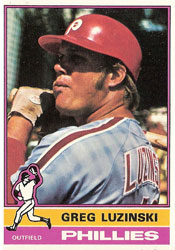
Nicknamed “The Bull” because of his size (6-1, 230 pounds) and power, Luzinski produced one of the most destructive seasons ever against a Cardinals team.

Luzinski’s 1977 performance was referenced recently because of how Pirates third baseman Pedro Alvarez tormented the 2012 Cardinals. With seven home runs and 23 RBI against St. Louis in 2012, Alvarez became the first player to achieve those combinations versus the Cardinals since Luzinski _ and the first Pirates player to do so since left fielder Ralph Kiner in 1950 _ according to the Elias Sports Bureau.

A look at the numbers of that trio against the Cardinals:

PLAYER……………YEAR……..HOMERS……..RBI……..BATTING AVG

Pedro Alvarez……2012……….7…………………..23…….. .397 (23-for-58)

Greg Luzinski……1977……….9…………………..28…….. .351 (20-for-57)

Ralph Kiner………1950………9…………………..23…….. .337 (28-for-83)

In 16 games against the ’77 Cardinals, Luzinski also had seven doubles and nine walks. He posted a .441 on-base percentage and .947 slugging percentage versus St. Louis that year.

Luzinski, 26, did much of his damage against two of the Cardinals’ best pitchers _ Bob Forsch, a 20-game winner in 1977, and Al Hrabosky, St. Louis’ saves leader that year.

Against Forsch, Luzinski hit .467 (7-for-15) with four home runs in 1977. Luzinski was 3-for-4 (.750) with a homer against Hrabosky.

Starter Eric Rasmussen and reliever Butch Metzger were the most effective St. Louis pitchers against Luzinski in 1977. Luzinski was 0-for-10 against Rasmussen and 0-for-5 against Metzger that year. Luzinski was 20-for-42 (.476) against the rest of the 1977 Cardinals staff.

Luzinski had three 5-RBI games against the ’77 Cardinals. The second occurred on July 13 when Luzinski drove in all the Phillies’ runs and hit a pair of homers against Tom Underwood in a 5-2 Philadelphia victory. Underwood had been acquired by the Cardinals from the Phillies a month earlier. Boxscore

“Luzinski is the best two-out hitter in baseball,” Underwood said to the Associated Press. “He never misses a down-and-in pitch. I’m not the first guy he’s going to hit home runs off and certainly not the last. I made two bad pitches and I paid for it.”

Luzinski’s first homer off Underwood went 450 feet to “The Bull Ring,” a section of the left-field stands at Philadelphia’s Veterans Stadium that seated youngsters who were provided tickets by Luzinski.

Luzinski, who had signed a five-year, $1.5-million contract, bought 126 loge box seats for each of 36 Phillies home games and gave all of the tickets to youngsters from organizations such as the Salvation Army and the Big Brothers Association. Each ticket cost $4.50, so Luzinski paid $20,412, with no discount from the Phillies, both The Sporting News and Associated Press reported.

Luzinski also provided autographed pictures of himself to every youngster in “The Bull Ring” and he donated $100 to the organization in that section any night a Phillies home run landed there.

“There are many children who have never had box seats and I want to give some of them a chance to sit there and see how much fun it can be just to go to a baseball game at the Vet,” Luzinski said to The Sporting News.

In a three-game Phillies sweep of the Cardinals Sept. 9-11, 1977, Luzinski drove in eight runs and hit a home run apiece off Hrabosky, John Urrea and John Sutton. Afterward, the soft-spoken slugger surprised reporters when he told them he deserved to win the NL Most Valuable Player Award for his overall 1977 performance.

“I’ve had a hell of a season,” Luzinski said to the Associated Press. “… I’ve been consistent all year. That’s the key.”

Cardinals manager Vern Rapp agreed Luzinski would be the best choice for NL MVP. “What Luzinski has done proves he is the most valuable … Luzinski has always delivered when it meant something toward the ballclub winning,” Rapp said.

Luzinski finished the season with 39 homers, 130 RBI, a .309 batting average, a .394 on-base percentage and a .594 slugging percentage, leading the Phillies to their second consecutive NL East title.

But another left fielder, George Foster, playing for the second-place Reds of the NL West, was voted the NL MVP Award by the Baseball Writers Association of America. Foster received 291 total points and 15 first-place votes; Luzinski had 255 total points and 9 first-place votes.

Though the Reds finished 10 games behind the NL West-champion Dodgers, Foster had better statistics than Luzinski: 52 homers, 149 RBI, a .320 batting average, a .382 on-base percentage and a .631 slugging percentage.

“The way I figure it out we couldn’t win without The Bull,” Phillies catcher Tim McCarver said to The Sporting News, in explaining why Luzinski deserved the award. “And I think the Reds could have finished second without George Foster.”

Countered Reds second baseman Joe Morgan, who had won the award in both 1975 and ’76: “There’s really no comparison. If Foster replaced Luzinski in the Phillies lineup, they’d win by 20 games. George has done better in every offensive category and is a far better defensive player than Greg.”

Previously: Cardinals helped Joe Lis look like all-star
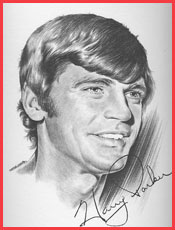
Harry Parker seemed a good fit for the Cardinals in their first amateur draft in 1965.

A standout in baseball, basketball and cross country at Collinsville (Ill.) High School near St. Louis, Parker, a right-handed pitcher, was the fourth-round choice of the Cardinals.

He became the most successful big-league player taken by St. Louis in that draft. Most of that success came with the Mets instead of the Cardinals.

Though he wasn’t a star, Parker was successful in the Cardinals’ system, made his big-league debut with St. Louis and pitched in a World Series for the Mets in 1973.

Before 1965, amateurs could sign with any big-league organizations of their choosing. When the major leagues instituted the draft, the Cardinals were selecting as the defending World Series champions.

Their first three selections _ pitcher Joe DiFabio, first baseman Terry Milani and outfielder Billy Wolff _ never made it to the big leagues. The fourth choice was Parker.

Signed by Cardinals scout Joe Monahan, Parker led the Collinsville baseball team in wins in three consecutive seasons and was named the team’s most valuable player his senior year. He and his younger brother, Tom, also played basketball, helping Collinsville to a state championship. Tom went on to a standout basketball career at the University of Kentucky.

Parker pitched well in the Cardinals’ system. He was 12-5 with a 2.80 ERA for a 1967 Class A Modesto team managed by Sparky Anderson. In 1970, Parker was 8-6 with a 3.59 ERA for manager Warren Spahn’s Class AAA Tulsa club.

The Cardinals promoted him to the big leagues in August 1970. On Aug. 8, Parker debuted against the Expos at St. Louis. He walked seven and yielded six runs in 5.1 innings. Boxscore

“If (Parker) was a bit nervous,” The Sporting News reported, “it was understandable. He probably was the first pitcher to make his major-league debut a few hours before his high school class reunion.”

Parker’s hitting may have been more noteworthy than his pitching that day. On the first big-league pitch thrown to him, Parker singled to right off Mike Marshall.

Three days later, Aug. 11, Parker earned the only win of his Cardinals career in a game that became part of franchise lore.

The Padres led 8-6 when Parker relieved in the top of the ninth. With two outs, he yielded a two-run single to third baseman Ed Spiezio, a former Cardinal, extending San Diego’s lead to 10-6.

In the bottom half of the inning, the Cardinals mounted a comeback against relievers Ron Willis (another ex-Cardinal) and Ron Herbel. After scoring a run, St. Louis had the bases loaded with two outs when Carl Taylor, batting for Parker, hit a grand slam off Herbel, handing Parker the win. Boxscore

Parker was 1-1 with a 3.22 ERA in seven games for the 1970 Cardinals. He spent most of the 1971 season at Tulsa (11-12, 3.70 ERA) and appeared in four games (0-0, 7.20 ERA) for St. Louis that year.

In October, a day after the Pirates won the 1971 World Series title, the Cardinals traded Parker, pitcher Chuck Taylor, outfielder Jim Beauchamp and infielder Chip Coulter to the Mets for pitchers Jim Bibby, Rich Folkers and Charlie Hudson and outfielder Art Shamsky.

Parker had his best big-league season for the 1973 National League champion Mets. He was 8-4 with a 3.35 ERA in 38 games.

Parker beat the Cardinals twice in relief that season. Those wins were huge, considering the Cardinals finished 1.5 games behind the Mets in the NL East. Parker got the win with three shutout innings of relief in the Mets’ 10-3 victory over the Cardinals on Aug. 6. Boxscore He beat the Cardinals again with four shutout innings of relief in the Mets’ 5-2 victory on Sept. 23, dropping St. Louis three games behind New York. Boxscore

In the 1973 World Series, Parker pitched in three games against the Athletics and was the losing pitcher in Game 3. In the 11th inning, second baseman Ted Kubiak (a former Cardinal) walked and advanced on catcher Jerry Grote’s passed ball. Shortstop Bert Campaneris singled, scoring Kubiak and giving Oakland a 3-2 victory. Boxscore

Two years later, Aug. 4, 1975, the Cardinals reacquired Parker on waivers from the Mets. “My arm is well again,” Parker told The Sporting News. “I had a shoulder problem that I pitched with all of 1974.”

Parker was 0-1 with a 6.27 ERA in 14 games for the 1975 Cardinals. When it became apparent he hadn’t won a spot in the bullpen the following spring, the Cardinals traded Parker to the Indians for pitcher Roric Harrison on April 7, 1976.

In three seasons with the Cardinals, Parker was 1-2 with a 4.89 ERA in 25 games. In his six years in the majors, Parker had a regular-season mark of 15-21 with a 3.85 ERA.

(Updated Oct. 7, 2020)

Bob Gibson and Sandy Koufax were scheduled to start against one another in a September 1962 showdown of two of the premier pitchers of the era.

The matchup never materialized.

Gibson broke his leg before the game and Koufax was knocked out without completing an inning.
The unlikely standout that night: Cardinals right fielder Charlie James.

On Sept. 21, 1962, at St. Louis, Koufax was making his first start in more than two months. The Dodgers left-hander had been sidelined because of an injured pitching hand. News reports called it a circulatory problem in the index finger of his left hand. The injury was much more serious _ a crushed artery in the palm of his hand, according to Jane Leavy in her book “Sandy Koufax: A Lefty’s Legacy.”

Though, Leavy reported, the hand injury had bothered Koufax since April (by July, the tissue was close to gangrene, she wrote), he entered the September start against St. Louis with a 14-5 record and 2.15 ERA.

Gibson was 15-13 with a 2.85 ERA. The Cardinals right-hander had lost his last four consecutive decisions and was looking to finish on a high note in his final three starts of the 1962 season, beginning with the Friday night game against the Dodgers.

Trouble occurred before the game started.

Wearing new spikes, Gibson participated in batting practice. Turning away sharply from a pitch, his spikes caught in the ground and he toppled over in pain, The Sporting News reported. Gibson fractured a bone above his right ankle and his leg was placed in a cast.

“It sounded just like a twig snapping,” Gibson told The Sporting News. “I could hear it and feel it tear.”

Gibson was replaced by Curt Simmons, a left-hander who had made one start since late August.

Koufax, meanwhile, was making his first appearance since a one-inning start July 17 at Cincinnati.

Relying mostly on fastballs against the Cardinals, Koufax walked the first two batters, Julian Javier and Curt Flood.

When Stan Musial struck out looking and Ken Boyer flied out to left, it appeared Koufax had found his groove, but he walked Bill White, loading the bases.

That brought to the plate James, a right-handed batter with a .277 average. James hadn’t hit a home run or driven in a run all month.

With the count 2-and-2, Koufax was a strike away from getting out of the jam. The next delivery was high and away. James swung and launched a shot onto the pavilion roof in right for a grand slam.

In a six-year big-league career, James hit 29 home runs. His only grand slam was the one off Koufax. James told New York Times columnist Arthur Daley the grand slam “gave me the most personal satisfaction and the most surprise” of any home run he hit.

“I was merely trying to meet the ball and was astonished to see it land on the roof in right field,” James said.

Years later, James told the St. Louis Post-Dispatch, “You couldn’t hit Koufax’s 100 mph fastball, but if the ball started at the knees, it would rise to belt high by the time it got to the plate. That was the only way you could hit it.”

Koufax walked the next batter, Gene Oliver, and was relieved by Ed Roebuck.

“If he had got out of that first inning,” Dodgers manager Walter Alston said about Koufax, “no telling how long he might have gone.”

Asked whether the left index finger still bothered him, Koufax replied, “My finger doesn’t feel 100 percent … but it does feel as good as it did the two or three games before I went under the doctor’s care.”

The Cardinals won, 11-2. Boxscore

Two years later, April 22, 1964, James hit another first-inning home run off Koufax, a three-run shot in a 7-6 Cardinals victory. Boxscore

In a 12-year big-league career, Koufax yielded 204 home runs, including six grand slams.

In 1987, as the baseball Cardinals headed toward the National League championship, the football Cardinals opened their last season in St. Louis.

Both franchises received spectacular years from players named Smith.

Ozzie Smith batted a team-high .303 with 40 doubles and 43 stolen bases, leading the baseball Cardinals to the 1987 pennant, their third in six years. Smith also led NL shortstops in fielding percentage (.987) and won a Gold Glove Award.

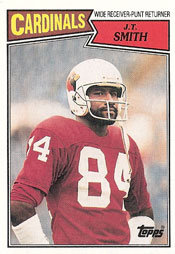
Wide receiver J.T. Smith led the NFL in receptions (91) and receiving yards (1,117) and was third in touchdown catches (eight), helping the football Cardinals showcase one of the most potent attacks during the 1987 season.

Coached by Gene Stallings, the 1987 football Cardinals averaged 24.1 points per game, allowed an average of 24.5 points per game and finished 7-8 (tied with the Cowboys and Eagles for second place in the NFC East) before moving to Arizona the following year.

J.T. Smith, quarterback Neil Lomax and running back Stump Mitchell made the 1987 football Cardinals an entertaining, if not a championship-caliber, club. Lomax led the NFL in passing yards (3,387) and completions (275) and was third in touchdown passes (24). Mitchell rushed for 781 yards and made 45 receptions.

On Sept. 13, 1987, while David Cone and the Mets were beating the baseball Cardinals, 4-2, at Shea Stadium to move within 2.5 games of first-place St. Louis in the NL East, the football Cardinals opened the regular season with a 24-13 victory over the Cowboys at Busch Stadium.

Lomax threw a pair of touchdown tosses to wide receiver Roy Green, and a defense led by ends Freddie Joe Nunn and Curtis Greer held to one touchdown a fearsome Dallas offense that featured quarterback Danny White and running backs Herschel Walker and Tony Dorsett. It was the first time Lomax and Green had combined for more than one touchdown pass since 1984, The Sporting News reported. Boxscore

The football Cardinals split their first four games, then lost three in a row. They spent the rest of the season trying to get back to the .500 mark while reports circulated that team owner Bill Bidwill was looking to shift the franchise to Phoenix, Baltimore or Jacksonville.

On Dec. 13, 1987, two months after the baseball Cardinals defeated the San Francisco Giants in Game 7 of the NL Championship Series, the football Cardinals defeated the New York Giants, 27-24, in their home finale before 29,623.

Vai Sikahema returned a punt 76 yards for a touchdown, sparking the Cardinals to a 27-10 lead against a Giants team coached by Bill Parcells and defensive coordinator Bill Belichick and featuring quarterback Phil Simms.

Mitchell rushed for 111 yards, the first time since 1985 a running back (Eric Dickerson) had gained 100 yards against the Giants. “Our offensive line just knocked them around,” Lomax said. Boxscore

Bidwill was unhappy with the 54,000-seat capacity of Busch Memorial Stadium and, according to The Sporting News, was “investigating the possibility of moving while local businessmen were preparing a final proposal aimed at convincing him to stay.”

Two weeks later, on Dec. 27, 1987, the St. Louis football Cardinals played their last game. The Cowboys beat them, 21-16, at Dallas behind two touchdown runs by Walker. Boxscore

In mid-January, Bidwill said he was moving the franchise to Phoenix, ending the football Cardinals’ 28-year stay in St. Louis.


Joe Frazier was a bit of a late bloomer who developed into a productive left-handed pinch-hitter as a Cardinals rookie.

Frazier had 15 pinch-hit RBI as a Cardinals rookie in 1954.
In 1947, Frazier made his big-league debut, hitting .071 (1-for-14) in nine games for the Indians.

Frazier didn’t return to the major leagues until seven years later when he made the Opening Day roster of the 1954 Cardinals as a 31-year-old rookie outfielder.

Frazier had caught the attention of the Cardinals while tearing up the Class AA Texas League for Oklahoma City in 1953. Frazier earned the Texas League batting title with a .332 average, slugged 55 doubles and 22 home runs and had 113 RBI.

In October 1953, the Cardinals sent catcher Les Fusselman and cash to Oklahoma City to acquire Frazier. In assessing Frazier, Cardinals scout Joe Mathes told St. Louis journalist Bob Broeg, “Of this I’m certain _ he’s a major-league hitter.”

During spring training in 1954, Cardinals manager Eddie Stanky became impressed by rookie outfielders Frazier, Wally Moon and Tom Burgess. Stanky told reporters Frazier might beat out the venerable Enos Slaughter, soon to turn 38, for the starting right field job.

After the Cardinals left their Florida spring training camp and barnstormed their way back to St. Louis, Broeg filed this report on Frazier for The Sporting News:

Frazier … does not have the speed or outfielding skill of a Slaughter or Wally Moon. But the sturdy slugger has tremendous power that was reflected in long outs in spacious Florida parks before he began to find the range en route home in stadiums of major-league dimensions, hitting two homers April 1 at Birmingham against the White Sox and another two days later at Houston.

“I consider him a left-handed (Ray) Jablonski, a hitter of courage who thrives on men-on-base situations,” said Stanky.

Opting to begin the season with all three rookie outfielders on the roster, along with starters Stan Musial and Rip Repulski, the Cardinals traded Slaughter to the Yankees in April. “It’s the greatest shock I ever had in my life,” Slaughter said to The Sporting News.

The Cardinals’ outfield was Musial in left, Moon in center and Repulski in right, with Frazier and Burgess in reserve.

Frazier excelled as a pinch-hitter and was used primarily in that role. He ripped a two-run pinch-hit homer off the Phillies’ Robin Roberts on May 5. From July 5 through July 24, Frazier had six hits and a walk in eight pinch-hit appearances.

One of Frazier’s hits in that stretch was a two-run walkoff homer in the ninth off the Cubs’ Bob Rush, lifting St. Louis to a 2-1 victory on July 10. Frazier’s blast struck the screen on the pole above the pavilion roof at Busch Stadium. Boxscore

On Aug. 17, Frazier delivered a three-run pinch-hit homer in the seventh off Jim Wilson, leading the Cardinals to a 4-1 victory over the Braves at Milwaukee. The 385-foot shot into the right-field bleachers sealed Wilson’s first loss after eight consecutive wins and snapped the Braves’ nine-game winning streak. Boxscore

Frazier finished the 1954 season with 20 hits as a pinch-hitter _ two shy of tying the big-league mark of 22 established by Sam Leslie of the 1932 Giants. Frazier’s batting average as a pinch-hitter that season was .323, with 15 RBI. Overall, Frazier batted .295 (26-for-88) for the 1954 Cardinals.

Frazier played for the Cardinals in 1955, but hit .200 in 58 games. In May 1956, St. Louis traded Frazier and shortstop Alex Grammas to the Reds for outfielder Chuck Harmon. Frazier finished his big-league playing career that year with the Orioles.

After a stint as a minor-league manager, Frazier was named manager of the Mets in 1976. He led New York to an 86-76 record that year, but when the 1977 Mets stumbled to a 15-30 start, Frazier was replaced by another ex-Cardinal, Joe Torre.

Previously: 1956 Cardinals groomed nine big-league managers

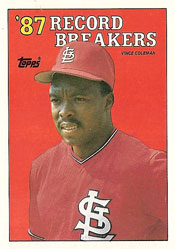
In 1987, Vince Coleman established a major-league stolen base record. He also achieved a personal goal with one powerful swing of the bat.

On Aug. 26, 1987, Coleman hit a home run over an outfield wall for the first time in three seasons with the Cardinals. He had logged 1,721 at-bats without hitting a ball out of the park, according to The Sporting News.

(Coleman had hit an inside-the-park home run on May 21, 1985, his rookie year, against the Braves’ Len Barker at St. Louis. Boxscore and video.)

Facing Astros left-hander Jim Deshaies, Coleman drove an opposite-field home run over the right field gate at St. Louis’ Busch Memorial Stadium. The fifth-inning solo shot was estimated to carry 386 feet.

“It’s a lot of fun to do it,” Coleman said to the Associated Press. “I had confidence in my ability that I’d hit at least one. I feel awfully proud.”

It was Coleman’s speed, though, that won that game for St. Louis.

With the score tied 4-4, Coleman doubled against reliever Juan Agosto leading off the seventh and moved to third on Ozzie Smith’s sacrifice bunt.

The next batter, Tommy Herr, grounded to shortstop Dale Berra, who looked toward Coleman, then threw to first to retire Herr. When Berra unleashed his throw, Coleman dashed for home. He slid across the plate with the winning run, beating the peg from startled first baseman Glenn Davis. Boxscore

“That last piece of baserunning was a beauty,” Cardinals manager Whitey Herzog said. “Really, it turned out bigger than the home run.”

Said Berra: “I went to fake him back to third and then I threw. That’s the first time that’s ever happened to me.”

Coleman finished the 1987 regular season with three home runs. He hit 28, three against Deshaies, in a 13-year major-league career. His single-season high was six for the 1990 Cardinals.

Most impressively, Coleman totaled 109 stolen bases during the 1987 regular season, becoming the first major-league player to swipe 100 or more in three consecutive years. He had 110 in 1985 and 107 in 1986.

“I think 100 stolen bases is a hell of an accomplishment,” Coleman said. “MVP honors are presented to the big home run hitters. I just get my personal satisfaction out of stealing bases and hope that I get compensated for it.”