Feeds:
Posts
Comments

For a player who spent all 18 of his big-league seasons in the American League, outfielder Johnny Damon had his share of memorable performances against the Cardinals, including a home run to lead off Game 4 in the historic sweep of the 2004 World Series by the Red Sox.
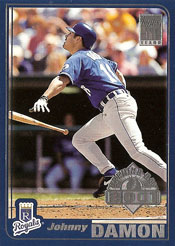
Yet it was an incident that occurred in 1997, in Damon’s first regular-season series against St. Louis, that may be what many Cardinals fans will most remember about him.

Damon, 38, was released in August 2012 by the Indians, two months after his two-run home run off reliever Maikel Cleto helped Cleveland to a 6-2 victory at St. Louis on June 8, 2012. A left-handed batter with more than 2,700 big-league hits, Damon may be facing the end of his major-league playing career.

He excelled against the Cardinals, batting .330 (31-for-94) with 18 runs in 23 regular-season games. Damon also hit .286 (6-for-21) against them in the 2004 World Series.

From the start, he was a fiery combatant when facing St. Louis. In August 1997, the Cardinals played the Royals in the regular season for the first time. The Cardinals won the opener of the three-game weekend series at Kansas City.

The next night, a Saturday, Aug. 30, the Royals pounded starter Manny Aybar and reliever Mark Petkovsek. When right fielder Jermaine Dye hit a grand slam off Petkovsek in the fourth inning, it increased the Royals’ lead to 14-1.

The next batter was Damon. Petkovsek’s first pitch to him hit Damon in the ankle. Damon charged the mound. He grabbed Petkovsek in a headlock and they tumbled to the ground.

Both benches and both bullpens emptied. During the next five minutes, the Associated Press reported, “play was halted as players wrestled and jostled, screamed and postured.”

Cardinals pitcher Andy Benes went after Tim Belcher and tore the front of the Royals starter’s jersey. Royals bench coach Jamie Quirk and Cardinals pitching coach Dave Duncan wrestled one another to the ground, the Associated Press reported.

Damon and Petkovsek were ejected. Two innings later, Belcher hit St. Louis right fielder Phil Plantier in the hip with a pitch.

There were no serious injuries, but there was plenty of huffing and puffing in the clubhouse after the Royals’ 16-5 victory. Boxscore

“The guys in red versus the guys in blue. Or was it the Bloods versus the Crips?” Chili Davis, the Royals’ designated hitter, said to the Lawrence Journal-World.

Said Damon: “I kind of thought he’d throw at me. I did what I had to do.”

An incredulous Cardinals manager Tony La Russa told the Lawrence newspaper, “Hitting the guy on the ankle? With a sinker? Are you kidding?”

Said Petkovsek: “I was just trying to throw a fastball inside. I was surprised he came out there.”

Asked whether hitting Plantier with a pitch was retaliation, Belcher said, “I was pitching him in all night.”

The Kansas City Star and St. Louis Post-Dispatch gave heavyweight treatment to the melee.

_ La Velle Neal of the Star: Basebrawl broke out at Kauffman Stadium Saturday night.

_ Dick Kaegel of the Star: Now it’s absolutely official. This Royals-Cardinals thing is a rivalry. The boys got down and dirty Saturday night.

_ Rick Hummel of the Post-Dispatch: Emotions already were running reasonably high for this first interleague meeting between the Cardinals and Kansas City Royals. But, in a tumultuous fourth inning Saturday, they reached fever pitch.

Not all bought into the notion the series had created bad blood between Missouri’s major-league teams. Said Royals catcher Mike Macfarlane to the Lawrence Journal-World: “How can there be bad blood? We’ve only played them twice.”

Damon was in the lineup, batting leadoff, the next afternoon, Aug. 31. He struck out three times, including in the ninth inning when he batted with two on and one out against closer Dennis Eckersley. Cardinals pitchers hit two batters and St. Louis won, 5-4.

Previously: Cardinals were Royals’ first opponent in Kansas City
(Updated Jan. 30, 2023)

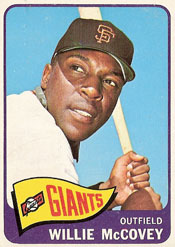
Before Mark McGwire, who played for the Cardinals from 1997-2001, another Big Mac, Willie McCovey of the Giants, hit the longest home run seen in St. Louis.

Cardinals broadcaster Mike Shannon has said the longest home run he has witnessed was hit by McCovey on Sept. 4, 1966, at St. Louis.
Leading off the third inning against Cardinals starter Al Jackson, McCovey hit a changeup that landed in the upper deck above the scoreboard in right-center field at Busch Memorial Stadium. The ballpark opened four months earlier, in May 1966.

Shannon was playing right field for the Cardinals that day and “had a good look” at McCovey’s home run. Shannon said he later asked McCovey (who had 521 career home runs in the major leagues) whether it was the longest ball he’d hit. “I don’t know if it was the longest,” Shannon said McCovey replied, “but it was the hardest.” Boxscore

Cardinals catcher Tim McCarver told writer Roger Angell of The New Yorker magazine, “There’s no doubt in my mind about this. It was as if McCovey had hit it off a tee. It caromed off the upper part of the scoreboard and bounced back onto the field.”

The book “Baseball’s Ultimate Power: Ranking the All-Time Greatest Distance Home Run” had this description of McCovey’s St. Louis home run: “The ball was struck on a line drive trajectory that resulted in a 515-foot journey.”

The Cardinals’ 2005 Busch Stadium commemorative yearbook said many who witnessed McCovey’s blast will continue to regard it as the longest home run in that stadium’s history. “That may be the farthest hit anywhere,” Shannon said. “I’ll never forget it as long as I live.”

In the first inning, with the Cardinals using an infield shift against the left-handed slugger, McCovey bunted for a single. Asked by Jack Hanley of The San Mateo Times whether he got more pleasure from the bunt or from the mammoth home run, McCovey replied, “The more I think about it, the more I’m becoming convinced I get a bigger kick out of the bunt. It’s because, when you do the unexpected, the other fellow is completely surprised and it’s a trifle upsetting. The bunt can win a ballgame as much as a homer.”

(On Sept. 16, 1966, 12 days after his shot in St. Louis, McCovey hit a 505-foot home run off Mets starter Jack Fisher at San Francisco’s Candlestick Park. It’s the longest home run hit at that stadium, according to the San Francisco Examiner. Boxscore)

Until McGwire arrived, Pirates first baseman Willie Stargell came closest to challenging McCovey’s home run for longest hit at Busch Memorial Stadium. On July 4, 1979, Stargell hit a slider from reliever Darold Knowles 510 feet, above and to the right of the scoreboard. Boxscore

“That’s the longest home run I’ve ever seen hit in this ballpark by a left-hander,” Cardinals first baseman Keith Hernandez said to the Associated Press.

Said Stargell: “When I saw it go out, I saw (Knowles) flinging something like his cap. He was disgusted. It was a ball that Darold, I’m sure, got in an area he didn’t want. It was a nice, easy swing. I had no idea it was going that far.”

Nineteen years after Stargell’s shot, McGwire hit what officially is called the longest home run at Busch Memorial Stadium. The 545-foot home run on May 16, 1998, against the Marlins’ Livan Hernandez hit the St. Louis Post-Dispatch sign in center field. For the remainder of the season, a giant Band-Aid marked the spot where the ball dented the sign. Boxscore

“It’s the best ball I’ve ever hit,” McGwire said. “I don’t think I can hit one better than that.”

In 2012, the Cardinals shut out the Cubs in consecutive games at St. Louis.

Those were the Cardinals’ first back-to-back shutouts of the Cubs in 23 years.

Spurred by an explosion of power hitting, the 2012 Cardinals beat the Cubs, 12-0, on July 21 and won again, 7-0, on July 22.

Jake Westbrook pitched seven scoreless innings July 21 and relievers Barret Browning, Victor Marte and Trevor Rosenthal completed the shutout. Lance Lynn pitched six scoreless innings July 22 and combined with relievers Fernando Salas and Marc Rzepczynski for the second consecutive shutout.

In 1989, the Cardinals’ back-to-back shutouts of the Cubs occurred in Chicago.

On June 9, 1989, a 15-mph wind came out of the northwest at Wrigley Field, meaning it was blowing toward the batters. Facing Scott Sanderson, the Cardinals scored in the first inning on back-to-back two-out doubles by Ozzie Smith and Pedro Guerrero.

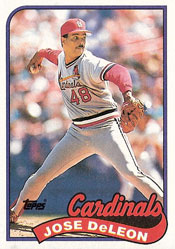
Cardinals starter Jose DeLeon made the run hold up. He limited the Cubs to three hits and struck out 10 in eight innings. In the ninth, Ken Dayley relieved, recorded an out and yielded a single to Damon Berryhill. Todd Worrell came in and retired the next two batters for the save in the Cardinals’ 1-0 victory. Boxscore

“It makes a big difference when the wind is blowing in,” DeLeon said to the Associated Press. “My breaking ball is a lot better when the wind is blowing in.”

Cubs manager Don Zimmer said DeLeon “was outstanding. Over the last two years, he’s the most improved pitcher I’ve seen in the big leagues.”

The next day, June 10, Joe Magrane pitched a complete-game shutout, Tony Pena drove in three runs and St. Louis won, 6-0. Magrane struck out nine, including Ryne Sandberg twice. Boxscore

“I wouldn’t trade (Magrane) for any pitcher in the league, except maybe (Doc) Gooden,” Cardinals manager Whitey Herzog told The Sporting News.

DeLeon (16-12, 3.05 ERA, three shutouts) and Magrane (18-9, 2.91 ERA, three shutouts) had successful seasons for the 1989 Cardinals, but the Cubs won the division title, finishing seven games ahead of St. Louis.

Previously: Cardinals have strong link to Mets’ 50-year anniversary

(Updated July 25, 2020)

Mel Ott, the left-handed Giants slugger who five times led the National League in home runs during the 1930s, was one of the boyhood favorites of Stan Musial.

Musial, in turn, was one of the boyhood idols of Dodgers pitcher Don Drysdale.
When Musial surpassed Ott as the NL career leader in RBI by hitting a two-run home run against Drysdale on July 25, 1962, at St. Louis, it was a feat with special meaning for the Cardinals standout.

Musial broke Ott’s NL RBI record of 1,860.

In 2020, Hank Aaron is the major-league career leader in RBI at 2,297. Aaron also is the all-time NL leader at 2,202. Barry Bonds rates second in career NL RBI (1,996), 45 ahead of Musial (1,951).

Musial, 41, had a splendid season for the Cardinals in 1962. He was batting .351 entering the game against Drysdale and the Dodgers at Busch Stadium. “Small wonder that the Polish boy from Donora, Pa., earns more than most bank presidents,” the Los Angeles Times noted.

A winner of his last seven decisions, Drysdale entered the game with a 17-4 record and 2.90 ERA.

In the sixth inning, the Dodgers led, 2-0, when Musial faced Drysdale with Bill White on first. Drysdale’s first pitch to Musial was a fastball, low and away. Musial swung and launched a drive that bounced off the right-field light tower, about 85 feet above the playing field, the Associated Press reported. The ball ricocheted back onto the field and was retrieved by umpire Ed Vargo, who gave it to Cardinals trainer Bob Bauman for safekeeping. Boxscore

“Not many balls have been hit harder off me,” Drysdale told the St. Louis Post-Dispatch. “If the light tower hadn’t stopped the ball, they’d have a tough time measuring the distance. The ball would have gone right through Hurricane Esther.”

The two RBI gave Musial 1,862, moving him ahead of Ott (who had driven in his last run in 1946) for the all-time NL lead.

In his book “Stan Musial: The Man’s Own Story,” Musial said, “Ottie, one of my early idols, was a class guy as well as a great player and I’m glad I had the chance to play against him. I liked his mannerisms and his manners.”

Drysdale congratulated Musial in the Cardinals clubhouse and told reporters Musial was his boyhood idol. Drysdale was 5 years old when Musial got his first major-league RBI in his debut game on Sept. 17, 1941.

“We didn’t have big-league baseball in California when I was growing up,” Drysdale said to the Post-Dispatch. “So I’d pick up the paper and look at the box scores. If Stan didn’t get at least one hit, I was unhappy.”

Replied Musial: “I’m glad I broke the record against a tough pitcher.”

Musial said Drysdale “has a real good sinker, his control is all right and he can strike out a man when he has to.”

Drysdale, like Musial, was inducted into the National Baseball Hall of Fame. Musial batted .324 (22-for-68) against Drysdale, but the hit that gave him the career NL RBI lead was his lone career home run off the dominating Dodger.

Be careful not to tip your pitches and don’t let a blowout loss keep you down.

Those were among the lessons learned by the 1961 Cardinals after a humiliating loss to the Pirates.

The Pirates beat the Cardinals, 19-0, on Aug. 3, 1961, at St. Louis. It’s the most lopsided shutout loss in Cardinals history. Until then, the only other National League game decided by a 19-0 score was the Cubs’ victory over the Giants on June 7, 1906, according to The Sporting News.
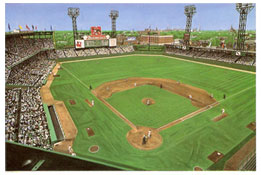
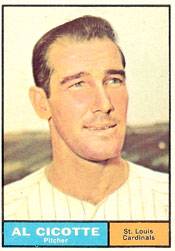
Pittsburgh had 24 hits against three Cardinals right-handers: Al Cicotte, Bob Miller and Lindy McDaniel. Each of the nine Pirates in the starting lineup, including pitcher Harvey Haddix, had at least one hit.

“Some of our pitchers were tipping their pitches,” Cardinals manager Johnny Keane said to the Associated Press. “We were watching them closely after (the Pirates) got a big lead and we could call almost every pitch. Maybe the Pirates could, too.”

Cicotte, making the last start of a five-year big-league career, yielded eight runs in two innings. Miller gave up nine runs in three innings. McDaniel surrendered two runs, but shut out the Pirates over the last three innings.

Among the most notable Pittsburgh hitting achievements that Thursday night at Busch Stadium:

_ Roberto Clemente had hits in each of his first five at-bats. He finished 5-for-6, improving his league-leading batting average to .366, 24 points higher than the next-best hitter, Frank Robinson of the Reds.

“This is just one of those years when the balls are falling in for hits,” Clemente said. “I’m less tense this season than ever before. I can relax better at the plate.”

_ Smoky Burgess had two home runs (both off Cicotte) and six RBI. The homers were the first by Burgess since June 22.

“This is the first time in almost six weeks I’ve been able to pull the ball,” Burgess said. “I know now I tried to play too soon after I hurt my finger late in June. Everything is fine now.”

_ Dick Stuart hit a grand slam off Miller and finished with five RBI.

_ Bill Mazeroski, the eighth-place batter, had four hits.

_ Three Pirates, Don Hoak, Bill Virdon and Bob Skinner, each had three hits. All of Skinner’s hits were doubles.

Pittsburgh, the defending World Series champion, broke a five-game losing streak with the victory. Boxscore

“I can’t help thinking we’d be in the first division if you could spread those runs around a little,” Pirates manager Danny Murtaugh said.

The loss dropped the Cardinals to 48-53.

In a classic example of the power of perserverance, the Cardinals followed the blowout loss with an eight-game winning streak, turning around their season. The Cardinals were 20-9 in August and finished the season at 80-74.

Among the wins in that streak: a shutout of Pittsburgh. On Aug. 9, six days after the Pirates scored 19, Curt Simmons and Ed Bauta combined for a seven-hitter in St. Louis’ 4-0 victory.

The Cardinals collected a club-record 13 doubles in a game against the Cubs, but were aided by unusual circumstances.

On July 12, 1931, the first-place Cardinals played the Cubs in a Sunday doubleheader at Sportsman’s Park in St. Louis. The Cubs’ player-manager was former Cardinals standout Rogers Hornsby.

“The park, with fewer than 35,000 seats, was inadequate to accommodate all who wanted to see the struggle,” The Sporting News reported, “and shortly after daybreak the eager customers began to arrive at the park. The gates were opened at 9 o’clock and long before noon every unreserved seat in the park was occupied and the spectators were standing in the aisles.”

With insufficient security to manage the growing wave of arrivals, ballpark and team officials lost control of the situation and spectators pressed toward the outfield gates in confusion.

“When the gates in the bleacher and pavilion walls were opened, the customers avalanched out into the field like invading hordes,” The Sporting News reported. “There were no police or guards to herd them into position and they spilled all over the field. An attempt was made to herd the fans back to the walls, but it was hopeless.”

According to the Associated Press, “Umpires appealed to the crowd to move back. Finally, a police detail arrived and aided in the work.”

The opener of the doubleheader began with thousands of people standing in the outfield. The overflow, according to The Sporting News, was deepest in right field “about 70 feet beyond first base and extending through center field, not more than 150 feet back of second base and across over (to) the left foul line, perhaps 100 feet beyond third base.”

Official attendance was 45,715. That exceeded by 7,419 the previous regular-season record crowd for a Cardinals home date (against the Giants on May 20, 1928).

The doubleheader was played, The Sporting News opined, “under unspeakable conditions.”

Uncatchable balls hit into the outfield crowd were declared ground-rule doubles.

The Cubs won the opener, 7-5, overcoming a 3-2 Cardinals lead by scoring five runs in the seventh, three on Hack Wilson’s home run off Bill Hallahan. The Cubs hit five doubles; the Cardinals, four.

“Conditions for that first game were bad enough, but they were excellent compared to those that prevailed during the second contest,” The Sporting News reported.

The Cardinals and Cubs combined for 23 doubles in the second game, and the Cardinals won, 17-13.

All of the doubles were official, though most were tainted.

“Pop flies that good infielders could have caught dropped in the crowd for doubles and the two games were more like county fair exhibitions than major league contests,” The Sporting News reported. “In the two games, there were 32 doubles and perhaps six of the two-baggers were legitimate.”

Seven players accounted for the Cardinals’ 13 doubles in Game 2. Rip Collins and Gus Mancuso hit three apiece. Chick Hafey and Frankie Frisch each hit two. George Watkins, Andy High and Ernie Orsatti contributed one each.

The Cubs got doubles from Woody English and Gabby Hartnett (each with three), Footsie Blair (two) and Rogers Hornsby and Les Bell (one apiece). Boxscore

The 1931 Cardinals finished as the major-league leaders in doubles, with 353. The Cubs were second at 340.

Previously: Rip Collins was one-of-a-kind hitter for Cardinals