Feeds:
Posts
Comments

Pedro Borbon was best-known as a Reds pitcher, but he began and ended his professional playing career with the Cardinals.
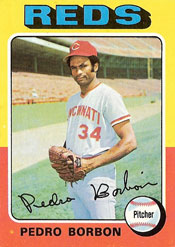
Borbon was a reliable reliever for the Big Red Machine teams of the 1970s. In 12 big-league seasons (1969-80), Borbon was 69-39 with 80 saves. He pitched in the World Series for the Reds in 1972, 1975 and 1976. He won 11 and saved 14 for Cincinnati in 1973 and was 10-5 with 18 saves for the 1977 Reds.

What’s not as well-known is Borbon became a professional baseball player on one of the most magical days in Cardinals history. He was signed as a non-drafted free agent by St. Louis on Oct. 15, 1964, the day the Cardinals won Game 7 of the World Series against the Yankees.

Borbon was a success in his three seasons in the St. Louis system. He was 6-1 with a 1.96 ERA in 38 games for Class A Cedar Rapids in 1966 and 5-4 with a 2.29 ERA in 36 games for Class A St. Petersburg in 1967. Both clubs were managed by Ron Plaza.

In 1968, Borbon, 21, caught the attention of several big-league organizations with his performance for the Cardinals’ Class A Modesto club of the California League.

He established a league record by appearing in 18 consecutive games without allowing an earned run. In a May 15 game against Fresno, with the score 4-4, Modesto manager Joe Cunningham brought  in Borbon in the ninth inning with a runner on first, one out and a 3-and-0 count on batter Chris Arnold. Borbon struck out Arnold on three pitches and catcher Ted Simmons, 18, threw out the runner attempting to steal second. Modesto scored in the bottom of the ninth, giving Borbon the win.

Borbon finished 8-5 with a 2.34 ERA and 96 strikeouts in 100 innings for Modesto in 1968. In December, the two-time defending National League champion Cardinals failed to protect Borbon on their major-league roster and he was chosen by the Angels as the fourth pick in the first round of the Rule 5 draft.

The Angels were one of at least five big-league clubs that rated Borbon as the best available player in the draft, according to The Sporting News.

“He might be a real catch,” Angels manager Bill Rigney said. “Everyone was high on him.”

Borbon made the Angels’ roster in 1969. He got the win in his major-league debut on April 9 against the Seattle Pilots. Boxscore He finished 2-3 with a 6.15 ERA in 22 games for the 1969 Angels. In November, the Angels dealt Borbon and pitchers Jim McGlothlin and Vern Geishert to the Reds for outfielder Alex Johnson and infielder Chico Ruiz. Bob Howsam, the Reds’ general manager, had been the Cardinals’ general manager when Borbon signed with St. Louis.

Eleven years later, Borbon, 33, was looking for work after being released by the Giants in April 1980. The Cardinals gave him a job as their batting practice pitcher. After two weeks, they determined Borbon was better than some of the pitchers in their bullpen. St. Louis relievers had a collective 7.46 ERA. Desperate for help, general manager John Claiborne acquired Jim Kaat, 41, from the Yankees and signed Borbon. A headline in The Sporting News blared, “Redbirds Turn to Greybeards to Liven Up Their Bullpen.”

Borbon provided immediate results. He pitched three scoreless relief innings against the Astros in his Cardinals debut on May 3, 1980. Boxscore

In his second Cardinals appearance, Borbon earned a save _ and got revenge against the team that released him _ with 2.2 scoreless relief innings against the Giants. Boxscore

Borbon’s third appearance resulted in his first Cardinals win _ and last of his career in the majors _ in a 15-7 St. Louis victory over the Dodgers. Boxscore

But Borbon’s effectiveness soon waned. He yielded a home run in each of his final three appearances. The last two came in consecutive games _ a three-run homer by Padres catcher Gene Tenace on May 24 Boxscore and a grand slam by Padres third baseman Barry Evans (his second and last home run of a five-year big-league career) on May 25. Boxscore

Four weeks after they had added him to the roster, the Cardinals released Borbon. His St. Louis record: 1-0 with one save and a 3.79 ERA in 10 games. With that, Borbon’s big-league career was finished.

His son, a left-handed pitcher also named Pedro Borbon, had a nine-year career in the majors with the Braves, Dodgers, Blue Jays, Astros and Cardinals. Like his father, he finished as a Cardinal, pitching seven games for St. Louis in 2003 and posting an 0-1 record and 20.25 ERA.
(Updated Aug. 22, 2020)

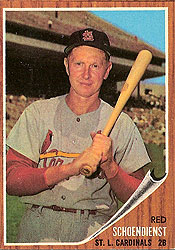
If second baseman Red Schoendienst had signed with the expansion Angels _ and he came close to doing just that _ he might never have returned to the Cardinals and become their manager, guiding them to two National League pennants and a World Series title.

Rejecting a “lush contract” from the 1961 Angels, Schoendienst accepted an invitation to try out for a spot with the Cardinals, made the roster, finished his playing career with them, became a coach on manager Johnny Keane’s staff and then replaced Keane.
In October 1960, a year after his comeback from tuberculosis, Schoendienst, 37, was released by the Braves.

“It doubtless was shocking to many that the Braves began cleaning house by cutting one of baseball’s biggest names,” The Sporting News reported.

In his book, “Eddie Mathews and the National Pastime,” Braves third baseman Eddie Mathews said, “That move made no sense to us. They didn’t trade him for anybody. They just let him go. Red was getting up in years, but he had some baseball left.”

Schoendienst had opened the 1960 season as the Braves’ starting second baseman. He was batting .306 on May 13, but manager Chuck Dressen eventually lost confidence in him. After starting at second base for the Braves on Aug. 10, Schoendienst appeared in only one game after Aug. 11 and finished the season with a .257 batting average in 68 games.

General manager John McHale offered Schoendienst a non-playing job in the Braves’ organization (The Sporting News reported it probably was a minor-league manager position) but Schoendienst rejected it. “I don’t know what they had in mind,” Schoendienst said, “but I told them to forget it.”

Schoendienst, who had excelled for the Cardinals from 1945-56 before being traded to the Giants and then the Braves, told reporters he preferred to stay in the National League. “You hear some people say I’ve slowed up in the field,” Schoendienst said. “Well, maybe I have a little bit, but I’m confident that I can still make the plays at second base and I know I can help some club next year.”

In November 1960, St. Louis general manager Bing Devine invited Schoendienst to attend Cardinals spring training in 1961 for a tryout. “There is no question in my mind that he can prove valuable in a reserve capacity,” Devine said. “Meanwhile, I told him that if any other opportunity comes his way he is not committed to the Cardinals.”

A month later, Angels general manager Fred Haney offered Schoendienst a contract to join the expansion team as a second baseman, The Sporting News reported. Haney had been manager of the Braves in 1957 and 1958 when Schoendienst helped Milwaukee win two pennants and a World Series championship.

Schoendienst told friends, “If the contract is satisfactory, I’ll sign it. I think I can play 100 games in 1961.”

The Sporting News reported the contract as “lush” and proclaimed Haney “undoubtedly will take the veteran second baseman to camp with the club at Palm Springs.”

Instead, Schoendienst, who turned 38 in February 1961, chose to attend Cardinals camp as a non-roster player. “I told Fred (Haney) I’d be better off staying in St. Louis with my family,” Schoendienst said.

Reporting in top condition after a winter of workouts, Schoendienst impressed Devine and manager Solly Hemus with his play. On March 15, they signed him to a contract and declared he would back up starting second baseman Julian Javier.

The move paid off for the Cardinals and Schoendienst. He hit .300 in 72 games for the 1961 Cardinals. He was a player-coach for Keane (who replaced Hemus) in 1962 _ and did even better, hitting .301 in 98 games.

Schoendienst remained a Cardinals coach in 1963 and 1964 (appearing as a pinch-hitter in 1963) and became St. Louis manager in 1965. In 14 years as Cardinals manager, Schoendienst had a 1,041-955 record. Only Tony La Russa had more wins as a Cardinals manager.

Previously: Red Schoendienst made Cardinals home run history

(Updated April 24, 2022)

The Cardinals played a significant role in the birth of the Mets as a National League franchise.

In 1962, the Cardinals were the opponent when the expansion Mets played their first spring training exhibition game and their first regular-season game. The Cardinals won both.

The Cardinals and Mets had their spring training camps in St. Petersburg, Fla., in 1962. Two former Cardinals player-managers, Rogers Hornsby and Solly Hemus, were on Mets manager Casey Stengel’s coaching staff. Former Cardinals on the 1962 Mets roster included catchers Hobie Landrith and Chris Cannizzaro, outfielder Bobby Gene Smith and pitchers Bob Miller, Craig Anderson and Herb Moford.

First game

On March 10, 1962, before an Al Lang Field crowd of 6,872, including baseball commissioner Ford Frick, the Cardinals beat the Mets, 8-0, in their spring training opener, the first game played by the expansion team.

Minnie Minoso and Gene Oliver each hit home runs for the Cardinals, who collected 12 hits. Mets starter Jay Hook allowed five runs in four innings. Curt Flood was the first batter to face the Mets. Stan Musial contributed a sacrifice fly for the Cardinals.

Three Cardinals pitchers, Lindy McDaniel, Ray Washburn and Curt Simmons, combined to limit the Mets to four hits, including a triple by Don Zimmer.

First win

The Mets earned their first victory the next afternoon, March 11, 1962, beating the Cardinals, 4-3, before 2,574 at St. Petersburg.

Larry Jackson and Paul Toth held the Mets scoreless on one hit through seven innings and the Cardinals built a 3-0 lead.

In the eighth, the Mets broke their streak of 16 consecutive scoreless innings when Choo Choo Coleman hit a two-run home run to right against Johnny Kucks. Elio Chacon, Rod Kanehl and Gus Bell followed with consecutive singles, tying the score.

The Mets won in the ninth against Ed Bauta when, with two outs and none on, Richie Ashburn doubled and Chacon followed with a RBI-single.

Bob Botz, a right-hander who pitched a scoreless top of the ninth, earned the first win in Mets history. Botz never appeared in a regular-season game for the Mets. On April 2, 1962, he was traded to the Braves. The Cardinals acquired him from the Angels in April 1963 and assigned him to the minor leagues.

Playing for keeps

The Mets went to St. Louis to open the regular season. At the hotel, several players got trapped in an elevator for 20 minutes. “It wasn’t like it was just a few guys,” pitcher Jay Hook told author Janet Paskin. “We were packed in there like sardines.”

Then, the April 10 opener was postponed because of rain. It was the first time a Cardinals home opener had been scratched in more than 25 years.

They played for real on April 11. According to the book “Tales from the 1962 Mets,” Sherman Jones was supposed to be the Mets’ starting pitcher, but he got sidelined when, while lighting a cigarette, the head of the match flew off and struck him in the eye, blinding him temporarily. Roger Craig got the start instead.

Musial, 41, was 3-for-3 with two RBI, a walk and a run, Bill White drove in three runs and Julian Javier contributed four hits and scored three runs as the Cardinals beat the Mets, 11-4, before 16,147 at St. Louis. Boxscore

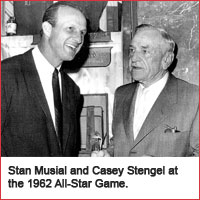
Stengel, the Mets’ 71-year-old manager, managed the Braves when Musial made his big-league debut against them 21 years earlier in 1941.

“He’s the only player left from my last time in the National League,” Stengel said to the Associated Press. “No wonder they keep him around.”

Ashburn, the first batter in Mets regular-season history, flied out to center. Bell got the first Mets hit, a single to center in the second. Gil Hodges hit the first Mets home run, with none on in the fourth.

Larry Jackson pitched a complete game for the Cardinals. Craig lasted three innings and took the loss, his first of 24 in 1962.

Cardinals dominate

A week later, April 18, 1962, the Cardinals played their first game against the Mets at New York and it was another romp. Ken Boyer hit two home runs and scored four times, and Musial was 2-for-4 with two RBI and a run in a 15-5 Cardinals triumph before 4,725 on a Wednesday afternoon at the Polo Grounds. Boxscore

The win improved St. Louis’ record to 5-0. The Mets dropped to 0-6 on their way to a 40-120 season.

The Cardinals won 13 of 18 against the 1962 Mets. Musial hit .468 with four home runs, 15 RBI and 11 walks in 17 games against them. Other Cardinals who excelled against the Mets in 1962: White (.360 batting average, 19 RBI), Boyer (.329, 23 RBI), Flood (.392, 13 RBI), Washburn (4-0 record), Jackson (3-0) and McDaniel (1-0, four saves).

The 1962 Cardinals batted .311 against the Mets, with 30 home runs.

Previously: An interview with former Cardinals pitcher Al Jackson

The Cardinals thought so highly of Gene Freese they offered to trade Ken Boyer for him.

Freese, an infielder, hit 14 home runs as a Pirates rookie in 1955 and batted .283 for them in 1957.
“I like that Freese … He’s my type of player,” Cardinals general manager Frank Lane told The Sporting News. “He’s aggressive and strong.”

In November 1957, Lane agreed to deal Boyer and another player (probably pitcher Willard Schmidt) to the Pirates for Freese and outfielder Frank Thomas, according to The Sporting News, but “Anheuser-Busch brass is understood to have frowned on the proposed deal.”

Soon after, Lane resigned to become general manager of the Cleveland Indians. Bing Devine replaced Lane in St. Louis and Freese appealed to him, too. On June 15, 1958, Devine acquired Freese and utility player Johnny O’Brien from the Pirates for shortstop Dick Schofield and cash.

The Cardinals projected Freese as a player who could back up Don Blasingame at second, Eddie Kasko at short or Boyer at third. In late July 1958, Blasingame was injured and Freese got his first stretch of starts for the Cardinals. After Blasingame returned to the lineup, manager Fred Hutchinson, unhappy with the weak hitting of Kasko and backup Ruben Amaro, installed Freese as the shortstop.

Though he lacked range, Freese provided pop. On Aug. 7, 1958, Freese, batting second, was 3-for-5 with a double and three runs scored in the Cardinals’ 12-1 victory over the Giants at St. Louis. Boxscore

Freese also was part of a power performance against the Dodgers at the Coliseum in Los Angeles. On Aug. 17, 1958, Curt Flood and Freese led off the game with back-to-back home runs to left field off Sandy Koufax. It was only the fifth time a National League team opened a game with consecutive homers. Boxscore Freese slugged three home runs in the four-game series.

Impressed, The Sporting News reported, “Since coming to the Redbirds, the 24-year-old Freese has been a life-saver. He’s filled in competently at both second base and shortstop … Neither the ex-Pirate nor the Cards’ high command has any illusions about his defensive talent. He doesn’t pretend to be a premier shortstop, but Hutchinson reluctantly sacrificed defense to get some hitting.”

Freese hit .257 with six home runs in 62 games for the 1958 Cardinals, but his on-base percentage was a poor .294. He committed eight errors in 28 games at shortstop and four errors in 14 games at second base.

On Sept. 29, a day after the 1958 season ended, the Cardinals traded Freese to the Phillies for infielder Solly Hemus, who became St. Louis’ player-manager, replacing Hutchinson.

Freese became the starting third baseman for the 1959 Phillies, hitting 23 home runs. His best season was 1961. As the third baseman for the National League champion Reds, managed by Hutchinson, Freese posted single-season career highs of 26 home runs and 87 RBI.

On a wet Memorial Day evening in St. Louis, the Cardinals received a special performance from a player who was starting to show he, too, was special.

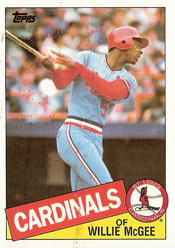
In his 16th game for the Cardinals since his promotion from Class AAA Louisville, rookie center fielder Willie McGee had his first four-hit game in the big leagues and sparked a 10-run fourth inning, leading St. Louis to an 11-6 victory over the Giants on May 31, 1982. Boxscore
McGee, batting sixth in the order, stroked two of his four singles in the fourth inning. The 10 runs were the most the Cardinals had scored in an inning in two years and the most in the National League at that point of the 1982 season.

The performance lifted McGee’s batting average to .378 and his on-base percentage to .410. McGee had transformed from a fill-in to a regular who would be integral to the Cardinals’ successful run to their first World Series title in 15 years.

“Willie has been very impressive,” Cardinals manager Whitey Herzog said to the Associated Press after the game. “In spring training, I knew he was going to come up here and hit big-league pitching the way he has.”

Seven months earlier, Oct. 21, 1981, the Cardinals had acquired McGee from the Yankees in a trade for pitcher Bob Sykes. McGee had spent five seasons in the Yankees’ minor-league system without reaching the majors.

“After my second or third year, I started telling myself the Yankees weren’t the only team,” McGee said to the Associated Press. “I know I can hit. ”

McGee didn’t make the 1982 Cardinals’ season-opening roster. Sent to Louisville, he hit .291 in 13 games. When outfielder David Green suffered a hamstring injury May 7, the Cardinals called up McGee, who made his big-league debut three days later.

McGee, 23, started in the outfield in just one of his first nine big-league games. The Memorial Day performance helped solidify him as St. Louis’ everyday center fielder.

An all-day rain in St. Louis had left the Busch Stadium field wet. Both teams skipped fielding and batting practice. Attendance for the Memorial Day evening game was a paltry 11,313, even though the Cardinals were in first place in the National League East.

The Giants led 3-1 before the Cardinals battered them for 10 runs in the fourth. The Cardinals had 15 batters in the inning and 12 reached base on nine hits, two walks and an error against three pitchers, starter Renie Martin, Dan Schatzeder and Fred Breining.

Eight of St. Louis’ nine hits in the inning were singles (Ozzie Smith doubled). McGee and pinch-hitter Tito Landrum each singled twice in the inning. Smith, McGee and Landrum also drove in two runs apiece in the fourth.

Orlando Sanchez, a catcher who entered the game 2-for-30 for the season, singled in the first run of the fourth, knocking out Martin. Schatzeder yielded six runs and six hits.

“It’s the momentum,” said McGee. “It’s like when you play basketball. One team gets the momentum and just keeps going. I felt my adrenaline pumping.”

Herzog said McGee’s second single in the fourth inning was the key hit. Batting right-handed against the left-hander Schatzeder, McGee delivered a bases-loaded two-run single to right.

“He had two strikes and he reached out and hit a breaking ball,” Herzog said.

Said McGee: “I’m starting to relax and just let things happen.”

The win, the Cardinals’ sixth in seven games, boosted their record to 31-18, giving them a 3.5-game lead over the second-place Mets.

McGee would go on to bat .296 for the season, with 24 stolen bases and 56 RBI.

In his book “White Rat: A Life in Baseball,” Herzog said, “Willie McGee … became the biggest story in baseball that summer … Once Willie McGee hit town and the kid pitchers started coming through, I began to feel that 1982 might be the Cardinals’ year.”

Previously: Five fabulous facts about Willie McGee

In the mid-1950s, two world-class athletes were produced from the same neighborhood in Omaha, Neb.

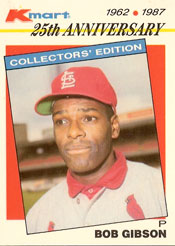
Bob Gibson, who would become the greatest pitcher in St. Louis Cardinals history, and Bob Boozer, a standout basketball forward who would become a NCAA all-American, an Olympian and a NBA champion, were friends and teammates.
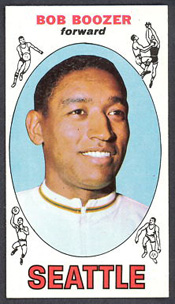
Both were coached by Bob Gibson’s older brother, Josh, on a YMCA-sponsored baseball team, the Monarchs. Both were teammates on a YMCA-sponsored basketball team, the Travelers. Both were teammates for a year on the Omaha Tech High School varsity basketball team. Both became business partners as radio station owners.

“He and Bob Gibson showed people that minority players could come out of Omaha and play professional football or baseball or whatever it may be,” Gale Sayers, running back for the Chicago Bears, told the Omaha World-Herald.

Sayers and two other football standouts, Marlin Briscoe (first black quarterback in the American Football League and later a wide receiver for the undefeated 1972 Dolphins) and Heisman Trophy winner Johnny Rodgers, were raised in the same Omaha neighborhood as Gibson and Boozer, following in their paths.

“I used to sit in the stands at Burdette Field (in Omaha) and watch Gibby pitch,” Boozer said to Leo Adam Biga, who wrote a series on standout black athletes from Omaha. “As good a baseball player as he was, he was a finer basketball player. He could play. He could get up and hang.”

A positive influence on both was Josh Gibson. “He was my mentor,” Bob Gibson said in a 2009 interview with Matt Crossman of The Sporting News. “Not just mine, but he coached guys like Bob Boozer, the basketball player, and Gale Sayers. He was really influential on the kids in Omaha at the time.”

In his book, “From Ghetto to Glory,” Bob Gibson said, “At a dinner in Omaha, Bob Boozer made a speech and said he probably would not be where he is now if it had not been for Josh. Another athlete who came under Josh’s influence is Gale Sayers.”

Bob Gibson, 17 months older than Boozer, went to Creighton, played for the Harlem Globetrotters and eventually gave up basketball to pursue a Hall of Fame career with the Cardinals.

Boozer, 6 feet 8 and 215 pounds, went to Kansas State and averaged 21.9 points per game in three varsity seasons and twice was named all-American. As a junior, he led Kansas State to the NCAA Tournament Final Four.

In 1959, Gibson’s rookie season with the Cardinals, Boozer was chosen as the No. 1 overall pick in the NBA draft by the Cincinnati Royals, but Boozer declined to join the NBA that year, preferring to keep his amateur status so he could play for the United States in the 1960 Summer Olympics in Rome. Boozer helped the U.S. win the gold medal, then embarked on a NBA career.

Boozer played in the NBA for 11 seasons (1960-71) and averaged 14.8 points and 8.1 rebounds per game for his career. He played for the Royals (1960-63), Knicks (1963-65), Lakers (1965-66), Bulls (1966-69), SuperSonics (1969-70) and Bucks (1970-71). With teammates Kareem Abdul-Jabbar and Oscar Robertson, he helped the Bucks win the 1971 NBA championship.

That same year, Starr Broadcasting sold Nebraska radio stations KOWH and KOZN to an ownership group led by Gibson and including Boozer.

“I don’t think I understood the full meaning of the word bigotry until I tried to sell advertising time for KOWH,” Gibson said in the book “Stranger to the Game.” “Almost none of the established businesses would buy from us and they searched hard for reasons not to.”

Gibson and his partners sold the stations to RadiOmaha in 1978.

“As the principal investor in KOWH, I had been operating at a personal liability that was eventually too much to handle,” Gibson said.

Boozer worked 27 years as a community affairs executive and federal lobbyist for a communications company, Northwestern Bell-US West.

In 2005, the Omaha World-Herald ranked the top 100 Nebraska athletes of all-time. The top five, in order: Gibson, Sayers, pitcher Grover Cleveland Alexander, Boozer and Rodgers.

“There are other neighborhoods in America that have produced impressive lists of athletes and maybe some have been more prolific than the north side of Omaha,” Gibson said in “Stranger to the Game.” “… But I have a hard time believing that any community as small and isolated as the Logan Fontenelle housing projects can match us for quantity and quality and diversity of athletes.”

Previously: How Bill Bergesch got Bob Gibson to the Cardinals