(Updated Feb. 20, 2023)
Hank Aaron could have added to his home run total if not for an unusual call in a game against the Cardinals.
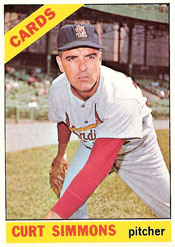 Aaron, who would break Babe Ruth’s career home run record of 714 in 1974 and finish with 755, hit a home run against the Cardinals in 1965 that didn’t count toward his total.
On Aug. 18, 1965, at St. Louis, Aaron came to bat for the Braves against Cardinals starter Curt Simmons with the score tied 3-3 in the eighth.
In his autobiography, “I Had a Hammer,” Aaron said, “I always had difficulty with Curt Simmons because he would put the ball behind his back and then pound his leg with his glove. You never knew where the ball was coming from. Simmons used to drive me crazy with his herky-jerky delivery and his floating change of pace.”
In the 1965 game, Simmons teased Aaron with a changeup so high and so slow it seemed much like a blooper pitch. “I double-hitched my swing,” Aaron said in his book, “and took a big step up to meet the ball.”
Aaron lifted a high fly ball onto the pavilion roof in right for an apparent go-ahead home run.
Instead, Aaron was called out by plate umpire Chris Pelekoudas for being out of the batter’s box when he connected with the ball, nullifying the home run. Pelekoudas, in his sixth season as a National League umpire, ruled Aaron’s left foot was in front of the batter’s box.
“It’s the worst call I’ve ever seen,” Aaron said to the Associated Press. “I did the same thing the time before and popped up, and he (Pelekoudas) didn’t say a word. I always hit Simmons that way.”
Braves manager Bobby Bragan argued with the umpire and was ejected.
“It was either a grudge call, or he wanted to get his name in the paper,” Bragan said. “I’ve never seen such a call.”
Said Pelekoudas: “Bragan’s protest was strictly on judgment. His only argument was about a grudge _ and that is stupid. I didn’t hesitate in making the call.”
Cardinals catcher Tim McCarver said Aaron stepped out of the box and, “I expected (Pelekoudas) to call it.”
Cardinals coach Joe Schultz told the St. Louis Post-Dispatch, “You’ve got to give the umpire credit for having the nerve to call it.”
Aaron said in his book, ‘I won’t swear to you that I didn’t step over the line of the batter’s box, but it was nothing that I or other hitters hadn’t done before.”
Cardinals backup catcher Bob Uecker wasn’t in the game, but years later, in July 1973, he claimed to the Boston Globe and the Associated Press that he “pointed out Aaron’s cleat marks” to Pelekoudas. “It was one of the few occasions I’ve seen Aaron blow his stack,” Uecker said to the Associated Press.
In his 1982 book “Catcher in the Wry,” Uecker told another version. “I had to tell Henry the truth. It wasn’t me,” Uecker said. “Tim McCarver was the catcher who took the homer away from him, but it was the sort of thing I would have been proud to do.”
In the ninth, with Ray Washburn pitching in relief of Simmons, the Braves sent Don Dillard to pinch-hit with a runner on base and two outs. Dillard delivered a home run _ the last of his big-league career.
In a fitting twist, the Cardinals argued the ball hit by Dillard didn’t clear the wall and shouldn’t have been ruled a home run, but the Cardinals lost that argument and the game, 5-3. Boxscore
Umpire Bill Jackowski said the ball hit the top of the wall, caromed off a fan in the stands and bounced back onto the field.
The Post-Dispatch reported the ball Dillard hit “came straight down and hit the outfield wall padding before bouncing onto the field.”
“I came very close to catching the ball,” Cardinals center fielder Curt Flood said to the Post-Dispatch. “I thought it was a big can of corn. There was no way for the ball to come down the way it did if a fan had touched the ball.”
 In the first series of its 2012 baseball card set, Topps printed two cards of St. Louis utilityman Skip Schumaker. The common card shows an image of Schumaker sliding. The other card, which has been released in limited supply (driving up demand and price), shows only Schumaker’s shoe as the so-called “rally squirrel” dashes across home plate.
 Two Cardinals _ pitcher Howie Pollet and outfielder Tommy Glaviano _ were part of the red backs. Six Cardinals _ pitchers Gerry Staley, Red Munger and Harry Breechen; second baseman Red Schoendienst; outfielder Enos Slaughter; and third baseman Billy Johnson _ were part of the blue backs.
 The deal propelled the Cardinals to three National League pennants and a World Series title and launched Smith toward a Hall of Fame career.
 (Updated June 10, 2023)
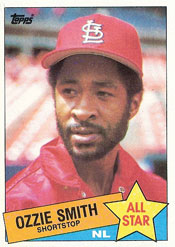 Because the public isn’t allowed to attend the games, there were only about five people in the stands — likely friends or relatives of the players. So the event took on a “Field of Dreams” aura as Hall of Fame players such as Lou Brock, Ozzie Smith and Bruce Sutter stepped onto the field in crisp, white Cardinals uniforms to play inside a ballpark so empty it might as well have been an Iowa cornfield.
 In 15 years with the Cardinals, 1974-88, Forsch pitched two no-hitters and helped St. Louis win the 1982 World Series title.
 At one point, a guy says to Bob, “We always wondered if your son played baseball.” And Bob said, “I have two daughters. I don’t have a son.” And the guy pointed at me and said, “Isn’t he your son?”
 RetroSimba