Feeds:
Posts
Comments

When the Houston Colt .45s began play in the National League in 1962, one of the most anticipated homestands was the one with the Cardinals.

Houston had been a Cardinals minor-league affiliate from 1921-35 and from 1946-58. Many in the region were Cardinals fans.

The 1962 Cardinals had several close connections to Houston. Cardinals manager Johnny Keane and pitching coach Howie Pollet were Houston residents. Keane had played for Houston (1934-37) and also had managed the club (1946-48). Pollet had pitched for Houston (1939-41).

Also, Cardinals coach Harry Walker had been the last Houston manager (1956-58) while it was a Cardinals affiliate. Top 1962 Cardinals players, such as third baseman Ken Boyer and pitcher Larry Jackson, had played for the Houston farm club.

St. Louis made its first visit to Houston for the second homestand in Colt .45s history (the franchise changed its name to Astros in 1965). The Cardinals and Colt .45s were scheduled for three midweek night games April 24-26.

The Cardinals won one, lost one and tied another. Two games each were decided by a run and the other ended in a tie after 17 innings.

According to Clark Nealon of the Houston Post in a story for The Sporting News, Houston “waited years for the first National League series with the St. Louis Cardinals and when it came it was tremendous.”

Houston 4, Cardinals 3, April 24, 1962

In pre-game ceremonies, The Sporting News reported, each member of the Cardinals was “introduced individually to ringing applause.”

At the end, the cheers were for Houston starter Hal Woodeshick, who pitched a six-hitter.

Houston left fielder Don Taussig, who had played for the Cardinals in 1961, hit a solo home run off Jackson in the sixth.

With one on and two outs in the ninth, Bill White ripped a sinking liner that Houston right fielder Johnny Weekly snared at his shoetops.

Attendance was 19,335 _ impressive for a weeknight at a ballpark that seated about 25,000. Boxscore

Cardinals 5, Houston 5, 17 innings, April 25, 1962

In the afternoon, Keane was honored at a Chamber of Commerce luncheon and presented with a replica of a Colt .45 gun. He told the audience, “We’re a lot better club than we showed you on April 24.”

The Cardinals’ manager again was honored in ceremonies before the game. Among his gifts was a king-sized pass to “the first World Series game in Houston.” (It would be 2005 before Houston made its first World Series appearance.)

The game began at 8:02 p.m. It was halted at 1:15 a.m. because of a local curfew in Houston that forbid starting an inning after 12:50 a.m. The game was replayed on another date but all the statistics counted.

Boyer’s RBI-single to left in the ninth off Turk Farrell scored Julian Javier from second, tying the score 5-5.

Ed Bauta pitched eight scoreless innings for the Cardinals after entering in the 10th.

The Cardinals had runners on first and second with no outs in the top of the 17th, but Doug Clemens struck out and Red Schoendienst hit into a double play.

Six Houston pitchers struck out 18 Cardinals, including Boyer three times. Houston left 16 runners on base and the Cardinals stranded 15. Boxscore

Cardinals 3, Houston 2, April 26, 1962

The Cardinals were spared embarrassment by salvaging a victory in the series. Bob Gibson pitched a two-hitter for his first win of the season and Stan Musial drove in the deciding run with a two-out single in the eighth, scoring Curt Flood from third base. Boxscore

Part Two: Cardinals broke Astrodome hex with 19 RBI in one game

Part Three: Forsch vs. Forsch: Bob had edge in brotherly matchup
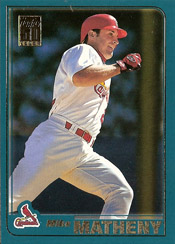
Pat Hentgen played one season for the Cardinals, but his impact on the franchise was significant.

It was Hentgen who recommended the Cardinals sign Mike Matheny, a free agent, to a contract in December 1999. The Cardinals were looking for a backup to catcher Eli Marrero.
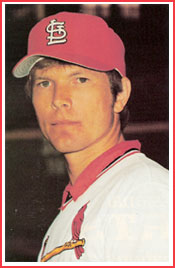
Matheny signed a one-year deal for $750,000, leapfrogged Marrero to become the starting catcher in 2000 and remained the Cardinals’  catcher for five seasons, helping them to four postseason appearances and their first National League pennant in 17 years.

After the 2011 season, Matheny became the Cardinals’ manager, replacing Tony La Russa, and led them to a National League pennant in 2013.

Hentgen, a right-handed starting pitcher who won the American League Cy Young Award in 1996, was acquired by the Cardinals from Toronto in November 1999 along with pitcher Paul Spoljaric in a trade for catcher Alberto Castillo and pitchers Lance Painter and Matt DeWitt.

Matheny had been Hentgen’s teammate with Toronto in 1999. Though Matheny was the backup to Blue Jays catcher Darrin Fletcher, he made a lasting impression on Hentgen because of his arm, defense, leadership and management of a pitching staff.

In an article in May 2000, the Associated Press reported the Cardinals signed Matheny “largely at the urging of Hentgen.”

“He was pretty vocal about it. He was on my side,” Matheny said. “That’s just the ultimate compliment _ when a pitcher with as much experience and success as Pat has had thinks that highly of me to put his name on the line.”

Matheny had a stellar start for St. Louis in 2000. He batted .313 in April and threw out 15 of the first 22 baserunners who attempted to steal.

When Marrero tore a ligament in his left thumb on July 1, the Cardinals had little help behind Matheny. A couple of weeks later, Matheny cracked a rib but continued to play. He wore a flak jacket and had his chest taped before every game.

Gritty determination was one element of Matheny’s leadership style. He also displayed respect and selflessness when the Cardinals acquired first baseman Will Clark from the Orioles on July 31, 2000.

For most of his 15-year big-league career, Clark had worn uniform No. 22 _ the same number worn by Matheny in his seven seasons in the major leagues. Matheny offered the number to Clark as a welcome to the Cardinals, asking for nothing in return. Clark was touched by the gesture. Matheny switched to uniform No. 44.

“It’s just a number,” Matheny told The Sporting News in September 2000. “I don’t see the big deal.”

Matheny hit .261 with 47 RBI in 128 games for the 2000 Cardinals. He sat out the postseason after he accidently severed two tendons and a nerve in his right ring finger while using a hunting knife he received as a 30th birthday gift. Matheny threw out 49 of 93 baserunners attempting to steal in 2000 and received the NL Gold Glove Award.

Hentgen had a 15-12 record and 4.72 ERA in 33 starts for the Cardinals. He became a free agent after the 2000 season and signed with the Orioles.

(Updated Nov. 2, 2019)

The Cardinals planned for Bob Forsch to be a third baseman, not a pitcher.

Forsch was chosen by the Cardinals in the 26th round of the 1968 amateur draft and sent to their Gulf Coast League team in Sarasota. Forsch, 18, played third base and some outfield. His instructors included George Kissell and Joe Medwick. Forsch displayed a strong arm but batted .224 in 44 games.

In the book “Tales From The Cardinals Dugout,” Forsch described his first day as a professional ballplayer:

I had sort of thought I was going to Florida on a vacation to play baseball. And so I went to the minor-league complex and they gave me a uniform. It was wool. And it had patches in the seat from where other guys had ripped it up while they were sliding. They didn’t have enough caps, because there were too many players. So I got a batting helmet and put that on.

In 1969, Forsch continued to play third base but hit .203 in 26 games for Lewiston of the Northwest League and .235 in 33 games for Modesto of the California League.

At age 20, his playing career was in jeopardy after he opened the 1970 season by hitting .149 in 20 games for Modesto, striking out 21 times in 47 at-bats. Forsch was moved to Cedar Rapids of the Midwest League and did even worse, hitting .088 through 19 games.

Short of pitchers, manager Roy Majtyka put Forsch into a game as a reliever against Clinton. Forsch had pitched in batting practice for Cedar Rapids and had posted a 9-1 record as a pitcher during his senior year in high school at Sacramento, Calif.

The first Clinton batter Forsch faced was Bob Hansen, who would become a first baseman with the Brewers. Forsch’s first pitch sailed over Hansen’s head.

“Mick Kelleher, our shortstop, came over to me and said, ‘Come on, Bob, you can throw it by him,’ ” Forsch told The Sporting News in 1974. “Hansen hit the next pitch for the longest home run I’ve ever seen, even though I threw the ball as hard as I could.”

Forsch worked three innings and gave up six hits and four runs, but his career as a pitcher had begun. The Cardinals sent him to Lewiston and instructed manager Fred Hatfield to use Forsch as a pitcher. In seven games, five as a starter, Forsch was 2-3 with a 4.94 ERA.

When Forsch reported to spring training in 1971, he didn’t know whether the Cardinals planned to employ him as a pitcher or as a third baseman because the Cardinals had a shortage of third basemen in their farm system.

Bob Kennedy, a former big-league player and manager, was the Cardinals’ director of player development and he made the decision Forsch would be converted exclusively to pitching.

Forsch was 11-7 with a 3.13 ERA for Cedar Rapids in 1971 and 8-10, including a no-hitter, for Arkansas in 1972. After the 1972 season, he went to the Florida Instructional League and posted a 7-1 record while working with instructor Bob Milliken.

Forsch was 12-12, including another no-hitter, for Tulsa in 1973.

Playing for manager Ken Boyer at Tulsa in 1974, Forsch was 8-5 with a 3.67 ERA in 15 games when the Cardinals, on the recommendation of Kennedy, called him to the major leagues in July. “He threw hardest and had an excellent curve,” Kennedy explained.

Said Forsch: “I didn’t even know how to throw a curve until Bob Milliken showed me how at the Florida Instructional League.”

Matty Alou, one of baseball’s best hitters in the 1960s and 1970s, had one of the most productive seasons of his 15-year big-league career with the Cardinals.

Alou is best remembered for his years with his first major-league team, the Giants, and his time with the Pirates, with whom he won a National League batting crown, hitting .342 in 1966.

Often overlooked is Alou’s splendid 1971 season with the Cardinals. Alou had career highs of 74 RBI and seven home runs with the 1971 Cardinals and hit .315 in 149 games.

A left-handed batter, Alou was adept at hitting the ball to all fields.

“Matty and Stan Musial handle the bat better than anyone I’ve ever seen,” Cardinals hitting coach Ken Boyer told The Sporting News in August 1971. “Like Stan, Matty has a great level swing, and, like Stan, he can handle just about any kind of pitch.

“Alou uses bats of at least 10 different weights,” Boyer said. “He studies the pitchers and the defense as well as anybody because he’s always looking for some way to beat you.”

The Cardinals acquired Alou and pitcher George Brunet from the Pirates for pitcher Nelson Briles and outfielder Vic Davalillo on Jan. 29, 1971.

In announcing the deal, Cardinals general manager Bing Devine said he and manager Red Schoendienst agreed Alou, 33, would bat leadoff and play center field. Left fielder Lou Brock would move from the leadoff spot to bat No. 3 in the order and second baseman Ted Sizemore, acquired from the Dodgers, would bat between Alou and Brock.

“Guys like Alou and Sizemore make things happen,” Devine said. “They ought to help make the Cardinals a much more exciting team.”

Alou said his goal was to hit .335 for the 1971 Cardinals. “I like to hit in St. Louis. It’s a good park for hitters. The ball comes off the AstroTurf good and the ground in front of the plate is hard.”

The Cardinals batted Alou, Sizemore and Brock in the top three spots of the order for the first 14 games of the 1971 season and went 8-6 before Schoendienst returned Brock to the leadoff spot and moved Alou to the No. 2 position.

Alou was a free swinger and Brock’s ability to steal bases was compromised when Alou would foul off or hit, rather than take, pitches. It was when Schoendienst moved Sizemore to No. 2 in the batting order and Alou to No. 3 that the Cardinals’ offense clicked. Asked to explain why he had so many more RBI with the Cardinals than he had with the Pirates, Alou said, “It makes a lot of difference hitting behind Lou Brock instead of (Pirates catcher) Jerry May and the pitcher.”

Alou hit .332 in 78 games from the No. 2 spot and .294 in 46 games from the No. 3 position.

Though he began the 1971 season as St. Louis’ center fielder, Alou moved to right field after Jose Cardenal was traded to the Brewers, and took over first base for Joe Hague when the Cardinals inserted Luis Melendez as the right fielder.

Alou hit .313 in 73 games as the center fielder, .364 in 20 games as the right fielder and .305 in 58 games as the first baseman.

In 1972, Alou played first base and right field for the Cardinals and hit .314 in 108 games, but the Cardinals wanted to move Joe Torre from third base to first base. Out of contention for a postseason spot, the Cardinals traded Alou to the Athletics on Aug. 27, 1972, for outfielder Bill Voss and a minor leaguer.

Speaking to reporters about how he enjoyed his time with the Cardinals, Alou called Schoendienst the “best man I ever played for. He kept everybody loose.”

Alou was reacquired by the Cardinals for the stretch run on Sept. 6, 1973, in a cash deal with the Yankees. He hit .273 in 11 games. After the season, the Cardinals sold his contract to the Padres.

Alou’s career statistics as a Cardinal: .314 batting average, 322 hits in 268 games, 30 stolen bases.

Matty Alou and his brothers Felipe and Jesus all were big-league outfielders. Asked in October 1971 who was the best ballplayer of the three, Felipe told The Sporting News, “I have the most ability. Matty is the best hitter. He has more guts and confidence than Jesus (Alou) and I put together. But Jesus is the most professional of all three.”

On July 7, 1974, I went with my parents and younger sister to a Cardinals-Reds doubleheader at Riverfront Stadium in Cincinnati. It was a blistering hot Sunday afternoon along the Ohio River. I was 18 and pumped with a mix of excitement and dread about seeing the team I followed passionately, the Cardinals.

The excitement came from the anticipation of seeing two Cardinals games in one day. The Cardinals were in first place in the National League East, three games ahead of the Expos, and I was getting my first look at them in person that year.

The dread came from knowing the Cardinals would be facing the Big Red Machine. This was the Reds lineup of Pete Rose, Ken Griffey Sr., Joe Morgan, Johnny Bench, Tony Perez and George Foster.

We had missed by one day seeing St. Louis ace Bob Gibson, who had pitched a three-hitter in the Cardinals’ 3-1 victory against the Reds Saturday afternoon. Boxscore

For the doubleheader, the Cardinals’ starters would be a pair of 24-year-old right-handers _ Bob Forsch, making his major-league debut, in Game 1, and Mike Thompson, 0-2 with a 5.06 ERA, in the second game.

Thompson was yanked after allowing three runs on four walks in one inning of Game 2 and never pitched again for St. Louis. (The Reds won, 11-2. Boxscore).

Forsch, though, was splendid in the opener. Paired against Tom Carroll, 21, a right-hander who also was making his major-league debut, Forsch pitched with poise against a potent lineup.

Griffey, Morgan, Perez and Bench each was 0-for-3 against Forsch. Bench struck out twice. Rose managed only an infield single against the rookie.

Center fielder Cesar Geronimo, the seventh-place batter, was Forsch’s nemesis. In the second inning, after a home run by first baseman Ted Simmons gave the Cardinals a 1-0 lead, Geronimo hit a two-out double, scoring Dan Driessen from second base, tying the score.

In the seventh, Geronimo hit a home run against Forsch. It was the deciding run in the Reds’ 2-1 victory. Forsch pitched 6.2 innings, allowing four hits, five walks and striking out two. Boxscore

“When you give up just two runs and four hits, you ought to win,” Tim McCarver, who caught Forsch’s debut game, told the St. Louis Post-Dispatch. “I’m proud of Bobby. He did a good job, an excellent job. You couldn’t ask any more of him.”

I became a big Bob Forsch fan that day and remained so. His sudden death at age 61 on Nov. 3, 2011, stunned and deeply saddened me.

After my wife and I settled in Florida in 2002, we went as spectators to a Cardinals fantasy camp game at Jupiter, Fla., and saw Forsch as he and pitcher Joe Magrane were walking down the right-field line at Roger Dean Stadium. We called to them and they came over and were wonderful to us. I mentioned to Forsch that I had witnessed his debut in the majors. He smiled and said, “In the pregame meeting, they told me, ‘Whatever you do, don’t walk Geronimo.’ Well, I didn’t.”

Forsch wrote a book, “Tales From The Cardinals Dugout,” which I had brought with me and asked him to sign it. In bold, clear handwriting, he wrote, “Diane and Mark: Hope you enjoy! Bob Forsch”

There is a passage in the book where Forsch writes about his big-league debut:

“Tim McCarver caught my first big-league game … Red Schoendienst was the manager then and all Red said before I went to the mound was, ‘Go out and do the best you can. No matter what happens, you’ll get another chance.’ That was good to hear. I didn’t know Red well enough to think he’d lie to me!

“We had gone over the hitters before the game, how to pitch to each one … Geronimo was their center fielder, and he was real fast and a threat to steal. They told me, ‘Just don’t walk him. Make him hit to get on.’ He ended up hitting a double … and a home run. But, hey, I didn’t walk him.”

(Updated April 4, 2025)

To get insights into what made Tony La Russa a Hall of Fame manager, I recommend the book “The Wizard of Waxahachie.” Written by Warren Corbett, it is a well-researched biography of Paul Richards, a baseball innovator who had a long career as a player, manager and executive in the minors and majors.

Richards managed the White Sox and Orioles. He was director of player development for the White Sox when La Russa began his managerial career in the Chicago farm system. Richards became a mentor to La Russa.

In an interview with Cardinals Yearbook in 2014, La Russa said, “Managing is about preparation and leadership. It’s a message Paul Richards preached and it’s more true now than ever before.”

La Russa wrote the introduction to Richards’ biography. Reading it provides a link to the philosophies La Russa followed.

“During the three-year period from 1978 to 1980, when I’d managed in AA, AAA, and the White Sox, Paul’s influence was a career maker for me,” La Russa said. “He continually provided lessons on baseball fundamentals, strategies and leadership.

“To this day his emphasis on playing the game correctly and what that meant has been a key to my survival as a manager in baseball. His explanation of different offensive and defensive strategies has helped put my teams in a position to compete. And his leadership advice set the foundation for my contributions as a decision maker that I am expected to provide.

“My favorite example of a ‘Paulism’ was his principle that a manager should make decisions by ‘trusting your gut, not by trying to cover your butt.’ A manager’s decision must avoid the temptation of taking the popular or conventional path that your bosses, fans and media expect. Instead your responsibility as a manager is to decide what you think is your team’s best shot and then take it.”

La Russa was true to that principle throughout his Cardinals career.

An example of how La Russa applied Richards’ teachings is how he handled an incident in Game 2 of the 2006 World Series. Tigers pitcher Kenny Rogers appeared to be caught doctoring the baseball. La Russa told the umpires about the foreign substance on the ball but didn’t ask them to inspect Rogers. Critics claimed La Russa was protecting his friend, Tigers manager Jim Leyland. Instead, it was La Russa following a principle he learned from Richards, and later manager Sparky Anderson.

In the book “Tony La Russa: Man on a Mission,” author Rob Rains explained, “It was Anderson and Paul Richards who taught him the difference between having a strategy and a philosophy, and those thoughts filled his head as he watched Rogers pitch.”

La Russa explained, “I had the luxury and good fortune of teachers who taught me the difference between philosophy and strategy. In that situation, I might have strategized, ‘Hey, I can get this guy thrown out of the game.’

“Strategies have their place, but they don’t replace philosophy, because philosophy is what you represent, and what you want your team to represent … We want to win within our philosophy. Part of that philosophy is abhorring BS baseball. I don’t like it … I believe in the beauty of the competition. Let’s play the game. We get ready, they get ready. You play as hard as you can, and there’s a winner and a loser.

“I was so appreciative of all the teachers I had over the years, and in the end you just have to believe in the lessons you have learned about their philosophies.”