Feeds:
Posts
Comments

(Updated Oct. 28, 2017)

In a 2011 World Series jammed with dramatic moments, the Cardinals’ championship was defined, in large part, by the home run.

_ Albert Pujols hit three home runs in Game 3.

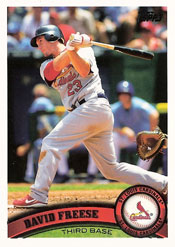
_ David Freese hit a walkoff 11th-inning home run in Game 6.

_ Allen Craig hit three home runs, including a go-ahead shot in Game 7.

_ The eight home runs hit by the 2011 Cardinals established the franchise record for most in a World Series. The previous mark was set in 1968 when the Cardinals hit seven home runs in a World Series against the Tigers.

_ The nine home runs allowed by the 2011 Cardinals are tied for the second-most in the franchise’s World Series history. Only the Yankees, with 10 in 1964, hit more home runs against the Cardinals in a World Series.

_ The 17 total home runs by the Cardinals and Rangers are the most in a World Series involving the Cardinals. The previous high was 15 total home runs _ in the 1964 World Series between the Cardinals and the Yankees and again in the 1968 World Series between the Cardinals and the Tigers.

Here are the home run totals in World Series involving the Cardinals:

YEAR…….CARDINALS HRS…….OPPONENT HRS…….TOTAL HRS

1926………4………………………….4…………………………8

1928………1………………………….9…………………………10

1930……..2………………………….6………………………….8

1931……..2…………………………..3…………………………5

1934……..2………………………….2………………………….4

1942……..2………………………….3………………………….5

1943……..2………………………….2………………………….4

1944……..3………………………….1………………………….4

1946……..1………………………….4………………………….5

1964……..5………………………….10……………………….15

1967……..5…………………………8………………………….13

1968……..7…………………………8………………………….15

1982……..4…………………………5………………………….9

1985……..2…………………………2………………………….4

1987……..2…………………………7………………………….9

2004…….2…………………………4…………………………..6

2006…….2…………………………4…………………………..6

2011……..8…………………………9………………………….17

2013…….2………………………….4………………………….6

(Updated Dec. 21, 2024)

Lost amid the historical splendor of Albert Pujols’ performance in Game 3 of the 2011 World Series was the achievement of Yadier Molina.

Though it paled in comparison to the hitting of Pujols (the first Cardinals player with three home runs, five hits and six RBI in a World Series game), Molina also accomplished a franchise standard in Game 3.

Molina became the first Cardinals catcher with four RBI in a World Series game.

Molina produced a two-run double in the fifth inning off Scott Feldman, a sacrifice fly in the sixth off Mike Gonzalez and a RBI-double in the eighth off Mark Lowe in the Cardinals’ 16-7 victory over the Rangers Oct. 22. Boxscore

The performance by Molina continued a remarkable year for him at the plate. In the regular season, Molina hit a team-best .305, with 32 doubles, 14 home runs and 65 RBI.

Asked about his hitting approach, Molina said to Stan McNeal of Cardinals Yearbook in 2019, “One thing my dad told me was never strike out. Try to hit the ball. That’s something that has stayed with me. When I get two strikes, I just try to hit the ball.

“Right now, players want to hit the ball so hard, but they’re striking out too many times. Why? If you hit the ball 100 mph but strike out more than 100 times, why don’t you hit the ball 95, 90 mph and get base hits? They’re trying to hit the ball 450 feet, but you can hit it 380 and still get a home run.”

Recalling how Yadier learned to hit as a youth in Puerto Rico, his brother Bengie Molina, who also played in the majors, said in an article he did for the 2019 Cardinals Yearbook, “Our game was tape ball. We’d get a newspaper and scrunch it into the shape of a ball, then wrap it with electrical tape. For hitting, we’d cut a broomstick down to the length of a bat.

“We also learned to hit by doing a really challenging drill with my dad. He would sit in a chair and flip corn kernels or dried beans to us, which we tried to hit with a broomstick … The more we practiced that drill, the better our hand-eye coordination got. I believe that’s one reason Yadi has never struck out much.”

Until Game 3 of the 2011 World Series, Molina had played in 10 World Series games over three years (2004, 2006 and 2011) and had produced one RBI. That came on a double in Game 4 of the 2006 World Series against the Tigers. Boxscore

Tim McCarver and Joe Garagiola had held the club record for most RBI by a catcher in a World Series game, with three. McCarver did it twice. As a broadcaster on the telecast of the Cardinals-Rangers Game 3, McCarver witnessed Molina’s performance.

Here’s a look at the three-RBI games by McCarver and Garagiola:

TIM McCARVER

In each World Series game in which McCarver drove in three runs, one swing produced the RBI each time.

In Game 5 of the 1964 World Series, McCarver hit a three-run home run off Yankees reliever Pete Mikkelsen in the 10th inning, snapping a 2-2 tie and carrying the Cardinals to a 5-2 victory. Boxscore

Four years later, McCarver launched a three-run, fifth-inning home run off reliever Pat Dobson in the Cardinals’ 7-3 Game 3 victory over the Tigers in the 1968 World Series. Boxscore

JOE GARAGIOLA

One of three Cardinals in the game to get four hits (Whitey Kurowski and Enos Slaughter were the others), Garagiola drove in his three runs off three relievers in St. Louis’ 12-3 victory over the Red Sox in Game 4 of the 1946 World Series. Boxscore

Garagiola had a RBI-single off Jim Bagby in the third inning, a RBI-double off Bill Zuber in the seventh and a RBI-single off Mace Brown in the ninth.

Jaime Garcia is the fifth Cardinals left-hander to pitch seven scoreless innings in a World Series game, but the first not to record a win for doing so.
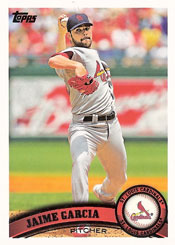
Garcia held the Rangers without a run for seven innings in Game 2 of the 2011 World Series but got no decision when Texas scored twice against the bullpen in the ninth and won, 2-1.

The other Cardinals left-handers to pitch at least seven scoreless innings in a World Series game _ Bill Hallahan, Ernie White, Harry Breechen and John Tudor _ all earned wins in those starts. Hallahan and Breechen each did it twice.

BILL HALLAHAN

In 1930, Hallahan, 28, led National League pitchers in strikeouts (177) and walks (126) while compiling a 15-9 record and 4.66 ERA.

After the Athletics won the first two games of the 1930 World Series, Hallahan started Game 3. In the first inning, the Athletics loaded the bases with two outs before Hallahan struck out Bing Miller.

The Athletics reached base in seven of nine innings, but Hallahan kept them from scoring. In the ninth, the Athletics put two on with two outs. Hallahan struck out Jimmy Dykes to end the game and preserve the Cardinals’ 5-0 victory. Boxscore

Hallahan gave up seven hits, walked five and struck out six. In the first inning, Hallahan yielded two singles and a walk, but struck out the side.

“We had plenty of chances to score in the opening inning while Hallahan was wild,” Athletics manager Connie Mack told the Associated Press. “Unfortunately, however, when he did get it over he was unhittable.”

In 1931, Hallahan again led NL pitchers in strikeouts (159) and walks (112) while posting a 19-9 record and 3.29 ERA.

And, again, Hallahan shut out the Athletics in the World Series.

In Game 2 of the 1931 Series, Hallahan pitched a three-hitter in the Cardinals’ 2-0 victory. Boxscore

Hallahan retired the first 11 batters before issuing a walk to Mickey Cochrane with two outs in the fourth.

The Athletics got their first hit in the fifth, a Bing Miller single. Philadelphia loaded the bases with one out before Hallahan induced pitcher George Earnshaw to ground into a double play.

The Cardinals almost blew the game in the ninth. The Athletics had two on with two outs when Hallahan struck out Jimmy Moore, who swung at a pitch in the dirt that catcher Jimmie Wilson mishandled.

Moore, thinking the game over, started toward the dugout as fans poured onto the field. Athletics coach Eddie Collins shouted at Moore to head to first base. As he did, Wilson grabbed the ball and inexplicably fired it to third base. All hands were safe. The bases were loaded.

The next batter, Max Bishop, uncorked a twisting fly ball into foul territory down the right field line. First baseman Jim Bottomley gave chase, stumbled into the Athletics bullpen, caught the ball and fell into the stands, completing a dramatic ending.

Hallahan walked seven and struck out eight.

In his syndicated column, Cardinals second baseman Frankie Frisch said of Hallahan, “He was effective because he had great speed, a fine breaking fast curve and good control of his change of pace slow curve.”

ERNIE WHITE

White, 26, rode a hot streak into the 1942 World Series, winning his last three regular-season starts and finishing 7-5 with a 2.52 ERA.

In Game 3 of the Series, White limited the Yankees to six hits, walked no one and struck out six in the Cardinals’ 2-0 victory. Boxscore

White set the tone in the first inning when, with Phil Rizzuto on second and two outs, he struck out Joe DiMaggio. White also benefitted from a spectacular catch by each outfielder: Stan Musial, Terry Moore and Enos Slaughter.

It was, White told the St. Louis Globe-Democrat, “the greatest game I ever hope to pitch.”

HARRY BREECHEN

After posting a 16-5 record in 1944, Breechen, 29, started Game 4 of the World Series against the Browns. Breechen held the Browns scoreless for the first seven innings as the Cardinals built a 5-0 lead. In the eighth, the Browns scored on a double-play grounder.

Though the Browns reached Breechen for nine hits and four walks, they were limited to that lone run as the Cardinals evened the Series with a 5-1 victory. Boxscore

In 1946, Breechen lost four of his first five decisions. He won his last two regular-season starts to finish 15-15 with a 2.49 ERA.

In Game 2 of the World Series against the Red Sox, Breechen pitched a four-hit shutout in the Cardinals’ 3-0 victory. Boxscore

Ted Williams was 0-for-4 with a strikeout versus Brecheen. In the ninth, Dom DiMaggio led off with a single, but Breechen retired Williams on a pop-up and got Rudy York and Bobby Doerr each to fly out.

“He (Breechen) certainly fooled me,” Williams said. “Somebody had told me he never threw a screwball. All of a sudden, Breechen would rear back and toss one of them at me.”

JOHN TUDOR

After limiting the Royals to a run and beating them in Game 1 of the 1985 World Series, Tudor, 31, did even better in Game 4, shutting out Kansas City on five hits in a 3-0 Cardinals victory. Boxscore

Tudor, who was 21-8 with a 1.93 ERA during the regular season, walked one and struck out eight, including George Brett twice on breaking pitches. Tudor retired the side in order in five innings, including the ninth. The Royals’ only extra-base hit was an eighth-inning double by Lynn Jones.

“I did just about everything right tonight,” Tudor told The Milwaukee Sentinel. “… I mixed pitches up and got them over the plate. I knew I had good stuff when I was warming up.”

JAIME GARCIA

Garcia, 25, held the Rangers to three singles and a walk in Game 2 of the 2011 Series. Texas was hitless until Michael Young singled with two outs in the fourth.

Garcia, a 13-game winner in 2011, stood to get the win when Allen Craig, batting for Garcia in the seventh, slashed a RBI-single to give the Cardinals a 1-0 lead, but Texas scored twice in the ninth, winning 2-1. Boxscore

“I’ve been working a lot to keep the ball down, get ahead early in the count,” Garcia told MLB.com.
(Updated Feb. 4, 2023)

When Arthur Rhodes pitched for St. Louis in Game 1 of the 2011 World Series, he became the fifth Cardinals player _ and the first in 29 years _ to appear in a Fall Classic at age 40 or older.

All five Cardinals age 40 or older to play in a World Series were pitchers:
_ Grover Cleveland Alexander, 41, in the 1928 World Series.

_ Jesse Haines, 41, in the 1934 World Series.

_ Dazzy Vance, 43, in the 1934 World Series.

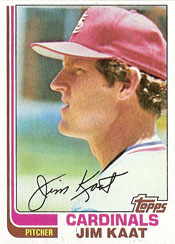
_ Jim Kaat, 43, in the 1982 World Series.

_ Arthur Rhodes, 41, in the 2011 World Series.

Haines and Vance pitched in the same game.

Alexander, Haines, Kaat and Vance were inducted into the National Baseball Hall of Fame.

Here is a look at their World Series performances for the Cardinals after they turned 40:

GROVER CLEVELAND ALEXANDER

The right-hander was a hero of the 1926 World Series, winning two starts and sealing the Cardinals’ Game 7 victory against the Yankees with an iconic save. It was a different story for Alexander and the Cardinals in the 1928 World Series.

At 41, Alexander still was effective. He made 31 starts, completing 18, for the 1928 Cardinals and was 16-9 with a 3.36 ERA for the National League champions.

So it was somewhat surprising when the Yankees pummeled him in the World Series. Alexander started Game 2 and lasted 2.1 innings, allowing six hits, four walks and eight runs, including a three-run, first-inning home run to Lou Gehrig. The Yankees won, 9-3. Boxscore

In Game 4, the Yankees led 4-1 with one out in the seventh when Alexander relieved starter Bill Sherdel. Alexander yielded three runs, including solo homers to Babe Ruth and Cedric Durst, and the Yankees went on to a 7-3 victory, sweeping the Series. Boxscore

Alexander ended the 1928 World Series with a record of 0-1 and a 19.80 ERA, allowing 11 runs in five innings.

JESSE HAINES

The right-hander started games for the Cardinals in the 1926, 1928 and 1930 World Series. At 41 in 1934, he primarily was a reliever. He appeared in 37 games, 31 in relief, during the regular season, posting a 4-4 record and 3.50 ERA.

In his lone appearance in the 1934 World Series, Haines entered Game 4 against the Tigers with one out in the eighth. He yielded a RBI-single to third baseman Marv Owens, and then struck out outfielder Pete Fox and pitcher Elden Auker. Boxscore

DAZZY VANCE

When the Reds placed Vance on waivers after the right-hander went 0-2 with a 7.50 ERA for them in 1934, it appeared his career was done at 43. The Cardinals, however, claimed him on June 25, bringing him back for a second stint with the club, and he was a productive member of the staff. Vance was 1-1 with a 3.66 ERA in 19 games, 15 in relief, for St. Louis.

A 16-year big-league veteran, primarily with the Dodgers when he led the National League in strikeouts seven seasons in a row, Vance made his only World Series appearance in Game 4 of the 1934 Series. He relieved starter Tex Carleton with two outs in the third. Though he yielded a RBI-single to Hank Greenberg, he pitched 1.1 innings, striking out three, including Tigers player-manager Mickey Cochrane. Boxscore

JIM KAAT

In the 1965 World Series, Kaat made three starts for the Twins and was matched each time against the Dodgers’ Sandy Koufax. Kaat won one of those three.

Seventeen years later, at 43, Kaat was an effective situational left-handed reliever for the Cardinals. During the 1982 regular season, Kaat appeared in 62 games and was 5-3 with a 4.08 ERA.

In the 1982 World Series, Kaat pitched in four of the seven games and had a 3.86 ERA, helping St. Louis to its first Fall Classic championship in 15 years.

In his book “Still Pitching,” Kaat wrote of Cardinals manager Whitey Herzog:

“Herzog was the most brilliant and the brightest manager I ever played for. The way he used me, and the way he ran a game, he was the best.”

ARTHUR RHODES

In his 20th big-league season, Rhodes, 41, made his first World Series appearance in Game 1 in 2011.

Entering with two outs in the eighth, Rhodes retired Josh Hamilton on a flyout to center and held the lead for closer Jason Motte, who sealed the Cardinals’ 3-2 victory over Texas. Boxscore

Rhodes turned 42 during the World Series _ on Oct. 24, 2011 _ and pitched in Game 7 on Oct. 28. Overall, Rhodes made three appearances in the 2011 World Series and didn’t allow a base runner in a total of one inning.

Rhodes had been released by the Rangers Aug. 8 and was signed by the Cardinals three days later.

(Updated May 25, 2019)

The history between the Cardinals and Rangers is highlighted by the seven-game World Series they played in 2011. Before then, their interactions were more quirky than rich.

Since the Washington Senators relocated to Texas and became the Rangers after the 1971 season, they have made some noteworthy trades with the Cardinals.
The Rangers also launched the managerial career of one of the Cardinals’ legends, Whitey Herzog, who was 47-91 with Texas in 1973.

Here’s a look at some of the deals between the Rangers and Cardinals:

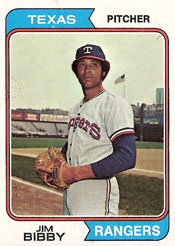
_ Cardinals send pitcher Jim Bibby to the Rangers for pitcher Mike Nagy and catcher John Wockenfuss, June 6, 1973: The trade was a bust for St. Louis. Bibby, seldom used by the Cardinals, became a 19-game winner for Texas in 1974. The right-hander recorded 111 wins in a 12-year big-league career.

Herzog had pushed for the Rangers to acquire Bibby. When Herzog was farm director of the Mets, Bibby was a prospect in New York’s minor league system.

At the time of the trade, Cardinals general manager Bing Devine told The Sporting News, “Whitey said Bibby has a better arm than half his pitchers.”

Nagy never won a game for the Cardinals and Wockenfuss (who became a reliable utility player for the Tigers) never played a regular-season game for St. Louis.

_ Cardinals send outfielder Tommy Cruz and cash to the Rangers for pitcher Sonny Siebert, Oct. 26, 1973: Cruz, the middle of the trio of outfielder brothers for St. Louis (Jose and Hector were the others), never played a regular-season game for Texas.

Siebert, a St. Mary, Mo., native who had success with the Indians and Red Sox, realized a lifelong dream by joining the Cardinals. He had been a high school basketball standout in suburban St. Louis and had been a baseball and basketball player at the University of Missouri.

Siebert, 37, opened the 1974 season in the Cardinals’ rotation. He was 6-3 with a 1.98 ERA on June 10. He finished the season 8-8 with a 3.84 ERA.

The right-hander’s most memorable win for St. Louis came on Sept. 11, 1974, at Shea Stadium in the Cardinals’ 4-3 25-inning victory over the Mets. Siebert pitched 2.1 innings of scoreless relief to earn the win, his last as a Cardinal. Boxscore

_ Cardinals send shortstop Eddie Brinkman and pitcher Tommy Moore to the Rangers for outfielder Willie Davis, June 4, 1975: St. Louis acquired the mercurial Davis with the hope his offense would spark them to a championship in 1975. Though the Cardinals fell short, Davis mostly delivered, filling in for injured outfielders Bake McBride and Reggie Smith.

Davis batted .291 with 50 RBI in 98 games. Brinkman, the Cardinals’ Opening Day shortstop, played one game for cash-strapped Texas before he was peddled to the Yankees. Moore never won a game for the Rangers.

Davis, 35, had clashed with Rangers manager Billy Martin. He staged a sitdown protest in center field when teammate Steve Hargan failed to hit a batter in retaliation after Davis was brushed back by an opponent’s pitch. Davis also irked Texas general manager Dan O’Brien by repeatedly asking for advances in his salary. “At some point, you’ve got to draw the line,” O’Brien told United Press International.

The trade was popular with Cardinals players. St. Louis second baseman Ted Sizemore, who had been Davis’ teammate with the Dodgers, told the Associated Press, “The man can play. He comes to play. He likes to play.”

Said Davis to The Sporting News: “With the Cardinals, I know I can play baseball again without being suppressed. I can be loose again.”

By September, though, Davis’ personal and financial problems caught up with him. He refused to play some games while his wife pursued an alimony case that threatened to restrict his wages. After the season, when he demanded a five-year contract for $1 million, the Cardinals traded him to the Padres.

_ Cardinals send shortstop Royce Clayton and pitcher Todd Stottlemyre to the Rangers for pitcher Darren Oliver, third baseman Fernando Tatis and outfielder Mark Little, July 31, 1998: Clayton and Stottlemyre were eligible to become free agents after the season and the Cardinals were uncertain they could re-sign them.

On the day of the trade, Texas was a game behind the first-place Angels in the American League West. The Cardinals were six games under .500 and 13.5 games behind the first-place Astros in the National League Central.

Clayton hit .285 for Texas in 1998 and Stottlemyre won five of 10 starts, helping the Rangers win the division title. St. Louis general manager Walt Jocketty, meanwhile, was positioning for the future.

“The guy we liked is Tatis,” Jocketty told The Sporting News when the trade was made. “We needed to find a third baseman and he was the best guy available.”

Tatis slugged 34 home runs for the Cardinals in 1999 and contributed to their division championship season in 2000.

(Updated Dec. 15, 2016)

A dominant bullpen contributed to the success of the Cardinals’ 2011 postseason, resulting in a World Series championship. To fully appreciate how far the Cardinals’ bullpen progressed, it’s important to look back to where it was on Opening Day in 2011.

Consider:

_ Of the seven relievers on the Cardinals’ 2011 Opening Day roster, only two, Mitchell Boggs and Jason Motte, remained with the team in the postseason.

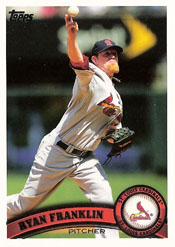
_ Five of the Cardinals’ relievers on Opening Day were Bryan Augenstein, Miguel Batista, Ryan Franklin, Trever Miller and Brian Tallet. None remained with the team in the postseason.

_ Opponents batted .367 in 27.2 innings against Franklin, who opened the season as St. Louis’ closer. Since 1996, the Cardinals’ first season with manager Tony La Russa and pitching coach Dave Duncan, only one St. Louis pitcher had a higher batting average against in 27 or more innings: Mike Maroth, whom opponents batted .394 against in 38 innings in 2007.

_ The quartet of Augenstein (.407 batting average against in 5.2 innings), Franklin (.367 in 27.2 innings), Miller (.306 in 15.2 innings) and Tallet (.339 in 13 innings) all allowed opponents to bat better than .300 against them in 2011.

_ The 26 blown saves by the 2011 Cardinals during the regular season were the most by any of the nine St. Louis teams to make the postseason since the arrival of La Russa and Duncan.

_ Only three Cardinals teams under La Russa and Duncan qualified for the postseason while failing to successfully convert at least 65 percent of their save opportunities. Those teams: 1996 Cardinals (64 percent, with 43 saves in 67 chances), 2000 Cardinals (63 percent, with 37 saves in 59 chances) and 2011 Cardinals (64 percent, with 47 saves in 73 chances).

_ The trio of Batista, Franklin and Miller had seven blown saves in nine opportunities in 2011, setting a terrible early-season pattern for the Cardinals.

_ Once help arrived for the bullpen, the Cardinals found an effective mix. Six Cardinals relievers held opponents to batting averages of .207 or less during the 2011 regular season: right-handers Eduardo Sanchez (.144 batting average against), Octavio Dotel (.182), Fernando Salas (.186), Motte (.202), Lance Lynn (.203) and left-hander Arthur Rhodes (.207).

_ The trio of Dotel, Salas and Sanchez in 2011 were the first Cardinals to each pitch at least 24 innings and hold opponents to a regular-season batting average of less than .200 since Troy Percival (.171), Jason Isringhausen (.179) and Russ Springer (.181) in 2007.

_ Three Cardinals relievers each pitched at least 22 innings and held opponents to one home run apiece during the regular season: Dotel, left-hander Marc Rzepczynski and Sanchez. To put into perspective how important that was to the bullpen’s turnaround, consider that Franklin yielded nine homers in 27.2 innings and Tallet gave up four homers in 13 innings.