Feeds:
Posts
Comments

The last Cardinals pitcher to give up five home runs in a game was Scott Terry.
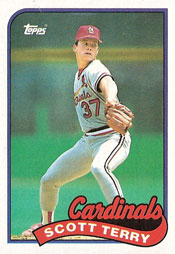
On June 4, 1989, at St. Louis, Terry started for the Cardinals against the Cubs and gave up six hits in 4.1 innings _ five of those hits were home runs.

Ryne Sandberg and Shawon Dunston each hit two solo homers against Terry and Mitch Webster added a two-run shot in the Cubs’ 11-3 victory. Boxscore

Terry entered the game having allowed three homers in 58.2 innings over 10 starts that season.

“Not only does it hurt your confidence,” Terry told The Sporting News, “but it’s embarrassing.”

Said Cardinals manager Whitey Herzog to the Associated Press: “There were no cheap ones. Those hits were deep. I’ve never seen the ball carrying like that.”

After Sandberg smacked his second solo homer with one out in the fifth, giving Chicago a 6-3 lead, Herzog lifted Terry for Frank DiPino, a former Cub. DiPino threw a waist-high brushback pitch to the first batter he faced, Mark Grace, who charged the mound, prompting both benches to empty.

Though the melee was brief, it was costly. Grace partially separated his shoulder and was ejected. St. Louis third baseman Terry Pendleton bruised his elbow and left the game.

“It was not my intention to hit him,” DiPino said, “but I’ve got to show some protection for myself. They’ve just hit five home runs ahead of me and I’m going to lay one over the middle of the plate? It doesn’t work that way. It was a purpose pitch. I threw it where I wanted to throw it. But I didn’t do it so he would charge the mound.”

Said Grace: “(DiPino) didn’t like me last year, even when we were teammates.”

DiPino responded: “We weren’t the best of friends … I just don’t like guys who are cocky.”

Cardinals ace Bob Gibson never gave up five home runs in a game, but he did allow four multiple times.

On Aug. 28, 1963, when the Giants beat St. Louis, 5-3, at San Francisco, Tom Haller hit two solo homers, Orlando Cepeda hit one and Chuck Hiller hit a two-run shot against Gibson. Boxscore

The Giants also hit four homers against Gibson on May 8, 1973, at San Francisco. Bobby Bonds hit two homers _ a solo shot on Gibson’s first pitch of the game and a two-run homer _ and Willie McCovey and Dave Kingman each launched solo homers against Gibson in the Giants’ 9-7 victory. Boxscore

“If you get one hit off Bob Gibson, it’s a good night,” Bonds said, “so this one is great.”

In the other game in which Gibson allowed four homers, the Cardinals beat the Mets, 8-5, at St. Louis. Charlie Smith hit a two-run homer and Jesse Gonder, Johnny Lewis and Jim Hickman all had solo shots against Gibson. Boxscore
(Updated April 9, 2019)

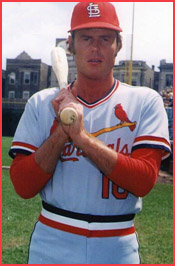
Dave Campbell’s brief career with the Cardinals was most notable for what he didn’t do.

In 21 at-bats for the 1973 Cardinals, Campbell failed to get a hit.

Campbell went 45 consecutive at-bats without a hit in 1973. His streak occurred while playing for three teams.
In 2019, Chris Davis of the Orioles set a major-league record for a position player by extending his hitless streak to 47 consecutive at-bats.

Campbell, an ESPN baseball broadcaster from 1999-2010, began his seventh big-league season in 1973 as an infielder for the Padres. He went hitless in his last 17 at-bats for San Diego before he was traded to the Cardinals for infielder Dwain Anderson on June 7, 1973.

In 24 plate appearances in 13 games for St. Louis, the best Campbell could achieve was a walk, a sacrifice bunt and a sacrifice fly.

Campbell’s lone batting highlight as a Cardinal came on July 10, 1973, against the Dodgers at Los Angeles. In the top of the seventh, with the Dodgers ahead 2-1, the Cardinals had Jose Cruz on third, Mike Tyson on first and one out when manager Red Schoendienst called on Campbell to pinch-hit for pitcher Tom Murphy.

Facing Dodgers starter Claude Osteen, Campbell hit a sacrifice fly to center, scoring Cruz with the tying run. The Cardinals went on to a 5-4 victory. Boxscore

Campbell’s final at-bat as a Cardinal came on Aug. 17, 1973, at St. Louis against the Padres. After San Diego scored twice in the 13th inning, snapping a 2-2 tie, the Cardinals had Ted Simmons on second and Hector Cruz on first with two out. Schoendienst chose Campbell to pinch-hit for pitcher Diego Segui. Campbell popped out to second base, ending the game. Boxscore

The next day, the Cardinals traded Campbell to the Astros for outfielder Tommie Agee. St. Louis, in first place in the National League East, was seeking to bolster its bench for a pennant push.

“It’s tough to leave a club that is in first place and has a shot at the big money,” Campbell told The Sporting News. “But due to my past association with (Astros coach) Preston Gomez it could be a break for me. Preston was the manager at San Diego when I was a regular there for four years. So he knows what I can do.”

After a 17 at-bat hitless streak for the Padres and a 21 at-bat hitless streak for the Cardinals, Campbell went hitless in his first seven at-bats for the Astros, tying the major-league mark of 45 consecutive hitless at-bats by a non-pitcher.

On Sept. 19, 1973, in the opener of a doubleheader against the Padres at Houston, Campbell hit a two-run double against Clay Kirby in the first inning, breaking his drought. Boxscore  Campbell had four hits in the doubleheader: two in each game.

In an eight-year big-league career, Campbell batted .213.

(Updated Sept. 3, 2018)

Bill Greason had a short, but important, stint with the Cardinals. He was the first African-American Cardinals pitcher.

Greason, 29, made his major-league debut with the Cardinals on May 31, 1954, as the starter in the first game of a Memorial Day doubleheader at Chicago’s Wrigley Field.
He yielded three home runs _ two to Hank Sauer and one to Ernie Banks _ and the Cubs beat the Cardinals, 14-4. Boxscore

Greason, an Atlanta native who served with the Marines in Iwo Jima in World War II, began pitching Negro League baseball in 1947. As a teammate of Willie Mays on the 1948 Birmingham Black Barons, Greason posted a 6-4 record with a 3.30 ERA for the Negro American League champions. The lanky right-hander earned Birmingham’s only win in the 1948 Negro World Series against the Homestead Grays.

After stints in the Negro League and the Mexican League, Greason became the second black to play in the Texas League. In 1953, he was 16-13 with a 3.61 ERA and 193 strikeouts for Oklahoma City, catching the attention of the Cardinals.

On Oct. 13, 1953, the Cardinals acquired Greason from Oklahoma City for three minor league players.

In an article headlined “Cards, Reshuffling Hands, Get Texas Negro Ace In Deal,” Bob Broeg wrote in The Sporting News: “Greason, frequently mentioned in the past as highly promising, is likely to become the first Negro player ever to perform for the Cardinals.”

Pitching for Santurce in the Puerto Rico Winter League, Greason further impressed. On Jan. 6, 1954, after Tommy Lasorda pitched Santurce to a 4-3 victory over Caguas in the opener of a doubleheader, Greason won the second game, 3-2, holding Caguas to three singles, one by Hank Aaron.

On Jan. 20, 1954, The Sporting News wrote of Greason: “The big Negro hurler purchased by the Cardinal organization from Oklahoma City last fall has accounted for approximately half of Santurce’s conquests and is rated a good chance to make the Cardinal staff.”

Two weeks later, the magazine reported: “With the purchase of first baseman Tom Alston from San Diego (Pacific Coast), the Cardinals now have 14 Negro players in their organization. Alston is the only member of the parent club.”

As spring training ended, the Cardinals assigned Greason and another black pitcher, Brooks Lawrence, to Class AAA Columbus (Ohio), managed by Johnny Keane.

Alston made the Cardinals’ roster, and the first baseman became the first African-American to appear in a big-league game for the Cardinals when he started in the season opener April 13, 1954, against the Cubs at St. Louis. Boxscore

At Columbus, Greason compiled a 4-5 record, winning his last three decisions. On May 28, the Cardinals sent pitcher Mel Wright to Columbus and called up Greason.

Greason’s debut as the first African-American Cardinals pitcher started well. The Cardinals scored twice in the first. In the bottom half of the inning, Greason retired the first two batters. Then, Ralph Kiner singled and Sauer homered, tying the score.

In the third, with St. Louis leading 4-2, Greason again set down the first two Cubs batters. Then, Sauer homered, Randy Jackson singled and Banks homered, giving Chicago a 5-4 lead. In the fourth, Greason was lifted for pinch-hitter Sal Yvars.

Greason’s line: 3 innings, 6 hits, 5 runs, 1 walk and 2 strikeouts.

On June 6, a Sunday afternoon in St. Louis, Greason got the start against the Phillies, but it was a disaster. The leadoff batter, Willie Jones, homered. When Greason walked the next two batters, Richie Ashburn and Earl Torgeson, Cardinals manager Eddie Stanky removed him from the game. Boxscore

Greason sat for two weeks before making his third and final appearance, pitching a scoreless inning of relief against the Giants in New York on June 20. Boxscore

Two days later, the Cardinals sent Greason and pitcher Stu Miller to Columbus.

“They’ll have a chance to come back if they do well enough at Columbus,” Stanky said, “but they weren’t helping us enough and we had to make the move.”

Greason never appeared in the major leagues again. His career stats: 4 innings, 8 runs (6 earned), 8 hits, 4 walks, 2 strikeouts, 0-1 record, 13.50 ERA.

Greason pitched in the Cardinals’ minor-league system until 1959. After his playing career, Greason returned to Birmingham, worked in a department store and became a minister. In September 2014, Greason, 90, was honored by the Cardinals at Busch Stadium for having been a pioneer in helping break the franchise’s color barrier 60 years before.

(Updated July 26, 2020)

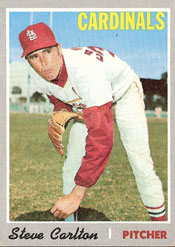
In 1970, Cardinals pitcher Steve Carlton could do almost nothing right against the Reds. The Cincinnati hitter who hurt him the most was Johnny Bench.

On July 26, 1970, a muggy Sunday afternoon in Cincinnati, Bench went 4-for-5 with three home runs, seven RBI and three runs scored in the Reds’ 12-5 victory against the Cardinals. All three home runs were hit versus Carlton. Boxscore

To give Bench a break from catching in the midsummer heat, Reds manager Sparky Anderson started the 22-year-old in left field that day. It was one of 17 games Bench started in the outfield in 1970. Pat Corrales, a former Cardinal, was the Cincinnati catcher.

“If that boy didn’t have to catch, there’s no telling what you might see,” Anderson told the Dayton Journal Herald.

Bench said to the Dayton Daily News, “If I can hit like that, I don’t care where I play, but there’s no question I feel stronger when I’m playing in the outfield.”

Hardball tactics

In the first inning, Bench, batting in the cleanup spot, hit a Carlton fastball over the right-center field wall at Riverfront Stadium for a three-run home run. When Bench followed by hitting a slider for a two-run home run to left in the second, Carlton fired a brushback pitch at the next batter, Lee May, sending him sprawling to the dirt.

“Carlton throwing at May is, well, it’s just baseball, but I don’t like anybody throwing at my hitters,” Anderson said to the St. Louis Post-Dispatch.

Said Cardinals manager Red Schoendienst: “A pitcher doesn’t have a chance any more. There’s the lively ball and the AstroTurf and the smaller strike zone … If you’re a pitcher, you have to brush back those hitters.”

Reds starter Wayne Simpson delivered payback the next inning when Carlton batted and was struck in the right calf by a pitch. Anderson approached Simpson about it between innings. “I told him I didn’t want him bothering with Carlton,” Anderson said. “I don’t like that type of baseball.”

When Simpson came to the plate in the bottom half of the third, Carlton threw a pitch inside. Simpson made a move toward Carlton, but no fight erupted.

Bench let his bat do the talking. He led off the fifth by belting a fastball over the wall in left for his third home run of the game against Carlton. “That’s the best day I’ve had since I hit three homers one day as a nine-year-old playing Little League ball at Cement, Okla.,” Bench told the Cincinnati Enquirer.

Said Anderson: “He’s only 22 and already he’s the best there is. Name me another catcher of our time you’d match him against.”

Fine wine

In his book “Chasing the Dream,” Joe Torre, who was Carlton’s roommate on Cardinals road trips in 1970, recalled, “After the game, Lefty and I commiserated over dinner and a little wine. I guess we had more than a little wine. When we got back to our hotel suite, I think we broke every stick of furniture in the room. When we awoke in the morning and realized what we had done, we tried to glue everything back together.

“When we left the suite, we had to make sure we didn’t close the door too hard because we were afraid the noise would cause everything to fall apart.”

Bench was the first Reds player with seven RBI in a game since Frank Robinson did it in May 1963, and he was the first Reds player with three home runs in a game since Art Shamsky in 1966. Bench went on to lead the National League in home runs (45) and RBI (148) in 1970, winning the Most Valuable Player Award and powering the Reds to the pennant.

Carlton made four starts against the Reds in 1970, posting an 0-4 record and 7.82 ERA. In 25.1 innings versus Cincinnati, Carlton yielded 24 runs and 35 hits.

Three years later, on May 9, 1973, Bench, catching and batting third, again smashed three home runs against Carlton, who was with the Phillies, in Cincinnati’s 9-7 victory at Philadelphia. Boxscore

“I don’t see how a man can cover so much of the plate,” Carlton told The Sporting News. “I threw Bench six inches inside and six inches outside, but it didn’t matter.”

Bench hit .305 (39-for-128) against Carlton in his career. The 12 home runs Bench belted against Carlton were the most he hit in his career against a left-hander.

Both Bench and Carlton are enshrined in the National Baseball Hall of Fame.

If not for Rafael Furcal, Rick Ankiel would have won the National League Rookie of the Year Award.

Furcal, acquired by the Cardinals from the Dodgers July 31 in a trade for minor-league outfielder Alex Castellanos, earned the NL’s top rookie honor in 2000 when the shortstop hit .295 with 40 stolen bases for the Braves.
Furcal received 25 of 32 first-place votes from members of the Baseball Writers Association of America. He also had six second-place votes and one third-place vote, giving him 144 total points in the balloting.

Ankiel, a left-handed pitcher, was 11-7 with a 3.50 ERA for the 2000 Cardinals. He struck out 194 in 175 innings and yielded only 137 hits.

Finishing second to Furcal in the rookie of the year balloting with 87 points, Ankiel received six first-place votes, 17 seconds and six thirds. Mets outfielder Jay Payton (.291, 17 home runs) was a distant third, with 37 points.

Though Ankiel had an epic meltdown in the 2000 postseason (nine wild pitches and 11 walks in four innings), that performance didn’t impact the rookie of the year balloting because all votes were submitted before the playoffs began.

Furcal, the first middle infielder to win the NL Rookie of the Year Award since Steve Sax of the Dodgers 18 years earlier, had come to spring training as a non-roster player in 2000 and was issued a uniform with the number 78.

He led NL rookies in runs scored (87), walks (73) and on-base percentage (.394).

“He’s got a lot of confidence,” said Braves outfielder Andruw Jones when asked about Furcal in November 2000. “I’m not saying he’s cocky, but he knows when he does his best he can be successful.”

Said Furcal in a statement to reporters after learning he had won the award, “There were a lot of other rookies who had great years, and for me to win this means my hard work has paid off.”

Ankiel never would regain the pitching skills he showed in the 2000 regular season, and was converted to an outfielder. At the time of the rookie honor, though, many thought he would recover from the wildness that plagued him in the playoffs.

“He’s a young kid and he’s tough as nails,” Cardinals pitching coach Dave Duncan told the Associated Press. “He’s going to be fine.”

Said Pirates manager Gene Lamont of Ankiel: “He’s probably the best-looking young pitcher in baseball, at least in our league. When he starts throwing that curveball and change-up across (the plate), they’ll start talking about him like they did about (the Cubs’) Kerry Wood.”

After Ankiel was named the surprise starter of Game 1 of the 2000 NL Division Series against the Braves at St. Louis, the first batter he faced was Furcal, who singled and then was caught attempting to steal. In the third, after Furcal popped out to first base, Ankiel threw the first of his five wild pitches in the inning. Boxscore

Furcal made a big impression on the Cardinals in his first game against them. On Aug. 4, 2000, at St. Louis, Furcal was 2-for-2 with three walks, two RBI, two steals and two runs scored against Andy Benes and reliever Matt Morris in a 6-4 Braves victory. Boxscore His career batting average against the Cardinals is .344 (83-for-241).


(Updated Dec. 27, 2024)

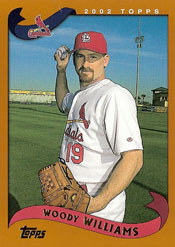
In August 2001, the Cardinals began a transformation from underachievers to postseason qualifiers when they acquired pitcher Woody Williams from the Padres for outfielder Ray Lankford.

After winning the National League Central championship in 2000, the Cardinals were expected to contend in 2001, but they entered August in third place at 53-51 _ 8.5 games behind the first-place Cubs and four behind the Astros.

With the emergence of rookie Albert Pujols, the Cardinals had a surplus of outfielders, including Jim Edmonds, J.D. Drew and Lankford. Complaining about a lack of respect, Lankford, 34, was falling out of favor with team management. It didn’t help that he was hitting .235 with 105 strikeouts in 264 at-bats. Lankford had missed on 36 percent of his swings.

On Aug. 2, 2001, the Cardinals sent Lankford (who agreed to waive his no-trade clause) and more than $2.8 million to the Padres for Williams. Andy Benes was struggling (7.06 ERA entering August) and the Cardinals needed a fifth starter to join a rotation of Matt Morris, Darryl Kile, Dustin Hermanson and Bud Smith.

“We’re extremely happy,” Cardinals general manager Walt Jocketty said to the St. Louis Post-Dispatch. “Woody Williams is a quality pitcher and a quality person.”

Williams, who would turn 35 Aug. 19, didn’t appear to be the obvious solution. He was 8-8 with a 4.97 ERA for the Padres, yielding 170 hits in 145 innings.

“I’m going to use this as a steppingstone that will allow me to get back to where I want to be,” Williams said.

Relying on a change of speeds and sharp location, Williams made his first Cardinals start on Aug. 4, 2001, against the Marlins at St. Louis and pitched six shutout innings. He left the game to a standing ovation from the crowd of 42,312. Luther Hackman and Gene Stechschulte combined to pitch three shutout innings in relief, preserving the win for Williams in a 3-0 victory. Boxscore

Starting with that game, the Cardinals went 38-16 the remainder of the season, finishing in a tie for first place with the Astros at 93-69 and qualifying for the playoffs for a second consecutive season.

The Cardinals couldn’t have done it without Williams, who was 7-1 with a 2.28 ERA for them, limiting batters to 54 hits in 75 innings.

Looking back on his Cardinals days, Williams told Stan McNeal of Cardinals Magazine in 2024, “When I got to St. Louis, I’d had a problem with giving up the long ball in my career … In St. Louis, my mentality became, ‘I’m going to attack the zone and keep the ball in the ballpark.’ I’ll be doggone if those guys behind me didn’t support me like crazy and make me look like a much better pitcher.”