Feeds:
Posts
Comments

Described in a 1967 wire service story as having “the diplomacy and tact of a marine drill sergeant at boot camp,” Red Sox manager Dick Williams accused Cardinals pitcher Nelson Briles of deliberately hitting Boston slugger Carl Yastrzemski with a pitch in Game 3 of the World Series.

The incident was the biggest on-field controversy of that World Series.

Following the lead of their manager, Red Sox players complained bitterly.

Whether he hit Yastrzemski intentionally or, as Briles first claimed, the pitch squirted uncontrollably out of his tight grip, the Cardinals got the upperhand in a Series they would win in seven games.

Williams, a St. Louis native who grew up rooting for Cardinals outfielder Joe Medwick, was one of the game’s best managers. He led the Red Sox, Athletics and Padres to pennants, won consecutive World Series titles with Oakland and was elected to the National Baseball Hall of Fame.

In 1967, the fiery Williams took a dispirited Red Sox franchise that had finished ninth in the 10-team American League in 1966 and pushed them to an unlikely pennant in his first year as a big-league manager.

So respected was Williams that one of his managerial adversaries, Eddie Stanky, whose White Sox finished three games behind Boston in 1967, sent the Red Sox skipper a telegram that read, “You did a remarkable job. Continued success in the World Series. Win, lose or draw, you’re the greatest.”

Relishing the underdog role, Williams implored his players not to back down against the National League champions. After St. Louis won Game 1 behind ace Bob Gibson, Boston took Game 2 on Jim Lonborg’s one-hitter. Lonborg, following Williams’ tone, was the intimidator, brushing back several Cardinals.

Entering the pivotal Game 3 in St. Louis, the Cardinals needed to regain their swagger. Briles took the initiative, telling reporters the Red Sox are “a weaker hitting team than any team we face in the National League.”

After Boston leadoff batter Jose Tartabull grounded out against Briles to begin Game 3, the ball was being tossed around the infield until it got to third baseman Mike Shannon. In the book “Spirit of St. Louis,” Briles told author Peter Golenbock, “Shannon, who had a strong arm, … took the ball and tried to throw it through my chest. He was saying, ‘What the hell is going on? Isn’t anybody going to protect us?’ That’s the message that came with that throw.”

After the next batter, Dalton Jones, struck out, the ball again was whipped around the infield until reaching Shannon. He fired it back to Briles, with even more force than the first throw.

Briles got the message. Up next was Boston’s best player, Yastrzemski, who led the American League in batting average, home runs and RBI.

Briles’ pitch hit Yastrzemski in the back of the left leg, in the middle of the calf. As the Red Sox star went sprawling to the ground, Williams shot out of the dugout and confronted plate umpire Frank Umont.

“He did that deliberately,” Williams said to Umont. “What are we going to have, a throwing contest here?”

Umont replied, “Don’t worry. I’ll take charge of the situation.”

The umpire beckoned Cardinals manager Red Schoendienst and told both skippers that any more purpose pitches would result in substantial fines.

Yastrzemski attempted to steal second base and was thrown out by catcher Tim McCarver. Lou Brock then led off the Cardinals’ half of the first with a triple and scored on Curt Flood’s single. Inspired, the Cardinals went on to a 5-2 victory behind Briles’ complete-game seven-hitter. Boxscore

“From that point on,” Briles told Golenbock, “we had a Series. All that junk was out of the way. There were no more knockdowns, no more nonsense. And I think at that moment I gained the respect of the ballclub.”

After the game, Williams and his players lashed out.

“I know he was trying to hit him,” Williams told Will McDonough of the Boston Globe.

Said Lonborg: “When a pitcher goes behind the hitter like that, he is definitely trying to hit him. If a pitcher doesn’t have better control than that, he shouldn’t be in the big leagues.”

Yastrzemski told McDonough: “He tried to hit me. There’s no doubt about it.”

Briles and Schoendienst told different stories.

Briles to McDonough: “I didn’t throw at him. I was just gripping the ball too hard and the pitch got away from me.”

Said Schoendienst: “We hear so much about Lonborg brushing guys back.”

Responded Williams, “Yes, but there’s a difference between brushing someone back and deliberately hitting him.”

Red Sox pitcher Jose Santiago called the Cardinals “bush league” and Boston center fielder Reggie Smith said Briles “is a big-mouth popoff.”

All the huffing and puffing played into Briles’ hands. Smith admitted, “We wanted to beat him so bad that I think we got all fouled up. Everyone was overanxious and not waiting for good pitches.”

The Series went seven games, but only one other batter was hit by a pitch.

In Game 6 at Boston, Briles entered in relief to jeers in the fifth. The first batter he faced was Red Sox starting pither Gary Waslewski.

Briles hit him.
After climbing back from a 9-0 deficit against the Giants and tying the score, the Cardinals lost the game.

On July 17, 1954, at St. Louis, the Giants led 9-0 in the third inning behind their ace, Johnny Antonelli. The Cardinals rallied with five runs in the sixth, three in the seventh and one in the eighth, tying the score at 9-9, but the Giants won, 10-9, in 11.
The game matched Antonelli, 24 and hailed by Giants catcher Wes Westrum as the best left-handed pitcher in the National League, against Royce Lint, a 33-year-old rookie left-hander making his third big-league start for the Cardinals.

From the beginning, the game followed script as a mismatch. Three of the first four batters reached base against Lint. The Giants led 2-0 in the first before manager Eddie Stanky lifted Lint and replaced him with Cot Deal, a 31-year-old right-hander pitching in his last major-league season.

The Giants scored seven times against Deal in the third for a 9-0 lead.

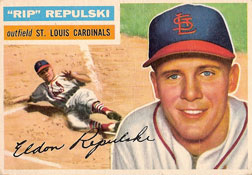
After cruising through five innings, Antonelli surrendered five runs in the sixth _ the big hits being a two-run single by Rip Repulski and a two-run double by Red Schoendienst.

In the Cardinals’ three-run seventh, pinch-hitter Joe Frazier hit a two-run triple against Hoyt Wilhelm.

The Cardinals tied the score, 9-9, in the eighth when pinch-runner Dick Schofield scored on first baseman Whitey Lockman’s error.

Marv Grissom and Windy McCall held the Cardinals hitless over the last three innings. In the 11th, Harvey Haddix, pitching his third inning of relief for the Cardinals, yielded a sacrifice fly to Don Mueller. Boxscore

The winning run was scored by Billy Gardner, who was a pinch runner for a pinch runner.

After pinch-hitter Bobby Hofman led off the 11th with a single, Giants manager Leo Durocher sent in pitcher Ruben Gomez as a pinch runner. Gomez reached second on a sacrifice and went to third on an infield single.

As Mueller stepped to the plate, Durocher looked at Gomez and remembered the pitcher was scheduled to start the next day’s game. Concerned Gomez might risk injury if he had to slide on a play at the plate, Durocher replaced Gomez with Gardner, a reserve infielder.

“If it all sounds screwy, that was the pattern of the contest,” the New York Daily News noted.

That was one of several unusual occurrences in the game:

_ Though the teams combined for 19 runs, no one hit a home run.

_ Though the Cardinals had nine runs and 15 hits, two of their top hitters, Stan Musial and Wally Moon, were a combined 0-for-10.

_ In the fourth, Giants center fielder Willie Mays received word of the death in Alabama of his aunt, Sarah Mays, with whom he had lived as a child. Heartbroken, Mays was unable to continue and was removed from the game by Durocher.

(Updated July 12, 2020)

With one swing of the bat, the Cardinals’ Stan Musial won the 1955 All-Star Game for the National League.

In 2011, MLB.com asked fans to vote for the best All-Star Game moment. Musial’s 12th-inning walkoff home run at Milwaukee on July 12, 1955, was voted the best.
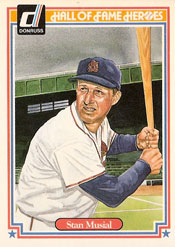
It was Musial’s fourth All-Star Game homer. He would hit two more All-Star Game home runs, giving him six for his career. That remains the record. The runners-up are Ted Williams and Fred Lynn, each with four.

Warming up

In batting practice before the 1955 game, the National League players were told they would get just one swing each the last time around. “Tell you what let’s do,” Duke Snider of the Dodgers told Musial and Ted Kluszewski of the Reds. “Let’s swing from the heels and go for the distance.”

According to The Sporting News, Musial went first and and sent a shot into the right-field bleachers, near where he would later hit his game-winning homer. Kluszewski sent an even deeper blast over the fence. When Snider stepped in, he took a mighty swing _ and missed. “Serves me right,” Snider said.

Wild swings

Musial wasn’t named an all-star starter in 1955. He entered in the fourth inning as a replacement for Del Ennis in left field and wasn’t much of a factor for most of the game. Musial struck out in the fourth against Early Wynn, grounded into a double play in the sixth against the same pitcher, and tapped to second baseman Bobby Avila in the eighth with Whitey Ford on the mound. In the ninth, Musial drew a walk from Frank Sullivan of the Red Sox.

In the dugout, all-star teammate Frank Thomas told Musial, “You’ve been pulling your head, trying to kill the ball,” the St. Louis Post-Dispatch reported.

Musial admitted to the St. Louis Globe-Democrat, “I was going for the bundle the two previous times up.”

Just meet the ball

With the score tied at 5-5, Musial was the first to bat for the National League in the bottom of the 12th. “This time, I was just trying to get on base,” Musial told the Globe-Democrat.

As Musial approached the batter’s box, American League catcher Yogi Berra, who had been bantering happily with him throughout the game, was grumbling.

“What’s the matter, Yogi?” Musial asked.

“It’s these extra innings,” Berra replied. “Tough on a guy catching every day.”

As Musial dug in at the plate, he said, “Yeah, I’m getting tired, too.”

Sullivan’s first pitch to Musial was a fastball just above the waist. Musial uncoiled and met the pitch squarely. “The moment Musial connected, everyone in the park, including Sullivan, knew that the ballgame was over,” The Sporting News reported.

The home run gave the National League a 6-5 victory. Boxscore and Video

After Musial crossed the plate, his teammates wanted to carry him off the field, but Musial resisted the gesture.

Obliging every media request for a picture or interview, Musial was one of the last players to leave the locker room. Most of the National League stars were waiting aboard the team bus when Musial emerged from the clubhouse and got surrounded by adoring fans.

“It took a squad of police to disperse the happy crowd and hustle Musial to the waiting bus,” The Sporting News reported. “For the final run of about 100 feet from the point where the crowd had Stan pinned against a wall to the (bus), five police officers formed a wedge with Musial in the middle and forced their way through the throng. They had the most difficulty with a middle-aged matron who was intent upon kissing Musial.”

(Updated May 22, 2022)

Once a tradition as reliable as fireworks and ice cream, the big-league baseball doubleheader was a staple of Independence Day in the United States.

The Cardinals played a July 4 doubleheader every year from 1927 through 1950.

Since 1900, the Cardinals have played 59 Independence Day doubleheaders _ but none since 1984.

Played at San Francisco’s Candlestick Park on a Wednesday, with Game 1 beginning at 10:30 a.m., the last Cardinals doubleheader on July 4 featured the debut of one of their starting pitchers, the first career save for one of their relievers and a timely hitting display by a first baseman who would be dealt to the Giants after the season.

Riding a six-game winning streak entering the doubleheader, the Giants were stopped in Game 1 by the pitching of Cardinals rookie left-hander Ricky Horton.

Horton allowed the Giants’ leadoff batter to reach base in four of seven innings pitched, but limited San Francisco to two runs.

“I didn’t exactly have good stuff,” Horton said to the St. Louis Post-Dispatch. “The whole day I was behind a lot of hitters.”

Paced by first baseman David Green’s two-run home run, the Cardinals led, 4-2, when manager Whitey Herzog turned to closer Bruce Sutter in the eighth.

Sutter loaded the bases with one out before striking out pinch-hitters Chili Davis and Scot Thompson.

In the ninth, Sutter gave up three hits and a run, but with runners on first and second, one out, he retired Dusty Baker and Joel Youngblood on forceouts, preserving the 4-3 win for Horton and St. Louis. Boxscore

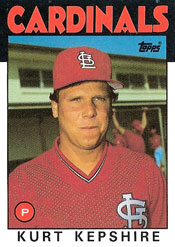
For Game 2, Herzog started Kurt Kepshire, a right-hander making his major-league debut.
Called up from Class AAA Louisville, where he was 7-5 with a 4.60 ERA in 16 starts, Kepshire limited the Giants to a run through eight innings.

In the ninth, with one out and the Cardinals ahead, 5-1, Kepshire walked Thompson and Youngblood. Jeff Lahti relieved and retired Bob Brenly on a flyout and Al Oliver on a groundout, earning his first big-league save. Boxscore

“I had butterflies, but I wasn’t petrified,” Kepshire said to the Associated Press. “The wind made my breaking ball hang early in the game, so I started using the fastball more.”

Said Herzog: “He challenges those guys. He’s got some guts. I love it.”

The Giants stranded 19 baserunners in the doubleheader. Referring to the Cardinals’ two rookie starting pitchers, Giants shortstop Johnnie LeMaster told the San Francisco Examiner, “We let two guys get away with some awful bad stuff.”

Green drove in the go-ahead run in Game 2. Seven months later, he was traded by the Cardinals to the Giants as a key part of the deal for slugger Jack Clark.

One unfortunate note: Late in the second game, the San Francisco Examiner reported, someone flung a large explosive from the upper deck in center field down past the scoreboard to the seats in the lower deck. “The bomb went off in a blast that sent white smoke billowing and a roar reverberating through the stands,” according to columnist Art Spander. A 24-year-old woman was injured, suffering facial burns and cuts, and taken to a hospital.

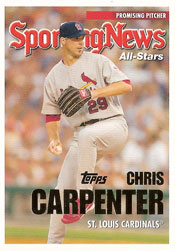
Just how well Chris Carpenter pitched for the 2005 Cardinals may become more fully appreciated with time.

Carpenter, who won the 2005 National League Cy Young Award with a 21-5 record and 2.83 ERA, put together a one-month stretch then that recently was touted as historically unprecedented in both its successfulness and its artistry.
Detroit’s Justin Verlander in 2011 won six straight starts, allowing four runs and 35 baserunners, with 51 strikeouts, in 49.2 innings pitched.

Since 1900, only one big-league pitcher, Chris Carpenter, has had six wins in six starts, with as many innings pitched and strikeouts as Verlander, and as few runs and baserunners allowed, according to the Elias Sports Bureau.

In 2005, from June 14 to July 17, Carpenter went 6-0 in 50.2 innings pitched, with two runs and 27 baserunners allowed, and 54 strikeouts.

Carpenter had a 0.35 ERA during that six-game stretch, lowering his season ERA from 3.49 to 2.34.

“Unfairly to (Carpenter), we kind of expect him to go out and throw shutouts,” teammate Scott Rolen told MLB.com in July 2005. “It’s not that easy.”

Said Cardinals manager Tony La Russa of Carpenter then: “I would say location is (the key). He’s really getting the ball down quite a bit with movement. ”

Here is a look at Carpenter’s dominant 2005 stretch:

June 14, at Toronto, Cardinals 7, Blue Jays 0: Carpenter pitched a one-hitter and struck out 10 against his former club. The lone hit was a sixth-inning double by shortstop Russ Adams. Boxscore

June 20, at Cincinnati, Cardinals 6, Reds 1: Carpenter shut out the Reds for eight innings. After Felipe Lopez led off the Reds’ ninth with a home run and Rich Aurilia walked, Ray King relieved Carpenter and finished the game. Boxscore

June 25, at St. Louis, Cardinals 8, Pirates 0: In a game that took just 2:09, Carpenter pitched a four-hitter and struck out 11. Boxscore

July 1, at St. Louis, Cardinals 6, Rockies 0: Carpenter held Colorado scoreless for 7.2 innings. With a runner on base and two outs in the eighth, La Russa lifted Carpenter and brought in King, a left-hander, to face left-handed batter Todd Helton. King struck out Helton. Boxscore

July 6, at Phoenix, Cardinals 2, Diamondbacks 1: After Carpenter limited Arizona to three hits (including an Alex Cintron solo homer) in eight innings, St. Louis broke a 1-1 tie in the ninth on David Eckstein’s RBI-suicide squeeze bunt. Jason Isringhausen preserved the win for Carpenter with a scoreless ninth. Boxscore

July 17, at St. Louis, Cardinals 3, Astros 0: In his first start after the all-star break, Carpenter outdueled Roger Clemens, pitching a three-hitter and striking out nine. Boxscore

After the win over Houston, La Russa, speaking to Matthew Leach of MLB.com, said of Carpenter, “When he threw the ball inside today, he was right on the black with movement. He got ground balls to the left side. He’s pitching to a very wide plate because he goes to the other side. His breaking ball is down with good break. He’s locating very, very well with good stuff.”

Said Carpenter: “It’s all about execution and location.”

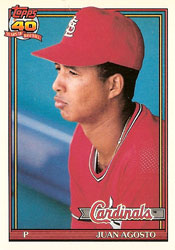
Perhaps no performance better symbolizes the disappointing tenure of Juan Agosto with the Cardinals than the 1992 game in which he gave up the winning run by hitting a batter with the bases loaded.

Agosto’s name resurfaced June 22 as the Mets beat the Athletics, 3-2, in the 13th inning when Brad Ziegler hit Justin Turner with a pitch, forcing in the winning run. It was the first time a major-league team had won on a game-ending hit-by-pitch in the 13th inning or later since the Mets beat Agosto and the Cardinals 19 years ago, according to the Elias Sports Bureau.

Agosto, a left-handed reliever, signed a three-year, $4.6 million free-agent contract with the Cardinals in December 1990. The money was guaranteed: a $500,000 signing bonus, with base contracts of $1 million in 1991, $1.5 million in 1992 and $1.6 million in 1993.

At the time, that deal was considered quite lucrative for a left-handed reliever who wasn’t a stopper. The Cardinals and their fans expected Agosto to be an effective setup specialist for closer Lee Smith.

Agosto had built a reputation for durability while pitching for the White Sox, Twins and Astros. In 1988, he was 10-2 with four saves and a 2.26 ERA in 75 games for Houston.

“Juan solidifies our bullpen considerably,” Cardinals general manager Dal Maxvill told The Sporting News in announcing the signing. “He is a workhorse who wants to pitch every day.”

Though he did pitch often, Agosto often didn’t pitch well.

Lacking command, Agosto drew the ire of many Cardinals fans, starting with his first season in 1991. Though he appeared in 72 games and had a 5-3 record with two saves, Agosto had more hits allowed (92) than innings pitched (86) and had a 4.81 ERA. He hit a team-high eight batters and recorded more walks (39) than strikeouts (34). Batters hit .291 against him.

When Agosto started poorly in 1992, booing increased from Cardinals fans.

On April 23, 1992, at New York’s Shea Stadium, the Cardinals and Mets battled into the 13th inning of a scoreless duel.

The Mets had been held to four hits entering the 13th. Then, Agosto yielded singles to Dave Magadan and Junior Noboa, and issued a walk to Charlie O’Brien.

That brought up Daryl Boston, a left-handed batter. Claire Smith, writing for the New York Times, described what happened next:

When the ball hit him in the stomach, unbuttoning his jersey and settling between uniform and undershirt, 3 hours 57 minutes of baseball finally, and officially, came to an end.

“It just slipped out of my hand,” Agosto said of the pitch that struck Boston and gave the Mets a 1-0 victory.

Cardinals manager Joe Torre summarized it best when he told reporters: “If you’re a baseball fan, this is a great game. If you’re a Cardinals fan, your stomach hurts like mine does.” Boxscore

Agosto continued to struggle. His record was 2-4 with a 6.25 ERA when the Cardinals released him June 13, 1992. When he received the news, Agosto approached Torre and apologized for his performance.

“I told him there was nothing to apologize for,” Torre told reporters. “He took the ball every time. He never made an excuse. He wanted to stay here.”

Agosto’s overall record as a Cardinal: 7-7, 5.20 ERA, 131 hits allowed in 117.2 innings.

In reporting Agosto’s departure from St. Louis, The Sporting News wrote:

The Cardinals ate their biggest contract ever when they released reliever Juan Agosto … The Cardinals owe Agosto, who had a 6.25 ERA, about $2.7 million.