Feeds:
Posts
Comments

The Cardinals played at Dodger Stadium in Los Angeles for the first time on May 18, 1962.

Bill White drove in three runs and Ken Boyer drove Dodgers starter Johnny Podres out of the game. The Cardinals won, 8-3.  Boxscore

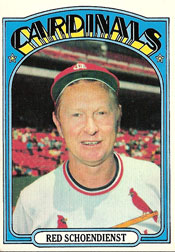
In the first inning, with Red Schoendienst on first and two outs, Boyer hit a drive that struck Podres in the left forearm.

Podres threw three pitches out of the strike zone to the next batter, Gene Oliver, and walked off the field, unable to pitch. Stan Williams relieved and threw ball four to Oliver, loading the bases.

Charlie James followed with a two-run single and the Cardinals were on their way to a fruitful weekend.

The Cardinals won all three games in the series and never used a reliever. Larry Jackson, Ray Sadecki and Curt Simmons pitched successive complete-game victories.

Podres went to the hospital, where X-rays revealed no fracture. Six days later, he started against the Mets and Podres went on to enjoy a 15-win season.

(Updated May 14, 2018)

A rough beginning doesn’t always result in a losing season. Some of the Cardinals’ best years began poorly:

_ 2011: Under manager Tony La Russa, the Cardinals lost six of their first eight and their relief pitching was a mess. However, they finished strong, posting an 18-8 record in September and qualifying for the postseason playoffs. From there, the Cardinals won the National League pennant and the World Series championship.

_ 2005: The Cardinals opened with a 3-4 record. Included in that stretch were back-to-back 10-4 and 13-4 poundings by the Phillies that led to concerns about St. Louis’ starting pitching. Jeff Suppan gave up 10 hits and six runs in four innings and Chris Carpenter was torched for 10 hits and eight runs in 3.1 innings. Carpenter finished with 21 wins, Suppan had 16 wins and the Cardinals earned the National League Central championship with a 100-62 record.

_ 2004: St. Louis started 1-3 and was 6-7 on April 19. The Cardinals lost three of four at home to the Brewers and were swept at home in a three-game series by the Astros. St. Louis went on to a 105-67 regular-season record and won its first pennant since 1987.

_ 2001: The Cardinals opened with three losses at Colorado and were 8-10 on April 22. In four of those losses, St. Louis gave up 10, 11, 13 and 17 runs. The Cardinals ended up 93-69, tied for first place with Houston in the NL Central and qualified for the playoffs.

_ 1985: After a 2-6 start, St. Louis still was struggling at 14-17 on May 14. Print reports speculated Whitey Herzog might be the first manager fired that year. The Cardinals opened with four consecutive losses _ two in extra innings and another by one run. St. Louis finished 101-61 and won the pennant.

_ 1982: The Cardinals started 1-3. Trailing the Pirates 6-5 with two outs and the bases empty in the bottom of the ninth, they were facing a fourth consecutive loss, but the Cardinals rallied to win 7-6, igniting a 12-game winning streak. The Cardinals finished 92-70 and won the World Series title.

_ 1942:  With a 6-7 record on April 29, the Cardinals were struggling for runs. They were held to three runs or fewer in six of their seven defeats. The Cardinals finished 106-48 and  were World Series champions.

_ 1934: St. Louis staggered to a 2-7 start. Dizzy Dean lost twice to the Cubs in that stretch. The Cardinals finished 95-58 and won the World Series championship.

_ 1930: The Cardinals dropped to 6-12 after losing a doubleheader to the Dodgers by scores of 2-1 in the opener and 11-10 in 13 innings in the second game. St. Louis went on to a 92-62 record and won the pennant.

The 1919 Cardinals experienced a dreadful season-opening drought.

Managed by Branch Rickey, the 1919 Cardinals scored a total of 10 runs in their first eight games. Their only win in that stretch was by a 1-0 score against the Cubs. Boxscore

Only once in their first eight games did the 1919 Cardinals score as many as three runs.

Only twice in their first 15 games did the 1919 Cardinals score more than two runs. In opening with a 3-12 record, their one outburst was an 8-1 win against the Reds on May 2.  Boxscore

Rogers Hornsby, the Hall of Fame player who some consider the best right-handed hitter of all time, was the third baseman and cleanup hitter for the 1919 Cardinals, but he couldn’t ignite the offense alone.

Hornsby, 23, in his fourth full big-league season and fifth overall, hit .318 with eight home runs and 71 RBI for the 1919 Cardinals. He led the team in all three categories. No other Cardinal hit more than two home runs.

The only other run producer of note for the 1919 Cardinals was second baseman and No. 3 batter Milt Stock. He hit .307 with 52 RBI and no home runs. Hornsby and Stock were the only Cardinals with as many as 50 RBI.

The 1919 Cardinals finished 54-83-1 and in seventh place in the eight-team National League. They scored 463 runs in 138 games and were shut out 11 times. Only the third-place Cubs (with 454) scored fewer. By comparison, the NL champion Reds scored 577 and the second-place Giants led the NL, with 605.

While Bill White visited his former teammate, Mike Shannon, in the broadcast booth at Busch Stadium on April 5, 2011, Albert Pujols stepped to the plate in the bottom of the first inning of the Pirates-Cardinals game.

As he did in his March 2011 phone interview with me, White said he hadn’t seen Pujols play much.

Shannon interrupted to say that:

_ The smartest player he ever saw was Giants outfielder Willie Mays. “I never took my eyes off of him on the field,” Shannon said.

_ The second-smartest player he ever saw was Pujols. “He is very intelligent on the field,” Shannon said.

White, in St. Louis to promote his autobiography “Uppity: My Untold Story About The Games People Play” (2011, Grand Central Publishing), chatted with Shannon and his Cardinals broadcast partner, John Rooney, during the first and second innings.

Teammates on the 1964 Cardinals team that won the World Series championship, White and Shannon clearly enjoy one another.

White said of Shannon, “This guy kept us alive (in 1964). Mike came in (from the minor leagues) … and had a lot of fun.”

“We had a lot of fun,” Shannon confirmed.

You had a lot of fun,” White said, tweaking the free-spirited Shannon.

That prompted Shannon to launch into a story about conducting an interview with Phillies third baseman Mike Schmidt. According to Shannon, Schmidt told him, “I really admired you … You had so much fun when you played.”

Shannon said he stopped the interview, turned off the tape recorder, and pointed out to Schmidt that he hit 548 home runs and Shannon hit only 68. “And you didn’t have any fun?” Shannon said incredulously. “No,” Schmidt replied.

“Mike (Schmidt) was a very serious person,” White said.

Shannon later chortled, to a clearly amused White, that he still sometimes goes to bed at 5 a.m. and still sometimes awakes at 5 a.m.

When the conversation turned to Johnny Keane, the manager who led the Cardinals to the 1964 World Series title and then resigned to join the Yankees, Shannon said, “I knew when he went over there (to New York) it would kill him.” (Keane died in January 1967, eight months after the Yankees fired him).

After explaining that Keane inherited a New York team that “was too old and couldn’t run,” White revealed that Yankees scout Mayo Smith (who later managed the 1968 Tigers in the World Series against St. Louis) used to ride on the Cardinals’ team bus in the latter part of the 1964 season.

“We should have realized then that he was there to talk to John about managing the Yankees,” White said.

With two out in the top of the second inning, Shannon turned over the microphone to a surprised White and tried to coax him into doing play-by-play. White was a good sport and tried to describe a pitch or two, but, clearly uncomfortable, told Shannon he hadn’t done any play-by-play since the 1980s when he and Phil Rizzuto were the Yankees’ broadcasters.

“It’s like riding a bike,” Shannon implored. “You never forget.”

White politely declined. “Besides,” he said slyly, “you’re not Rizzuto.”

When Albert Pujols grounded into three double plays on Opening Day in 2011, it put the spotlight back on Joe Torre.

Torre established a National League record by hitting into four double plays while with the Mets in a game against the Astros on July 21, 1975.

“It’s the first record I’ve ever set in baseball,” Torre told The Sporting News at the time. “But I’m not nearly as embarrassed by it as I am by my RBI total.”

Torre, traded after six seasons with the Cardinals to the Mets on Oct. 13, 1974, for pitchers Ray Sadecki and Tommy Moore, had 21 RBI in New York’s first 73 games in 1975.

Torre became the first player in the 100-year history of the NL to hit into four double plays in a game. He tied the major league record held by American League players Goose Goslin of the 1934 Tigers and Mike Kreevich of the 1939 White Sox.

Second baseman Felix Millan, batting No. 2 in the order for the Mets, had four singles but never reached second base. Torre, batting No. 3 in the order, followed each of Millan’s singles by grounding into double plays against pitcher Ken Forsch, brother of Cardinals pitcher Bob Forsch.

“I couldn’t have set a record without Millan,” Torre said, tongue in cheek, to the Associated Press after the game. “He ought to get an assist.”

Torre grounded into a 1-4-3 double play in the first, a 6-4-3 double play in the third, a 4-6-3 double play in the sixth and another 6-4-3 double play in the eighth. Boxscore

Asked whether he was trying to avoid hitting into a double play when he came to bat in the eighth with runners on first and second and none out, Torre replied, “I wasn’t worried. I wasn’t anxious. I made up my mind to be aggressive.”

Showing a sense of humor, Torre told reporters, “When I retire, I’m going to buy a shortstop and put him in my den. At night, when I’m lonely, I’m going to go down there and hit grounders to him.”

This is the third of three parts from a telephone interview I conducted with former Cardinals all-star first baseman Bill White on March 23, 2011.

White has written an autobiography in collaboration with journalist Gordon Dillow. The book is called “Uppity: My Untold Story About The Games People Play” (2011, Grand Central Publishing). It is available on Amazon.

White, gracious with his time and thoughtful with his answers, didn’t dodge any questions.

Q: You got traded back to the Cardinals in April 1969. Was that a surprise?

Bill White: No. I had torn my tendon in ’67. I couldn’t play anymore after that. Gene Mauch (Phillies manager) would let the grass grow six inches at first base so that the ball would stop and I could walk over and toss it to the pitcher. I couldn’t run. I had no mobility. I probably should have gotten out then.

There was hope the tendon would come around. It never did.

In 1968, Dick Allen hurt his right hand. He tore all the tendons and he couldn’t throw. So they decided to put him at first base. We couldn’t have two cripples on the team. I couldn’t run and Rich couldn’t throw. But he was younger and could still hit.

The general manager of the Phillies called me and asked if I’d be willing to go back to the Cardinals. I said, ‘I don’t think so.’ He said, ‘Bing Devine (Cardinals general manager) wants you to come back.’

Bing brought me back because he wanted me to manage at (Class AAA) Tulsa and eventually manage the Cardinals. I didn’t want to manage. I didn’t want to try to tell 25 other guys how to play the game. I’d rather do something where the success depends on me, not on other people.

Q: Elston Howard had said the Cardinals contacted him about replacing Harry Caray on the Cardinals broadcast team after the 1969 season …

Bill White: When Harry Caray was fired, I had gone to St. Louis and accepted the job. Jack Buck and (KMOX station boss) Bob Hyland and I sat down and we talked about it. I was very close with Buck.

I had already accepted the job. So when I flew back to Philadelphia, I started thinking about moving the family back to St. Louis. They were in schools in Philadelphia. And Philadelphia had some great colleges. I thought about that.

I also thought about replacing Harry Caray, who was extremely popular in St. Louis, and I thought that was a negative. So I called Bob Hyland back and I said, ‘Bob, I’m sorry, but I have changed my mind. I’m going to stay here in Philadelphia.’

Jack Buck wasn’t very happy with that. Jack was a great guy. When I was trying to buy a home in St. Louis and having a problem, Jack invited me over to his house and he said, “I’m going to find you a home here in this area.’ I said, ‘Jack, I can’t afford to live here.’ I think I was making $12,000 or $14,000 a year.

But those are the kinds of things you appreciate. And when I did take the Yankees (broadcast) job (in 1971), Jack called me and sort of chuckled and said, ‘You didn’t want to work for me. You want to work for those bums.’

I flew out to St. Louis and spent six hours at the stadium club, talking with Jack Buck and taping our conversation about how to broadcast.

Q: So many players from that ’64 Cardinals team have gone on to become successful broadcasters _ you and Tim McCarver and Bob Uecker and Mike Shannon and even Bob Gibson and Lou Brock did some broadcasting. Why do you think that was?

Bill White: We were better B.S.ers than players (laughter).

I think it was mainly Bob Hyland. And Jack Buck. Jack didn’t mind helping. A lot of broadcasters didn’t want to help you. They didn’t feel players should go directly from the field into the broadcast booth.

That happened to Phil Rizzuto (of the Yankees). Red Barber and Mel Allen really treated him badly. They didn’t want him up there. They had spent so many years honing their craft and they didn’t want a ballplayer up there with them. Phil talked about that. We discussed that quite a bit.

Q: I’m going to finish with a name association. I have five names and I’m going to ask you to respond to each. First, Stan Musial.

Bill White: Stan, for flat-out hitting, was the best hitter I’ve seen. I argued with Rizzuto regarding Joe DiMaggio and Ted Williams. But Stan was the best I’ve seen.

Q: Ken Boyer.

Bill White: Best third baseman I played with. For a big guy, he ran well. He drove in runs, did a great job fielding, and he didn’t get the publicity he should have gotten. When I was on the Veterans Committee for the Hall of Fame, I tried to get Ken’s name on that list, because he belongs with great consideration for the veterans part of the Hall of Fame.

Q: Curt Flood.

Bill White: Curt Flood was an excellent center fielder and a great leadoff man. Prior to Brock coming, he was our catalyst. He started things. When we got Brock, it made it even better. We had two guys, batting one and two, who were always on base.

Q: Bob Gibson.

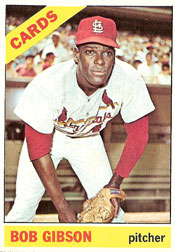
Bill White: One of the greatest competitors I played with, not only just pitching. On the bench, he pushed you. We were always good friends. One of the greatest pitchers I’ve seen.

Q: Albert Pujols.

Bill White: I’ve never seen him play, except for one exhibition game in Florida many years ago when I visited Bob Gibson. But if you look at his stats, he’s one heck of a player.

Do they knock him down? Oh, you can’t knock anybody down anymore, can you? That makes hitting a lot easier.

Bill White Interview: Part 1 // Part 2