Feeds:
Posts
Comments

On March 23, 2011, I interviewed former Cardinals all-star first baseman Bill White by telephone about the autobiography he has written in collaboration with journalist Gordon Dillow.

The book is called “Uppity: My Untold Story About The Games People Play” (2011, Grand Central Publishing). It is available on Amazon.

My interview with White, gracious with his time and thoughtful with his answers, is presented here in the second of three parts.

Q: On July 5, 1961, at the L.A. Coliseum, you hit three home runs off three different pitchers, all to that big right field. You were the first player to hit three homers to right field at the Coliseum. The next day, the Cardinals let go of manager Solly Hemus …

Bill White: They let him go that night. The headline the next day wasn’t, ‘White hits 3 home runs.’ The headline was, ‘Solly Hemus fired; Johnny Keane is new manager.’ Johnny was a super person. He was probably the best manager I played for.

Q: Why? What qualities did he possess?

Bill White: He didn’t want to get out in front of the players. He only asked you to do your job. And he also asked you not to do the things that you didn’t do well. That’s important. If you couldn’t do it, he wouldn’t ask you to do it. And he would sit down and talk to you and tell you why.

He was not necessarily the best tactical manager, but guys just liked to play for Johnny Keane. He was not an I guy. I played for a couple of I guys.

Q. You were part of an all-star infield with third baseman Ken Boyer, shortstop Dick Groat and second baseman Julian Javier. Was that the best infield you’ve ever seen?

Bill White: It was a good infield. It probably was not the best. Ken Boyer might have been the best third baseman I’d seen or played with. Groat had mobility problems. He understood how to play the hitters, but he had very little range and he didn’t have that real good arm. Javier was a pretty good second baseman. He made a great double play and he could go way out to center field for pop-ups because Curt Flood played a deep center field.

It was a good infield, the best infield that I was on, but I’m not sure it was the best ever. It might have been the best Cardinals infield.

Q: In 1964, the Cardinals’ offense was struggling. On June 15, the Cardinals acquired Lou Brock from the Cubs for Ernie Broglio. Did you know then the trade would turn out so well for the Cardinals?

Bill White: None of us did. We all thought it was nuts. Lou was a raw talent. At that point, he didn’t really understand baseball. He might try to steal while 10 runs up or 10 runs down.

When he got to St. Louis, Johnny Keane told him what he expected of him, and he turned him loose. I think Lou relaxed in St. Louis. Now he’s in the Hall of Fame. Without Brock, we would not have won.

Q: At what point did you think the Cardinals might catch the Phillies and win the pennant in 1964?

Bill White: When we played the Phillies in three games toward the end of the season. We beat them three in a row. We were on an upswing and they were on a downturn. They were a tired ballclub. You could see it.

Manager Gene Mauch had chosen to pitch Jim Bunning and Chris Short with almost no rest. That might have been a tactical mistake.

Q: What is your favorite memory of the 1964 World Series?

Bill White: Ken Boyer hitting the grand slam off Al Downing (in Game 4). And the pop-up by Bobby Richardson that Dal Maxvill caught for the final out of Game 7.

Q: After the 1965 season, the Cardinals traded you to the Phillies. What was your reaction to that deal?

Bill White: I didn’t mind the deal. I didn’t like the way it was done. The general manager of the Cardinals, Bob Howsam, said I was about five years older than I actually was.

When he did that, and said that publicly, it upset me, and I went in and challenged him … I said, ‘When you trade a guy in the big leagues, you say what a great player he was, and what a great player he will be. You don’t denigrate him.’

But it ended up great for me. because I got into radio and television in Philadelphia. And I still live there.

Everything in my life has been positive, because we made the most of whatever has happened.

Q: On May 18, 1966, you faced Bob Gibson for the first time since the trade. You singled and struck out the first two times at-bat. Then, with Dick Groat on base, you hit a home run. What do you recall?

Bill White: He must have made a heck of a mistake for me to hit a home run off him. After playing with him for so long, he knew how to pitch me. I didn’t like the ball inside from right-handers. Sliders inside would eat me up. So he must have made a mistake.

Q: Two years later, May 17, 1968, you beat Gibson, 1-0, with a RBI-single off him in the 10th. The next time you faced him, July 25, 1968, you came to bat in the second inning and he hit you with a pitch. Was it intentional?

Bill White: He was trying to pitch inside, let’s say that. He wasn’t headhunting. Gibson wasn’t a headhunter. But he would pitch inside. He did hit me on my right elbow.

He had told me before _ because I liked to charge the ball; I liked to go out and get the ball _ ‘You can’t do that against me.’ Bob was a great competitor. Bob and Sandy Koufax were two of the best when I was playing.

Tomorrow, Part 3: Bill White reveals how he almost replaced Harry Caray in the Cardinals’ broadcast booth and how general manager Bing Devine planned to make him a manager.

Yesterday: Part 1

Bill White, former all-star first baseman for the Cardinals, has written his autobiography in collaboration with journalist Gordon Dillow.

The book is called “Uppity: My Untold Story About The Games People Play” (2011, Grand Central Publishing). It is available on Amazon.

On the morning of March 23, 2011, I interviewed Bill White by telephone. He was gracious with his time and thoughtful with his answers.

That interview is presented here in the first of three parts on consecutive days.

Q: What prompted you to write this autobiography?

Bill White: We all think we’re young, but I’m 77 and I realized I really hadn’t done much publicly. You start thinking about how much longer you are going to be around and I decided I would put my life down on paper because it’s been a different life.

Q. Your major league debut, May 7, 1956, was in St. Louis for the Giants, and in your first at-bat you hit a home run off Ben Flowers. What is your recollection of that?

Bill White: The count was 2-and-2 and Flowers was a breaking-ball pitcher. He threw a curveball that I thought hit the outside corner. I started to walk toward the dugout. The umpire said, ‘Ball three.’ I turned back around and the next pitch was a fastball. I swung and it just cleared the right-field fence. St. Louis had that short right-field fence. It was just 322 to right-center field. I hit a line drive that just went over. I wasn’t elated. It was just what I was supposed to do.

Q: In March 1959 you are traded to the Cardinals for pitcher Sam Jones. What was your reaction to that deal?

Bill White: I was happy. I had gone into the Army in 1956, right after that first season with the Giants. I spent two years in the Army. Giants first baseman Orlando Cepeda had been rookie of the year and another first baseman, Willie McCovey, was down in Phoenix hitting .400. When I came back, there was no room for me. So I asked the Giants to trade me. St. Louis wasn’t my first choice, but it ended up that it was a great trade for me.

Q: Eddie Stanky, who was a special scout for the Cardinals then and had been your manager at Class AAA Minneapolis, had recommended you to the Cardinals, along with scout Ollie Vanek. Was Stanky a mentor to you?

Bill White: Yes. Eddie was a very good manager. He was a tough manager and he taught me a lot about baseball. He would question me during a game. He’d come up and say, ‘What’s the count? How many outs?’ That kept your mind on the game. And if you didn’t know the answers, the next day you might have to run laps. Stanky was very good to me about, No. 1, learning baseball, and, No. 2, keeping your mind on the game and not doing things that you couldn’t do well.

Q: In May 1960, you set a career high with 6 RBI in a game at the L.A. Coliseum, hitting two home runs, both off Don Drysdale. Your career batting average against Drysdale was .326 with seven home runs. Why were you so successful against him?

Bill White: Because he threw spitballs. It actually was oil he kept on the back of his hair. And when you loaded the ball up, it sunk. And I was a low-ball hitter. He was throwing to my strength.

Q: In the spring of 1961, you took a courageous stand against the segregationist practices going on during spring training in St. Petersburg, Fla. Players were separated in living quarters according to race. A yearly community business breakfast invited only white players, not blacks. You made enormous progress in getting things changed. How were you able to do that?

Bill White: Mainly because of general manager Bing Devine, and publicist Al Fleishman. Bing Devine was a very religious man. He was one of my mentors in St. Louis. He helped me get a home in St. Louis that the owner didn’t want me to buy.

Bing actually thought that we, the black players, were happy being segregated in spring training. We got extra money. We got a car for ourselves. Nobody ever complained. We would show up at the park and do our work and we would go back to the black area afterward.

What happened is that Dr. Ralph Wimbish of the NAACP had a friend who was a dentist who wanted to dock his boat at the St. Petersburg Yacht Club, and they wouldn’t let him do it. That upset me a little bit. Then one day when I went into the clubhouse I saw the list of people who were asked to go to the community breakfast and I said, ‘Wait a minute. These business guys are leasing public property and they won’t allow a minority to dock his boat there. They evidently don’t want minorities.’ That’s what started it. Then it blossomed more and more.

St. Louis at that time was one of the most segregated cities in the major leagues. But they sold Budweiser beer, which owned the Cardinals. The black people in St. Louis said, ‘They aren’t treating our kids right. We’re going to boycott Budweiser.’

That was a perfect storm. No. 1, a private business club in St. Petersburg not allowing blacks in, and, No. 2, all of a sudden there was a possibility Budweiser would get boycotted in St. Louis and it might spread all over the country.

So I think that had a part in August Busch saying, ‘We better do something about this. We better nip this in the bud.’ So the next year everything was integrated.

In the end, we became a better club, because in ’63 we became close, and in ’64 we won it. We got to know each other as people. And that’s important.

Tomorrow, Part 2: Bill White talks about Johnny Keane, Lou Brock and Bob Gibson.

Part 3 The Cardinals saw Bill White as a candidate to manage.

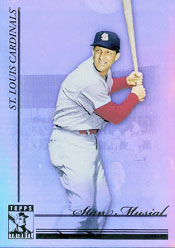
Bob Rush gave up 176 home runs in his big-league career. Stan Musial hit more of those than anyone.

Musial hit 10 homers against Rush, a right-hander who pitched for the Cubs, Braves and White Sox from 1948-60.

Rush posted a 3.65 ERA despite a 127-152 record in the big leagues.

The first time Musial hit a home run against Rush was Oct. 2, 1949, a solo shot in the fourth inning of a game St. Louis won, 13-5, at Wrigley Field in Chicago. Boxscore

His last two homers against Rush came in one game: July 17, 1958, at St. Louis. Musial hit a two-run homer in the first against Rush and followed with a three-run shot in the third. Boxscore

In a May 1973 interview with Baseball Digest, Rush said of Musial, “He was one of the greatest hitters I ever pitched against or saw during my playing career. He is a real credit to the baseball profession, both on and off the field.”

Musial’s most memorable hit against Rush was a double, not a home run.

On Aug. 12, 1956, Musial doubled in the sixth inning against Rush for the 1,071st extra-base hit of his career, tying Mel Ott of the Giants for the National League record. Boxscore

Rush is one of seven pitchers to yield 10 or more home runs to Musial. The list:

Warren Spahn, 17

Preacher Roe, 12

Johnny Antonelli, 11

Murry Dickson, 11

Don Newcombe, 11

Robin Roberts, 10

Bob Rush, 10

(Updated April 11, 2026)

Marty Marion of the Cardinals was the first shortstop to win the National League Most Valuable Player Award _ and he did it by the narrowest of margins.

Marion won the MVP Award by one point over Bill Nicholson of the Cubs in 1944. It was the tighest finish since the system of voting by three sports reporters from each of the eight National League cities was adopted in 1938, according to the Associated Press.

Marion started at shortstop for four Cardinals pennant winners (1942, 1943, 1944 and 1946) and led the National League in fielding percentage four times (1944, 1947, 1948 and 1950).

In 1944, Marion batted .267 with 63 RBI and helped the Cardinals to their second World Series title in three years. He hit .288 with runners in scoring position that season.

Marion played 55 errorless innings at shortstop in the World Series against the Browns. “To me, a highlight of the Series was the superiority our shortstop, Marty Marion, displayed over Vern Stephens, the Browns’ shortstop,” Cardinals outfielder Stan Musial said in his book “Stan Musial: The Man’s Own Story.”

Marion received 190 points to Nicholson’s 189 in the MVP voting by 24 sports reporters. In the book “Redbirds Revisited,” Marion said of that 1944 season, “I was a leader. Everyone looked up to me. Everything I did was for the team. I had several game-winning hits, and I took away a lot of hits at shortstop.”

Nicholson, a left-handed batter and outfielder, had a magnificent season for the Cubs: 33 home runs, 122 RBI and 116 runs scored. He was the league leader in all three categories.

The Cubs, however, finished fourth at 75-79, 30 games behind the first-place Cardinals (105-49).

In the book “The Spirit of St. Louis,” Cardinals outfielder Danny Litwhiler said, “Marty Marion, as far as I was concerned, if it was an important game, the most important game you have, and you need a base hit, I would take Marty over anybody I ever played with. He had something about him in a clutch _ he was tough. He was not a real good hitter, but in a clutch he was tough.

“He was also the best shortstop I ever saw … I didn’t realize how good he was until I played left field behind him. Balls would be hit that I just knew were going to be base hits … and his arm would come over and grab it and give it the flip to first base. He just had fantastic hands.”

The top points producers in the 1944 NL MVP balloting were:

_ Marty Marion, shortstop, Cardinals, 190 points.

_ Bill Nicholson, outfielder, Cubs, 189 points.

_ Dixie Walker, outfielder, Dodgers, 145 points.

_ Stan Musial, outfielder, Cardinals, 136 points.

_ Bucky Walters, pitcher, Reds, 107 points.

_ Bill Voiselle, pitcher, Giants, 107 points.

MVP voters could list up to 10 players on a ballot. Players were given 14 points for a first-place vote, nine for a second-place vote, eight for a third-place vote and so forth, ending with one point for a 10th-place vote.

Of the 24 first-place votes, Marion received seven and Nicholson, four.

“I think this was the greatest tribute to defensive play in the history of the MVP Award,” Musial said.

In “The Spirit of St. Louis” book, Marion said that when he received a phone call informing him he had won the MVP Award “I didn’t know what … it was. I never was impressed with it at all. That’s right. I didn’t think about things like that too much. Now, after years passed, that’s pretty nice, but back then, it didn’t mean a thing to me.”

(Updated Sept. 13, 2025)

The Cardinals played a role in launching Joe DiMaggio into his Hall of Fame career with the Yankees.

On March 17, 1936, DiMaggio played in his first Yankees game _ a spring training exhibition against the Cardinals in St. Petersburg, Fla.

DiMaggio, 21, displayed his greatness right from the start, with four hits in five at-bats, two runs scored and two RBI in the Yankees’ exhibition opener. He also made what the New York Times described as “a glittering catch” of Charlie Gelbert’s drive to deep center in the seventh inning.

The Cardinals won, 8-7, before about 2,000 spectators on a brisk day at Waterfront Park. According to the St. Louis Post-Dispatch, many fans were “wearing overcoats.”

DiMaggio, who joined the Yankees from San Francisco of the Pacific Coast League, started in center field, batted third in the lineup and received rave reviews.

Under the subhead “DiMaggio Has Great Day,” the New York Times reported DiMaggio was “the one shining light” in the game for the Yankees and concluded “if there was any doubt about this newcomer, he dispelled it today.”

The exhibition featured seven future Hall of Famers in the starting lineups: second baseman Frankie Frisch, left fielder Joe Medwick, first baseman Johnny Mize and shortstop Leo Durocher for the Cardinals, and first baseman Lou Gehrig, second baseman Tony Lazzeri and center fielder Joe DiMaggio for the Yankees.

The Cardinals had 14 hits and capitalized on six Yankees errors (none by DiMaggio). Frisch, the Cardinals’ player-manager, had four hits, three RBI and two runs scored.

With National League president Ford Frick in attendance, the game was played in less than ideal conditions. According to the New York Times, spectators wore overcoats to protect them from “a blustery wind that blew out of the north with galelike force.” The game couldn’t begin until “the infield was rendered presentable by burning gasoline.”

DiMaggio’s triple in the first inning off Cardinals starter Mike Ryba was “a mighty blow to the left-field fence,” the New York Times reported. DiMaggio scored on Gehrig’s single.

In the eighth, DiMaggio’s bases-loaded single to right drove in two.

The starting lineups that day:

CARDINALS

Terry Moore, cf

Frankie Frisch, 2b

Pepper Martin, rf

Joe Medwick, lf

Johnny Mize, 1b

Charlie Gelbert, 3b

Leo Durocher, ss

Bruce Ogrodowski, c

Mike Ryba, p

YANKEES

Roy Johnson, lf

Red Rolfe, 3b

Joe DiMaggio, cf

Lou Gehrig, 1b

George Selkirk, rf

Tony Lazzeri, 2b

Frank Crosetti, ss

Joe Glenn, c

Johnny Broaca, p

(The Cardinals’ Terry Moore ranked with DiMaggio as an elite center fielder. In the book “Few and Chosen,” outfielder Enos Slaughter, who debuted with the Cardinals in 1938, said, “I played against Joe DiMaggio and I played against Willie Mays, and Terry was as good as them. He had speed and a great arm, and nobody charged ground balls from the outfield like Moore. He’d charge the ball and make a perfect throw to third base or home.” In the same book, Marty Marion, Cardinals shortstop of the 1940s, said Moore “wore a very small glove and he had great big hands. I never saw a man with bigger hands than Terry. He often would catch a ball barehanded. I’m taking nothing away from Joe DiMaggio. He was a great center fielder, but he was no better than Terry.”)

The next day, March 18, 1936, the Cardinals beat the Yankees again, 6-5. DiMaggio went 2-for-4, with a triple and a single.

DiMaggio’s torrid start to spring training was an indicator of how he would perform as a rookie. In the 1936 season, DiMaggio hit .323 with 29 home runs, 44 doubles, 15 triples and 125 RBI, leading the Yankees to a 102-51 record and the American League pennant.

The Cardinals finished 87-67 _ five games behind the first-place Giants, who were defeated in the World Series by the Yankees in six games.

(Updated May 10, 2021)

On Oct. 5, 1970, the Cardinals, looking to steady their middle infield with a reliable sparkplug, made a trade with the Dodgers, swapping slugger Dick Allen for second baseman Ted Sizemore and catcher Bob Stinson.

Though Allen, in his lone St. Louis season, hit 34 home runs, the most by a Cardinal since Stan Musial’s 35 in 1954, the Cardinals had taken a step backward in 1970, in part, because of shoddy defense.

One area of need was second base. Longtime starter Julian Javier had back problems. Allen, a defensive liability at first base, third base or left field, was deemed expendable.

“I told him (Allen) he did everything we had expected of him,” Cardinals general manager Bing Devine told the Associated Press. “It was just that the club wasn’t balanced enough … The vital aspect was defense.”

Sizemore, who won the National League Rookie of the Year Award in 1969, had a reputation as an unselfish scrapper.

“The people here (in St. Louis) will like him because of his hustle and his ability to go all out,” Cardinals manager Red Schoendienst told reporters.

In five years (1971-75) with St. Louis, Sizemore batted .260, primarily from the No. 2 spot in the order. When Cardinals speedster Lou Brock broke the big-league single-season stolen base record in 1974, he cited the sacrifices made by Sizemore, who passed up many good pitches to hit in order to give Brock chances to steal.

Asked about Brock, Sizemore told Cardinals Gameday Magazine in 2014, “We would go over pitchers before games. He would tell me, ‘I’m going on this guy. If I get a decent jump, I will beat the throw to second base.’ He had it down.”

In the book “The Spirit of St. Louis,” Cardinals pitcher Rich Folkers told author Peter Golenbock, “Ted Sizemore … was probably the best No. 2 hitter I saw in my career. He hit 0-and-2 more than any hitter I ever saw, because with Lou Brock getting on base, he took and took and took, waiting for Lou to steal bases.

“I thought he was outstanding, though Ted never got the credit,” said Folkers. “These are the behind-the-scene things. You might say, “This guy only hit .260 in the big leagues.’ Yeah, but he got the ground ball to move him to third, or he took strikes so Brock could steal.”

Sizemore also was a steady fielder. He made four throwing errors in five years with the Cardinals.