Feeds:
Posts
Comments

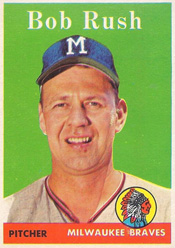
Bob Rush gave up 176 home runs in his big-league career. Stan Musial hit more of those than anyone.

Musial hit 10 homers against Rush, a right-hander who pitched for the Cubs, Braves and White Sox from 1948-60.

Rush posted a 3.65 ERA despite a 127-152 record in the big leagues.

The first time Musial hit a home run against Rush was Oct. 2, 1949, a solo shot in the fourth inning of a game St. Louis won, 13-5, at Wrigley Field in Chicago. Boxscore

His last two homers against Rush came in one game: July 17, 1958, at St. Louis. Musial hit a two-run homer in the first against Rush and followed with a three-run shot in the third. Boxscore

In a May 1973 interview with Baseball Digest, Rush said of Musial, “He was one of the greatest hitters I ever pitched against or saw during my playing career. He is a real credit to the baseball profession, both on and off the field.”

Musial’s most memorable hit against Rush was a double, not a home run.

On Aug. 12, 1956, Musial doubled in the sixth inning against Rush for the 1,071st extra-base hit of his career, tying Mel Ott of the Giants for the National League record. Boxscore

Rush is one of seven pitchers to yield 10 or more home runs to Musial. The list:

Warren Spahn, 17

Preacher Roe, 12

Johnny Antonelli, 11

Murry Dickson, 11

Don Newcombe, 11

Robin Roberts, 10

Bob Rush, 10

Marty Marion of the Cardinals was the first shortstop to win the National League Most Valuable Player Award _ and he did it by the narrowest of margins.
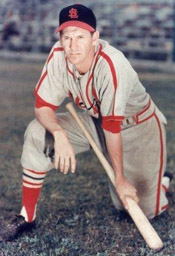
Marion won the MVP Award by one point over Bill Nicholson of the Cubs in 1944. It was the tighest finish since the system of voting by three sports reporters from each of the eight NL cities was adopted in 1938, according to the Associated Press.

Marion started at shortstop for four Cardinals pennant winners (1942, ’43, ’44 and ’46) and led the NL in fielding percentage four times (1944, ’47, ’48 and ’50).

In 1944, Marion batted .267 with 63 RBI and helped the Cardinals to their second World Series title in three years. Marion played 55 errorless innings at shortstop in the World Series against the Browns.

“To me, a highlight of the Series was the superiority our shortstop, Marty Marion, displayed over Vern Stephens, the Browns’ shortstop,” Cardinals outfielder Stan Musial wrote in his book “Stan Musial: The Man’s Own Story” (1964, Doubleday). “There had been some static during the regular season in St. Louis about which was the better. Marty didn’t have Stephens’ power, of course, but his edge afield, as he proved in the Series, was decisive.”

Marion received 190 points to Nicholson’s 189 in the MVP voting by 24 sports reporters.

Nicholson, a left-handed batter and outfielder, had a magnificent season for the Cubs: 33 home runs, 122 RBI and 116 runs scored. He led the NL that season in all three categories.

The Cubs, however, finished fourth at 75-79, 30 games behind the first-place Cardinals (105-49).

“Marty Marion, as far as I was concerned, if it was an important game, the most important game you have, and you need a base hit, I would take Marty over anybody I ever played with,” Cardinals outfielder Danny Litwhiler said in the book “The Spirit of St. Louis” (2000, Avon). “He had something about him in a clutch _ he was tough. He was not a real good hitter, but in a clutch he was tough.

“He was also the best shortstop I ever saw … I didn’t realize how good he was until I played left field behind him. Balls would be hit that I just knew were going to be base hits … and his arm would come over and grab it and give it the flip to first base. He just had fantastic hands.”

The top points producers in the 1944 NL MVP balloting were:

_ Marty Marion, shortstop, Cardinals, 190 points.

_ Bill Nicholson, outfielder, Cubs, 189 points.

_ Dixie Walker, outfielder, Dodgers, 145 points.

_ Stan Musial, outfielder, Cardinals, 136 points.

_ Bucky Walters, pitcher, Reds, 107 points.

_ Bill Voiselle, pitcher, Giants, 107 points.

MVP voters could list up to 10 players on a ballot. Players were given 14 points for a first-place vote, 9 points for a second-place vote, 8 points for a third-place vote and so forth, ending with 1 point for a 10th-place vote.

Of the 24 first-place votes, Marion received seven and Nicholson, four.

“I think this was the greatest tribute to defensive play in the history of the MVP Award,” Musial said.

Marion told Peter Golenbock, author of “The Spirit of St. Louis,” that when he received a phone call informing him he had won the MVP Award “I didn’t know what … it was. I never was impressed with it at all. That’s right. I didn’t think about things like that too much. Now, after years passed, that’s pretty nice. But back then, it didn’t mean a thing to me.”
(Updated Sept. 13, 2025)

The Cardinals played a role in launching Joe DiMaggio into his Hall of Fame career with the Yankees.

On March 17, 1936, DiMaggio played in his first Yankees game _ a spring training exhibition against the Cardinals in St. Petersburg, Fla.

DiMaggio, 21, displayed his greatness right from the start, with four hits in five at-bats, two runs scored and two RBI in the Yankees’ exhibition opener. He also made what the New York Times described as “a glittering catch” of Charlie Gelbert’s drive to deep center in the seventh inning.

The Cardinals won, 8-7, before about 2,000 spectators on a brisk day at Waterfront Park. According to the St. Louis Post-Dispatch, many fans were “wearing overcoats.”

DiMaggio, who joined the Yankees from San Francisco of the Pacific Coast League, started in center field, batted third in the lineup and received rave reviews.

Under the subhead “DiMaggio Has Great Day,” the New York Times reported DiMaggio was “the one shining light” in the game for the Yankees and concluded “if there was any doubt about this newcomer, he dispelled it today.”

The exhibition featured seven future Hall of Famers in the starting lineups: second baseman Frankie Frisch, left fielder Joe Medwick, first baseman Johnny Mize and shortstop Leo Durocher for the Cardinals, and first baseman Lou Gehrig, second baseman Tony Lazzeri and center fielder Joe DiMaggio for the Yankees.

The Cardinals had 14 hits and capitalized on six Yankees errors (none by DiMaggio). Frisch, the Cardinals’ player-manager, had four hits, three RBI and two runs scored.

With National League president Ford Frick in attendance, the game was played in less than ideal conditions. According to the New York Times, spectators wore overcoats to protect them from “a blustery wind that blew out of the north with galelike force.” The game couldn’t begin until “the infield was rendered presentable by burning gasoline.”

DiMaggio’s triple in the first inning off Cardinals starter Mike Ryba was “a mighty blow to the left-field fence,” the New York Times reported. DiMaggio scored on Gehrig’s single.

In the eighth, DiMaggio’s bases-loaded single to right drove in two.

The starting lineups that day:

CARDINALS

Terry Moore, cf

Frankie Frisch, 2b

Pepper Martin, rf

Joe Medwick, lf

Johnny Mize, 1b

Charlie Gelbert, 3b

Leo Durocher, ss

Bruce Ogrodowski, c

Mike Ryba, p

YANKEES

Roy Johnson, lf

Red Rolfe, 3b

Joe DiMaggio, cf

Lou Gehrig, 1b

George Selkirk, rf

Tony Lazzeri, 2b

Frank Crosetti, ss

Joe Glenn, c

Johnny Broaca, p

(The Cardinals’ Terry Moore ranked with DiMaggio as an elite center fielder. In the book “Few and Chosen,” outfielder Enos Slaughter, who debuted with the Cardinals in 1938, said, “I played against Joe DiMaggio and I played against Willie Mays, and Terry was as good as them. He had speed and a great arm, and nobody charged ground balls from the outfield like Moore. He’d charge the ball and make a perfect throw to third base or home.” In the same book, Marty Marion, Cardinals shortstop of the 1940s, said Moore “wore a very small glove and he had great big hands. I never saw a man with bigger hands than Terry. He often would catch a ball barehanded. I’m taking nothing away from Joe DiMaggio. He was a great center fielder, but he was no better than Terry.”)

The next day, March 18, 1936, the Cardinals beat the Yankees again, 6-5. DiMaggio went 2-for-4, with a triple and a single.

DiMaggio’s torrid start to spring training was an indicator of how he would perform as a rookie. In the 1936 season, DiMaggio hit .323 with 29 home runs, 44 doubles, 15 triples and 125 RBI, leading the Yankees to a 102-51 record and the American League pennant.

The Cardinals finished 87-67 _ five games behind the first-place Giants, who were defeated in the World Series by the Yankees in six games.

(Updated May 10, 2021)

On Oct. 5, 1970, the Cardinals, looking to steady their middle infield with a reliable sparkplug, made a trade with the Dodgers, swapping slugger Dick Allen for second baseman Ted Sizemore and catcher Bob Stinson.

Though Allen, in his lone St. Louis season, hit 34 home runs, the most by a Cardinal since Stan Musial’s 35 in 1954, the Cardinals had taken a step backward in 1970, in part, because of shoddy defense.

One area of need was second base. Longtime starter Julian Javier had back problems. Allen, a defensive liability at first base, third base or left field, was deemed expendable.

“I told him (Allen) he did everything we had expected of him,” Cardinals general manager Bing Devine told the Associated Press. “It was just that the club wasn’t balanced enough … The vital aspect was defense.”

Sizemore, who won the National League Rookie of the Year Award in 1969, had a reputation as an unselfish scrapper.

“The people here (in St. Louis) will like him because of his hustle and his ability to go all out,” Cardinals manager Red Schoendienst told reporters.

In five years (1971-75) with St. Louis, Sizemore batted .260, primarily from the No. 2 spot in the order. When Cardinals speedster Lou Brock broke the big-league single-season stolen base record in 1974, he cited the sacrifices made by Sizemore, who passed up many good pitches to hit in order to give Brock chances to steal.

Asked about Brock, Sizemore told Cardinals Gameday Magazine in 2014, “We would go over pitchers before games. He would tell me, ‘I’m going on this guy. If I get a decent jump, I will beat the throw to second base.’ He had it down.”

In the book “The Spirit of St. Louis,” Cardinals pitcher Rich Folkers told author Peter Golenbock, “Ted Sizemore … was probably the best No. 2 hitter I saw in my career. He hit 0-and-2 more than any hitter I ever saw, because with Lou Brock getting on base, he took and took and took, waiting for Lou to steal bases.

“I thought he was outstanding, though Ted never got the credit,” said Folkers. “These are the behind-the-scene things. You might say, “This guy only hit .260 in the big leagues.’ Yeah, but he got the ground ball to move him to third, or he took strikes so Brock could steal.”

Sizemore also was a steady fielder. He made four throwing errors in five years with the Cardinals.

(Updated Jan. 4, 2025)

Duke Snider had one of the most productive performances of his career in the same game Stan Musial achieved a slugging milestone.

On June 3, 1955, Snider went 4-for-5 with five RBI and two runs scored in the Dodgers’ 12-5 victory over the Cardinals at Ebbets Field in Brooklyn.
Snider clouted a three-run home run, a RBI-double and two singles, one of which was a squeeze bunt that scored Pee Wee Reese from third.

In the same game, Musial hit his 300th career homer _ a three-run shot off Johnny Podres in the fifth. Musial became the 13th player with 300 homers.

Snider’s big performance against the Cardinals was part of a three-game tear in which he totaled five homers and 13 RBI. Dubbing him “The Duke of Destruction,” Bill Corum of International News Service wrote, “I’ve never seen a hitter quite as dangerous as Duke Snider.” Boxscore

Special talent

A center fielder, Snider hit .300 in his career against the Cardinals, with 60 homers and 189 RBI.

In his book “Stan Musial: The Man’s Own Story,” Musial said, “After he learned the strike zone in the majors, the Duke became one of the great sluggers of our era. He couldn’t hit the high and tight pitch early, but he learned to lay off it. He had great power … He was a fine outfielder with a good arm and good speed.”

In choosing his all-time National League all-star team, Musial selected Willie Mays, Hank Aaron and Snider as the outfielders. Musial said with Snider in center, Carl Furillo in right and Andy Pafko in left “the Dodgers had the best-throwing outfield I ever saw.”

In the 1950s, the three center fielders in New York were Mickey Mantle of the Yankees, Mays of the New York Giants and Snider with the Brooklyn Dodgers.

In the book, “We Would Have Played For Nothing,” pitcher Ralph Branca, Snider’s Dodgers teammate, told former baseball commissioner Fay Vincent, “I think Duke was the best outfielder of the three of them. Duke got a great jump on the ball, charged the ground ball, and had the best arm of all three. Not only was he stronger, but he was more accurate.”

Snider wore No. 4 with the Dodgers in tribute to his boyhood favorite, Yankees first baseman Lou Gehrig. In the book “Voices from Cooperstown,” Snider said to author Anthony J. Connor, “When that movie ‘Pride of the Yankees’ came out with Gary Cooper playing Lou Gehrig, I saw it maybe 15 times … I still get tears in my eyes watching that show.”

Playing rough

In 1961, Snider was involved in two rough-and-tumble incidents involving Cardinals pitchers Larry Jackson and Bob Gibson.

While facing the Cardinals in a spring training exhibition game, Snider shattered his bat on a pitch from Jackson. The ball struck Jackson on the hip and the bat hit him in the jaw.

In his book “The Duke of Flatbush,” Snider said, “I reached first base, but Jackson was still on the ground, seriously injured. His jaw was broken … I felt awful about it, but that’s one of the occupational hazards of pitching.”

A few weeks later, April 17, 1961, in a game between the Cardinals and Dodgers in Los Angeles, Snider hit a two-run home run against Gibson in the third inning. Boxscore

“I knew what would happen next … Word was already around the league that he had that mean streak that so many good pitchers have,” Snider said.

When Snider came to bat in the fifth, a Gibson fastball struck him in the elbow. Snider told Fay Vincent, “He threw a 95 mph fastball right at my ribs. I put my right elbow down to protect my ribs and it hit me right on the bone.”

When he tried to bat again in the seventh, Snider felt a sharp pain in that right elbow and was lifted for a pinch-hitter.

The elbow was fractured and Snider was sidelined for a month.

“It’s the only time I was ever on the disabled list,” Snider said to Fay Vincent. “I know that Bob Gibson has told people he never threw at a player on purpose. Bob Gibson is a nice guy, but he stretches the truth a little bit once in a while.”

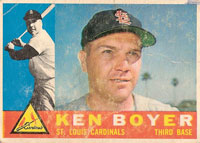
In 1957, third baseman Ken Boyer was moved to center field and led the Cardinals into the National League pennant race.

When the Cardinals traded starting center fielder Bill Virdon to the Pirates in May 1956, they expected one of the players they acquired in the deal, Bobby Del Greco, to be a mainstay at the position.

Del Greco, 23, was a bust, batting .215 with 18 RBI in 102 games in 1956.

In the Cardinals’ first intrasquad game in spring training 1957, Boyer played center field in a move manager Fred Hutchinson called an experiment, according to the Associated Press.

When the season opened April 16 at Cincinnati, Boyer was at third base and rookie Bobby Gene Smith, 22, started in center field for St. Louis. Four days later, Del Greco was traded to the Cubs.

Smith, who came up through the Cardinals system, wasn’t ready. On May 23, with Smith batting .225 and the Cardinals at 13-16, Hutchinson moved Boyer to center field and placed rookie Eddie Kasko, 24, at third base.

The Cardinals won 15 of their next 20, improving to 28-21. Their strong play continued deep into the summer. On Aug. 4, St. Louis was 63-41.

In late September, though, the Braves won two of three in St. Louis to nail down the pennant. Milwaukee finished 95-59; the Cardinals were second at 87-67.

Boyer played center field in 105 games and led National League center fielders in fielding percentage (.993). He made two errors in 885.2 innings played in center field.

Kasko was reliable at third base (.961 fielding percentage in 120 games) and hit .273 overall.

In 1958, Boyer returned to third base, Kasko moved to shortstop after the May trade of Alvin Dark to the Cubs, and the Cardinals turned to rookie Curt Flood in center field.