Feeds:
Posts
Comments

Al Hrabosky was desperate for a final chance to extend his big-league pitching career. He was released by the Braves on Aug. 30, 1982, and as 1983 spring training was about to begin no team had reached out to the left-handed relief pitcher known as the “Mad Hungarian.”

Hrabosky thought he still had something to offer. He had dropped 15 pounds, shaved his Fu Manchu, cut his hair, added a forkball to his mix and conceded that “some of my off-the-field habits need changing.”

He called Roland Hemond, general manager of the White Sox, and asked for a spring-training tryout. Hemond agreed. When Hrabosky arrived, he went to work trying to impress the White Sox manager and pitching coach: Tony La Russa and Dave Duncan.

In the spring of 1983, it was Duncan’s job to determine whether Hrabosky could help the White Sox. After Hrabosky’s first workout, Duncan said to The Sporting News, “He threw the ball pretty good and he’s in good shape.”

It wasn’t enough. La Russa and Duncan eventually decided to open the season with Kevin Hickey and Jerry Koosman as their left-handed relievers. Hrabosky was signed to a contact on April 8 and assigned to the Class AAA Denver Bears. It was his first minor-league assignment in 10 years.

Hrabosky had pitched for the Cardinals from 1970-78 and was a dominant closer for part of that stretch. At Denver, he joined a staff that included two other former Cardinals: right-handers John D’Acquisto and Steve Mura.

Hrabosky appeared in 26 games for Denver and made 15 starts, but he never got the call to Chicago from La Russa and Duncan. Hrabosky finished the Class AAA season with a 7-6 record and 5.82 ERA, giving up 135 hits in 116 innings.

At 34, his professional playing career was done.

In July 1960, Bob Gibson and Sandy Koufax were struggling 24-year-old pitchers.

Koufax had a 3-8 record for the Dodgers. Gibson was 1-2 for the Cardinals. Both had been tried as starters and were deemed to be too inconsistent.

After pitching a one-hitter against the Pirates on May 23, 1960, Koufax lost his next four decisions and his ERA rose to 4.64. In a July 4, 1960, start against the Cardinals at St. Louis, Koufax faced six batters, got one out and was lifted.

Gibson opened the 1960 season with the Cardinals, but was sent to the minors in May before he was brought back a month later. On July 6, 1960, Gibson started against the Cubs and gave up four runs in 2.1 innings, raising his ERA for the season to 6.00.

Banished to bullpen

On July 10, 1960, for the only time in their Hall of Fame careers, Gibson and Koufax appeared in the same game as relievers. Their dual relief appearance took place at the Los Angeles Memorial Coliseum on a Saturday afternoon.

Koufax was on a short hook; Gibson was used as a mop-up man.

Ron Kline started for the Cardinals and Stan Williams for the Dodgers but neither was effective.

Koufax entered in the seventh to protect a 7-6 lead. Ken Boyer reached on an error by third baseman Jim Gilliam and Daryl Spencer walked. Out came Koufax, replaced by Ed Roebuck. Boyer stole third and scored on George Crowe’s sacrifice fly, tying the score at 7-7. Koufax was charged with an unearned run.

The Dodgers regained the lead, 8-7, with a run off Bob Duliba in the bottom of the seventh. Duliba gave up three more runs in the eighth. With one out and runners on first and second, the Cardinals turned to Gibson. He struck out Maury Wills looking and retired Roebuck on a groundout. The Dodgers won, 11-7. Boxscore

On the rise

Koufax finished the season with an 8-13 record, appearing in 37 games (26 starts). Gibson went 3-6 in 27 appearances (12 starts).

From then on, whenever they faced one another, it was as starters who were considered the best in the business.

(Updated April 22, 2020)

Ernie Broglio was a 25-year-old pitcher with a powerful arm but a timid demeanor. Cardinals manager Solly Hemus didn’t like the way Broglio showed his dejection on the mound. So when the Cardinals opened the 1960 season, Hemus put the second-year right-hander in the bullpen instead of in the starting rotation.

Broglio didn’t earn his first win that year until May 16. On May 29, his record was 1-1. No one could have predicted what would happen next.

His confidence building with every appearance, Broglio began mixing in more starts with relief appearances.

Broglio credited teammate Larry Jackson, a Cardinals pitcher who had relieved and started, with helping him adjust.

“Larry explained that by going to the bullpen early in his career with the Cardinals he straightened himself out,” Broglio told The Sporting News in 1960. “So he suggested the same thing could work for me. I keep listening to Larry and my ERA keeps dropping.”

In July 1960, Hemus moved Broglio into the rotation and he soared.

Broglio put together an ironman season that is unimaginable in today’s game of pitch counts and nurturing of arms. He pitched in 52 games (28 relief and 24 starts), posted a 21-9 record and 2.74 ERA, and went 13-1 at home. Broglio was 14-7 as a starter and 7-2 in relief. He totaled 226.1 innings.

Broglio appeared in 24 home games (11 as a starter) and compiled a 1.81 ERA to go with that 13-1 home record in 1960. His most impressive home appearance came July 15 when he pitched a one-hitter and struck out 14 in a 6-0 victory over the Cubs. Boxscore

It’s unfortunate Hemus and Cardinals pitching coach Howie Pollet used Broglio without regard to arm damage. On Aug. 6, Broglio started against the Reds and went four innings. The next day, he pitched three innings of relief. It wasn’t the only time that season Broglio was used as a reliever the day after making a start.

“Ernie is the only pitcher in the league whose arm is so strong that he can be used as a starter and frequent reliever without losing effectiveness,” Pollet told The Sporting News.

On Aug. 11, 1960, Broglio pitched 12 innings in beating the Pirates, 3-2. Pittsburgh starter Bob Friend matched Broglio in pitching all 12 innings.

Four years later, Broglio would become the lasting symbol for lopsided trades when he was dealt to the Cubs for Lou Brock. Soon after he joined Chicago, Broglio developed arm problems and never was a dominant force again.

The trade of Ryan Ludwick from the Cardinals to the Padres is understandable if it gives St. Louis the financial flexibility to eventually sign Albert Pujols to an extension. Still, it’s a downer.

Ludwick represented himself and the team with class. He was supposed to be just a fill-in outfielder and pinch hitter when he joined the Cardinals in 2007. Instead, he developed into a blue-collar all-star who played aggressively and enthusiastically. He will be missed.

What often went unappreciated with Ludwick was his potent slugging. He ranks 12th in Cardinals history for highest career slugging percentage (a player’s total number of bases reached on hits divided by official times at bat).

Here are the top dozen career slugging percentage leaders as a Cardinal (minimum 1,500 plate appearances):

Mark McGwire, .683

Albert Pujols, .622

Johnny Mize, .600

Rogers Hornsby, .568

Chick Hafey, .568

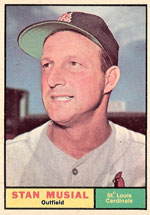
Stan Musial, .559

Jim Edmonds, .555

Joe Medwick, .545

Jim Bottomley, .537

Rip Collins, .517

Scott Rolen, .510

Ryan Ludwick, .507

To put that in perspective, here are just some of the players with lower slugging percentage’s than Ludwick’s as a Cardinal: Ken Boyer (.475), Bill White (.472), George Hendrick (.470), Enos Slaughter (.463), Ted Simmons (.459), Joe Torre (.458), Orlando Cepeda (.454) and Keith Hernandez (.448).

Whitey Herzog showed appreciation during his Baseball Hall of Fame induction speech July 25, 2010, when he remembered Harry Craft for helping him.

“Harry Craft was a guy who was always in my corner,” Herzog told the crowd at Cooperstown, N.Y. “He kind of saved my career. Claimed me on waivers when I wasn’t doing so good at Washington.

“I was able to get nine years (in the majors). I wasn’t a very good player … I was the kind of player everyone wanted; when they got me, they didn’t know what the hell to do with me.

“Anyway, Harry Craft was great to me and I was wishing he would be here today.” (Craft died at 80 in 1995).

Craft managed Herzog twice: in the minor leagues at Class AA Beaumont, Texas, and in the major leagues with the Kansas City Athletics.

Herzog was a 20-year-old prospect in the Yankees system when he was sent to Beaumont in 1952. He struggled there, batting .198 in 35 games.

“I wasn’t ready for the pitching in the Texas League,” Herzog wrote in the book, “White Rat.” “The manager there in Beaumont was Harry Craft, who took a real liking to me. Harry had been a great defensive outfielder but a poor hitter, and I think I reminded him of himself.”

Herzog persevered and, four years later, reached the major leagues with the Washington Senators.

By 1958, struggling to hit the curve, Herzog’s baseball career was in jeopardy. Herzog began the season by catching President Eisenhower’s Opening Day first pitch from the boxseats. (According to the report in The Sporting News, “It was a low, spinning throw which just missed the dirt as Whitey made the stab.”)

In May, the Senators placed Herzog on waivers. Craft, who was managing the Athletics, urged the club to sign Herzog. He became a backup to first baseman Vic Power and to outfielders Roger Maris, Bob Cerv and Bill Tuttle.

“Harry picked me up, which prolonged my big-league career long enough to qualify under the pension plan,” Herzog said. “In baseball, you never burn any bridges.”

(Updated Sept. 8, 2024)

Ralph Houk, who won three American League pennants and two World Series championships as Yankees manager from 1961-63, was an important mentor to Whitey Herzog.

Houk, who earned more than 1,600 wins as manager of the Yankees, Tigers and Red Sox, began his managing career with the Class AAA Denver Bears of the American Association in 1955. His center fielder that season was 23-year-old Whitey Herzog.

Playing on a Yankees farm club that included Marv Throneberry at first, Bobby Richardson at second and pitchers Don Larsen and Ralph Terry, Herzog batted .289 with 21 home runs, 98 RBI and a .412 on-base percentage in 149 games.

He also learned lessons from Houk’s managerial style that he later utilized when he managed the Cardinals.

“Ralph Houk was the best I ever saw at handling people,” Herzog said in his 1999 book, “You’re Missin’ a Great Game.”

“Ralph was a great manager because he knew how to keep 24, 25 different personalities happy. That’s harder than it looks. He let us know what he wanted us all to do, but he dealt with each of us on our own terms, too.

“I played some of my best ball for Mr. Houk, and I never forgot his example. Whether a player was a star or a scrub, I always made sure he felt important … I also tried to spend some time, even a minute or two, with each player every day … My players appreciated that.

“Maybe what I learned best from Ralph Houk was how important every guy is.”

(Herzog wasn’t alone in his admiration of Houk. In his book “The Quality of Courage,” Yankees slugger Mickey Mantle called Houk “the man I admire more than anybody else in baseball.”)

Mike Jorgensen, a reserve first baseman and outfielder for Herzog with the Cardinals in 1984 and 1985, told Cardinals Magazine, “I got to watch (Herzog) work his magic with strategy, particularly with the bullpen and bench players. I was a bench player at that time. He let you know when you were going to play.”

Here’s what other players said to Cardinals Magazine about Herzog’s skill at connecting with them:

_ Dane Iorg: “You felt he was your friend. He was always genuine. He was able to do that because he had confidence in his abilities to manage a baseball team … He could relate to players in a way that nobody else could that I ever played for.”

_ Danny Cox: “Whitey called a team meeting one time. We were kind of flat, not winning, not playing well. He said, ‘Guys, I hate to do this. We’re going to have a little curfew.’ There was this soft rumble from the guys. Whitey said, ‘Yeah, we’re going to have a little curfew _ it’s 4 a.m.’ Everyone laughed. Whitey said, ‘If I check rooms and you’re in before that, you’re going to get fined.’ He just wanted us to relax. He knew the problem was that we were trying too hard, not that we weren’t trying hard enough.”

_ Ken Oberkfell: “We were struggling, not playing really good baseball, and we were getting beat in games that lasted 3.5 hours. Whitey called a meeting. We thought, ‘Uh-oh, we’re going to get our butts chewed out, and we deserve it.’ He said, ‘If you guys are going to play this horseshit, do it faster. I’m tired of watching it.’ So we obliged him. We went out and got beat in two hours, but we got the point. He didn’t have to rant and rave. He was trying to loosen us up.”