Feeds:
Posts
Comments

One measure of a winner is the ability to come through under pressure. Fullback Ben Wilson passed the test multiple times.

He did it in college for the University of Southern California (USC), helping the Trojans win a national championship with big performances against UCLA and Notre Dame, and then in the Rose Bowl versus Wisconsin.

He did it in the pros, too, winning a job with the Green Bay Packers after being pushed aside by the Los Angeles Rams, helping Vince Lombardi’s team win a third consecutive NFL title.

Wilson also contributed to wins for the Rams and Packers against the St. Louis Cardinals in ways that went beyond the game statistics.

Known as Big Ben long before Pittsburgh Steelers quarterback Ben Roethlisberger got the nickname, Wilson valued education and understood the importance of preparing for a life outside of sports.

Big bruiser

Leaving his hometown of Houston, Wilson became a pre-med student at USC and played three years of varsity football as a fullback for head coach John McKay. Years later, reflecting on his senior season, Wilson told the Los Angeles Times, “Do you know I weighed 250 pounds in 1962? I was bigger than most college linemen and I overpowered them.”

UCLA linebacker Ronnie Hull told the newspaper, “He’s big as a house and as fleet as a deer.”

Wilson got off to a cautious start his senior season. He had undergone surgery in May 1962 to remove a bone chip in his right knee, an operation identical to one he had two years earlier on the other knee, according to the Los Angeles Times. He got better as the season progressed.

On Nov. 24, 1962, USC ran its record to 9-0 with a 14-3 triumph versus UCLA. Wilson scored the Trojans’ first touchdown and he set up the second, rumbling eight yards to UCLA’s 1-yard line before quarterback Pete Beathard carried for the score. Wilson, who averaged 4.6 yards on 10 carries, was awarded the game ball.

The next week, USC faced Notre Dame in the regular-season finale. In Wilson’s sophomore and junior seasons, Notre Dame had held USC scoreless and won handily both times.

It was a different story on Dec. 1, 1962. Playing before 81,676 at the Los Angeles Memorial Coliseum, USC prevailed, 25-0, and finished its regular-season schedule at 10-0. Wilson averaged 4.5 yards on 16 carries, rushed for two touchdowns and received a standing ovation.

Notre Dame’s Frank Budka fractured his right leg trying to bring down Wilson on one of his runs.

“We’ve faced some good fullbacks, but he’s the best by far,” Notre Dame quarterback Daryle Lamonica told the Los Angeles Times.

Wilson said to the newspaper, “This was my best game as a Trojan.”

For the second consecutive week, Wilson was awarded the game ball, but he gave it to tackle and co-captain Marv Marinovich. “I didn’t want to be selfish,” Wilson said to the Los Angeles Times.

On Jan. 1, 1963, with his father, mother, three sisters and a cousin from Houston in attendance, Wilson carried 17 times and scored a touchdown in USC’s 42-37 triumph against Wisconsin in the Rose Bowl at Pasadena, Calif. The Associated Press declared the 11-0 Trojans the national college football champions.

Different drill

Asked his plans for pro football after being drafted by the Rams, Wilson told the Los Angeles Times, “It all depends on whether the deal is enough. I’ve always wanted to be a doctor, but then I got interested in dentistry. The more I think about it, the more I like it. If I am accepted in dental school, and the pro deal isn’t good enough for me to set something aside, it would be useless to play.”

The Rams signed him to a two-year, no-cut contract at $20,000 a year and a $20,000 bonus spread over two years, the Los Angeles Times reported. “This gives me a chance to go to dental school,” Wilson told the newspaper.

As a rookie, Wilson was the Rams’ second-leading rusher in 1963, but after the season he told them he was leaving football and would enroll in the USC school of dentistry in the fall of 1964.

“I couldn’t find any school program where I could play football and continue my dental studies the rest of the year,” Wilson said to the Los Angeles Times. “I eventually want a position where I’m economically secure and at the same time getting personal satisfaction out of doing something for my fellow man. I’ve been accepted at USC and _ who knows? _ if I waited a few more years I might not be able to get in.”

The Rams tried to convince Wilson to stick with them, but when training camp opened he hadn’t changed his mind. “This idea of being a dentist is one I have nurtured for years,” he told the Los Angeles Times. “More than that, I feel like I want to do more for humanity than just entertain it.”

In August 1964, Wilson and Rams owner Dan Reeves found a solution. The University of Tennessee agreed to allow Wilson to play pro football and go to its dentistry school the rest of the year. Dean of admissions Eugene Tragesser told United Press International that Wilson had been accepted as the first black student at the University of Tennessee dental school and was expected to enroll in January 1965.

The Rams offered to pay the $7,500 annual tuition fee, the Los Angeles Evening Citizen News reported.

Wilson rejoined the Rams at training camp in late August 1964. “I’ve never seen a more intense worker,” Rams head coach Harland Svare said to the Los Angeles Times. “He’s got great desire, and he’s a great team man.”

(According to the Los Angeles newspaper, Wilson eventually had second thoughts about dentistry and chose to seek a master’s degree in business at USC.)

No longer wanted

Wilson was the Rams’ leading rusher in 1964. A year later, they went with a backfield by committee. In a 27-3 rout of the Cardinals on Dec. 5, 1965, the Rams used Dick Bass and Willie Brown “to soften up the Cardinals and then polished them off with the bull backs, Ben Wilson and Les Josephson,” the Los Angeles Times reported.

After George Allen replaced Harland Svare as head coach in 1966, Wilson reported to training camp about 15 pounds lighter at 219.

“I carried too much weight to move like an NFL back should,” Wilson said to the Los Angeles Times. “I was like a runaway locomotive once I got up a full head of steam. I was just too heavy to cut effectively. So I just moved in a straight line.”

In an August 1966 exhibition versus the Dallas Cowboys, Wilson rushed for 88 yards on 20 carries, but just before the regular season began he was placed on waivers. “It was quite a shock,” he told The Sporting News.

When Wilson went unclaimed, the Rams put him on their reserve list, or taxi squad, and he spent the entire 1966 season there without appearing in a game.

Wilson told the Green Bay Press-Gazette, “To be put on waivers is a humiliating thing at best _ very humiliating. When you are unable to make a connection with any club, it’s not the most ego-building thing that could happen to you.”

Playing to win

In July 1967, Wilson, 28, got a chance to extend his playing career when the Packers acquired him from the Rams for a draft choice. Jim Taylor, the fullback who led the Packers in rushing for seven consecutive seasons (1960-67), was sent to the New Orleans Saints. A second-year pro, Jim Grabowski, replaced him and the Packers wanted Wilson to be his backup.

Asked at training camp by the Green Bay Press-Gazette what it was like being coached by Vince Lombardi, Wilson replied, “He’s very tough, but he’s fair, and he’s dedicated to winning. I don’t think I’d want it any other way.”

Seeking their third straight NFL championship, the Packers entered the 1967 season with Grabowski and halfback Elijah Pitts as the starters, and Wilson and Donny Anderson as the reserves.

On Oct. 1, in the Packers’ romp over the Atlanta Falcons, Wilson got to play more than usual and did well, rushing for 82 yards and a touchdown.

Mostly, though, he served as a blocker on kickoff returns. In the seventh game of the season, Lombardi inserted rookie Travis Williams as the kick returner and he ran back three for 151 yards, including a touchdown, against the Cardinals. Game stats

Williams went on to return four kickoffs for touchdowns with the 1967 Packers. “They were wedge returns,” Lombardi told The Sporting News.

The blockers forming the wedge for Williams were, from left to right, linebacker Tommy Crutcher, guard Gale Gillingham, tackle Forrest Gregg and Wilson.

Job well done

In the Packers’ eighth game of the 1967 season, against the Baltimore Colts, both Jim Grabowski (knee) and Elijah Pitts (Achilles tendon) were injured. Wilson and Donny Anderson replaced them as the starting running backs.

The next week, facing the Cleveland Browns, Wilson had his first 100-yard rushing game as a pro. He followed that with 110 total yards (80 rushing and 30 receiving) versus the San Francisco 49ers and scored two touchdowns against the Minnesota Vikings.

Soon after, Wilson suffered foot and rib injuries. With Grabowski still sidelined, the Packers turned to a third-string fullback, Chuck Mercein.

Mercein was the fullback in the Packers’ playoff wins against the Rams and Cowboys (in the game dubbed the Ice Bowl).

Next up for the Packers was Super Bowl II in Miami against the Oakland Raiders. (The Raiders quarterback was the same Daryle Lamonica who started for Notre Dame in the game Wilson carried USC to victory.)

About 10 minutes before kickoff at the Super Bowl, Wilson was surprised to learn that he, not Mercein, would be the starting fullback.

He told the Green Bay Press-Gazette, “Coach Lombardi came over and said, ‘How do you feel?’ I said, ‘I feel fine.’ He looked at me kind of funny and walked away. A few minutes later, he came back and again asked me, ‘How do you feel?’ “

When Wilson assured the coach he felt fine, Lombardi said, “If you feel good, then we’ll start you.”

Though he sat out part of the fourth quarter after losing a contact lens, Wilson was the Packers’ leading rusher in the game, with 62 yards on 17 carries, and the Packers prevailed, 33-14.

Moving on

The Super Bowl turned out to be Wilson’s final game.

In March 1968, he had an operation to remove cartilage from his left knee, but there were complications and the knee did not respond.

Wilson reported to training camp (Phil Bengtson had replaced Lombardi as head coach) but told the Green Bay newspaper the knee had undergone “a fantastic amount of atrophy.”

The Packers took him off the roster before the start of the 1968 season.

Wilson went on to own five McDonald’s restaurants in Houston. According to his obituary, he enjoyed singing, fishing, crossword puzzles, card games, was extremely outgoing and never met a stranger.

Whether as a player or as a coach, Maxie Baughan was good at sizing up situations and calling the shots.

An outside linebacker who played in the NFL primarily from 1960 to 1970 with the Philadelphia Eagles and Los Angeles Rams, Baughan was the captain of the defense and chose the alignment for each play during a game.

Described by the New York Times as “one of the most fearsome linebackers of the 1960s,” Baughan was named to the Pro Bowl in nine of his first 10 seasons in the NFL. He knocked heads with the St. Louis Cardinals multiple times.

Baughan went on to have a long coaching career as an assistant in the NFL and as head coach in college at Cornell.

Ramblin’ Wreck

Baughan attended high school in Bessemer, Ala., a major steelmaking center. Recalling his boyhood days, Baughan told Gannett News Service, “I was going into the mills since as long as I can remember. I knew the first time I went in I didn’t want to work in there the rest of my life.”

(According to The Birmingham News, Baughan’s father, an electrician, died when he fell from a ladder at a coal mine near Birmingham in June 1961. He was 52. Baughan Sr. suffered a heart attack, fell onto high-voltage wires and was electrocuted, the Binghamton [N.Y.] Press and Sun-Bulletin reported.)

Maxie Baughan played football at Georgia Tech and excelled as a linebacker and center. “He’s one of the most consistently great football players I have coached,” head coach Bobby Dodd told the Philadelphia Inquirer.

(Baughan was quite a baseball fan, too. While at Georgia Tech, “I used to go all the time to old Ponce de Leon Park in Atlanta to see the [minor-league] Crackers and I loved it,” he said to The Montogmery [Ala.] Advertiser.)

Baughan graduated from Georgia Tech with a degree in industrial engineering.

As a youth, Baughan earned the Boy Scouts of America’s highest rank, the Eagle Scout Award. As a professional football player, Baughan became a Philadelphia Eagle. The team selected him in the second round of the 1960 NFL draft.

The Natural

The 1960 Eagles were a tough, talented group featuring Chuck Bednarik, Tom Brookshier, Tommy McDonald, Pete Retzlaff, Joe Robb and Norm Van Brocklin. Though a rookie, Baughan fit right in.

A brawl broke out on the field in a 1960 exhibition game between the Eagles and San Francisco 49ers. Hugh McElhenny, the 49ers running back who was nicknamed “The King” and who was destined for election to the Pro Football Hall of Fame, “was dropkicking the back of the head” of Eagles defensive tackle Ed Khayat, the Philadelphia Daily News reported.

According to the newspaper, Baughan came to Khayat’s rescue, “driving McElhenny clear across the field, pumping the heels of his hands into the veteran’s chest and finally lifting his helmet to deliver the fist de grace.”

Baughan said to the Daily News, “When I saw him kick Ed in the head, I just had to go after him.”

The rookie’s action earned him the respect of his teammates. His play as a linebacker earned him a spot as a starter. “He’s quick as a cat,” Eagles assistant coach Nick Skorich told the Daily News. “He uses his hands beautifully. He has good play sense, and he’s a hard, sharp tackler.”

Baughan looked the part, too. The Sporting News described him as “pug-nosed, weather-beaten.” Sandy Grady of the Philadelphia Bulletin put it this way: “A face that was forged in a furnace … pugnacity, intelligence and violence written on it.”

The first time he faced the St. Louis Cardinals, on Oct. 9, 1960, Baughan made 10 tackles, including seven unassisted, and broke up a pass, United Press International reported. Game stats

“He’s one of the hardest tacklers on the team, a quick thinker, fast, alert and as gung-ho as they come,” The Sporting News noted. “He took over on the starting unit as if the position had been made for him.”

The Eagles won the 1960 NFL championship, in part because of a defense that limited Vince Lombardi’s Green Bay Packers to 13 points in the title game.

L.A. story

In 1965, the Eagles opened the season against the Cardinals. With the score tied 20-20 at halftime, Baughan, captain of the defense, convinced head coach Joe Kuharich to call off the blitzes against quarterback Charley Johnson.

“We couldn’t blitz too much against them,” Baughan said to the Philadelphia Daily News. “Heck, they invented the blitz. They can pick it right up.”

Instead, with Baughan calling the defensive signals, the Eagles faked the blitz, then realigned their formation at the last instance. The jitter-bugging defense “completely confounded” Johnson, according to the Daily News. The Eagles limited the Cardinals to seven points in the second half and won, 34-27. Game stats

As the season progressed, the relationship between Baughan and Kuharich got rocky. “Near the end, the two of them were getting along like Richard Burton and Elizabeth Taylor in ‘Virginia Woolf,’ ” the Philadelphia Inquirer noted.

After the season, amid reports Baughan wanted to be traded, Los Angeles Rams head coach George Allen called Kuharich “31 times in as many days,” trying to make a deal for the linebacker, The Sporting News reported.

In April 1966, Kuharich relented. The Eagles dealt Baughan to the Rams for defensive tackle Frank Molden, linebacker Fred Brown and a draft choice. “Maxie Baughan is the best right side linebacker in the game,” Allen told The Sporting News.
The 1966 Rams defense featured the Fearsome Foursome front line of Deacon Jones, Merlin Olsen, Rosey Grier and Lamar Lundy. Joining Baughan as the linebackers were Bill George (a future Pro Football Hall of Famer) in the middle and Jack Pardee on the left side. Another standout, Eddie Meador, was the safety.

Amid all that talent, Allen chose Baughan to be the defensive captain and entrusted him to call the plays. “As the Rams’ defensive signal caller, Baughan was responsible for some 250 different defenses and 180 audible signals,” The Sporting News reported.

Baughan told the publication, “I would say that I audibilize about 85 percent of the time. A lot of things enter into my decision, like down and distance, the hash marks, field position, the particular formation.”

The Los Angeles Times noted, “His vast knowledge of Allen’s intricate defense and execution of the many audibles from a variety of formations has made the Rams one of pro football’s most effective defensive units. Equally important is the fact Maxie is a leader and serves as an inspiration to the team.”

Baughan thrived playing for Allen. He told the Ithaca (N.Y.) Journal, “I probably learned more about football from George Allen than anyone else.”

The Sporting News called Baughan “the brains of the Rams defense” and dubbed him “The Battering Ram.” 

Eventually, the battering took its toll. Baughan underwent knee surgeries after the 1967, 1968 and 1969 seasons. He suffered a concussion in a 1969 game against the Atlanta Falcons and was unconscious for almost 15 minutes, The Sporting News reported. The cumulative pain became unbearable.

“I’m allergic to some medicine, including pain killers,” Baughan told The Sporting News. “I can’t even take an aspirin. It started back in 1962 when I was with Philadelphia. I took a muscle relaxer and had a violent reaction. The Eagles’ trainer literally saved my life.”

Coaching carousel

The Rams fired Allen after the 1970 season and Baughan retired from playing. When Allen became head coach of the Washington Redskins in 1971, Baughan assisted him. That began a long second career as a coach.

Baughan was defensive coordinator at Georgia Tech for two years (1972-73). In 1974, he left to become defensive coordinator of the New York Giants, but before the season began he quit and rejoined Allen with the Redskins as a player-coach.

After stints as defensive coordinator of the Baltimore Colts (1975-79) and Detroit Lions (1980-82), Baughan became head coach at Cornell. He was recommended for the job by former Colts running back Tom Matte, who became a friend of Baughan when he was with Baltimore. Matte had connections to an influential almnus at Cornell.

Replacing Bob Blackman, who retired, Baughan coached six seasons (1983-88) at Cornell. The Ivy League program had losing records his first three seasons, then finished 8-2, 5-5 and 7-2-1 the last three seasons.

In April 1989, the Ithaca Journal reported a rift between Baughan and assistant coach Peter Noyes stemmed from a romantic relationship between Baughan and Noyes’ wife. Citing “personal tensions” for his decision, Baughan resigned.

He went on to be linebackers coach for the Minnesota Vikings (1990-91), Tampa Bay Buccaneers (1992-95) and Baltimore Ravens (1996-98). Among the linebackers he coached were standouts Derrick Brooks of the Buccaneers and Ray Lewis of the Ravens.

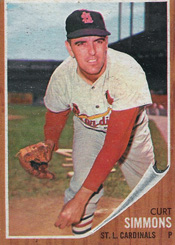
For a while, in the early part of September 1963, Cardinals pitcher Curt Simmons couldn’t do anything wrong at the ballpark.

From Sept. 1 to Sept. 13, Simmons won four starts in a row for the 1963 Cardinals and pitched three consecutive shutouts in that stretch.

His hot streak extended beyond the pitching mound. Simmons drove in runs and, in perhaps the most amazing feat of all, stole home.

Base thief

A left-hander who turned 34 in 1963, Simmons was a starter who overcame career-threatening injuries. Part of the big toe on his left foot was sliced off in a lawn motor accident in 1953 and he underwent surgery to remove bone chips in his left elbow in 1959. After the Cardinals signed him in May 1960 following his release by the Phillies, Simmons mixed more changeups and slow curves into his assortment of pitches.

Simmons was part of a 1963 Cardinals starting rotation with Bob Gibson, Ernie Broglio, Ray Sadecki and Lew Burdette.

On Sept. 1, 1963, Simmons started against the Phillies at Connie Mack Stadium in Philadelphia. In the second inning, with Tim McCarver on first and one out, Simmons hit a Chris Short pitch to the base of the scoreboard in center for a triple. McCarver scored, giving the Cardinals a 1-0 lead.

(The triple was the third and last for Simmons in 20 seasons in the majors. The others came in 1953 against Sal Maglie of the Giants and in 1955 versus Hy Cohen of the Cubs.)

With Julian Javier at the plate, the Cardinals called for a squeeze play. Overeager, Simmons broke for home too soon. Short noticed and tried to throw a pitch that Javier would be unable to bunt. In his excitement, Short threw the ball high over the outstretched mitt of catcher Bob Oldis. Simmons scooted safely to the plate and was credited with a steal of home.

Asked by the St. Louis Globe-Democrat whether he could recall his last previous swipe of home, Simmons said, “Maybe in high school. They don’t want to take too many chances with me (attempting to steal).”

(The steal of home versus the Phillies was the second and last stolen base for Simmons in the majors. The first came 10 years earlier when he swiped second base in a 1953 game against the Pirates.)

In the sixth, with Bobby Locke pitching for the Phillies, George Altman tripled and Simmons drove him in with a sacrifice fly for his second RBI of the game.

Simmons pitched a six-hitter for the win, beating the Phillies for the 12th time in 14 decisions since joining the Cardinals. Boxscore

In command

For the next two weeks, Simmons was unbeatable _ and also untouchable when it came to scoring runs against him.

On Sept. 5, he shut out the Mets and contributed a single and a walk in the 9-0 triumph. He thought he had another hit but his liner with the bases loaded was caught against the wall by right fielder Ed Kranepool. “How could they play me so deep?” Simmons said to the St. Louis Post-Dispatch. “They had a first baseman playing right field. If they had a regular outfielder, he wouldn’t have played so deep.” Boxscore

Four days later, Simmons shut out the Cubs on a five-hitter. Cleanup batter Ron Santo, held hitless, told the Post-Dispatch, “That’s the best I’ve seen Simmons.” Boxscore

On Sept. 13, Simmons pitched his third shutout in nine days when he beat the Braves and Warren Spahn.

Hank Aaron, who sometimes was frustrated by Simmons’ soft tosses, struck out twice. So did Eddie Mathews. Simmons held Aaron, Mathews and Joe Torre hitless. “Simmons is like Spahn,” Mathews said to the Post-Dispatch. “He knows what he’s going to do on every pitch.”

Simmons’ RBI-double down the left field line drove in a run and knocked Spahn out of the game in the second inning. Boxscore

Tough foe

The win streak ended for Simmons on Sept. 17 against his season-long nemesis, the Dodgers. Trailing the first-place Dodgers by two games in the National League standings, the Cardinals sent Simmons against Sandy Koufax, but the Dodgers won, 4-0. Boxscore

When the Dodgers completed a sweep of the three-game series the next night, it virtually secured the pennant for them.

In four starts versus the 1963 Dodgers. Simmons was 0-3, even though he had a 2.00 ERA over 36 innings. He lost twice to Koufax and once to Don Drysdale. The Cardinals totaled three runs in those three defeats.

For the 1963 season, Simmons was 15-9 with a 2.48 ERA. He pitched six shutouts and totaled 232.2 innings. (Koufax had 11 shutouts in 1963 and Spahn had seven.) Simmons also fielded flawlessly, committing no errors in 35 chances.

“Curt doesn’t beat himself,” Cardinals manager Johnny Keane remarked to the Post-Dispatch. “He walks few batters, fields his position and gets a base hit now and then.”

Eddie Fisher made sweet music with a pitch that could dance. That’s why the Cardinals wanted his help in their bid for a division title.

On Aug. 29, 1973, the Cardinals purchased the contract of Fisher, 37, from the White Sox. The right-handed knuckleball specialist was in his 15th and final season in the majors.

On the day Fisher was acquired, the Cardinals (67-64) led a weak National League East Division. They were two games ahead of the second-place Pirates (63-64) and 6.5 in front of the last-place Mets (60-70).

With Diego Segui, Orlando Pena, Al Hrabosky and Rich Folkers, the Cardinals had a reliable bullpen but wanted the insurance of another experienced reliever for the title run. Fisher fit the bill.

Home on the range

Fisher attended grades one through 12 at Friendship School in Altus, Okla. “There were only 16 in my graduating class, nine boys and seven girls, including Betty Hudgens, whom I later married,” Fisher recalled to The Sporting News.

He excelled in baseball and basketball. His Altus American Legion baseball teammate, Lindy McDaniel, also became a big-league pitcher. As a high school senior, Fisher was a principal player in a major upset. He shut out state powerhouse Capitol Hill, ending its 66-game winning streak in 1954.

“I could throw the knuckler then, but I could win with just a fastball and curve, so I never used it in a game,” Fisher said to The Sporting News.

After graduating, Fisher got a job in Oklahoma City reading gas meters. He also pitched for the company baseball team. Its manager, Roy Deal, was the father of Cardinals pitcher Cot Deal. Roy helped Fisher get an athletic scholarship to the University of Oklahoma.

Fisher didn’t throw the knuckleball in college either. “Eddie didn’t need the knuckler to win in college ball,” head coach Jack Baer explained to The Norman Transcript, “and there are very few catchers, let alone college catchers, who can handle a knuckler.”

As a college junior, Fisher got an offer from the Kansas City Athletics but opted to return to Oklahoma for his senior year. When no offers came after Fisher completed his college career, Roy Deal contacted a minor-league team in Corpus Christi, Texas, and helped him get a roster spot there.

Tuning up

Corpus Christi, a farm club of the Giants in 1958, was managed by a former American League catcher, Ray Murray, who encouraged Fisher to add the knuckler to his assortment of pitches.

A year later, in July 1959, Fisher, 23, was called up to the Giants. For Fisher’s debut, a start against the Pirates, manager Bill Rigney used backup catcher Jim Hegan, 38, who was in his 16th season in the majors. Experienced catching the knuckler, Hegan guided the rookie through the game. Fisher pitched seven innings, limiting the Pirates to one run and three hits, and got the win. Boxscore

A popular singer at the time also was named Eddie Fisher. The singer’s marriages to actresses Debbie Reynolds (their daughter is actress Carrie Fisher), Elizabeth Taylor and Connie Stevens added to his fame. Asked about sharing a name with the crooner, baseball’s Eddie Fisher told The Norman Transcript, “I can’t sing, and what’s more, I don’t like to.”

Teammates nicknamed the pitcher Donald Duck “because of the excellent imitation he does” of the Walt Disney character, The Sporting News noted.

Higher education

After the 1961 season, Fisher was sent by the Giants to the White Sox for pitchers Billy Pierce and Don Larsen. Pierce and Larsen helped the Giants win the 1962 pennant. The White Sox helped Fisher find his niche. The turning point came during the 1964 season when his teammate, knuckleballer Hoyt Wilhelm, persuaded him to use the knuckler as his main pitch.

“We’d be out there together in the bullpen and we’d talk shop,” Fisher told The Sporting News. “He kept hammering away at me to throw the knuckler more. He insisted it was my out pitch and he finally convinced me.”

The bullpen combination of Wilhelm and Fisher confounded American League batters. With the 1964 White Sox, Wilhelm was 12-9 with 27 saves and a 1.99 ERA. Fisher was 6-3 with nine saves and a 3.02 ERA. In 1965, Fisher led American League pitchers in appearances (82) and was 15-7 with 24 saves and a 2.40 ERA. Wilhelm was 7-7 with 21 saves and a 1.81 ERA.

Their knucklers baffled White Sox catcher J.C. Martin as well. Martin had 24 passed balls in 1964 and 33 in 1965.

Fisher was effective against all styles of hitters. Contact hitter Bobby Richardson batted .103 in 29 at-bats against him. Slugger Jim Gentile came up empty _ hitless in 15 career at-bats. “If it’s a good knuckleball, it doesn’t just float. It moves,” Gentile told The Oklahoman. “Swing at it, it might dip, might rise.”

American League batters hit .192 versus Fisher in 1964 and .205 in 1965. 

That’s a winner

On June 13, 1966, the White Sox traded Fisher to the Orioles for second baseman Jerry Adair. Fisher joined a bullpen with Stu Miller, Moe Drabowsky and Dick Hall.

Fisher made an immediate impact, earning a save or a win in five of his first seven appearances with the Orioles. He pitched in 44 games for them and was 5-3 with 14 saves and a 2.64 ERA. The Orioles (97-63) won the pennant.

Though Fisher led the league in appearances (67 combined for the White Sox and Orioles) for the second year in a row, he didn’t pitch in the 1966 World Series versus the Dodgers. The Orioles swept, getting shutouts from Jim Palmer, Wally Bunker and Dave McNally. The only Orioles reliever to appear in that World Series was Drabowsky, who pitched 6.2 scoreless innings and struck out 11 in Game 1.

Fisher never got to play for another World Series participant. He was with the Indians in 1968 and the Angels from 1969-72 before returning to the White Sox.

Final season

At spring training in 1973, Fisher, 36, had a 1.33 ERA in 27 innings pitched in exhibition games. White Sox manager Chuck Tanner and pitching coach Johnny Sain decided to open the season with Fisher as their No. 3 starter behind another knuckleballer, Wilbur Wood, and Stan Bahnsen.

Fisher won four of his first five decisions, but the good times didn’t last. He slumped in June (10.67 ERA in five starts) and was moved back to the bullpen. In 10 relief appearances covering 35.1 innings, he had a 3.57 ERA, prompting the Cardinals to acquire him. Barney Schultz, Cardinals pitching coach in 1973, helped St. Louis win a World Series title in 1964 as a knuckleball reliever who joined the club in August.

Cardinals manager Red Schoendienst put Fisher to work, pitching him in three consecutive games. In his second appearance, on Sept. 2, 1973, Fisher got the win with a scoreless inning of relief against the Mets. The triumph gave the Cardinals (69-67) sole possession of first place in the division, a game ahead of the Pirates (66-66), and pushed the Mets (63-72) nine games below .500. Boxscore

The next day, the Cardinals played a doubleheader against the Pirates. In the opener, with the score tied at 4-4, Fisher entered in the bottom of the 13th inning. The first batter he faced, Richie Hebner, clobbered a knuckleball to deep right.

“I definitely thought it was gone,” Cardinals catcher Ted Simmons told The Pittsburgh Press. “I was ready to walk off the field.”

Instead, the ball hit the wall and caromed past right fielder Jose Cruz. Center fielder Luis Melendez didn’t back up Cruz as he should. The ball bounced along the artificial surface of the outfield as Hebner steamed around the bases.

Melendez said to The Pittsburgh Press, “I’ve got to be there (backing up the play). If I get there when I was supposed to, it only would have been a double.”

When Melendez finally got to the ball, he reached for it and didn’t come up with it. He reached a second time and again couldn’t grab it. Pirates third-base coach Bill Mazeroski told The Pittsburgh Press that he intended to hold Hebner at third, but when Melendez twice failed to retrieve the ball, “I sent him in. If he picks it up the first or second time, I don’t send him in.”

Hebner scooted to the plate with a walkoff inside-the-park home run, and Fisher was the losing pitcher. Boxscore

Two weeks later, on Sept. 17, Fisher got a win, pitching two scoreless innings and driving in a run with a single against the Expos’ Mike Marshall. Boxscore

By then, though, the Cardinals (74-76) were sliding. The Mets won seven in a row from Sept. 18 to Sept. 25 and finished as the only team in the division with a winning record (82-79).

(The 1973 Cardinals ended 81-81, sixth overall in the National League, a finish that today would have them popping champagne corks and selling postseason merchandise as lame playoff qualifiers.)

Fisher was released by the Cardinals after the season, ending his playing days. He was 2-1 with a 1.29 ERA for them. For his career in the majors, Fisher was 85-70 with 82 saves.

A couple of American pitchers finishing out their military service in the Korean War became baseball pioneers of sorts in Japan.

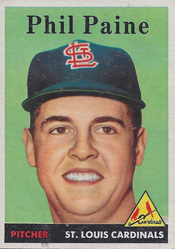
Leo Kiely and Phil Paine were the first to play in the major leagues in the U.S. and in professional baseball in Japan.

Kiely, a left-hander with the 1951 Boston Red Sox, and Paine, a right-hander with the 1951 Boston Braves, played for teams in the Japanese Pacific League in late summer 1953.

Kiely, 23, made his Japanese debut on Aug. 8, 1953, for the Mainichi Orions, according to the Society for American Baseball Research. Paine, 23, made his Japanese debut on Aug. 23, 1953, for the Nishitetsu Lions.

Jersey guy

Born and raised in Hoboken, N.J. (site of the first organized baseball game played in June 1846 between the Knickerbocker Club and New York Nine), Leo Kiely was 5 “when he was run down by an ice truck _ run over twice, in fact, by the same truck,” the Boston Globe reported.

Both of his legs were broken, just under the knees, and he broke his pelvis, too, according to the Globe.
“That ice truck sure tried to do a job on me,” Kiely told the Boston newspaper. “I was playing in an alley when it backed over me and ran over my legs. Then the guy put on full speed ahead and ran over me again.”

As a teen, Kiely worked for $38 a week as a truck driver’s helper on a Hoboken newspaper, The Jersey Observer. Then he became a press room apprentice at the newspaper, serving the role of flyboy. (The term came about because the job required catching stacks of newspapers as they flew off the presses.) “He had dreams of becoming a printer,” the Globe reported.

Kiely also developed into a standout sandlot baseball player. In August 1947, in the championship game of the Build Better Boys Sandlot Association tournament at Jersey City, Kiely, 17, “looked like Frank Merriwell, Jack Armstrong, and the Rover Boys all rolled into one,” the Bayonne Times reported.

He pitched a four-hitter, striking out nine, and hit a home run as Hoboken ended Bayonne’s four-year hold on the league title. Red Sox scout Bill McCarren signed Kiely to a contract.

Because of his childhood accident, “one leg is still a bit shorter than the other and _ even in his baseball shoes _ he has to wear a slight lift in one shoe,” the Globe reported.

In late June 1951, during his fourth season in the minors, Kiely got called up to the Red Sox. Because he had not been to spring training with the big-league club, “most of the Red Sox had never heard of him when he was brought up,” according to the Globe.

Red Sox manager Steve O’Neill put Kiely, 21, into the starting rotation. He made his big-league debut against the Washington Senators on July 2, 1951, and got the win, pitching a complete game. Boxscore

Kiely finished the 1951 season with a 7-7 record and 3.34 ERA for the Red Sox.

Special delivery

Phil Paine, from Chepachet, Rhode Island, excelled in baseball and hockey as a youth. The Philadelphia Phillies signed him when he was 18 and he pitched two seasons in their farm system. When the Phillies exposed him to the minor-league draft, the Braves claimed him in December 1949.

At Hartford in 1951, Paine was managed by Tommy Holmes, the former Braves outfielder who twice led the National League in hits. When Braves manager Billy Southworth resigned in June 1951, Holmes replaced him.

A month later, Paine was told there was a telegram for him in the Hartford clubhouse. “I thought it was from the draft board,” Paine told The Sporting News. “I nearly fell over when I read it and found out I’d been called up to the Braves.”

Paine, 21, went 2-0 with a 3.06 ERA in 21 relief appearances for the 1951 Braves.

“This kid has got a lot of stuff,” Holmes told The Sporting News. 

Braves pitching coach Bucky Walters said to the Globe, “That boy’s got it. Phil has a perfect disposition for a pitcher, including that touch of meanness that a pitcher needs … I think he’s going to be a great pitcher.”

Soldiering on

After their rookie seasons in the big leagues, Kiely and Paine were inducted into the U.S. Army in the fall of 1951. Even with his leg condition, Kiely passed an Army physical. “The Army decided he was fit for service, although disqualified for combat,” The Sporting News reported.

Both men spent most of the Korean War stationed in Japan and pitched for military base baseball teams.

The signing of an armistice on July 27, 1953, brought an end to the Korean War. Kiely and Paine, both still in military service, then joined the Japanese teams, agreeing to play until they were discharged from the Army. Until then, no one who had played in the major leagues had played for a professional team in Japan.

The arrangement was that Kiely and Paine would pitch on their days off from military duty. Paine was paid $575 a game, The Sporting News reported.

According to baseball-reference.com, Kiely went 6-0 with a 1.80 ERA for the Mainichi Orions, and Paine was 4-3 with a 1.77 ERA for the Nishitetsu Lions.

Both men were discharged from the Army in the fall of 1953 and prepared to return to their major-league teams the following spring.

Much had changed since Kiely and Paine last pitched in the majors. The Braves moved from Boston to Milwaukee and Charlie Grimm was the manager. The Red Sox had a different manager, too _ Lou Boudreau.

San Francisco detour

Kiely was 5-8 for the Red Sox in 1954 (the highlight was a shutout of the Philadelphia Athletics), then got moved to the bullpen in 1955 and was 3-3 with six saves and a 2.80 ERA. In the winter, he worked on the docks in Hoboken, according to the Globe.

After posting a 5.47 ERA for the Red Sox in 1956, Kiely was sent to the minors the following year. 

The 1957 season was San Francisco’s last as a minor-league town. Pitching for the San Francisco Seals, Kiely was 21-6 with a 2.22 ERA. Twenty of those wins came in relief.

The Red Sox brought him back in 1958 and Kiely, 28, was 5-2 with 12 saves.

He pitched two more years in the majors _ with the 1959 Red Sox and 1960 Kansas City Athletics. In his final inning, he struck out his former Red Sox teammate, Ted Williams. Boxscore

Cardinals caravan

Paine made 11 relief appearances with the 1954 Braves and 15 with the 1955 team, then spent most of 1956 and 1957 in the minors.

On April 19, 1958, the Cardinals claimed him off waivers and put him in their bullpen. Paine was 5-1 with a save in 46 appearances for the 1958 Cardinals. Combined with his 5-0 mark during his years with the Braves, he had a career record of 10-1 in the majors.

After the season, the Cardinals went on a goodwill tour of Japan and played 16 exhibition games against Japanese all-star teams. Paine was one of eight pitchers the Cardinals brought on the tour.

At Fukuoka, Japan, Paine visited Camp Drake, the military base where he had been stationed, and spoke at a luncheon held in his honor, according to the Society for American Baseball Research. He was the starter and winning pitcher for the Cardinals in the 10th game of the tour at Fukuoka, United Press International reported.

In December 1958, after the Cardinals returned home, they traded Paine and Wally Moon to the Dodgers for Gino Cimoli. The Dodgers made the deal only after the Cardinals agreed to add Paine, the Los Angeles Times reported.

Paine’s former team, the Nishitetsu Lions, offered him a contract to pitch for them in 1959, according to United Press International, but he opted to report to spring training with the Dodgers. They assigned him to the minors and he finished his playing career there.

Willie Mays was the first right-handed batter to hit 400 home runs in the National League. The milestone homer came against a familiar foe, Curt Simmons of the Cardinals, and was witnessed by another 400-homer hitter, Stan Musial.

On Aug. 27, 1963, at Candlestick Park in San Francisco, Mays capped a two-month hot streak with his 400th career home run for the Giants.

At the time, nine others had achieved the feat: Babe Ruth (714), Jimmie Foxx (534), Ted Williams (521), Mel Ott (511), Lou Gehrig (493), Stan Musial (472), Eddie Mathews (419), Mickey Mantle (415) and Duke Snider (403).

(Musial, Mathews, Mantle and Snider still were active. Musial would finish with 475, Mathews 512, Mantle 536 and Snider 407.)

The only right-handed batter in the 400-homer group besides Mays was Foxx. (Of his 534 home runs, Foxx hit 524 as an American Leaguer and 10 as a National Leaguer.) All the others, except Mantle (a switch-hitter), batted from the left side.

Mays, 32, was considered the best bet to break the National League career home run mark of 511 held by Mel Ott.

On a roll

After leading the National League in home runs (49) and total bases (382) and powering the Giants to a pennant in 1962, Mays got baseball’s highest salary in 1963 _ $105,000.

He had a substandard start to the season, hitting .233 in April and .257 in May. At the urging of the Giants, Mays got his eyes examined “and was told they were fine,” according to his biographer James S. Hirsch.

He found a groove after the all-star break and nearly was unstoppable. Mays hit .322 in July, .387 in August and .378 in September.

From July 28 through Aug. 27, Mays hit safely in 27 of 28 games. In that stretch, he raised his 1963 season batting average from .274 to .308.

His only hitless game in that period came on Aug. 13 when Jim Maloney of the Reds shut out the Giants on a two-hitter.

(The game was noteworthy for another reason. It was the first time Mays played a position other than center field in the majors. In the eighth inning, after Norm Larker batted for shortstop Ernie Bowman, manager Al Dark put Larker at first base, moved Orlando Cepeda from first to left, Harvey Kuenn from left to right, Felipe Alou from right to center and Mays from center to shortstop. Mays had no fielding chances in his one inning at short, but he told the Associated Press, “Man, that’s too close to the plate.” Boxscore)

Numbers game

On Aug. 25, 1963, facing the Reds’ Joe Nuxhall at Candlestick Park, Mays hit his 399th home run. Later , with Joey Jay pitching, Mays drove a pitch to deep left. “If Frank Robinson hadn’t caught the ball a scant foot from the top railing, Willie would have had his 400th major-league homer,” The Sporting News reported.

The next day, Aug. 26, the Cardinals opened a series at San Francisco. Mays got two singles, but no home run, against Ernie Broglio. Curt Simmons provided another opportunity on Aug. 27.

Mays had a history of success against Simmons. In 1961, for instance, Mays had a .692 on-base percentage versus the Cardinals left-hander, reaching base nine times (six hits, two walks, one hit by pitch) in 13 plate appearances. For his career, Mays finished with a .423 on-base percentage (39 hits, 22 walks, two hit by pitches) versus Simmons.

In the Aug. 27 game, with the Giants ahead, 3-0, Mays led off the third inning and lined a 2-and-1 pitch from Simmons the opposite way to right. The ball carried over the outstretched glove of George Altman, struck a railing and went over the fence for home run No. 400.

Orlando Cepeda followed with another homer against Simmons, who then was lifted for Barney Schultz. The first batter he faced, Felipe Alou, hit the Giants’ third consecutive home run of the inning. Boxscore

“I stay in good shape and I think I can hit a lot more,” Mays said to United Press International. “I may be able to reach the 500 mark.”

Stan Musial, stationed in left field when Mays hit his 400th homer, told The Sporting News, “He has an excellent chance to beat Mel Ott’s National League mark of 511 before he decides to call it quits.”

Asked about Musial, who had declared two weeks earlier that he would retire after the 1963 season, Mays said to Si Burick of the Dayton Daily News, “Nicest man I ever knew. When I was a kid coming up, I never thought a star on another team would help you, but he talked to me a lot about hitting. He even let me use his lighter bat a couple times when I was in a slump.”

(The kindness shown by Musial was paid forward by Mays. A week after Mays’ 400th home run, Cardinals pitcher Bob Gibson hit a 400-foot homer against the Pirates’ Don Schwall with a bat Mays had given him, The Sporting News reported. At 34 ounces, it was two ounces heavier than Gibson’s bat. Boxscore)

Join the club

On the same day Mays hit his 400th home run, Hank Aaron of the Braves slugged his 333rd (against Don Nottebart of the Houston Colt .45s). Three years later, on April 20, 1966, Aaron achieved home run No. 400 versus the Phillies’ Bo Belinsky.

Aaron went on to hit 755 home runs and Mays finished with 660.

In his book, “I Had a Hammer,” Aaron said, “I considered Mays a rival, certainly, but a friendly rival. At the same time, I would never accept the position as second best (to him). I’ve never seen a better all-around ballplayer than Willie Mays, but I will say this: Willie was not as good a hitter as I was. No way.”

In August 2023, 60 years after Mays became the 10th player to reach 400 career home runs, the total number of players achieving the feat had risen to 58.