As Cardinals, pitchers Murry Dickson and Howie Pollet were beneficiaries of the productive hitting of Enos Slaughter. As Pirates, they were victims of the same.
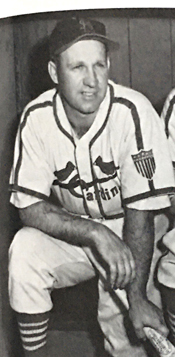 In September 1952, Slaughter delivered walkoff wins for the Cardinals in consecutive games versus the Pirates.
One of those game-winning hits came against Dickson. The other occurred an inning after Slaughter tied the score versus Pollet.
Six years earlier, Dickson (15 wins) and Pollet (21 wins) were two of the top starters for the 1946 World Series champion Cardinals. Slaughter led the National League in RBI (130) that season and made a daring dash from first to home to score the winning run in Game 7 of the World Series.
A lot had changed by 1952. The Cardinals no longer were a consistent contender, and Dickson and Pollet were pitching for one of the all-time worst teams.
Getting it done
At 36, Slaughter still had a prominent role with the 1952 Cardinals as their right fielder, cleanup hitter and team captain. Though not a classic power hitter, Slaughter was a challenge for any pitcher. He led the 1952 Cardinals in RBI (101) and triples (12), and hit .300.
Slaughter was in his usual lineup spot for the Cardinals against the Pirates on Saturday night, Sept. 6, 1952, at Sportsman’s Park in St. Louis. With 20 games left to play, the Cardinals were 77-57, but nine behind the first-place Dodgers.
Starting for the Pirates was Murry Dickson. The year before, he had 20 wins for the Pirates. In 1952, he would suffer 21 losses. The Pirates entered the game with a 39-98 record on their way to a 42-112 finish. The Pirates’ catcher was another former member of the 1946 Cardinals, Joe Garagiola.
Dickson and the Pirates took a 4-3 lead into the bottom of the eighth. Red Schoendienst led off for the Cardinals and singled. Stan Musial followed with a sharp grounder to first baseman Tony Bartirome, who threw to shortstop Dick Groat, covering second, for the force out of Schoendienst. Groat’s relay throw to Bartirome nearly completed a double play, but umpire Babe Pinelli ruled Musial safe at first.
(Pinelli’s call peeved the Pirates. As the Pittsburgh Post-Gazette noted, “Joe Garagiola sounded off quite freely with Pinelli after the game on the trip to the clubhouse. Both exercised the freedom of speech article in the Constitution.”)
Instead of batting with the bases empty, Slaughter came up with Musial on first and laced a double off the screen in right field. Musial raced home, tying the score at 4-4.
Dickson still was pitching in the 10th when Solly Hemus led off with a double. After Schoendienst popped out, Musial was walked intentionally, bringing up Slaughter. (Musial in his career batted .419 with 52 hits versus Dickson. Slaughter batted .267 with 27 hits against him.)
Slaughter hit Dickson’s first pitch onto the right field roof for a three-run walkoff home run and a 7-4 Cardinals victory. Boxscore
The home run was Slaughter’s 1,900th career hit. He would finish with 2,383.
(Slaughter hit four walkoff home runs in the majors, three for the Cardinals and one for the Athletics.)
Encore performance
The next day, before what the St. Louis Post-Dispatch described as a “slender Sunday crowd” of 9,298, Howie Pollet started against his former team.
Pollet shut out the Cardinals for seven innings, limiting them to two hits, but in the eighth, with the Pirates ahead, 3-0, the Cardinals loaded the bases with none out. Musial struck out, but Slaughter followed with a triple high off the screen in right-center, tying the score.
“Came the ninth and now defeat was inevitable,” The Pittsburgh Press noted. “It always is with the Pirates.”
Pirates manager Billy Meyer sent Jim Waugh, an 18-year-old rookie, to pitch the bottom of the ninth against the Cardinals. After retiring the first batter, he walked the next three.
Another rookie, Cal Hogue, relieved, facing Slaughter with the bases loaded. Hogue’s best pitch was “a jagged overhanded curve,” according to Bob Broeg of the Post-Dispatch.
Working the count to 3-and-1, Slaughter sent a fly into medium right-center. Dick Hall, the Pirates’ 6-foot-6 rookie center fielder, loped over to the ball, then turned away and shielded his eyes from the sun.
The ball fell a few feet in front of him for a single as Solly Hemus streaked home from third with the winning run.
Unlike his game-winning home run the night before, Slaughter’s walkoff single wasn’t crushed but the result was the same. Martin J. Haley, covering the game for the St. Louis Globe-Democrat, described it as a “sun-kissed single.”
(St. Louis native Dick Hall eventually was converted from an outfielder to a pitcher. He became a successful reliever, pitching in three World Series for the Orioles and earning 93 wins and 71 saves in the majors.)
According to the Globe-Democrat, even if Hall had caught the ball, Hemus “undoubtedly would have scored” from third on the sacrifice fly.
“The sad sack Buccos walked off the field as though trailing a funeral procession,” The Pittsburgh Press reported. Boxscore
Jubilant Cardinals manager Eddie Stanky told Broeg that “all the adjectives in the world can’t describe” Slaughter.
“I didn’t expect him to do nearly what he’s done this season,” Stanky said. “I didn’t think he’d come close to driving in 100 runs.”
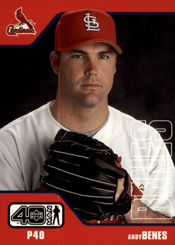 On Sept. 6, 2002, brothers Andy Benes of the Cardinals and Alan Benes of the Cubs were the starting pitchers in a game at St. Louis. It was the first time a Cardinals starting pitcher was matched against a sibling, the St. Louis Post-Dispatch reported.
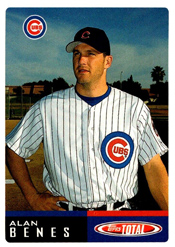 Two weeks later, Andy rejoined the Cardinals. In late August, the Cubs called up Alan.
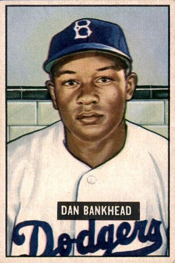 In August 1947, Bankhead debuted for the Dodgers against the Pirates. His second appearance came against the Cardinals.
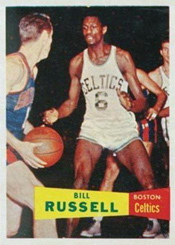 In April 1956, the Celtics traded for the rights to the Hawks’ first-round draft spot and used it to take Russell. Eight months later, when Russell made his NBA debut with the Celtics, it came in a game against the Hawks.
 Defining the spirit of a Cardinals club that used aggressiveness to overcome a lack of power, Glenn Brummer stole home, giving the Cardinals an improbable walkoff win in the heat of a pennant race.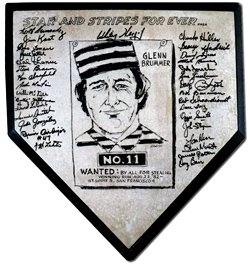

 RetroSimba