The Reds thought they beat the Cardinals on a home run that didn’t count. The Cardinals thought they won on a home run that did count. The unsatisfying result was that neither team won. A tie score was declared and a makeup game was scheduled.

The adventure began on a Saturday afternoon, May 14, 1938, when the Reds and Cardinals played at Sportsman’s Park in St. Louis.
In the sixth inning, the Reds led, 3-1, and had runners on first (Billy Myers) and third (Lonny Frey), two outs, when Dusty Cooke hit a deep drive to right-center against Cardinals rookie starter Max Macon.
“The ball soared on and on,” The Sporting News reported, and still was rising as it carried over the outfield wall and the bleacher seats. It struck an iron girder just below the roof “at a point where the pavilion is not protected by screen,” the St. Louis Post-Dispatch observed, and caromed back into the playing field.
Lee Ballanfant, the umpire with the closest view, ruled the ball was in play. Center fielder Enos Slaughter retrieved it and threw to third baseman Joe Stripp. Cooke, sliding, arrived just ahead of the ball.
Cooke was credited with a two-run triple, extending the Reds’ lead to 5-1, but the Reds argued that he hit a three-run home run, making it a 6-1 score.
According to the Associated Press, Sportsman’s Park had no ground rule for a ball striking a beam underneath the pavilion roof and falling back into the playing field.
Ballanfant, backed by the other two umpires, Bill Klem and Ziggy Sears, determined it was a judgment call.
Reds manager Bill McKechnie disagreed and filed a protest, saying the umpires deprived Cooke of a home run. The Reds contended it was a home run because the ball cleared the outfield wall and would have landed on the pavilion roof or in the seats if it hadn’t struck the girder.
Diamond drama
Trailing 5-1, the Cardinals rallied for four runs in the bottom of the ninth. If Cooke had been allowed a home run instead of a triple, the Reds would have held on for a 6-5 victory. Instead, the score was 5-5 and the game went to an extra inning.
In the 10th, Frank McCormick’s two-out single scored Lonny Frey from second, giving the Reds a 6-5 lead.
Joe Stripp led off the bottom of the inning with a single against Ray Benge. Gene Schott relieved and fell behind in the count, 3-and-1, to Enos Slaughter.
Given the sign to swing away, Slaughter crushed a home run above the pavilion roof in right, turning “an impending defeat into a glorious Cardinals victory,” the Post-Dispatch reported. Cardinals rushed onto the field and “mauled and hauled Slaughter from the plate to the dugout” in celebration of the 7-6 comeback triumph. Boxscore
According to the Sporting News, McKechnie called National League president Ford Frick at his New York office and was assured a hearing would be held.
“Even officials of the St. Louis team anticipate Frick will allow the protest,” The Cincinnati Post reported.
Play it again
Frick decided to visit Sportsman’s Park and see for himself the spot where Cooke’s drive struck the beam near the pavilion roof.
On June 3, two days after he made his inspection, Frick ruled Cooke’s hit was a home run, but instead of awarding the Reds a 6-5 victory, Frick declared the outcome a 7-7 tie. He ruled that all statistics from the game counted in the record book, but the outcome did not. He ordered the game replayed in its entirety.
The Reds had hoped Frick either would award them a win, or rule for play to resume in the sixth, with the Reds batting, two outs, and a 6-1 lead.
“If that was a home run, the Reds won the game, and it must be difficult for manager McKechnie to understand Frick’s ruling to replay,” J. Roy Stockton wrote in the Post-Dispatch.
McKechnie, a former Cardinals manager who led them to the 1928 National League pennant, told The Cincinnati Post, “Frick’s decision that we must replay the entire game is unjust.”
“Frick showed a distinct lack of courage,” McKechnie said to the Cincinnati Enquirer.
Frick told the Associated Press that awarding the Reds a win, or resuming the game in the sixth inning, would penalize the Cardinals “for an error which was in no part its own and concerning which they had no responsibility.”
The Cardinals, though, were unhappy, too. They thought Frick should have upheld the decision of the umpires and validated the 7-6 victory.
Just peachy
The makeup was scheduled as the second game of a Saturday doubleheader on Aug. 20 at Sportsman’s Park.
The Cardinals scored four in the first, knocking out Reds starter Peaches Davis.
In the seventh, with the Cardinals ahead, 5-1, Johnny Mize hit a ball that struck near the edge of the pavilion roof atop the screened section in right. Mize stopped at second base, but umpire Dolly Stark incorrectly ruled it a home run. The Reds argued, and plate umpire George Barr overruled Stark, declaring the hit a double.
The Reds scored three in the eighth, but the Cardinals held on for a 5-4 victory. Boxscore
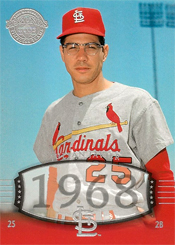 Three times in his career, Javier hit a home run in a 1-0 Cardinals victory. The only other player to hit a home run in three 1-0 Cardinals triumphs is Ken Boyer, according to researcher Tom Orf.
 The final time Boyer hit a home run in a 1-0 Cardinals win was June 25, 1960, at Philadelphia. Leading off the ninth, he lined the first pitch from Jim Owens just over a railing into the first row of seats in left at Connie Mack Stadium.
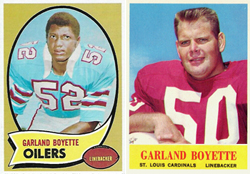 Two years later, the Cardinals cut him, but that wasn’t the only insult he endured. Philadelphia Chewing Gum Corporation produced a football card of Boyette that year, but fumbled the assignment. The name on the card was Garland Boyette, but the photo was of Don Gillis, a former Cardinals center who no longer was in the league. Boyette was black and Gillis was white.
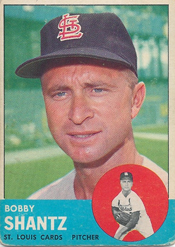 On May 7, 1962, the Cardinals traded pitcher John Anderson and outfielder Carl Warwick to the Houston Colt .45s for Shantz.
 On July 28, 1964, Broglio started for the Cubs against the Cardinals at Wrigley Field in Chicago. It was the first time the Cardinals and Cubs played one another since the June 15 deal of Brock and pitchers
  On April 16, 1962, Gibson gave away a six-run Cardinals lead in the first and didn’t last the inning against the Phillies.

