Feeds:
Posts
Comments

On the verge of giving up hope of reaching the major leagues, Ron Allen persevered and was given a chance by the Cardinals.

On Sept. 15, 1971, in a swap of minor-leaguers, the Cardinals acquired Allen from the Mets for third baseman Bobby Etheridge.

A switch-hitting first baseman, Ron Allen was the younger brother of big-leaguers Dick Allen and Hank Allen.

Dick Allen was a slugger who hit 34 home runs when he played for the Cardinals in 1970.

Ron Allen also had power, but hadn’t advanced out of the minor leagues since he signed with the Phillies in 1964.

In August 1972, nearly a year after the Cardinals dealt for him, Allen was 28 and in his ninth season in the minors when he got the call he had waited for so long.

All in the family

Four Allen brothers, Coy, Hank, Dick (also known as Rich or Richie) and Ron, were all-state high school basketball players in their hometown of Wampum, Pa., according to The Sporting News. All also were baseball standouts.

The oldest brother, Coy, went to work in the steel mills, Ron Allen told the Philadelphia Daily News. Hank, Dick and Ron got other opportunities.

Dick Allen was a 16-year-old amateur shortstop in 1958 when Phillies scout Johnny Ogden first saw him. “I knew this boy could be one of the great hitters,” Ogden told The Sporting News.

Determined to keep Dick Allen from getting away, the Phillies signed Hank Allen, 19, to a $4,000 contract in April 1960. Soon after, Dick Allen, 18, signed with the Phillies for $70,000. Both were right-handed batters.

Ron Allen, 21 months younger than Dick, tried to keep pace with him. A natural left-hander, Ron learned to hit from both sides of the plate in high school.

“We’ve always been as close as two brothers can be, both on and off the field,” Ron Allen told Bill Conlin of the Philadelphia Daily News. “In baseball, I played third and he played short the first two years we played. I hit third and he hit fourth. The year he signed with the Phillies, I hit cleanup and he hit third. I had a better average, around .500, but he hit about seven more homers than me.”

While Hank and Dick pursued professional baseball careers, Ron enrolled at Youngstown State in Ohio.

“Mom was determined there was going to be one Allen who went to college,” Ron told the Philadelphia Daily News. “Mom was pretty set on it.”

A history major, Ron Allen excelled in basketball and baseball at Youngstown State. After his junior year, he signed with the Phillies. At 6 feet 3 and 210 pounds, Ron was a prospect “with good power,” the Philadelphia Inquirer noted.

That same year, Dick Allen became the first of the Allen brothers to reach the majors, and he made an impact. Dick led the National League in extra-base hits and total bases in 1964 and won the Rookie of the Year Award.

Two years later, Hank Allen got to the big leagues with the Senators.

Down on the farm

Ron Allen spent his first three seasons (1964-66) in the Phillies’ system at the Class A level. At spring training in 1967, the Philadelphia Daily News reported, “No man in the Phillies camp can propel a baseball further than” Ron Allen, but “the rap on his hitting is he swings at too many bad balls and strikes out too much.”

“All I want to do is get to the big leagues,” Ron said. “I’ll shine shoes to get there if I have to.”

While Dick Allen thrived as a big-league slugger, Ron remained stuck in the minors. His sixth and best season in the Phillies’ system came in 1969 when he hit .300 with 25 home runs and 97 RBI for Class AA Reading.

After the season, Dick Allen, who had run-ins with Phillies management, was traded to the Cardinals.

Ron Allen, who spent winters working as a draftsman for the city engineering department in Youngstown, reported to Phillies spring training in 1970, but didn’t impress. “I don’t think he’s going to hit good pitching,” farm director Paul Owens told Stan Hochman of the Philadelphia Daily News.

On April 10, 1970, the Phillies traded Ron Allen to the Mets.

“I knew the Phillies wouldn’t give me a chance,” Ron told United Press International. “They said one Allen is enough. I was really happy to be traded.”

The Mets assigned him to the minor leagues. He hit 21 home runs in the Mets’ farm system in 1970 and 20 the next year before the Cardinals acquired him after the completion of the 1971 minor-league season.

The wait ends

Assigned to the Cardinals’ Class AAA Tulsa team in 1972, Ron hit .267 with 16 home runs and 51 RBI in 103 games.

On Aug, 7, 1972, the Cardinals released backup first baseman Donn Clendenon and opted to call up Ron to replace him.

Cardinals director of player development Bob Kennedy said Ron told him he had been considering quitting baseball, the St. Louis Post-Dispatch reported.

Elated by the promotion, Ron said to Kennedy, “I don’t want four or five years in the major leagues. I just want one swing.”

Four nights later, on Aug. 11 against the Pirates, Ron made his major-league debut. Batting for pitcher Lowell Palmer, he struck out versus ex-Cardinal Nelson Briles. Boxscore

On Aug. 13, in the second game of a doubleheader against the Pirates, Ron started for the first time in the majors. Playing first base in place of Matty Alou, he was hitless in four at-bats versus Steve Blass. Boxscore

Ron’s highlight came on Aug. 17 at San Diego against the Padres. He entered the game in the eighth inning after Joe Torre, playing first base for an injured Alou, was ejected.

Leading off the ninth, Ron got his first big-league hit, a home run to right against reliever Mike Corkins.

“Allen hit a good pitch, low and away,” Corkins told the Post-Dispatch. “He used to hurt me in the minors, too.” Boxscore

Life after baseball

The home run was Allen’s only hit in the majors. In 14 plate appearances for the Cardinals, Ron had three walks and one hit, batting .091. The Cardinals released him to Tulsa on Sept. 5, 1972. Having achieved his goal of reaching the majors, Ron retired from baseball.

Ron told United Press International he was “grateful for what I got. It’s been a constant struggle just to make it to the top.”

That same year, Dick Allen, playing for the White Sox, led the American League in home runs and RBI, and won the Most Valuable Player Award. Hank Allen also played for the White Sox that season.

Hank finished his big-league career in 1973 and Dick’s last season was 1977.

Hank became a thoroughbred horse trainer and Ron was his stable foreman, according to the Los Angeles Times. In 1989, Northern Wolf, a horse trained by Hank, raced in the Kentucky Derby and Preakness.

Ron was inducted into the Youngstown State athletic hall of fame in 1990.

In 2010, when he was 66, Ron fulfilled a promise made to his mother and completed his college education, earning a bachelor’s degree in general studies from Youngstown State.


Relegated to long relief and mop-up roles with the Reds, Doug Bair got a chance to revive his career with the Cardinals.

On Sept. 10, 1981, the Cardinals acquired Bair from the Reds for infielder Neil Fiala and pitcher Joe Edelen.

Durable and effective, Bair gained the confidence of manager Whitey Herzog and was a key contributor to the Cardinals’ World Series championship year in 1982.

Traveling man

A right-hander who pitched college baseball at Bowling Green, Bair was picked by the Pirates in the second round of the 1971 amateur draft.

In five seasons as a starting pitcher in the Pirates’ farm system, Bair “spent so much time in buses, he qualified for a Greyhound pension,” Hal McCoy of the Dayton Daily News noted.

In 1976, his sixth season in the minors, Bair became a reliever and pitched well enough to earn a promotion to the Pirates in September.

After the season, he was traded to Oakland. Bair got into 45 games for the 1977 Athletics and led them in saves (eight), but the team was out of contention by mid-July and finished in last place.

“Things got completely out of hand there,” Bair told the Dayton Daily News. “Some veterans were showing up 10 or 15 minutes before game time.”

The Athletics traded their ace, Vida Blue, to the Reds after the season, but commissioner Bowie Kuhn voided the deal. So the Reds settled for Bair instead.

Bair impressed manager Sparky Anderson, who made him the Reds’ closer in 1978.

“He’s so smooth and easy,” Anderson told the Cincinnati Enquirer. “Just like Don Gullett was. Smooth, easy, then flip. Pfffft. Boom. The fastball is right on top of you. You can’t sit on it or he’ll eat you alive with his breaking pitch.”

Bair was 7-6 with 28 saves and a 1.97 ERA for the 1978 Reds. He remained their closer at the beginning of the 1979 season, but manager John McNamara, who had replaced Anderson, switched to Tom Hume later in the year.

Change of scenery

In December 1980, Whitey Herzog, who had the dual role of Cardinals manager and general manager, was “talking in earnest” to the Reds about a proposed trade, the St. Louis Post-Dispatch reported. The Reds offered a package of pitchers, Bair, Mike LaCoss and Paul Moskau, for catcher Terry Kennedy, but Herzog opted to deal Kennedy to the Padres for reliever Rollie Fingers and others.

With Hume and Joe Price getting most of the meaningful relief work, Bair was moved to the back of the Reds’ bullpen in 1981.

Though Bair had a 5.77 ERA in 24 appearances for the 1981 Reds, Cardinals scout Mo Mozzali highly recommended him, Joe McDonald, executive assistant to Herzog, told the Post-Dispatch.

Seeking a reliable reliever to set up closer Bruce Sutter, the Cardinals took a chance on Bair.

“I know I can perform,” Bair said to the Cincinnati Enquirer. “It’s really a new life for me.”

Back in step

After Bair, 32, reported to the Cardinals, pitching coach Hub Kittle detected a flaw in his delivery and made a fix.

“When I stepped back to get my left leg into rocking position, I was stepping toward first base entirely too much,” Bair told The Sporting News. “Now I step more straight back toward second. I’m lifting my leg more than swinging it. It keeps me more in balance.”

In his first appearance for the Cardinals, Bair pitched a scoreless inning against the Mets and got the win. Boxscore

Bair didn’t allow a run in his first six innings as a Cardinal. In 11 games for them in 1981, he was 2-0 with a save and a 3.45 ERA.

In April 1982, the Cardinals acquired another Reds reliever, Jeff Lahti. He joined, Sutter, Bair and Jim Kaat in giving the Cardinals a dependable bullpen.

Bair got off to a strong start (1-0, 1.04 ERA in April and 2-1, one save, 2.21 ERA in May) and was splendid in the stretch run (1-0, two saves, 1.65 ERA in September).

“He’s just as important to the team as I am,” Sutter said to The Sporting News.

Bair made 63 regular-season appearances for the 1982 Cardinals, and allowed only nine of 38 inherited runners to score. He yielded 69 hits in 91.2 innings.

“He’s worked very, very hard,” Kittle told the Cincinnati Enquirer. “Lots of dedication. Doug Bair is as tough a son of a buck as you’ll ever find. A good man.”

Bair was 5-3 with eight saves and a 2.55 ERA in the regular season in 1982. He was the losing pitcher in Game 4 of the World Series against the Brewers.

Second title

In 1983, Bair was 1-1 with a save and a 3.03 ERA in 26 games for the Cardinals when they traded him in June to the Tigers, where he was reunited with manager Sparky Anderson.

Bair helped the Tigers to a World Series championship in 1984.

The Cardinals reacquired him in September 1985 to help in their pennant push. He pitched a total of two scoreless innings. After the season, Bair, 36, became a free agent and signed with the Athletics.

In 15 years in the majors with seven teams, Bair was 55-43 with 81 saves. He was 8-4 with 10 saves and a 2.72 ERA for the Cardinals, and 0-0 with six saves and a 3.86 ERA against the Cardinals.

Feeling ridiculed by the needling he got from former Cardinals teammates, Tim McCarver lashed out at a friend, Lou Brock, and started a fistfight with him.

On Sept. 6, 1971, during a game between the Cardinals and Phillies at Philadelphia, McCarver punched Brock in the face on the field at Veterans Stadium. Brock fought back, swinging at McCarver and landing a couple of shots, before they wrestled to the ground and were separated.
The sight of influencers from Cardinals glory days tearing into one another was, as broadcaster Jack Buck put it, “a bit sickening,” St. Louis Post-Dispatch columnist Bob Broeg noted.

A week later, McCarver and Brock got physical again _ not in a fight, but in a jarring collision at home plate. 

Sticks and stones

Brock and McCarver were integral players on Cardinals clubs that won three National League pennants and two World Series titles in the 1960s. After the 1969 season, McCarver was traded to the Phillies.

On Sept. 6, 1971, the Cardinals and Phillies had a Monday night doubleheader in the City of Brotherly Love. The opener matched pitchers Bob Gibson of the Cardinals against Rick Wise. Brock, the Cardinals’ left fielder, was in his customary leadoff spot. McCarver was the Phillies’ catcher and batted second.

The game was scoreless in the third when Brock led off with a single and stole second. After Ted Sizemore coaxed a walk, Matty Alou hit a pop fly in foul territory near the Cardinals’ dugout. McCarver dropped it for an error.

Cardinals manager Red Schoendienst told the Post-Dispatch, “McCarver was mad because of missing that pop-up.”

From the dugout and from the basepaths, Cardinals players heckled McCarver about botching the play.

“To say there was a little noise drifting out of the Cardinals’ dugout whenever McCarver was in earshot thereafter is to put it mildly,” the Philadelphia Daily News noted.

Cardinals first-base coach George Kissell said, “They were getting on Tim pretty good.”

Given the chance to continue his plate appearance, Alou drew a walk, loading the bases.

The next batter, Joe Torre, singled, scoring Brock and Sizemore. In his book, “Oh, Baby, I Love It,” McCarver said, “I was still burning from my error.”

When Brock got to the dugout, he continued to taunt McCarver, who had allowed more steals than any other National League catcher in 1971.

“Brock kept trying to show me up,” McCarver told the Post-Dispatch. “When Torre was on first base, Brock was yelling, ‘There he goes! There he goes!’ “

As The Sporting News noted, “The inference was McCarver’s arm was so bad that he couldn’t even throw out a slow runner like Torre.”

In his book, McCarver said, “I really snapped … I took my catching and throwing seriously.”

Unsympathetic, Schoendienst told the Post-Dispatch, “It’s not anyone else’s fault that McCarver can’t throw anybody out.”

Brock said to Philadelphia Inquirer columnist Frank Dolson, “Yelling, ‘There he goes!’ shouldn’t be enough to upset McCarver, who is one of the biggest agitators in the game.”

According to George Kissell, McCarver yelled to Brock, “We’re going to stick one in your ear.”

While McCarver stewed, Wise unraveled. He gave up a RBI-double to Ted Simmons and a three-run home run to Joe Hague before being replaced by rookie Manny Muniz.

McCarver’s miscue had opened the gates to a 6-0 Cardinals lead. Adding to the embarrassment, his former teammates laughed at him, he told the Post-Dispatch.

“Guys beating you 6-0 know better than to laugh at you,” McCarver said to the Philadelphia Inquirer.

Regarding Brock, McCarver told Stan Hochman of the Philadelphia Daily News, “We played together long enough and he knows my boiling point … I just don’t like to be shown up.”

Macho man

Brock was the first batter for the Cardinals in the fourth. In his book, McCarver said, “I encouraged my pitcher, Manny Muniz, to intimidate Lou.”

“The first pitch crowded Brock back from the plate,” the Post-Dispatch reported. “The second pitch, another inside serve, also made him give ground.”

Brock took two or three steps in the direction of the mound. McCarver followed and heard Brock shout something to Muniz.

“I just asked Muniz, ‘What’s going on?,’ ” Brock said to the Post-Dispatch. “The kid was making me a dartboard.”

According to the Philadelphia Daily News, McCarver said Brock warned Muniz he’d come after him if another pitch came close.

“No, you’re not,” McCarver replied to Brock.

Brock turned and headed to the plate, his arms at his sides, when McCarver punched him.

“A sucker punch,” George Kissell told the Post-Dispatch.

“It was a sucker punch,” Bob Gibson agreed, “and I didn’t think much of it.”

Brock retaliated, landing a couple of punches, and then grabbed McCarver. They fell to the ground before being pulled apart by teammates.

“I’ve known McCarver since he was a kid, but I lost a lot of respect for him tonight,” Kissell said to the Post-Dispatch. “He shouldn’t let his emotions take over like that.”

What are friends for?

McCarver was ejected by plate umpire Al Barlick.

“I’m sorry the thing happened, but I felt I was right when I did it,” McCarver said to the Philadelphia Daily News. 

In his book, McCarver added, “I can’t say I’m proud of what I did, but I do have to say that put in the same situation I’m sure I would react the same way.

“In moments like that, however irrationally, your instincts simply take over.”

Brock told the Philadelphia Daily News, “I was surprised Tim punched at me, but sometimes these things just explode. Tim’s too much of a pro to do what he did, but when there’s a feeling of frustration you do strange things. I have no hard feelings against him.”

McCarver said, “As far as I’m concerned, it’s all over. He’s a good friend of mine.”

Long may you run

After McCarver’s ejection, Brock continued his plate appearance versus Muniz, drew a walk and swiped second against McCarver’s replacement, Mike Ryan.

Leadng off the bottom of the fourth, Ryan was the first batter Bob Gibson faced after the fight. Gibson’s first pitch to Ryan sailed over his head.

In the sixth, Brock reached on an error, stole second and was thrown out by Ryan attempting to steal third.

An inning later, the Phillies brought in their third-string catcher, rookie Pete Koegel, after Ryan was injured. Brock swiped second _ his fourth steal of the game _ against Koegel in the eighth. Boxscore

Encore performances

The next night, Sept. 7, the Cardinals and Phillies played the series finale, and emotions remained raw.

In the first inning, Brock walked, tried to steal second and was thrown out by McCarver.

Brock noted to the Post-Dispatch, “He threw me out trying to steal, and I didn’t go punching him.”

McCarver countered to the Philadelphia Daily News, “I threw him out, and I didn’t go prancing over to the dugout like King Kong.” Boxscore

Six days later, on Sept. 13, the Phillies were in St. Louis for a two-game series.

Before the opener, Bob Broeg asked McCarver whether he regretted punching Brock. McCarver replied, “From practically the very minute I threw the punch. It was, I’m afraid, a sucker punch and I’m not proud of it.”

McCarver added, “I was agitated and apparently misunderstood something Lou had said … I like to think that out of this unfortunate flare-up we’re better friends than before. I hope so.”

In that night’s game at Busch Memorial Stadium, McCarver “was lustily booed by a crowd that used to adore him,” the Philadelphia Daily News reported.

McCarver produced three hits, scored twice and threw out Dal Maxvill attempting to steal. Boxscore

Storybook stuff

Hollywood would have a tough time coming up with a better script for what happened in the Sept. 14 series finale.

In the first inning, Brock was awarded first base on catcher’s interference when McCarver accidentally tipped his bat. Brock stole second and advanced to third on McCarver’s errant throw. Matty Alou’s infield out scored Brock.

In the ninth, the Phillies led, 5-4, but the Cardinals had Brock on third with one out and their top run producer, Joe Torre, at the plate.

Facing Chris Short, Torre hit a fly ball to medium right. Willie Montanez, a former Cardinals prospect, caught it for the second out. Brock tagged and sped for the plate, trying to score the tying run.

The throw reached McCarver on a hop. McCarver snared it and spun around to tag Brock, who was barreling toward him.

“Brock went into McCarver like a NFL bomb-squader goes into a punt returner,” Bill Conlin wrote in the Philadelphia Daily News. “The collision was tremendous, McCarver getting flipped over backwards, Brock landing in a heap on the first-base side of the plate.”

McCarver held onto the ball and Brock was called out by umpire John McSherry, ending the game. Boxscore

As Phillies players congratulated McCarver, he “broke away from them and went for Brock, grabbed his hand and shook it,” the Philadelphia Daily News reported.

“I told Lou to have a nice winter,” McCarver said.

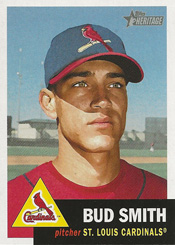
On the verge of being unable to complete his masterpiece, Bud Smith rediscovered the strike zone in the nick of time and got the job done.

On Sept. 3, 2001, Smith pitched a no-hitter for the Cardinals against the Padres.
With his pitch count rising and his command fading, Smith was in danger of getting a mound visit from manager Tony La Russa, who was considering lifting the rookie left-hander.

One pitch away from creating an uncomfortable situation, Smith managed to prevent the conversation neither he nor La Russa wanted to have.

Tapping his potential

Born and raised in the Los Angeles metropolitan area, Robert Allan Smith got the nickname Bud from his father, Allan, a construction worker, who would come home from work and ask his son to get him a cold Budweiser from the refrigerator, according to the St. Louis Post-Dispatch.

Smith was 18 when he was chosen by the Cardinals in the fourth round of the 1998 amateur draft.

His breakout season came in 2000 when he had a 17-2 record in the minors. Among the wins were a pair of seven-inning no-hitters for Arkansas.

A finesse pitcher, Smith was listed at 6 feet, 170 pounds. When Cardinals broadcaster Jack Buck got a look at him at spring training in 2001, he exclaimed to Post-Dispatch columnist Bernie Miklasz, “He’s as thin as soup.”

The Sporting News described Smith as “a Tom Glavine-type: smallish but with a good enough fastball and decent changeup.”

“I create ground balls,” Smith told Miklasz. “I’m not a big strikeout guy.”

Ups and downs

Smith, 21, started the 2001 season in the minors, but was called up to the Cardinals in June. He made his debut for them with an inning of scoreless relief at Denver. Boxscore

On June 17 against the White Sox, Smith got his first big-league win in his first big-league start. Boxscore

He was 2-0 with a 2.25 ERA in July, but 0-2 with a 5.73 ERA in August.

In his last three August starts, Smith gave up 14 earned runs in 14 innings. The last game in that stretch was against the Padres in St. Louis. The Cardinals won, 16-14, but Smith was shelled for seven runs, five earned, before he was lifted in the fourth. Ryan Klesko hit a 472-foot home run against him. Boxscore

Looking good

La Russa was considering removing Smith from the rotation if he didn’t improve in his next start, Sept. 3, in a rematch versus the Padres at San Diego.

The game would be Smith’s first in his home state as a big-leaguer. In attendance were his mother, stepfather, 14 other immediate family members and 10 high school buddies, the Associated Press reported.

“Smith tried to change speeds and use both sides of the plate better than he did in his three previous outings,” The Sporting News reported.

In sync with catcher Eli Marrero, Smith executed the strategy splendidly. “That’s the first time I’ve felt that comfortable in a while,” he told the Post-Dispatch.

Smith retired the first five batters before issuing a walk to ex-teammate Ray Lankford in the second. Rickey Henderson walked in the third. Five of the Padres’ first 15 outs were strikeouts. In five innings, Smith’s pitch count was at 70.

“I was almost rooting for him to give up a hit so we could get him out of there,” pitching coach Dave Duncan told the Post-Dispatch.

Henderson walked again in the sixth, but the no-hitter was intact.

In the seventh, Smith hung a changeup to Bubba Trammell, who drove the pitch deep to left.

“That ball was the biggest scare of the night,” Smith told the Post-Dispatch.

As he watched left fielder Albert Pujols run toward the wall, “I thought the only chance I had was if Albert jumped and robbed him,” Smith said.

The ball didn’t carry as far as Smith feared, and Pujols caught it at the wall.

Mission accomplished

In the late innings, aware a no-hitter was at stake, “I was shaking,” Smith said to the Post-Dispatch. “I was so nervous.”

With the Cardinals ahead, 4-0, La Russa made some defensive changes in the eighth, including shifting Pujols from left to first base in place of Mark McGwire.

In the same inning, Tony Gwynn, 41 and in his last season of a Hall of Fame career, got a standing ovation as he came to the plate as a pinch-hitter. Smith was so focused, “I couldn’t hear anybody in the stands,” he told the Post-Dispatch.

Gwynn grounded out to shortstop Edgar Renteria.

In the ninth, relievers Dave Veres and Steve Kline warmed up rapidly in the Cardinals’ bullpen. Henderson, like Gwynn, a future Hall of Famer, led off and hit a broken-bat grounder to short for the first out.

After getting ahead on the count 1-and-2 to D’Angelo Jimenez, Smith walked him. La Russa sensed trouble. Smith had thrown more than 120 pitches and leaving him in the game “went against La Russa’s instincts,” The Sporting News noted.

The next batter was Ryan Klesko, who had hit the mammoth home run against Smith five nights earlier. When the first three pitches to Klesko missed the strike zone, La Russa said he was tempted to relieve Smith if he walked Klesko, the Post-Dispatch reported.

Asked whether he really would have lifted Smith, La Russa replied, “I probably would have made a trip (to the mound) and asked him to be honest. If he said, ‘I’m toast,’ it would have been better to let the reliever make the mistake.”

La Russa never had to leave the dugout. On the 3-and-0 pitch to Klesko, Smith threw a fastball for a strike. He came back with a curve for strike two. On the next pitch, Klesko sliced a grounder toward short. Renteria grabbed it on the short hop and fired to first in time for the second out.

Next was cleanup batter Phil Nevin. He got the count to 2-and-1. On Smith’s 134th pitch, Nevin smacked a sharp grounder up the middle. Smith snared it, ran halfway to first base and flipped underhanded to Pujols for the final out.

“He hit it right to me, but I didn’t know I had the ball,” Smith told the Associated Press. Boxscore and Video of last 3 innings

Smith was the third Cardinals rookie to pitch a no-hitter, joining Paul Dean (1934) and Jose Jimenez (1999).

The no-hitter was the start of a stretch of 12 wins in 13 games for the Cardinals. Smith was 3-0 with an 0.43 ERA in three September starts, helping the Cardinals finish in a tie with the Astros atop the division and qualify for the playoffs.

Smith’s record with the Cardinals in the regular season: 6-3 with a 3.81 ERA.

In the National League Division Series against the Diamondbacks, Smith started and won Game 4. Boxscore

The next year, Smith was 1-5 with a 6.94 ERA when the Cardinals packaged him in a trade to the Phillies for Scott Rolen.

After the deal, Smith never appeared in another big-league game. The no-hitter was his only complete game in the majors.

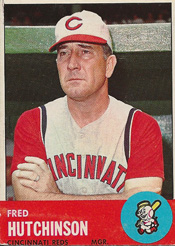
An experiment with technology went haywire for the Reds in a game against the Cardinals.

On Aug. 18, 1961, Reds manager Fred Hutchinson used a shortwave radio to communicate instructions from the bench to his third-base coach.
The innovative effort lasted an inning before Hutchinson went back to using traditional hand signals to relay signs.

Sign language

The Reds were the surprise of the National League in 1961. In addition to talents such as Frank Robinson, Vada Pinson and Wally Post, the Reds were loaded with former Cardinals. They included the manager (Fred Hutchinson), hitting coach (Dick Sisler), relief ace (Jim Brosnan) and three infield starters (second baseman Don Blasingame, shortstop Eddie Kasko and third baseman Gene Freese).

On Aug. 18, the Reds (73-46) were in first place, 13 games ahead of St. Louis (58-57) and one ahead of the second-place Dodgers (69-44), entering a weekend series with the Cardinals at Cincinnati.

Earlier that season, the Dodgers unveiled a walkie-talkie system for manager Walter Alston to communicate with base coaches, the Dayton Journal-Herald reported. The Reds were determined not to be left out of the modern communications game.

Before the series opener against the Cardinals, Hutchinson informed reporters of the new way he planned to send instructions to the third-base coach.

Hutchinson had a microphone in the dugout and coach Reggie Otero, stationed at third, was provided an earpiece.

“A blue wire, connected to an amplifier in the dugout, has been run underground to the third-base coaching box, where it forms a loop around Otero,” the Dayton Journal-Herald reported. “Otero is equipped with a receiver under his shirt and an earplug. Anything broadcast through the amplifier can be heard by Otero as long as he’s within the loop.”

Party line

In the first inning, Otero heard Hutchinson’s instructions just fine. Problem was, so did a lot of others.

Because of a snafu in the system, Hutchinson’s instructions to Otero also were coming through the loudspeaker in the press box.

Fans in seats near the press box could hear what was being said, too, United Press International reported.

“It threw the Reds’ bosses into a tizzy,” the Associated Press noted.

General manager Bill DeWitt Sr. called Hutchinson in the dugout and told him to stop using the shortwave device.

Hutchinson went back to using hand signals to send signs to Otero, who relayed them the same way to the batters and runners.

Unfazed, the Reds scored four runs in four innings against Bob Gibson. Gordy Coleman hit a three-run triple with two outs in the first. Frank Robinson stole home with two outs in the third.

Behind the complete-game pitching of American League castoff Ken Johnson, who mixed knuckleballs with sinkers, the Reds won, 6-3. Boxscore

They finished the season four games ahead of the Dodgers and became National League champions for the first time in 21 years.

When the body of Cardinals scout Les Wilson was found bloodied and battered in a hotel room, police suspected murder. Turns out, the victim killed himself.

On Aug. 17, 1946, Wilson, 35, died after a hellish night of hallucinations and destructive drinking.

The demons that tormented him took a terrible toll.

Farm work

Edward Leslie Wilson was born in St. Louis on Aug. 15, 1911, according to baseball-reference.com. He relocated with his family from St. Louis to Fayetteville, Ark., when he was 8, the Associated Press reported.

Wilson excelled at baseball in high school in Fayetteville. A catcher and infielder, he went on to play multiple seasons in the minors.

He broke his hand when Dom Dallessandro, a future big-leaguer, accidently stepped on it during a play at first base, according to the Associated Press.

After the hand injury, Wilson returned to Fayetteville and ran a cab company, the Associated Press reported.

He attempted a comeback as a player, then became an umpire in the minors from 1938-41.

Wilson enlisted in the Army Air Forces on Dec. 12, 1941, five days after the Japanese attack on Pearl Harbor.

Soon after his honorable discharge on Jan. 15, 1946, the Cardinals hired Wilson to be a scout.

At the Cardinals’ minor-league spring training camp at Albany, Ga., in 1946, Wilson worked with Wally Schang, manager of the Marion, Ohio, team, in selecting a roster, the Marion Star reported.

Early in the season, Wilson spent nearly a week in Marion, “helping shape the team,” according to the Marion newspaper.

Wilson “discovered and signed several of the players now on the active list, including catcher Vern Rapp,” the Marion Star reported. Rapp would manage the Cardinals in 1977 and 1978.

Mystery visit

After his work with Marion, Wilson’s other assignments included helping run Cardinals tryout camps in Canada, Nebraska and Missouri, according to the Ottawa Citizen and the Associated Press.

Eventually, Wilson was assigned to scout in Texas, United Press reported.

During the first week of August, Joe Mathes, head of the Cardinals’ farm and scouting systems, said he spoke to Wilson in Houston, the Associated Press reported. Mathes said he assigned Wilson to be in Colorado Springs, Colo., for the American Legion Tournament Aug. 11-14.

“He wasn’t supposed to be in Dallas,” Mathes told the Dallas Times-Herald.

Wilson checked in to a Dallas hotel on Aug. 13. The next night, Aug. 14, he was told to leave because he became intoxicated and destroyed several pieces of furniture in his room, the hotel manager told United Press.

Wilson was arrested on a charge of drunkenness on the night of Aug. 14 and spent his 35th birthday, Aug. 15, in jail. He was released the morning of Aug. 16 after paying a $10 fine.

Dark night

At 6:05 on the morning of Aug. 16, Wilson checked in to the Savoy Hotel and was given a room on the fourth floor, the Associated Press reported. United Press described it as “a third-rate Dallas hotel.”

That night, Wilson had a hotel porter, William Brown, bring him two bottles of whiskey and a bottle of wine, United Press reported. Brown said Wilson was alone in the room.

Hours later, at 3:15 a.m. on Aug. 17, another porter, Johnny Lee Joe, was summoned to Wilson’s room. The porter “found the room wildly disarranged” and Wilson was “bloody and battered,” United Press reported.

Wilson, alone in the room, wanted ice water. The porter asked Wilson if he needed help. “Wilson said no, he had hurt himself in a fall, but would be all right,” United Press reported.

About six hours later, at 9:45 a.m. on Aug. 17, housekeeper Opal Cooper entered the room and discovered Wilson dead.

Gruesome scene

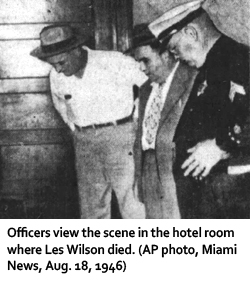
“His blood-stained, bruised body was found in a sitting position, propped against the wall,” The Sporting News reported.

Police suspected Wilson “died in a desperate battle with robbers in his room,” United Press reported.

“The walls were splattered with blood from baseboards to shoulder height,” according to United Press. “Blood even was splattered on the ceiling. Furniture was broken and blood soaked the broken bed.”

The first physician on the scene saw gashes on Wilson’s head and shoulders and determined those were knife wounds, United Press reported.

“A coroner’s investigation disclosed Wilson had been slashed across the throat and stabbed in the head and shoulders by an unknown assailant,” according to United Press.

“Wilson’s body was a mass of bruises, indicating he also was engaged in a fistfight with his attacker before the fatal wounds were inflicted.”

According to the Associated Press, detective chief Will Fritz “said he believed Wilson had been knocked unconscious in a fight, regained his senses and staggered about the room in a dazed condition. He said that could explain blood stains on the wall.”

Detective Fritz estimated the time of death to be 5:30 a.m.

No weapons were found in the room. On the dresser was a wallet, but the only money found were a few scattered coins, United Press reported.

According to the Associated Press, “on the floor of the wrecked room police found fragments of a torn photograph of a woman.”

An empty whiskey bottle and one half-full were on a window sill when officers arrived, United Press reported.

“Police had not the slightest doubt they were confronted with a murder,” United Press noted. “It promised to be a murder mystery.”

According to the Associated Press, two men dressed in khakis were sought by police in connection with the murder. The men were seen walking down the hotel’s fourth-floor hallway with Wilson the afternoon of Aug. 16.

Police also held three persons for questioning: the late-night porter, and two hotel guests _ a 33-year-old man Detective Fritz said had been arrested many times, and a 30-year-old woman.

Drunken violence

The case took an unexpected twist after an autopsy was ordered by a justice of the peace.

The autopsy was conducted by two physicians at Parkland Hospital in Dallas: Dr. Morton Mason, a toxicologist, and Dr. Charles Ashworth, a pathologist.

Dr. Mason ruled cause of death was “acute alcoholism.”

Wilson “killed himself with alcoholic gluttony in a wild, all-night wrestle with whiskey-produced phantoms,” United Press concluded. “Not one of his many wounds, all evidently inflicted when he flung himself against the walls of his hotel room in pursuit of bottle demons, was sufficient to have caused death,” the doctors said.

Dr. Ashworth said Wilson suffered a smashed nose and swollen upper lip, International News Service reported.

Detective Fritz said Wilson lost considerable blood from nose bleeding, the Associated Press reported.

According to The Sporting News, friends attributed Wilson’s “mental condition to reaction from the war and the death of his father last year.”

Wilson, unmarried, was survived by a cousin and an aunt, both of St. Louis, the Associated Press reported.

Cardinals owner Sam Breadon authorized a Dallas mortician, Vernon O’Neal, to hold funeral services and burial in Dallas Aug. 20 at Holy Trinity Catholic Church, according to the Associated Press.