Feeds:
Posts
Comments

In a decision that impacted the course of baseball broadcasting, the Braves rejected a chance to acquire Mike Shannon from the Cardinals for Bob Uecker.

During spring training in 1964, the Cardinals were in the market for a backup catcher and the Braves were seeking a reserve outfielder.

The Cardinals targeted Uecker because of his strong arm, quick release and defensive skills. To get him, they offered the Braves their choice of an outfielder _ Shannon or Gary Kolb. The Braves picked Kolb.

If the Braves had taken Shannon, he likely wouldn’t have contributed as he did to Cardinals clubs that won two World Series championships and three National League pennants in the 1960s.

If Shannon hadn’t had a prominent role as a Cardinals player, he likely wouldn’t have gotten the opportunity to become a team broadcaster.

As it turned out, Uecker, with the Brewers, and Shannon, with the Cardinals, built successful careers as broadcasters and continued in those roles into their 80s.

Outfield glut

After being called up from the minors to the Cardinals during the 1962 and 1963 seasons, Shannon was looking to be on their Opening Day roster in 1964.

Shannon had lots of competition for one of the six outfielder spots. The favorites to open the season as outfield starters were Charlie James in left, Curt Flood in center and Carl Warwick in right, The Sporting News reported.

Competing with Shannon for backup jobs were Doug Clemens, Ron Cox, Gary Kolb, Johnny Lewis, Bobby Tolan, Corky Withrow and Don Young.

As spring training neared its end, the Cardinals settled on Clemens and Lewis for two of the three reserve outfield spots. Clemens and Lewis batted left-handed, giving the Cardinals the chance to platoon them with James and Warwick.

The last outfield spot came down to Kolb and Shannon.

What the Cardinals needed was a backup to catcher Tim McCarver. The Cardinals had Jim Coker and Dave Ricketts as candidates, but were looking for an upgrade.

Uecker, who had spent parts of the 1962 and 1963 seasons with the Braves, was available because he was third on the depth chart behind Joe Torre and Ed Bailey.

Easy choice

The Cardinals offered Coker and an outfielder for Uecker.

“We had a choice of Gary Kolb or Mike Shannon,” Braves general manager John McHale told the St. Louis Post-Dispatch.

Kolb produced a .403 on-base percentage (26 hits, 22 walks) with the 1963 Cardinals. He also batted .500 (9-for-18) against the Braves that year. Shannon batted .308 (eight hits) for the 1963 Cardinals. “We asked 15 people, some with the Braves and others who were friends of mine in baseball, which one they preferred,” McHale said. “It was 14-to-1 in favor of Kolb.”

McHale said Walter Shannon, a former Cardinals farm director who had joined the Indians’ scouting staff, cast the lone vote for Mike Shannon. A couple of St. Louis natives, Walter and Mike were not related, but those Shannons stuck together.

Taking advantage

The trade of Uecker to the Cardinals for Kolb and Coker was made on April 9, five days before the Cardinals opened the season.

Cardinals consultant Branch Rickey rated Kolb a top prospect and opposed the deal made by general manager Bing Devine. According to the book, “October 1964,” when Uecker was introduced to Rickey in the Cardinals’ clubhouse, Rickey replied, “I didn’t want you. I wouldn’t trade 100 Bob Ueckers for one Gary Kolb.”

Uecker, though, gave the 1964 Cardinals the defense they desired. He threw out 38 percent of runners attempting to steal. By comparison, McCarver’s rate was 29 percent. Uecker also contributed a game-winning hit against the Braves in the pennant stretch.

Shannon hardly played early in the 1964 season. He had three at-bats and struck out each time. The Cardinals sent him to their Jacksonville farm club in early May. Called back to the majors in July, Shannon took over in right field and drove in 43 runs in 88 games. He also hit a home run against Yankees ace Whitey Ford in Game 1 of the World Series.

Kolb hit .188 with no home runs in 64 at-bats for the 1964 Braves and was traded to the Mets in July 1965.
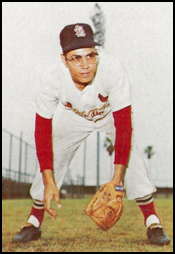
Sparky Anderson had a hand in convincing the Cardinals to stick with Julian Javier as their second baseman.

In March 1965, the Cardinals were considering trading Javier, their second baseman since 1960. Anderson, three weeks into his job as a manager in the Cardinals’ farm system, spoke up at an organizational staff meeting and advocated for keeping Javier.

Anderson’s assessment wasn’t the sole reason Cardinals general manager Bob Howsam didn’t trade Javier, but it was a contributing factor.

Until he joined the Cardinals that month, Anderson hadn’t worked with Howsam. The discussion about Javier gave Howsam the chance to see how Anderson evaluated talent and how he expressed himself when offering opinions that were contrary to others in the organization.

It was the start of a strong working relationship. Five years later, when Howsam was general manager of the Reds, he hired Anderson to be the Cincinnati manager, launching him on a path to a Hall of Fame career.

Performance review

Julian Javier was part of the all-Cardinals National League starting infield in the 1963 All-Star Game, and he helped the Cardinals become World Series champions in 1964.

Bing Devine, the Cardinals’ general manager when Javier was acquired from the Pirates in 1960, was replaced by Howsam in August 1964. Naturally, Howsam began making his own evaluations of the roster.

Javier produced a career-high 65 RBI in 1964 and reached double figures in home runs (12) for the first time, but he batted .241 and his on-base percentage of .282 was awful. Javier also made a career-high 27 errors. After the season, while playing winter baseball in the Dominican Republic, Javier lost control of his emotions and punched umpire Emmett Ashford.

Some within the Cardinals’ organization concluded Javier might be more of a liability than an asset. Internal options to play second base included a couple of local candidates, Jerry Buchek and Dal Maxvill. When a hip injury prevented Javier from being able to play in the 1964 World Series, Maxvill started all seven games at second base and didn’t commit an error.

Dinner conversation

Sparky Anderson got fired after managing minor-league Toronto in 1964 and was selling cars at a dealership in Los Angeles. Anderson wanted to get back into baseball, and when the manager of the Cardinals’ farm club at Rock Hill, S.C., suddenly resigned on the eve of spring training in 1965, Anderson got the job.

In his third week with the Cardinals at spring training, Anderson went to dinner with farm director Sheldon “Chief” Bender, minor-league manager George Kissell and scout Mo Mozzali.

In his book, “The Main Spark,” Anderson said, “There was a lot of conversation about Julian Javier. They were talking about the possibility of dealing Hooley to another club before the start of the season.”

Anderson asked his dinner companions, “Does he have good range?” Probably the best in the league among second basemen, he was told.

“Does he throw well?,” Anderson asked. The best of the second basemen in the league, came the response.

“Does he make the double play?” Anderson wanted to know. Again, the answer was he was the best at it in the National League.

“Then why the hell are you talking about trading him?,” Anderson said.

According to Anderson, his colleagues said Javier was inclined to be lazy and loafed a bit.

In his book, Anderson said he told the group if Javier did so many things well, “but was a little on the lazy side, the organization should be able to find someone who can handle him and get the most out of him. A club should have a better reason for trading a good player than the fact he dogs it a little.”

No to yes men

The next day, Howsam led an organizational staff meeting in the Cardinals’ spring training clubhouse. Joining Howsam were Bender, Cardinals manager Red Schoendienst, his coaches, Mozzali and all of the club’s minor-league managers.

After Schoendienst talked about the big-league roster, Howsam called on Mozzali, who raised the topic of trading Javier. In the middle of his remarks, Mozzali said, “Mr. Howsam, at dinner last night, Sparky here had some opinions that I think you might want brought out to all of us.”

As a newcomer to the organization, Anderson was surprised to be called out to express an opinion about a prominent player. In his book, Anderson said, “I was petrified.”

“Yes, I’d like to hear his opinion,” Howsam replied.

Anderson said he “sort of apologized” and explained his comments were intended as casual dinner conversation, but Howsam repeated that he’d like for Anderson to share his views.

“So I told him what I’d told the others, emphasizing that it didn’t seem logical to want to trade the No. 1 man at a position for that reason,” Anderson said. “Why not try to find somebody who could motivate him?”

Howsam thanked Anderson for his perspective.

Javier remained the Cardinals’ second baseman.

“Not that I believe I had that much influence at that stage,” Anderson said in his book, “but the point is Howsam is a listener. He’ll hear any man’s opinion. He doesn’t always go with your recommendation, but he’ll hear you out, then make up his own mind.”

Javier helped the Cardinals win two more pennants and another World Series title. In the 1967 World Series, when the Cardinals prevailed against the Red Sox, Javier batted .360, hit a three-run home run in Game 7 and fielded splendidly, making 12 putouts and contributing 20 assists.

Howsam was gone from the Cardinals by then. He left in January 1967 to become general manager of the Reds. Anderson, still managing at the Class A level in the Cardinals’ system, departed after the 1967 season to manage a Class AA club with the Reds.

After coaching for the Padres in 1969, Anderson was hired by Howsam to manage the Reds.

In March 1972, Howsam acquired Javier from the Cardinals. Used as a utility player by Anderson, Javier completed his playing career by helping the Reds win the 1972 National League pennant.

Just as with Covid today, Cardinals team members in 1996 were urged to be responsible and get inoculated to help protect themselves and others from a contagious disease.

On Oct. 23, 1996, St. Louis County health officials said four employees of Bartolino’s South restaurant at 5914 South Lindbergh Boulevard were diagnosed with the highly contagious hepatitis A disease.

Health officials recommended that everyone who ate food from the restaurant between Oct. 9, 1996, and Oct. 20, 1996, should receive an injection of immune globulin, which contains antibodies to the disease.

As many as 4,000 people, including players and other team members of the Cardinals, were at risk, the St. Louis Post-Dispatch reported.

At risk

On Oct. 13, after the Cardinals beat the Braves in Game 4 of the National League Championship Series at St. Louis, Bartolino’s South served the team a catered meal of salad, pasta and chicken, the Post-Dispatch reported.

Also, the night before, the restaurant catered a party at the house of Cardinals catcher Tom Pagnozzi, according to the Post-Dispatch.

Unknown at the time was that a Bartolino’s South salad maker and three busboys had hepatitis A, health officials said.

Hepatitis A, a viral infection of the liver, can be passed by eating food prepared or handled by an infected person.

After the Cardinals lost Game 7 of the series at Atlanta on Oct. 17, team members dispersed to their homes.

Six days later, Cardinals officials learned the team may have been exposed to the viral infection. A club spokesman said the team was trying to contact all players, coaches and other personnel who shared the dinner and urged them to get a immune globulin shot.

Doing the right thing

“What we’re trying to do is to focus on preventing future cases,” said Dr. Linda Fisher, medical director of the St. Louis County health department. “The most important thing right now is that people who ate in the restaurant during that period of time need to promptly get these shots.”

To be effective, the immune globulin shot must be received within 14 days of exposure to the virus, the Post-Dispatch reported.

According to the Centers for Disease Control, the immune globulin shot provides immunity for about 90 days. The immune globulin shot is different than a vaccine. Hepatitis A vaccine provides long-term protection and requires two inoculations six months apart.

On Oct. 23, the day it was revealed the restaurant workers were afflicted, the St. Louis County health department and area hospitals administered more than 2,500 doses of immune globulin to customers of the restaurant, the Post-Dispatch reported.

Among those who said they received the free shots that day were Pagnozzi and Cardinals trainer Gene Gieselmann.

According to the book “Cardinals Journal,” players, coaches and staff followed the advice of health officials and began a round of antibiotic shots as a precautionary measure, even though no one on the club had been reported ill.

The total number of restaurant customers who got the shots to protect them from hepatitis A reached 3,400, according to the Post-Dispatch.

In December 1996, the greater St. Louis chapter of the Missouri Restaurant Association and local health groups started a program to help prevent the spread of hepatitis A. According to the Post-Dispatch, the association arranged for restaurant employees to get vaccinations at a discount of $5 per person.

Hal Smith, a Cardinals catcher in the 1950s, had a significant role in the club’s success in the 1980s.

On Oct. 21, 1981, the Cardinals got minor-league outfielder Willie McGee from the Yankees for pitcher Bob Sykes. The Cardinals made the trade on the recommendation of Smith, a Cardinals scout, who watched McGee play for the Yankees’ Nashville farm club and liked what he saw.
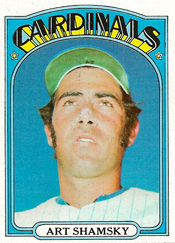
McGee went on to become one of the Cardinals’ best and most popular players, using his hitting, fielding and speed to help them win three National League pennants and a World Series title.

Pining for pinstripes

McGee was 17 and recently graduated from high school in 1976 when the White Sox selected him in the June amateur baseball draft. McGee was chosen in the seventh round, just after the Tigers took Ozzie Smith and just before the Red Sox selected Wade Boggs.

If McGee had signed with the White Sox, he eventually might have made his debut in the majors for Tony La Russa, who became White Sox manager in August 1979. Instead, McGee decided to attend community college.

The decision appeared to be shrewd when the Yankees took him in the first round of the secondary phase of the draft in January 1977, “but, unwise to the ways of negotiating contracts, he wound up signing for less than the White Sox had offered him,” the St. Louis Post-Dispatch reported.

“I probably could have got more if I knew what I was doing,” McGee said.

In 1978, his second season in the Yankees’ system, McGee, a natural right-handed batter, started switch-hitting.

He was considered a promising prospect when he got to Class AA Nashville in 1980, but in July he suffered a broken jaw and was limited to 78 games for the season. McGee hit .283. Designated hitter Buck Showalter, the future big-league manager, led Nashville in batting average (.324) and hits (178) in 1980.

Odd man out

The Yankees put McGee on their 40-man big-league winter roster after the 1980 season, but in December they signed free-agent outfielder Dave Winfield and needed to open a spot for him.

McGee was one of two players the Yankees considered dropping from their roster. The other was his best friend on the Nashville team, Ted Wilborn, a switch-hitting outfielder who played briefly with the Blue Jays and Yankees.

Yankees vice president for baseball operations Bill Bergesch, a former Cardinals minor-league executive who signed Bob Gibson to his first pro contract, told the New York Daily News, “We liked Willie. We considered him a fine prospect, but our minor-league people liked the other player (Wilborn) better.”

McGee said to The Tennessean newspaper, “Somebody had to go and I was the least experienced.”

By being reassigned outright to Nashville, McGee was frozen on the minor-league roster and couldn’t be recalled by the Yankees.

Good report card

McGee, Wilborn and Don Mattingly formed the Nashville outfield in 1981. McGee led Nashville in batting (.322) and had 24 stolen bases. Mattingly batted .316 and led the club in hits (173). Wilborn hit .295 and had 43 steals.

Hal Smith, the Cardinals’ starting catcher from 1956-60, was scouting the Nashville team extensively because the Yankees were looking to make a deal for Cardinals pitcher Bob Sykes.

During the 1981 season, “a proposed trade with the Yankees that would have involved Sykes fell through,” the Post-Dispatch reported, but the clubs were hopeful of reviving the deal after the season.

Cardinals executive Joe McDonald said the trade evolved when he received a report from Smith about McGee.

“Smith scouted Willie and turned in a good report,” McDonald said to the Post-Dispatch. “We liked his speed and we liked his bat.”

The Yankees looked to trade McGee to get something in return rather than lose him in the Rule 5 draft of players left unprotected on minor-league rosters.

In exploring potential deals, Bergesch told the New York Daily News, “There wasn’t a whole lot of interest in him” except from the Cardinals.

The trade of Sykes for McGee was made the same day the Yankees played the Dodgers in Game 2 of the 1981 World Series and drew little attention.

As good as advertised

McGee was placed on the Cardinals’ 40-man big-league winter roster.

Though he never had played above the Class AA level, he impressed the Cardinals at spring training in 1982.

“He speaks only when spoken to and goes largely unnoticed in the clubhouse,” the Post-Dispatch noted, “but he has skills that have marked him as a soon-to-be major leaguer.”

“Got a quick bat,” said Cardinals manager Whitey Herzog. “It’s unusual to see a young hitter with a quick bat from both sides of the plate.”

Batting from the right side, McGee dazzled by dashing from the plate to first base in 3.9 seconds.

At Yankees training camp, Sykes, weakened by shoulder ailments, was sent to the minors. He’d never pitch in a big-league game for the Yankees.

Upset about receiving what they considered damaged goods, the Yankees wanted the trade voided. “They think they’re going to get McGee back,” Herzog told the Post-Dispatch, “and they’re not.”

Making an impact

McGee began the 1982 season at Louisville. “I thought I was going to play the full year in triple-A to get some experience because I hadn’t played there before,” he told The Sporting News.

The plan changed when Cardinals outfielder David Green tore his right hamstring and was placed on the disabled list on May 8. The Cardinals called up McGee, who had hit .291 in 13 games with Louisville.

From the start, the rookie played like he belonged. He hit .378 for the Cardinals in May and .349 in June.

“I certainly didn’t think he’d be able to come up here and handle the pitching like he has,” Herzog told The Sporting News.

For the season, McGee hit .296 and swiped 24 bases for the Cardinals. He hit .308 in the National League Championship Series versus the Braves, and was the standout of World Series Game 3, with two home runs and two spectacular catches against the Brewers. Boxscore and Video.

On Jan. 24, 1983, the Cardinals traded outfielder Stan Javier and infielder Bobby Meacham to the Yankees for outfielder Bob Helson and pitchers Steve Fincher and Marty Mason. The Post-Dispatch reported the deal was to appease Yankees owner George Steinbrenner, who held hard feelings toward the Cardinals for sending Sykes in exchange for McGee 15 months earlier.

A St. Louis homecoming was neither sentimental nor successful for Art Shamsky.

On Oct. 18, 1971, Shamsky was the best-known name among the four players the Cardinals acquired in a trade with the Mets. The Cardinals sent pitchers Harry Parker and Chuck Taylor, first baseman-outfielder Jim Beauchamp and infielder Chip Coulter to the Mets for Shamsky and pitchers Jim Bibby, Rich Folkers and Charlie Hudson.
Bibby would develop into a successful starting pitcher for the Rangers, Indians and Pirates, and Folkers became a reliable reliever for the Cardinals, but at the time of the deal neither was a prominent player. Bibby had no big-league experience and Folkers had spent part of one season in the majors.

Shamsky, born in St. Louis and raised in suburban University City, was an outfielder and first baseman who hit with power from the left side. He helped the Mets become World Series champions in 1969. The Cardinals projected him to be a pinch-hitter and role player for them in 1972, but it didn’t work out.

Cardinals fan

In his book, “The Magnificent Seasons,” Shamsky said of his boyhood in the St. Louis area, “My life was basically two things: Following the St. Louis Cardinals, or playing baseball with my friends.”

Shamsky’s favorite Cardinals player was Stan Musial and he’d ride a streetcar to the original Busch Stadium to see him play.

Starting at age 8, Shamsky played Khoury League youth baseball for the John C. Roberts Shoe Co. team managed by Milton Mandel. “Art was so small when we first got him,” Mandel told the St. Louis Post-Dispatch, “that we used him as leadoff man in hopes he’d be walked. I never thought he’d sprout the way he did.”

According to the Dayton Daily News, Shamsky “paid his own expenses to the Cardinals’ rookie camp in St. Petersburg when he was still in high school, but he was turned back as a kid who was too skinny and lacked power.”

What the Cardinals didn’t count on, the Dayton newspaper noted, was “the development of his wrists and fast hands.”

Regarding those quick wrists, Shamsky told the Post-Dispatch, “I strengthened them by working out a lot, playing handball and squeezing rubber balls.”

After graduating from University City High School at age 16 in 1958, Shamsky attended the University of Missouri for one year. Though the Cardinals made an offer, the Reds signed him in September 1959. The next season, his first in the minors, Shamsky was a roommate of Pete Rose, according to the Society for American Baseball Research.

Power source

On April 17, 1965, Shamsky, 23, made his big-league debut for the Reds in his hometown. Pinch-hitting at Busch Stadium, he struck out against Cardinals ace Bob Gibson. Boxscore

Two months later, Shamsky beat the Cardinals with a home run to the Busch Stadium pavilion roof versus Gibson. Boxscore

“Shamsky has a smooth, easy stroke,” the Post-Dispatch reported. “He ties into the ball well because of his quick, strong wrists.”

According to the Cincinnati Enquirer, Shamsky was a hitter “who many say can whip the bat as quick as the great Ted Williams.”

In 1966, Shamsky hit 21 home runs, including four in consecutive plate appearances. The first three came on Aug. 12 at Cincinnati when the lanky slugger entered a game against the Pirates in the eighth inning. Each time Shamsky batted, the Reds were behind. One of his home runs put them ahead and the other two tied the score. Boxscore

“That was the greatest clutch-hitting performance I ever saw,” Pete Rose said to the Dayton Daily News.

The next time Shamsky batted, on Aug. 14 against the Pirates, he hit another home run, giving him four in a row. Boxscore

“His power comes from his wrists rather than his arms or body,” Dayton columnist Si Burick observed. “If he depended on his biceps or any other part of his body, he would be working in an office.”

Aching back

In November 1967, Mets president Bing Devine acquired Shamsky from the Reds. A month later, Devine replaced Stan Musial as Cardinals general manager.

After platooning with Cleon Jones in left field for the Mets in 1968, Shamsky experienced back problems in 1969 and opened the season on the disabled list.

In his book, “After the Miracle,” Shamsky said, “The pain was so bad that I honestly wondered if I was ever going to play again.

“To make matters worse, I would get hooked on Percocet, an opioid analgesic, relying on the pills when I started playing again and taking sleeping pills at night.”

Shamsky batted .300 with 14 home runs in 100 games for the 1969 Mets, who won the World Series championship. He also hit .538 (with seven hits) in the National League Championship Series against the Braves. Video

After hitting .293 in 1970, Shamsky’s back woes intensified and he had a .185 batting mark in 1971.

“I’ve been to so many different doctors, chiropractors and osteopaths for my back pain,” Shamsky said in his book. “I once saw a doctor who stuck cotton swabs of cocaine up my nose to deaden my nerves.

“I desperately wanted to keep playing ball.”

City slicker

Though Devine made the trade to acquire Shamsky for a second time and bring him to the Cardinals, he told the Post-Dispatch, “It’s a major deal only from the standpoint of numbers.” Or, as the New York Daily News noted, it was a trade “more distinguished for the quantity than the quality.”

Shamsky, a New York City resident who partnered with former Yankees infielder Phil Linz in owning two nightclubs there, was described by the New York Times News Service as “thoroughly modern Manhattan.”

Shamsky didn’t attempt to cloak his feelings about the trade. “To be honest,” he said to the Post-Dispatch, “my home is now in New York and I have two businesses there, so I’d rather have stayed in New York.”

The back problems followed Shamsky from New York to Cardinals spring training camp. After hitting .190 in Grapefruit League games, Shamsky was released by the Cardinals before the 1972 season began.

He played briefly in 1972 for the Cubs and Athletics, failed to hit with either, and was finished as a player at age 30.

Shamsky’s career batting average in the majors was the same as his career batting average versus the Cardinals: .253.

He was at his best against right-handers, hitting .417 (10 hits) against Don Drysdale and .350 (14 hits) versus Jim Bunning. Shamsky also hit four home runs, including a grand slam, against the Cardinals’ Nelson Briles.

Like a fading supermodel, reliever Chuck Hartenstein found himself out of fashion soon after he joined the Cardinals.

Described by The Sporting News as “a little stick of a guy who stands 5 feet 10 and weighs 150 pounds” and who “doesn’t show anything in the way of muscles,” Hartenstein was given the nickname Twiggy by a teammate.

In the late 1960s, when Hartenstein was at his peak as a National League closer, British fashion model Twiggy, 5 feet 6 and 110 pounds, was a cultural icon among the hip crowd. About the time Twiggy retired from modeling, Hartenstein was struggling to remain in the majors.

A right-hander whose signature pitch was a sidearm sinker, Hartenstein had a short stint with the Cardinals in 1970. He had a second career as a coach and scout in the majors and instructor in the minors.

Thick and thin

Born and raised in Texas, Hartenstein went to the University of Texas and was a teammate of future Cardinals first baseman Joe Hague. Hartenstein earned a bachelor’s degree in business administration and marketing, but opted to pursue a professional baseball career, signing with the Cubs in May 1964.

Hartenstein became a protege of Cubs minor-league instructor Fred Martin, a former Cardinals pitcher, who taught him to throw the sinker. Years later, future Hall of Famer Bruce Sutter learned the split-fingered fastball from Martin.

“(Martin) taught me just about everything I know,” Hartenstein told The Sporting News.

Hartenstein had his breakout season in 1967. Called up to the Cubs in June, he became their closer, posting a 9-5 record and team-leading 11 saves.

Reliever Dick Radatz, dubbed “The Monster” because of his 6-foot-6, 230-pound frame, gave Hartenstein the Twiggy nickname, The Sporting News reported, but Hartenstein told the Society for American Baseball Research it was outfielder Billy Williams who came up with the tag.

According to the Pittsburgh Press, Hartenstein was so skinny “he could tread water in a test tube.”

Hartenstein entered 1968 as the Cubs’ closer, but his season quickly unraveled. In April, his errant fastball struck Braves batter Joe Torre in the head. “Torre went down like a fallen tree,” the Atlanta Constitution reported.

In his book, “Chasing the Dream,” Torre said, “I never saw it. It smashed against my cheek. It split my palate, broke my cheek and my nose. My teammates had to carry me off the field. I was in shock.”

Hartenstein told the Chicago Tribune, “I’m sorry it happened. I couldn’t believe the ball hit him. It was a fastball and it bore in on him. I had thrown two away from him for strikes, and this one was supposed to brush him back. I certainly didn’t want to hit him, but he just didn’t move.”

Hartenstein had a terrible April (0-2, 6.75 ERA) and was replaced as closer by Phil Regan. After clashing with manager Leo Durocher, Hartenstein was demoted to the minors in June.

“I found out one thing about Durocher: When you got in his doghouse, you never got out of it,” Hartenstein told the Pittsburgh Post-Gazette.

Snapped twig

The Cubs traded Hartenstein to the Pirates in January 1969. He led the 1969 Pirates in saves (10) and was 5-4. Hartenstein was effective against the Cardinals that year, yielding no hits or runs in four appearances totaling five innings.

In 1970, Hartenstein had another bad April (7.04 ERA) and was replaced as closer by Dave Giusti, who was acquired from the Cardinals.

Placed on waivers in June, Hartenstein was selected by the Cardinals. According to the Pittsburgh Press, when Pirates general manager Joe Brown called and told him he was going to the Cardinals, Hartenstein asked, “Football or baseball?”

The transaction made Hartenstein a teammate of Joe Torre, who was traded by the Braves to the Cardinals a year earlier. Hartenstein was thrilled to join a team that featured a lineup with hitters such as Torre, Dick Allen and Lou Brock. “This club could win it all,” he told the Pittsburgh Press.

The 1970 Cardinals could hit, but their bullpen was weak. The Cardinals would finish the season with the fewest saves (20) in the major leagues.

Manager Red Schoendienst said to the St. Louis Post-Dispatch, “Twiggy told me he’ll pitch everyday if we want him to,” but Hartenstein didn’t help. After pitching three scoreless innings against the Pirates in his Cardinals debut, he was shelled in his next five outings. Boxscore

In July, when Nelson Briles came off the disabled list, going into the starting rotation and bumping Chuck Taylor into the bullpen, Hartenstein was given his unconditional release.

In six appearances for the Cardinals, Hartenstein had an 8.77 ERA, surrendering 13 runs in 13.1 innings.

Hartenstein blamed the AstroTurf infields at Busch Memorial Stadium and other National League ballparks for his troubles.

“Sure, I’ve pitched some bad games,” he told the Boston Globe, “but almost everything hit on the ground was finding holes. An infielder playing on the AstroTurf has to be a step quicker than when he plays on a grass infield.”

In Hartenstein’s short time with the Cardinals, he wore three different uniform numbers (22, 26 and 50), according to baseball-reference.com.

The Red Sox, who played on a grass infield, signed Hartenstein for the remainder of the 1970 season and he flopped with them, too (0-3, 8.05 ERA).

Learning to teach

Hartenstein spent the next six seasons (1971-76) in the Pacific Coast League, pitching for farm clubs of the White Sox, Giants and Padres.

In 1977, Hartenstein, 35, returned to the majors with the Blue Jays, an American League expansion club. In May, Rod Carew hit a ball that struck Hartenstein, dislocating his right thumb. When he recovered, Hartenstein gave up four home runs _ to Bernie Carbo, Butch Hobson, Fred Lynn and Jim Rice _ in a July 4 loss to the Red Sox at Fenway Park. Boxscore

“It was great instruction for anyone who wants to be a pitching coach,” Hartenstein said to the Boston Globe. “I showed exactly what you shouldn’t do.”

After finishing 0-2 with a 6.59 ERA for the 1977 Blue Jays, Hartenstein became a minor-league instructor. In 1979, he got back to the majors as pitching coach for the Indians. The club’s bullpen coach was Dave Duncan, who years later was Cardinals pitching coach.

Hartenstein also was Brewers pitching coach from 1987-89 when Dan Plesac developed into a top closer.

In six seasons as a big-league pitcher, Hartenstein was 17-19 with 24 saves. In 13 appearances versus the Cardinals, he had a 1.96 ERA.