Feeds:
Posts
Comments

When his arm was sound, Ernie White had the talent to be an ace on the Cardinals’ pitching staff.

In June 1941, White pitched consecutive two-hit shutouts for the Cardinals against the Dodgers and Giants.

The back-to-back gems were the centerpieces in a stretch of 27.2 scoreless innings pitched by White, a left-hander who threw hard with an easy motion.

White earned 17 wins for the 1941 Cardinals, but arm ailments kept him from ever having another double-digit win season.

Turning pro

In 1937, White, 20, was pitching for a textile mill team in his native South Carolina when he was discovered and signed by Cardinals scout Frank Rickey, brother of club executive Branch Rickey, according to the Society for American Baseball Research.

White made his Cardinals debut in 1940 and was a prominent part of the pitching staff in 1941.

Besides White, the 1941 Cardinals pitching staff for manager Billy Southworth included Lon Warneke, Mort Cooper, Max Lanier, Harry Gumbert and Howie Krist. All posted double-digit win totals for the 1941 Cardinals.

On June 7, 1941, the Cardinals started Sam Nahem against the Giants at the Polo Grounds. A New York native, Nahem had a law degree from St. John’s University and enjoyed classical music and literature.

A right-hander, Nahem gave up three runs and was relieved by White with none out in the second. Referring to Nahem as the “boy lawyer,” J. Roy Stockton of the St. Louis Post-Dispatch wrote dismissively, “The Brooklyn barrister didn’t have his usual stuff. Southworth told Sam to spend the rest of the afternoon reading, or something.”

White pitched eight scoreless innings of relief and got the win as the Cardinals prevailed, 11-3. Boxscore

Right stuff

White’s next appearance came on June 15 in a start versus the Dodgers in the second game of a doubleheader at St. Louis.

With two outs and none on in the third inning, pitcher Hugh Casey doubled for the Dodgers’ first hit of the game. White hit Pee Wee Reese with a pitch and walked Billy Herman, loading the bases.

“Ernie was plainly rattled,” W. Vernon Tietjen of the St. Louis Star-Times observed.

Up next was Pete Reiser, who hit a hard grounder to the right side toward Don Padgett, a hulking catcher and outfielder who was making a rare start at first base.

“Padgett threw his 215 pounds at the ball, stuck out his glove and, sure enough, when he picked himself up the ball was stuck in it,” Tietjen wrote in the Star-Times.

Padgett tossed to White, covering first, for “a sensational putout.”

In the bottom half of the third, White doubled, sparking a three-run Cardinals uprising.

White allowed one other hit, a double by Reese in the sixth, and finished with a two-hit shutout in the Cardinals’ 3-0 victory. Boxscore

Special talent

The shutout of the Dodgers ran White’s scoreless innings streak to 17.

His next appearance came June 21 in a start versus the Giants at St. Louis. White pitched another two-hit shutout. The Giants’ hits were singles by Billy Jurges in the second and Mel Ott in the fourth.

In the sixth, White stroked a RBI-single against Bill Lohrman, “a drive that took Lohrman’s cap right off his head and made him wonder, no doubt, if perhaps he wasn’t wearing his protective helmet during the wrong part of the game,” the Post-Dispatch noted. Boxscore

Four days later, on June 25, White started against manager Casey Stengel’s Braves at St. Louis.

In the second, with two outs and Braves runners on second and third, Sibby Sisti grounded a ball just out of the reach of second baseman Creepy Crespi. The hit scored both runners, ending White’s scoreless streak at 27.2 innings.

White held the Braves scoreless in the last seven innings and got the win as the Cardinals triumphed, 6-2. White also drove in one of the Cardinals’ runs with a sacrifice fly.

The win boosted White’s record for the season to 5-1 and kept the Cardinals in first place, a half-game ahead of the Dodgers. Boxscore

In the Star-Times, W. Vernon Tietjen wrote, “Everybody knows baseball pennants are rarely, if ever, won without a Paul Derringer or Bucky Walters, a Dizzy Dean, a Carl Hubbell or a Red Ruffing. Everybody knows, too, that the Cardinals are still leading this race without a substantial facsimile thereof. A good many persons strongly suspect, however, that the Cardinals have one in the making in Ernest Daniel White.”

White “has all the attributes of pitching greatness,” Tietjen declared. “His fastball, delivered with no more apparent effort than a warmup pitch, leaves batters wondering where it went.”

Career curtailed

The Cardinals (97-56) finished in second place, 2.5 games behind the champion Dodgers (100-54). White was 17-7 and was third in the National League in ERA at 2.40. He had 12 complete games and three shutouts.

An arm ailment sidelined White for part of the 1942 season, but he pitched a shutout in Game 3 of the World Series, leading the Cardinals to a 2-0 victory over the Yankees at New York. The Yankees’ lineup featured four future Hall of Famers: Bill Dickey, Joe DiMaggio, Joe Gordon and Phil Rizzuto. Boxscore

According to the Society for American Baseball Research, White was the first pitcher to shut out the Yankees in a World Series game since the Cardinals’ Jesse Haines did it in 1926.

White had a shoulder injury in 1943. He entered the Army in January 1944, fought in the Battle of the Bulge in World War II and was discharged in January 1946.

He returned to baseball, but his arm wasn’t right. The Cardinals released White in May 1946 and he signed with the Braves, rejoining his former Cardinals manager, Billy Southworth. His final season in the majors was 1948 and he departed with a career mark of 30-21 with a 2.78 ERA.

White went on to manage teams in the farm systems of the Braves, Reds, Athletics, Yankees and Mets for 15 seasons.

In 1963, 22 years after his scoreless innings streak ended against Casey Stengel’s Braves, White became a coach on the staff of Stengel’s Mets. 
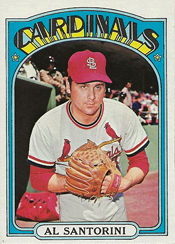
Al Santorini pitched for a while with Bob Gibson and Steve Carlton in the starting rotation of the Cardinals.

On June 11, 1971, the Cardinals acquired Santorini from the Padres for outfielder Leron Lee and pitcher Fred Norman.

A right-hander, Santorini’s three seasons with the Cardinals were highlighted by the three shutouts he pitched in 1972. Overall with the Cardinals, Santorini was 8-13.

Prized prospect

A son of a truck driver for Ballantine beer, Santorini was born in Irvington, N.J., and excelled at high school athletics in Union Township, N.J.

Santorini was a standout prep quarterback and bowler, but his best sport was baseball. As a pitcher, his high school record was 35-1. A high school teammate, Elliott Maddox, also went on to play in the majors.

Santorini, 18, was considered a prime prospect entering the June 1966 amateur baseball draft. The Cardinals, with the seventh selection in the first round, drafted Leron Lee. The Phillies had the ninth pick in the first round and their scout, Paul Owens, hoped they’d take Santorini.

“I scouted Santorini quite a bit,” Owens told the St. Louis Post-Dispatch. “He had a great fastball and looked so good that I recommended we select him as No. 1.”

Instead, the Phillies used their first-round pick to draft Mike Biko, a pitcher who never reached the majors.

With the 11th pick in the first round, the Braves chose Santorini and assigned him to the minors. The next year, he underwent an operation on his right elbow.

After posting a 2.68 ERA for Class AA Shreveport in 1968, Santorini was called up by the Braves and made his major-league debut in a start against the Giants on Sept. 10 at Atlanta. The Braves’ starting catcher, Walt Hriniak, also was playing his first game in the majors. The regular catcher, Joe Torre, shifted to first base.

Santorini held the Braves scoreless for two innings, but gave up four runs in the third. The big blow was Willie McCovey’s decisive three-run home run. McCovey never got another hit versus Santorini, finishing 1-for-17 against him in his career. Boxscore

A month later, the Braves failed to protect Santorini in the National League expansion draft and he was picked by the Padres.

Fun and games

In three seasons with the Padres, Santorini was 9-24. He was 0-1 against the Cardinals but with a 2.86 ERA in 28.1 innings.

On May 26, 1971, Santorini started both games of a doubleheader for the Padres against the Astros at San Diego.

In Game 1, Padres manager Preston Gomez thought he would outmaneuver the Astros, who started a lineup of mostly left-handed batters. As Santorini warmed up in the Padres’ bullpen before the game, left-hander Dave Roberts secretly got loose in the San Diego Chargers’ football clubhouse.

“When they saw Santorini warming up, they had all those left-hand hitters ready to hit against him,” Gomez said to the Associated Press.

After Santorini retired leadoff batter Roger Metzger, Roberts relieved. He pitched the remainder of the game, but the Astros won, 2-1. Boxscore

In Game 2, Santorini started, went six innings and gave up four runs. His counterpart, Larry Dierker, pitched a one-hitter and the Astros prevailed, 8-0. Boxscore

Two weeks later, Santorini was dealt to the Cardinals.

Hard to win

Used as both starter and reliever, Santorini was 0-2 with two saves and a 3.81 ERA for the 1971 Cardinals. He had a 2.10 ERA in 14 relief appearances and a 5.62 ERA in five starts. In his first start for the Cardinals, Santorini lost, 1-0, to Don Gullett and the Reds. Boxscore

With the Cardinals, Santorini was reunited with Joe Torre, his former Braves teammate. Helped by weight loss, Torre won the National League Most Valuable Player Award with the Cardinals in 1971. He urged Santorini to lose weight, too.

Santorini went from 202 pounds to 190 after the 1971 season. He and Torre shared an apartment in north St. Louis County at the start of the 1972 season.

“Every time Joe caught me having a high-calorie soft drink or eating anything, he’d call me things like fatso or slob,” Santorini told the Post-Dispatch. “Joe is like a guy who gave up smoking finally and then can’t stand to see anyone else smoking.”

Santorini began the 1972 season as a reliever and spot starter. On April 17, 1972, with his parents in attendance at Philadelphia, Santorini got his first Cardinals win in a relief stint versus the Phillies. Boxscore

The win snapped a streak of 12 consecutive losses for Santorini, dating back to April 1970. “It was beginning to get to me,” Santorini told The Sporting News. “It has to make you wonder some.”

Throwing zeroes

On July 4, 1972, Cardinals starting pitcher Scipio Spinks injured a knee in a plate collision with Reds catcher Johnny Bench and was sidelined for the rest of the season. Santorini (4-6) replaced Spinks in the rotation.

Santorini pitched the first of his three Cardinals shutouts on Aug. 6, 1972, in a 6-0 victory against the Phillies. He told the Philadelphia Daily News his arm stiffened in the sixth inning, “but you don’t want to come out when you’re pitching a shutout.” Boxscore

On Sept. 16, Santorini shut out the Pirates in a 4-0 win. A key moment occurred in the seventh when, with two outs and runners on second and third, Santorini struck out Richie Zisk, a former New Jersey prep rival, on three pitches. “Those were the three hardest pitches I threw all day,” Santorini told the Post-Dispatch. Boxscore

Two weeks later, on Wednesday afternoon Sept. 27 in the Cardinals’ final home game of the season, 3,380 spectators, the smallest crowd to attend a Cardinals game since Busch Memorial Stadium opened in May 1966, watched Santorini spin a shutout in a 4-0 triumph over the Mets.

Santorini threw 149 pitches and struck out a career-high 12 batters, extending his scoreless innings streak to 20.

“My buddies back in New Jersey were probably watching the game on TV, just off the golf course and drunk,” Santorini said to the Post-Dispatch. “They don’t work.” Boxscore

Santorini finished 8-11 with a 4.11 ERA for the 1972 Cardinals.

The next year, he had a 5.50 ERA in six relief appearances when the Cardinals traded him to the Royals for pitcher Tom Murphy on May 8, 1973.

Santorini spent the rest of the 1973 season in the minors. In 1974, he was in the Phillies’ system, but was released in July.

Santorini called the Cardinals and they signed him to pitch for their Tulsa affiliate. “I was lucky to latch onto a club for the remainder of the season,” Santorini told The Sporting News. “I feel I still can do the job in the major leagues as a reliever.”

After posting a 5.57 ERA for manager Ken Boyer’s Tulsa team, Santorini was bypassed when the Cardinals called up players in September. At 26, his pitching career was finished.

Only one of the 267 career home runs hit by George Hendrick in the big leagues stayed in the park, and it enabled the Cardinals to beat Fernando Valenzuela the first time they faced him.

On June 11, 1981, Hendrick’s two-run inside-the-park home run against Valenzuela provided the margin of victory in the Cardinals’ 2-1 triumph over the Dodgers at St. Louis.

The next day, major-league players went on strike and play wouldn’t resume for two months.

Dodger in danger

A left-hander with an exceptional screwball, Valenzuela debuted in the majors with the Dodgers as a reliever in September 1980. He earned a spot in the Dodgers’ starting rotation in 1981 and gained national prominence when he won his first eight decisions.

Valenzuela, 20, was scheduled to make his first career appearance against the Cardinals on Thursday, June 11, in the finale of a three-game series at Busch Memorial Stadium.

His first visit to St. Louis was highly anticipated, but it took a dark turn on June 10 when Valenzuela received a death threat. He was taken that night from Busch Memorial Stadium by FBI agents and placed under round-the-clock protection, the Los Angeles Times reported.

Despite the threat, Valenzuela, 20, made his start versus the Cardinals the following night. A crowd of 39,250 turned out for the matchup of Valenzuela (9-3) against the Cardinals’ Silvio Martinez (1-4).

Extra security was provided for Valenzuela because St. Louis police chief Eugene Camp said the FBI had received information of a plot to kidnap the pitcher, the St. Louis Post-Dispatch reported. Camp said undercover St. Louis police officers were assigned to keep watch over Valenzuela.

Cardinals capitalize

Those in attendance wouldn’t have known from Valenzuela’s performance that he had been threatened. He pitched with poise and command against the Cardinals.

His only trouble on the field came in the first inning. With two outs and none on, Keith Hernandez coaxed a walk. George Hendrick followed and looped a liner to right field.

“It appeared to be an ordinary single,” the Post-Dispatch noted.

Right fielder Pedro Guerrero charged the ball, hoping for a catch, but it landed five feet in front of him, skipped past him and bounced to the wall. Hernandez and Hendrick circled the bases, giving the Cardinals a 2-0 lead.

“I thought I had a chance,” Guerrero said to the Los Angeles Times. “I just couldn’t get it. No excuses.”

Valenzuela told the Post-Dispatch, “It was a very strange home run.”

Fulfilling expectations

The Dodgers got a run in the sixth when Ken Landreaux scored from first on Dusty Baker’s two-out double, but Silvio Martinez allowed nothing more. Bruce Sutter relieved with one out in the eighth and shut down the Dodgers the rest of the way, preserving the win, the last for Martinez in the big leagues.

Valenzuela went seven innings, yielding three hits, walking three and striking out nine, before he was relieved. Hendrick’s fluke home run and singles by Gene Tenace and Tito Landrum accounted for the Cardinals’ hits. Boxscore

“Fernando is everything they said he was,” Tenace told the Post-Dispatch. “Besides having tremendous poise, he has four pitches and he’s not afraid to throw any of them in any situation. He has two great screwballs, a hard one and a slow one. He has an excellent curve, plus a good fastball.”

Landrum said, “By having two speeds on his screwball, he really keeps you off balance. One is a kind of fadeaway. The other breaks hard.”

Keith Hernandez added, “He’s got the best screwball I’ve ever seen. The Lord blesses a select few and he was definitely blessed.”

After the game, six men, all of them either police officers or FBI agents, escorted Valenzuela from the ballpark through a private exit, the Post-Dispatch reported.

Silly seasons

The victory moved the Cardinals (30-20) to within 1.5 games of the first-place Phillies (34-21) in the National League East. The players went on strike the next day.

Before play resumed on Aug. 10, baseball declared the games completed before the strike would count as one season, and the games completed after the strike would count as a second season. Those teams with the best division records in each season would advance to the playoffs.

The Phillies were declared champions of the National League East Division in the first season.

Baseball made the decision even though, because of scheduling inconsistencies, all teams were not playing the same amount of games. 

After the strike, the Expos (60-48) finished atop the National League East in the second season and the Cardinals (29-23) placed second.

The Phillies and Expos were the National League East teams that went to the playoffs, even though overall in 1981 the top three records in the division belonged, in order, to the Cardinals (59-43), Expos (60-48) and Phillies (59-48).

The Dodgers, who finished atop the National League West in the first season of 1981, became National League and World Series championships.

Pedro Guerrero overcame his gaffe against the Cardinals and hit .300 for the Dodgers. He was named World Series most valuable player, hitting .333 with two home runs versus the Yankees.

Valenzuela finished 13-7 with eight shutouts in 1981 and won both the National League Cy Young Award and Rookie of the Year Award. He was 1-0 in the World Series, pitching a complete game.

Guerrero and Valenzuela both eventually played for the Cardinals.

Though it wasn’t unusual for Darryl Kile to hit a batter with a pitch, the number he plunked in a game against the Cardinals was extraordinary, even for him.

On June 2, 1996, while with the Astros, Kile hit four Cardinals batters with pitches in a game at St. Louis. Three of the four who were struck figured in the scoring, leading to a Cardinals victory.

Kile was the first National League pitcher to pelt four batters with pitches in one game since the Cubs’ Moe Drabowsky did it exactly 29 years earlier, on June 2, 1957, against the Reds. Boxscore

Breaking bad

The Sunday afternoon game between the Astros and Cardinals at Busch Memorial Stadium matched a pair of right-handers, Kile vs. Todd Stottlemyre.

In the second inning, Kile plunked the leadoff batter, Ray Lankford. He moved to second on Gary Gaetti’s single and scored on John Mabry’s hit.

Gaetti was hit by a pitch in the sixth, but the Cardinals didn’t score.

It was a different story in the eighth. With two outs, none on and the Cardinals clinging to a 1-0 lead, Gaetti and Mabry each singled. The next batter, Danny Sheaffer, hitless in his last 10 at-bats, was hit by a pitch, loading the bases. It was the first time in three years Sheaffer got plunked in a major-league game.

Up next was Luis Alicea, the Cardinals’ hot hitter. Alicea had hit a home run in each of his three previous games. With the bases loaded, he dug in, expecting Kile to throw a strike.

“I wanted to get a good rip at it,” Alicea told the St. Louis Post-Dispatch. “I was disappointed because I didn’t even have a chance.”

Kile hit Alicea with a pitch, scoring Gaetti from third and giving the Cardinals a 2-0 lead.

“I was just trying to make too good a pitch,” Kile told the Associated Press.

Kile said he hit three batters with curveballs. Regarding the two he plunked in the eighth, Kile said, “You just can’t do stuff like that.”

The Astros got a runner to second base with two outs in the ninth, but Stottlemyre got Craig Biggio to pop out to shortstop Royce Clayton, completing the shutout win. Boxscore

Batters beware

Kile hit a league-high 16 batters with pitches in 1996. It was the second time he led the league in most batters hit by pitches. The other was when he plunked 15 in 1993.

After being acquired by the Cardinals in November 1999, Kile twice led the club in most batters hits by pitches (13 in 2000 and eight in 2002) and placed second in 2001 (11).

In 12 years in the majors, Kile hit 117 batters with pitches. By comparison, Bob Gibson, who had a reputation as an intimidator, hit 102 batters with pitches in 17 years. Gibson is the Cardinals franchise leader in that category.

The major-league record for most batters hit by pitches is 277 by Gus Weyhing, who pitched from 1887-1901, including part of the 1900 season with the Cardinals.

Two years after being named an American League all-star, Richie Scheinblum became a Cardinals pinch-hitter, closing out his big-league playing career.

A switch-hitting outfielder, Scheinblum was acquired by the Cardinals to help in their quest for a division title late in the 1974 season. Scheinblum was adept at pinch-hitting and the Cardinals wanted him solely for that role.
Scheinblum never got to play in the postseason. The Pirates edged out the Cardinals for the 1974 National League East title.

Scheinblum had six at-bats, all as a pinch-hitter, and produced two singles for the Cardinals. After the season, the Cardinals sold his contract to a team in Japan.

Known as much for his dry wit as for his baseball skills, Scheinblum hit .263 in eight seasons in the majors with the Indians, Senators, Royals, Reds, Angels and Cardinals.

Live and learn

As Bob Broeg noted in the St. Louis Post-Dispatch, Scheinblum was born in the same New York City hospital in which Babe Ruth died and in which scenes for “The Godfather” were filmed.

Describing his early childhood in the Bronx, Scheinblum told The Sporting News, “They tore down my neighborhood to build slums.”

Scheinblum moved with his family to Englewood, N.J. His Little League coach was a woman, Janet Murke, who taught him to hit from either side of the plate, The Sporting News reported.

After graduating from high school, Scheinblum played baseball at the C.W. Post campus of Long Island University in Brookville, N.Y., and earned a degree in business administration.

Playing in the Central Illinois Collegiate Summer League, Scheinblum had a job with an ice cube manufacturer.

“We worked from 6 a.m. to 4 p.m.,” Scheinblum told The Sporting News. “We were paid 80 cents an hour for making ice cubes for the Polar Bear Ice Cube Company. They’d wrap two of us in heavy clothes to keep us from freezing and put us in a room where the temperature was 30-below zero.”

Perennial prospect

Scheinblum was 21 when the Indians signed him in 1964 and sent him to the minors. A year later, he made the leap from Class A to the big leagues. Recalling Indians manager Birdie Tebbetts, Scheinblum told the Cincinnati Enquirer, “He used to tell me to go kneel in the on-deck circle until he could think of someone to send up to hit.”

Scheinblum spent most of the next three seasons (1966-68) in the minors. The Sporting News referred to him as “the perennial rookie.”

Lou Piniella also was an Indians outfield prospect. After the 1968 season, the Indians protected Scheinblum, rather than Piniella, from the American League expansion draft.

Scheinblum could hit and throw, but he was neither a graceful fielder nor fast. Asked what gave him the most trouble on defense, Scheinblum told the Kansas City Star, “Everything they hit at me.” Regarding his speed, Scheinblum said, “It takes me five steps to get out of the batter’s box.”

In the Indians’ 1969 spring training opener, Scheinblum “misjudged a fly ball into a triple and fell down fielding a single into a triple,” The Sporting News reported. “He hit an inside-the-park homer, but was called out at third for missing the bag.”

Improbably, Scheinblum began the 1969 season as the Indians’ Opening Day right fielder, batting third in the lineup.

“For four years I’ve been overawed,” he told The Sporting News. “Not anymore.”

He went hitless in his first 34 at-bats.

“The only good thing about playing in Cleveland is you don’t have to make road trips there,” Scheinblum said to Sports Illustrated.

Royal treatment

Demoted to the minors in 1970, Scheinblum hit .337 for Wichita and was dealt after the season to the Senators. Manager Ted Williams had Scheinblum on the 1971 Opening Day roster, but he hit .143 and was sent back to the minors.

“I’ve been sent down more than laundry in a chute,” Scheinblum said to the Los Angeles Times.

Playing for Denver, Scheinblum hit .388 in 106 games. It was the highest batting average in the American Association since Harry Walker hit .393 for the Cardinals’ Columbus farm club in 1951.

The Royals purchased Scheinblum’s contract and he opened the 1972 season with them as a reserve outfielder. In May, after Bob Oliver was traded, Royals manager Bob Lemon platooned Scheinblum and Steve Hovley in right field.

“At first, I was reluctant to go with Scheinblum because I didn’t think he was too good defensively,” Lemon told Sports Illustrated, “but we got to a point where we needed hitting. So I put him in.”

Scheinblum had an unorthodox way he batted. “I pull my head, swing up, and collapse my back leg _ things I shouldn’t do,” Scheinblum said.

The Indians and Senators had tried to change his style, but Royals hitting coach Charlie Lau left him alone. Scheinblum hit .386 in June and took over in right, joining an outfield with Amos Otis in center and former Indians teammate Lou Piniella in left.

“Amos covered everything,” Scheinblum told the Kansas City Star. “I was told to stand on the right field line and don’t move. Lou was told to stand on the left field line and don’t move. What our job was, when the ball was hit, we’d point.”

At the all-star break, the top three hitters in the American League were Scheinblum (.325), Piniella (.319) and Otis (.309). All three were named to the all-star team.

Scheinblum hit .300 for the season and his on-base percentage was .383. He was stunned when the Royals traded him and pitcher Roger Nelson to the Reds after the season for outfielder Hal McRae and pitcher Wayne Simpson.

Seeing red

The Reds were the reigning National League champions and were set in the outfield with Pete Rose, Cesar Geronimo and Bobby Tolan. “I’m probably the only guy in the history of baseball to hit .300, make the all-star team and not have a job the next year,” Scheinblum told the Cincinnati Enquirer.

Scheinblum was miserable in the role of reserve outfielder with the 1973 Reds, but attempted to maintain a sense of humor. Asked by teammate Jack Billingham why he always was spitting in the dugout, Scheinblum replied, “That’s the way I keep my weight down.”

Hit king Pete Rose called Scheinblum “the king of the one-liners.”

Scheinblum hit .300 as a Reds pinch-hitter but .222 overall. After the Reds traded him to the Angels in June 1973, Scheinblum told The Sporting News, “They try to discount everything you do over there to hold salaries down …. For the talent they have, they have the most underpaid team in baseball.”

He also took a swipe at the Reds’ manager, saying, “Two pennants have gone to Sparky Anderson’s head.”

In a letter published by The Sporting News, Reds public relations director Jim Ferguson responded, “Scheinblum did more talking than hitting.”

Helping hand

Scheinblum hit .328 in 77 games with the 1973 Angels. At spring training the next year, Angels manager Bobby Winkles assigned coach Whitey Herzog to work daily with Scheinblum on fielding. “We don’t think he’s been as good a defensive outfielder as he can be,” Winkles told the Los Angeles Times.

In April 1974, the Angels traded Scheinblum back to the Royals. Four months later, on Aug. 5, Scheinblum’s contract was purchased by the Cardinals.

Scheinblum, 31, was assigned to Tulsa and hit .247 in 24 games. In September, he was called up to the Cardinals, who entered the month 2.5 games behind the division-leading Pirates.

In his six plate appearances as a Cardinals pinch-hitter, all against right-handers, Scheinblum’s highlights were singles against relievers Gene Garber of the Phillies Boxscore and Dave Giusti of the Pirates. Boxscore

Scheinblum also appeared in the Cardinals’ epic 25-inning game versus the Mets. Batting in the 13th, he flied out to left. Boxscore.

Scheinblum spent the 1975 and 1976 seasons with the Hiroshima Carp in Japan.

His son, Monte Scheinblum, became a professional golfer and was the U.S. national long driving champion in 1992.

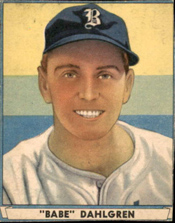
Babe Dahlgren, known best as the player who replaced Lou Gehrig in the Yankees’ lineup, pioneered the use of film to instruct Cardinals batters.

In 1965, the Cardinals hired Dahlgren, 52, to be director of filming. He took 16-millimeter movie film of the Cardinals at spring training and during regular-season games and then worked with manager Red Schoendienst and coaches to analyze swings of the batters.

At the time, everyday use of film to study and instruct players was considered innovative in baseball.

Journeyman career

Ellsworth Dahlgren was born in San Francisco and got the nickname Babe from his stepfather, according to the Society for American Baseball Research.

Dahlgren debuted in the majors as the Opening Day first baseman for the Red Sox in 1935. In February 1937, he was dealt to the Yankees, but with Lou Gehrig at first base, Dahlgren appeared destined for a backup role.

Dahlgren’s fate changed on May 2, 1939, when Gehrig’s streak of 2,130 consecutive games ended and Dahlgren replaced him. Boxscore

A right-handed batter, Dahlgren produced 89 RBI for the 1939 Yankees and hit a home run versus the Reds’ Bucky Walters in Game 2 of the World Series. Boxscore

Traded to the Braves after the 1940 season, Dahlgren also went on to play for the Cubs, Browns, Dodgers, Phillies and Pirates.

In 1943, when he was a National League all-star with the Phillies, Dahlgren had five hits in a game against the Cardinals at St. Louis. Boxscore

The next year, Dahlgren hit .289 with 101 RBI for the 1944 Pirates.

His last season in the majors was 1946 and he finished with 1,056 hits.

Dahlgren said the person who helped him most with hitting was Jimmie Wilson, the former Cardinals catcher who was his manager with the Cubs. “Jim taught me more about hitting in 10 minutes at Chicago in 1941 than I had learned the 10 previous years as a player,” Dahlgren told the St. Louis Post-Dispatch.

Baseball filmmaker

After leaving baseball, Dahlgren sold insurance, but his passion was filming batters. He invested in film equipment and taught himself how to use it.

“I bought my first camera in 1959,” Dahlgren told The Sporting News. “I shelled out $6,000. It was money I saved as a player.”

Dahlgren eventually spent much more on film equipment, including a slow-motion device.

“Babe spent four years perfecting his techniques, all without pay,” The Sporting News reported. “He even worked in a West Coast TV station for two years, minus salary, just so he could learn more about cameras and angles and the art of interviewing.”

Dahlgren went to spring training camps, shot film of batters and interviewed players such as Willie Mays and Ted Williams on camera about their approaches to hitting, according to The Sporting News.

He produced a film on hitting and titled it “Half a Second,” because “that’s how long it takes for a weak hitter to become a good one, that last half-second as the pitch comes to him,” Dahlgren said.

Dahlgren contacted owners of big-league clubs and tried to get them interested in his project. “Some listened and said no,” The Sporting News reported. “Most didn’t even listen.”

Sales job

After the 1963 season, Athletics owner Charlie Finley expressed interest in changing the dimensions of Municipal Stadium in Kansas City. Finley wanted to shorten the foul lines to help pull hitters slug home runs.

In a letter to Finley, Dahlgren wrote, “It is amazing that, in your short tenure in baseball, you have discovered the secret of the game _ hitting down the line.

“When a player hits straightaway, he has the pitcher, shortstop, second baseman and three bunched outfielders in line with a batted ball. When a player hits down the line, he has only the third baseman on the left field line and the first baseman on the right field line. If you design your park for pull hitting, you must have the batters with the know-how to take advantage of the short fences.”

About a month later, at the 1963 baseball winter meetings at Los Angeles, Dahlgren approached Finley, who was scheduled to leave for the airport in 40 minutes.

“We started talking and looking at my film,” Dahlgren said. “He called the airport and canceled his reservation. We spent almost six hours together.”

One and done

Finley hired Dahlgren to be the Athletics’ hitting coach and use film to analyze the swings of batters. According to The Sporting News, Dahlgren and the Athletics became the first in the majors to use film instruction on a full-time basis.

“This is what I’m interested in,” Dahlgren said. “It’s what I like to do. I feel this is my life’s work. I think I can help any hitter who is willing to work.”

Among the players on the Athletics’ 1964 big-league roster at spring training were Tony La Russa, Dave Duncan and Charlie Lau, who later became a hitting coach who relied on the use of video.

In his role with the 1964 Athletics, Dahlgren “started taking pictures in spring training and shot almost every game played during the regular season,” The Sporting News reported. “He had special showings every day for players who wanted to check their batting and pitching forms. Dahlgren also had a large backlog of film he used to demonstrate his theories on hitting.”

Dahlgren’s efforts were exemplary but the results were not. The 1964 Athletics finished in last place in the 10-team American League. They hit .239 and were eighth in the league in runs (621) and hits (1,321).

After the season, Dahlgren wasn’t retained and scout Whitey Herzog was added to the coaching staff.

Cardinals come calling

Dahlgren’s techniques with film intrigued Cardinals general manager Bob Howsam. On March 15, 1965, he hired Dahlgren and named him director of filming.

“I believe I helped some of the boys at Kansas City last year,” Dahlgren said to the Post-Dispatch, “but the expense, they felt, was too great.”

Howsam said, “I wanted Babe because I felt he could help established players to improve and young ones to learn.”

Dahlgren was hired to film Cardinals players and opponents and share the information with manager Red Schoendienst, hitting coach Mickey Vernon and pitching coach Joe Becker.

“One reason they may have been persuaded that this is a useful procedure is that Bill White was in a slump for many weeks last summer,” The Sporting News noted. “No one had a solution to his problems until White found his own answer with the help of home movies in his own basement.”

Unlike the cellar-dwelling Athletics, the Cardinals went to spring training in 1965 as the reigning World Series champions.

“I do believe if use of films of our players and of the opposition will help us win three or four games in a season,” Howsam told the Post-Dispatch, “the expenditure of $20,000 or so will be worthwhile.

“Use of films, on a limited basis, is not new,” Howsam said, “but not until last year has any ballclub made a day to day study of its hitters and pitchers.”

Howsam, who was involved with pro football’s Denver Broncos before joining the Cardinals, said, “Baseball, I’m convinced, has been far behind football in making realistic use of game and individual movies.”

Dahlgren lasted one season with the Cardinals. After hitting .272 in the 1964 championship season, the Cardinals hit .254 in 1965 and didn’t contend. First in the National League in hits (1,531) in 1964, the Cardinals ranked fourth (1,415) in 1965.

Howsam said the Cardinals did not get as much use out of the films as they had hoped.

After leaving the Cardinals, Dahlgren continued to help amateur players. Unfortunately, his films were destroyed in a house fire in 1980.