Feeds:
Posts
Comments

Sometimes in baseball a weak swing at a bad pitch can produce a good result. It happened that way for Randy Moffitt, a reliever for the Giants during the 1970s.
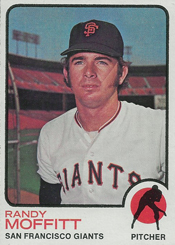
On July 8, 1974, at Jarry Park in Montreal, Moffitt pitched 3.1 scoreless innings against the Expos and was credited with a win.

His pitching, though, was only part of the reason the Giants prevailed. Moffitt’s bat was a factor, too. Actually, it wasn’t his bat. It belonged to teammate Bobby Bonds. Moffitt just happened to swing it. Well, actually, he didn’t swing. Moffitt simply moved the bat in the general direction of the pitch. Physics did the rest.

Here’s what happened:

With the score tied in the 10th inning, the Giants had a runner on first and none out. Moffitt was up next. Expecting the bunt sign, he reached for the heaviest bat he could find and grabbed one belonging to Bonds, the Giants’ home run leader that season.

“I could never swing that thing around deliberately,” Moffitt told the Montreal Gazette. “I had the fat bat because it was easier for me to bunt with that.”

Pitching was starter Steve Rogers, who hadn’t allowed a hit since the third inning.

The Expos, too, were expecting Moffitt to bunt. He had just two big-league hits and never had driven in a run. The corner infielders, first baseman Mike Jorgensen and third baseman Ron Hunt, moved way in, positioning themselves about 15 feet from the plate.

“Those two guys were sitting right in his lap,” Giants manager Wes Westrum told the San Francisco Examiner. “There was no way he could have sacrificed.”

Moffitt got the sign to swing away. Now he had to try to get that heavy bat around to meet the pitch.

Rogers delivered. “A fastball right down the middle,” Moffitt said to the Gazette.

No, said Rogers to the Montreal Star. “I didn’t throw him a fastball. It was a slider, high, and it was over the middle of the plate.”

A right-handed batter, Moffitt was hoping he could chop a grounder past Hunt. “I didn’t take a cut at the ball,” Moffitt told the Gazette, but somehow the bat connected solidly with the pitch.

Moffitt said to the Associated Press, “The ball hit the bat more than I hit the ball.”

It lifted into the air and carried _ way out to left-center. Playing in, left fielder Bob Bailey and center fielder Willie Davis turned and chased the ball but it landed past them and rolled toward the fence.

Mike Phillips scored from first with the go-ahead run and Moffitt hustled around the base paths. He thought he had a chance for an inside-the-park home run, but instead stopped at third with a stand-up triple because, “I decided I needed my strength for the finish,” he told the Associated Press.

Moffitt retired the Expos in the bottom half of the inning, sealing the 5-4 win. Boxscore

A sinkerball specialist, Moffitt was a better pitcher than hitter. In 12 seasons in the majors with the Giants (1972-81), Astros (1982) and Blue Jays (1983), he had 43 wins and 96 saves. Moffitt was 76 when he died on Aug. 28, 2025.

All in the family

Randy Moffitt was the younger brother of Billie Jean King, the tennis champion. Their parents, Billy and Betty Moffitt, raised Billie Jean and Randy in Long Beach, Calif. Billy was a fireman who later became a baseball scout for the Brewers.

“When Billie Jean was 10 years old, she was the star shortstop in the North Long Beach Girls’ Softball League,” Billy Moffitt said to Allen Abel of the Toronto Globe and Mail. “Her speed was her best asset. She could outrun all the other girls. She loved to play ball, but one day I told her, ‘There’s no future in this for a girl.’ I tried to get her into something that she could continue to do as she got older. I suggested swimming, but she said she didn’t like to swim. I sent her out to play golf, but she thought it was too slow. When she was 11, I gave her a racquet. She came back after the first day and said, ‘This is it. I’ll never give this up.’ ”

Randy Moffitt was five years younger than his sister. As Billy Moffitt recalled to the Globe and Mail, “He had to tag along to the tennis courts every day with his big sister. He won his share of tournaments, too, but his heart just wasn’t in it. Having to follow his sister everywhere made him sour on tennis. It wasn’t easy for him, being in the background all those years. He was always a quiet kid.”

At 14, Randy Moffitt quit playing competitive tennis. He said he turned to baseball because there weren’t enough boys his age to challenge him in tennis, according to the Globe and Mail.

Asked if he’d played tennis against his sister, Moffitt told Newsday, “When she’s serious, I couldn’t take a point off her, but she gets to laughing.”

Sink or swim

A pitcher and shortstop for Long Beach Polytechnic High School, Moffitt advanced to Long Beach State. The Giants picked him in the first round of the January 1970 amateur draft. Two years later, he was in the majors, joining a Giants bullpen with the likes of ex-Cardinal Jerry Johnson and 42-year-old Don McMahon.

Moffitt’s first save came against the Cardinals when he pitched two scoreless innings in relief of Sam McDowell. Boxscore

Moffitt led the Giants in saves in 1974 (15), 1975 (11) and 1976 (14).

In 1979, Moffitt began experiencing daily bouts with nausea. He passed blood, lost weight. “You can’t imagine how it feels to be nauseous every minute of every day,” Moffitt told the Houston Chronicle.

He eventually was diagnosed with having cryptosporidiosis, a disease caused by a parasite in the gastrointestinal tract.

It wasn’t until 1981 that doctors found a treatment to rid him of the illness. That year, during the players’ strike, the Giants released Moffitt. At 33, he was faced with having to rebuild his playing career.

The Astros signed him to a minor-league contract in 1982. Moffitt began the season at Tucson, but got brought up to the Astros in late April. He pitched in 30 games for them and posted a 3.02 ERA.

Granted free agency, Moffitt went to the Blue Jays in 1983. “He’s got a nasty sinker,” Blue Jays manager Bobby Cox told Peter Gammons of the Boston Globe. “He’s tough on right-handers. He’s unbelievably competitive.”

Moffitt had six wins and a team-leading 10 saves for the 1983 Blue Jays, but it turned out to be his last season in the majors. A free agent, Moffitt got a look from the Brewers, who agreed to send him to their Vancouver farm team. He signed in June 1984, was activated in July and released in August.
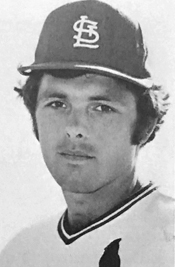
Marc Hill was supposed to be the catcher who moved Ted Simmons from behind the plate to first base in St. Louis.

Hill threw with the strength and quick release of Johnny Bench. He worked well with pitchers, caught pop flies and dug balls out of the dirt.

The problem was Hill didn’t hit like Simmons. He didn’t hit like Keith Hernandez either. With Hernandez emerging as the Cardinals’ first baseman, there was no place to move Simmons, a future Hall of Famer.

Blocked from getting much playing time with the Cardinals, Hill was traded to the Giants. His catching skills kept him in the majors for 14 seasons, including a stretch with the White Sox when Tony La Russa was their manager. Hill was 73 when he died on Aug. 24, 2025.

Catching on

Hill was from the Missouri town of Elsberry, located in Mississippi River bottomland, about 60 miles north of St. Louis. The area is known as a haven for duck hunters.

According to the St. Louis Post-Dispatch, Cardinals equipment manager Butch Yatkeman, a family friend, arranged for Hill, then 16, his parents and sister to attend a game of the 1968 World Series at Busch Memorial Stadium. Yatkeman also tipped off the Cardinals to Hill’s baseball talents.

Hill’s father, Henry, a St. Louis Browns minor leaguer in 1946, encouraged his son to lift weights. Hill also got strong working in the lumber yard his father managed. He became a baseball and basketball standout for Lincoln County High School.

In 1970, the Cardinals sent scouting supervisor Fred McAlister and instructor Vern Benson to see Hill, 18, play in a tournament at Hannibal, Mo. They liked what they saw. The Cardinals chose him in the 10th round of the June 1970 amateur draft. “He has a real major-league arm and good catching ability,” Cardinals general manager Bing Devine told the St. Louis American.

At the lowest levels of the minors, though, Hill’s inability to hit became a concern. In his first two seasons, at Sarasota (Fla.) in 1970 and at Cedar Rapids (Iowa) in 1971, he had more strikeouts than hits. “Hill was almost useless as a batter,” Cardinals instructor George Kissell told the Post-Dispatch. “You could almost walk through the batter’s box and he still couldn’t hit you.”

Nicknamed Booter, as in Boot Hill, the catcher’s hopes of reaching the majors appeared on the brink of being buried. “If I could just hit, I’d have it made,” Hill told the Mexico (Mo.) Ledger.

Making the majors

A turnaround came in 1973. Hill totaled 20 doubles, 12 home runs and 57 RBI for Cardinals farm clubs. His catching dazzled. According to the Tulsa World, Arkansas manager Tom Burgess said Hill “throws better than Johnny Bench, or anybody” and predicted “Hill will move Ted Simmons to another position.”

The Cardinals, in the thick of a division title chase, called up Hill, 21, for the last two weeks of the 1973 season. For the opener of the final series of the year, manager Red Schoendienst showed supreme confidence in Hill, having him make his big-league debut as the starting catcher against the Phillies. Simmons, 24, shifted to first base, replacing injured Joe Torre.

“Before the game, I was so scared they almost had to push me out of the dugout,” Hill recalled to Milton Richman of United Press International. “Ted (Simmons) asked me if I was nervous. I said yes and he said, ‘Try not to be. We’ll help you along.’ And he certainly did.

“We had a close relationship, Ted and I. There was no bitterness between us because we played the same position. He kind of nursed me, took care of me.”

With Hill catching, Mike Thompson (four innings) and Diego Segui (five innings) combined on a two-hit shutout in a 3-0 Cardinals triumph. Boxscore

Encouraging words

Before a spring training game at St. Petersburg, Fla., in 1974, Cardinals broadcasters Jack Buck and Mike Shannon told Reds catcher Johnny Bench about Hill’s laser beam throws from the plate to second base. Then, as Hill recalled to Milton Richman, “I was sitting on the Cardinals’ bench, pretty much by myself. I saw Johnny Bench walk by and I just plain shook in my britches. ‘There’s Johnny Bench, the best catcher in baseball,’ I said to myself.”

Bench gave a hello, told Hill he’d heard good reports about him and wished him well, United Press International reported.

Though Hill was star-struck in Bench’s presence, Cardinals management had no doubt he was ready for the majors.

“I don’t know of any catcher in the big leagues who throws better than Hill does,” Red Schoendienst said to the Post-Dispatch. Cardinals director of player personnel Bob Kennedy told the Columbia (Mo.) Daily Tribune, “He’s the best defensive catcher in all of baseball.”

Nontheless, the Cardinals determined Hill, 22, would be better off playing every day in the minors rather than serving as Simmons’ backup. So Tim McCarver was kept as the reserve catcher and Hill began the 1974 season with Tulsa.

Change of plans

Playing for Tulsa manager Ken Boyer, Hill hit with power, drove in runs and excelled at catching.

“I am not being cocky when I say I know I am going to be the Cardinals’ catcher pretty soon,” Hill said to Tulsa World sports editor Bill Connors in May 1974. “Ted Simmons knows it. He has been very nice to me … He has said he … will be glad to get down to first base whenever the Cardinals think I am ready … He may hit .350 when he gets that strain (of catching) off his legs.”

The Cardinals called up Hill in July 1974. He was the starting catcher in six games but didn’t hit well. Returned to Tulsa, Hill came back to St. Louis in late August, taking the roster spot of Tim McCarver, who was shipped to the Red Sox. Hill mostly sat and watched, though, because Simmons hit .349 with 27 RBI in 27 September games. “I’m not concerned about someone taking my catching job away from me,” Simmons told the Columbia Daily Tribune.

Meanwhile, Keith Hernandez, brought from Tulsa to St. Louis with Hill, made a strong impression with his fielding at first base and with his .415 on-base percentage (10 hits, seven walks) in 41 plate appearances.

The Cardinals concluded they’d do best having Simmons and Hernandez in the lineup in 1975. Two weeks after the 1974 season ended, they traded Joe Torre to the Mets for Ray Sadecki and Tommy Moore, and Hill to the Giants for Elias Sosa and backup catcher Ken Rudolph.

In explaining why he traded Hill, Bing Devine told the Post-Dispatch, “We couldn’t afford the luxury of keeping Hill and not playing him.”

Stop and go

In six seasons (1975-80) with the Giants, Hill played for four managers (Wes Westrum, Bill Rigney, Joe Altobelli, Dave Bristol). He was the Giants’ Opening Day catcher for three consecutive years (1977-79) but also was platooned with the likes of Dave Rader, Mike Sadek and Dennis Littlejohn.

Facing the Cardinals for the first time since the trade, Hill threw out Lou Brock on three of five steal attempts in May 1975. Boxscore, Boxscore, Boxscore

(Hill also went hitless in seven at-bats during the series.)

Described by the San Francisco Chronicle as “lead-legged,” Hill seemed to be trudging perpetually uphill when on the base paths. “The harder I try to run, the slower I get,” he told the San Francisco Examiner.

It was both a shock and thrill when Hill got his only stolen base in the big leagues _ against the Cardinals on May 2, 1978, at St. Louis.

With Bob Forsch pitching, Ted Simmons catching and Hill the baserunner on first, the Giants called for a hit-and-run with Johnnie LeMaster at the plate. Hill took off with the pitch, but LeMaster didn’t connect. Hill rumbled into second with a steal. Boxscore

Two weeks later, in a ceremony between games of a Cardinals-Giants doubleheader in San Francisco, Giants owner Bob Lurie and National League stolen base king Lou Brock presented Hill with the base he stole.

Helping hand

Milt May became the Giants’ catcher in 1980 and Hill was sent to the Mariners. Granted free agency after the season, he signed with the White Sox and spent six seasons (1981-86) with them as backup to catcher Carlton Fisk. “We have the best backup catcher in the game in Marc Hill,” White Sox manager Tony La Russa said to the Chicago Tribune.

La Russa and Hill developed a mutual respect. “I’ve never met anybody as totally unselfish as Marc Hill,” La Russa told the Tribune. Hill said to the newspaper, “Tony treats me like a superstar.” In May 1986, when reports circulated that White Sox general manager Ken Harrelson might fire La Russa, Hill gave teammates T-shirts with the words: “Save the Skipper.”

Hill became a minor-league manager in the farm systems of the White Sox, Mariners and Pirates. With Jacksonville in 1994, his shortstop was 18-year-old Alex Rodriguez. Hill twice served as a big-league coach _ in 1988 for Astros manager Hal Lanier and in 1991 for Yankees manager Stump Merrill.

In June 2025, Ted Simmons was interviewed by Jon Paul Morosi for the Baseball Hall of Fame podcast “The Road to Cooperstown.”

Here are excerpts:

On the influence of his mother, Bonnie Sue:

Simmons: “She worked in a factory. A tool and die place for 36 years and went every day … I saw a work ethic … My mother was a real monument for me and taught me what hard work, living a good, solid life behaviorally meant, and was responsible for giving me those kinds of traits and skills that I tried to keep my entire life.”

The reaction of his mother when Simmons in 1996, the year he turned 47, earned a degree from the University of Michigan, fulfilling her hope that one of her four offspring would graduate from college:

Simmons: “My mom (that day) was the happiest girl there ever was. It’s a really nice thing for me to think back upon.”

On first attending the University of Michigan during the campus unrest of the 1960s:

Simmons: “I often think about the middle 1960s when I think of today … In many ways, the way our society is today is volatile. When I was going to class in Ann Arbor, the walk through campus, you’d see blacks protesting, females protesting, foreign people protesting, and, politically, the place was on fire … It was all around you.”

On becoming an art and antique collector with his wife Maryanne, whom he married in May 1970, five years after their first date:

Simmons: “My wife was a fine arts major … My world began to open up when I saw who she was and what she was doing … (Cultural) diversity was really important to me. It’s where I saw understanding, education … (Cultural) diversity and baseball were such a gift. It took me everywhere in this world … and I learned from that.”

On spending his free time during baseball road trips visiting museums:

Simmons: “It’s just like a post-graduate degree. You don’t get the sheepskin, but you get the knowledge, and the knowledge is what you want … I was into it.”

On a lesson learned early in his pro playing career from Cardinals instructor George Kissell:

Simmons: “Sacrificing one’s self was one of the keynotes he emphasized. There are times when you must sacrifice yourself for the sake of the team … When you get a bunch of 17-, 18-year-olds, or in today’s game, 21-, 22-year-olds, who have a pocketful of money and a whole head full of ego, it’s hard to convince (them) it’s time to step back and think more in the context of the group as opposed to themselves. Very difficult thing to learn and, unless you learn it, it’s very difficult to end up in the pinnacle, in the seventh game of the World Series, with a team full of individuals.”

On playing for a pennant winner with the 1982 Brewers:

Simmons: “That’s where I … saw what a championship team is like. I saw what it took from the players, their skillset. You don’t fake that stuff … That whole season was just a culmination of a whole lot of hard work and anxiety and hope.”

On the most difficult adjustment to make when reaching the big leagues:

Simmons: “When you first come up, there’s something every opposition pitcher and team is going to find out about you, and that is: Can you hit a fastball that is up in the strike zone and inside? They would throw that every time until you proved you could hit it … because, if you can’t, you will be gone … It’s just an unmerciful thing you have to deal with … It’s the single most difficult pitch. Velocity high in the strike zone inside. It takes the quickest bat. It’s the hardest pitch to get the barrel in a position to hit hard … Inside fastball for a strike is the equalizer, it’s the determiner.”

Best hitter during his time in the majors (1968-88):

Simmons: “George Brett was the best I had seen. He was the best hitter who was all-encompassing. (Rod) Carew, (Tony) Gwynn, (Wade) Boggs _ hitting machines. But the guy who was dangerous and could drive in runs and could beat you was, for that time, Brett. He could manage any pitch.”

In a tribute to his wife Maryanne, who he called “my partner, my companion, my equal,” Simmons concluded his 2021 Baseball Hall of Fame induction speech with a line from “The End,” a Beatles song on the Abbey Road album: “And in the end, the love you take is equal to the love you make.

Simmons: “I had two songs I was thinking about. One was “A Song For You” by Leon Russell. I said no, that’s too obscure for most people. They’ll understand the Fab Four. That lyric _ in the end, the love you take is equal to the love you make _ is the single greatest lyric in my lifetime because it is so all-encompassing … Those are the two real romances in my life: my (baseball) career and my wife.”

In the fall of 1931, President Herbert Hoover had two strikes against him. The nation was in the throes of the Great Depression and alcoholic beverages were outlawed under Prohibition. To many Americans, Hoover wasn’t doing enough to improve the economy and was an obstacle to ending the ban on booze.

When Hoover attended Game 3 of the 1931 World Series between the Cardinals and Athletics at Philadelphia, spectators in the bleachers voiced their displeasure with him, booing when he arrived and when he departed.

The reaction was significant because it demonstrated how unpopular Hoover became. Three years earlier, when elected president in 1928, Hoover got 65.2 percent of the votes in Pennsylvania. Now he was being jeered there.

Orphan to president

Born in West Branch, Iowa, Hoover was 6 when his father, Jessie, a blacksmith and farm equipment salesman, suffered a heart attack and died. Three years later, the boy’s mother, Huldah, developed pneumonia and also died. Hoover moved in with an uncle, Dr. John Minthorn, in Oregon, according to University of Kentucky associate history professor David E. Hamilton.

Hoover eventually enrolled at Stanford and majored in geology. (He married the school’s lone woman geology major.) Hoover briefly was a shortstop for the Stanford baseball team, according to the White House Historical Association. Then he became a student manager for the university’s baseball and football teams.

Hoover used his geology degree to make a fortunate in mining.

The outbreak of World War I brought Hoover into public service. He organized the Committee for the Relief of Belgium, raising millions of dollars for food and medicine to help war-stricken Belgians. In 1917, President Woodrow Wilson, a Democrat, chose Hoover to run the U.S. Food Administration, leading the effort to feed America’s European allies. After the war, Hoover headed the European Relief and Rehabilitation Administration. “In this capacity, Hoover channeled 34 million tons of American food, clothing and supplies to Europe, aiding people in 20 nations,” according to historian David E. Hamilton.

Hoover then served as secretary of commerce in the administrations of President Warren Harding and President Calvin Coolidge.

In 1928, Hoover was the Republican nominee in the presidential race against Democrat Al Smith. A campaign circular proclaimed Hoover would put “a chicken in every pot and a car in every garage,” according to historian David E. Hamilton.

At a September 1928 game in Washington between the Yankees and Senators, a photographer asked Hoover to pose with Babe Ruth. Hoover agreed, but Ruth didn’t. According to the New York Times, Ruth barked, “I’m for Al Smith.”

Not even an endorsement from the popular Bambino, though, could save Smith. With the economy booming in the Roaring Twenties of the business-friendly Coolidge administration, voters overwhelmingly opted to keep a Republican in the White House. Hoover won, with 444 electoral votes to 87 for Smith.

Dark days

Hoover took in plenty of big-league baseball games as president. He threw the ceremonial first pitch on Opening Day at Griffith Stadium in Washington during each of his four years in office. Video

Hoover also became a good-luck charm for the Philadelphia Athletics. From October 1929 to July 1931, he attended five of their games and the A’s won every time. The first of those was the finale of the 1929 World Series at Philadelphia on Oct. 14. When he entered Shibe Park to see the Cubs and A’s, Hoover “received a rousing welcome … from the thousands of fans who crowded every corner of the stands,” the New York Times reported. Boxscore

Ten days later, the stock market crashed and the Great Depression followed.

In 1930, Babe Ruth sought an $80,000 salary from the Yankees. Told that was more than Hoover made, Ruth responded, “I had a better year than he did.”

According to the Encyclopedia Britannica website, “Hoover’s reputation as a humanitarian _ earned during and after World War I as he rescued millions of Europeans from starvation _ faded from public consciousness when his administration proved unable to alleviate widespread joblessness, homelessness and hunger in his own country during the early years of the Great Depression.”

In his book, “My Florida,” Ernie Lyons, editor of The Stuart (Fla.) News, told the story of the “Hoover chicken” to illustrate the hardships residents of his community experienced.

“Back in the closing days of the Hoover administration, the promise of ‘a chicken in every pot’ had fallen through so dismally that anything edible in the countryside was substituted,” Lyons wrote. “In our part of South Florida, the gopher tortoise, an edible land turtle, was a life-saver for genuinely poverty stricken families … The Hoover chicken resided _ and still does _ in long tunnels slanted back into the spruce terrain of high, dry backwoods sections … During the Great Depression, the gopher tortoise hunter was a common sight in our woods as he prowled with a long, limber hook-pole over his shoulder, carrying a croaker sack and a shovel. When he found a gopher tortoise hole, he would push the pole down the tunnel and fiddle around, sometimes for half an hour, to hook the tortoise by the carapace and haul it out.”

The consequences of the economic collapse took its toll on Hoover. In the book “The Powers That Be,” journalist David Halberstam wrote, “As the Depression grew worse, Hoover turned inward. He had been unable to deal with the terrifying turn of events. Immobilized politically by his fate, he grew hostile and petulant.”

Hoover attended Game 1 of the 1930 World Series between the Cardinals and Athletics at Philadelphia, but unlike the reception he got the year before, “it was a very quiet, undemonstrative crowd and … the entry of (Hoover) drew only a modest cheer,” The Sporting News reported. Boxscore

Philly flop

By 1931, the Great Depression had reached “panic proportions,” according to the book “Baseball: The Presidents’ Game” by William B. Mead and Paul Dickson. “More than 2,200 banks had failed in 1931 alone, stripping families of their savings. Unemployment was continuing to rise … Hoover was now a president besieged, his name part of the vocabulary of the Depression: shantytowns of the homeless were known as Hoovervilles.”

Hoover had committed to attend Game 3 of the 1931 World Series between the Cardinals and A’s at Philadelphia on Oct. 5, but he wasn’t in the mood. On Oct. 4 in Washington, he’d met late into the night with banking officials, but made no progress. In his memoirs, Hoover recalled, “I returned to the White House after midnight more depressed than ever before.”

Traveling to Philadelphia in the morning for a ballgame had no appeal. “Although I like baseball,” Hoover wrote in his memoirs, “I kept this engagement only because I felt my presence at a sporting event might be a gesture of reassurance to a country suffering from a severe attack of jitters.”

A few minutes before the start of the game, Hoover and his entourage were escorted onto the playing field at Shibe Park through a private entrance and proceeded through a lane of policemen to their box seats.

Light applause from the grandstand greeted his arrival, but then boos came from the bleachers. “Out of the first spontaneous applause there comes an unmistakable note of derision and this note is taken up by more timid souls until ultimately it becomes a vigorous full-rounded melody of disparagement,” Joe Williams of the New York World-Telegram reported.

As Paul Gallico of the New York Daily News put it, Hoover “entered the ballpark to the low, snarling rumble of popular disapproval.”

In “Baseball: The Presidents’ Game,” authors Mead and Dickson noted, “The booing became almost a roar.” Joe Williams wrote, “The catcalls and boos continue until Hoover and his party have taken their seats.”

Then a chant came from the bleacher sections: “We want beer.”

Prohibition was in its 12th year. It started in 1919 through an act of Congress, which overrode President Wilson’s veto. By 1931, many wanted the alcohol ban to end. Hoover, who supported Prohibition, was unmoved by the calls from Shibe Park spectators. “He sat there with his hands folded across his tum-tum and smiled, as if to reply, ‘Try and get it,’ ” Joe Williams noted.

Hoover was seated just as the Cardinals were finishing fielding practice. According to the Philadelphia Inquirer, Cardinals owner Sam Breadon, manager Gabby Street and equipment manager Butch Yatkeman went over to greet him. Street asked Hoover to autograph a baseball. Yatkeman brought three balls to autograph.

Then it was time for Hoover to throw the ceremonial first pitch from his box seat to A’s catcher Mickey Cochrane on the field. “He took a straight Republican windup, but he threw like a Bolshevik,” John Kieran wrote in the New York Times. “The ball went yards over Mickey Cochrane’s head and fell among four umpires.”

It was that kind of a day for Hoover. He didn’t even provide his customary good luck for the A’s. Burleigh Grimes held the A’s hitless for the first seven innings. Boxscore

With the Cardinals ahead, 4-0, after eight, Hoover decided to leave. A ballpark announcer bellowed over the loudspeakers, “Silence, please!” and requested that all spectators remain in their seats until Hoover and his entourage exited.

“This was the signal for another rousing shower of razzberries,” Joe Williams reported. Paul Gallico described the booing as “determined and violent.”

“A polite pattering of applause” from the grandstand was countered by “an undercurrent of growling” from other sections of the ballpark, Gallico observed.

In his memoirs, Hoover recalled, “I left the ballpark with the chant of the crowd ringing in my ears: ‘We want beer!’ ”

A year later, Franklin D. Roosevelt (472 electoral votes) thumped Hoover (59 votes) in the 1932 presidential election. The only large state to go for Hoover was Pennsylvania, with its 36 electoral votes.

Whether trying to drive in a run against Bob Gibson or snare a Stan Musial line drive to stop a Cardinals rally, Ernie Banks often excelled on the baseball field. The rough-and-tumble arena of Chicago politics was quite a different matter.

In December 1962, a month before he turned 32, Banks said he would run as a Republican candidate in the election for 8th Ward alderman in Chicago. A two-time winner of the National League Most Valuable Player Award, the slugger said he planned to continue his playing career with the Cubs while serving as alderman.
Though popular in Chicago _ he was nicknamed Mr. Cub _ Banks soon learned that being liked didn’t necessarily translate into votes, even with fellow Republicans and certainly not against a Democrat-controlled organization run by machine boss Mayor Richard J. Daley.

Mean streets

Banks’ desire to run for local office may have stemmed from an incident that occurred at his Chicago home.

On July 1, 1962, a bullet was fired through a window of Banks’ house at 8159 Rhodes Avenue, the Chicago Tribune reported. Banks was on a road trip with the Cubs, but his pregnant wife, Eloyce, and 3-year-old twin sons were in the house, along with Eloyce’s aunt, Mary Jones. No one was injured.

Eloyce Banks said she heard two shots fired in a gangway and at the rear of her home about 1 a.m., shortly after she returned from attending a debutante cotillion for Jacqueline Barrow, daughter of boxer Joe Louis, at the iconic Palmer House hotel, the Associated Negro Press news service reported.

According to the Tribune, Eloyce and her aunt found the window of a breakfast nook had been pierced by a bullet. A .38 caliber slug was found on the floor.

Mrs. Banks told police six teens were gathered near the house, shouting abusive remarks, Associated Negro Press reported.

“Police said they believed the bullet fired into the Banks home was the outgrowth of general rowdiness rather than personal malice against the ballplayer or his family,” according to the Tribune.

Ernie Banks said to the newspaper, “This upsets me tremendously … There have been quite a few boys, and girls, too, hanging around the corners in our areas, making wisecracks, noise and so forth … It seems that in the summer they have parties and things, then gather on the street after the parties break up.”

Urban leader

Five months later, Banks announced his candidacy for the 8th Ward alderman seat. “There has been some trouble in our community,” Banks told the Chicago Defender. “It’s the kind that happens in any community, but I just think many people don’t pay attention to teenagers.”

Banks’ agent, Herman M. Peterson, said to the Tribune, “He wants to get into politics primarily so he can do everything in his power to help youth.”

An aide to U.S. Senator Everett Dirksen, an Illinois Republican, encouraged Banks to run, the Tribune reported. Banks told the Chicago Defender, “I said all right, providing it did not interfere with my baseball. It won’t.”

(Dirksen was Senate Minority Leader at the time Banks ran. Dirksen went on to have a crucial role in the passage of the Civil Rights Act of 1964, working to craft a bipartisan compromise that secured votes to overcome a Senate filibuster.)

In Chicago, an alderman is the equivalent of what might be more commonly known elsewhere as a city council member. The 8th Ward was located in Chicago’s South Side and encompassed areas such as Calumet Heights, Chatham and South Shore. Banks resided in Chatham. So, too, at the time did gospel singer Mahalia Jackson and future sports commentator Michael Wilbon.

The 8th Ward alderman seat was held by a Democrat, James Condon. He’d been a Chicago police sergeant while attending night classes at DePaul, where he earned a law degree. As assistant state’s attorney for Cook County, Condon helped establish the nation’s first narcotics court, declaring in 1951 that “dope is as plentiful for kids on the South Side as lollipops,” the Tribune reported.

Before Condon, aldermen who served the 8th Ward included:

_ William Meyering, a U.S. military officer who had his right arm amputated after he was wounded in combat at Verdun, France, during World War I. Meyering received the Distinguished Service Cross for gallantry.

_ David L. Sutton, who received a blackmail note that said his 5-year-old son would be harmed unless the alderman placed $5,000 in a tomato can and left it, as instructed, in a vacant lot. Sutton gave the note to police detectives and his son was not abducted.

Rough stuff

Before announcing his candidacy, Banks didn’t seek the endorsement of the local Republican leadership. His entry into the race brought an unenthusiastic reaction from Michael J. Connelly, 8th Ward Republican committeeman, who indicated Banks’ busy baseball schedule would keep him from fulfilling an alderman’s responsibilities. Several other people were under consideration to be the endorsed Republican candidate, Connelly told the Tribune.

“Banks plans to buck the power of Michael J. Connelly … by running for alderman,” the Chicago Defender noted. “It is expected that Connelly will offer opposition to Banks’ move.”

Asked about Banks’ candidacy, Benjamin Lewis, Democratic alderman from the 24th Ward, told the Tribune, “He’s a minor leaguer as far as politics is concerned.”

(Two months later, a couple of days after he overwhelmingly was re-elected alderman of the 24th Ward, Lewis was found shot to death in his office. He was handcuffed and shot three times in the head with a .32 caliber automatic pistol. No suspect was arrested and the case remains unsolved.)

Banks did have the support of Cubs owner Philip K. Wrigley and the editorial board of the Tribune.

“I talked to the boss, Mr. Wrigley, and he told me it isn’t often one would get an opportunity like the one I have been offered,” Banks said to the Chicago Defender.

In an editorial, the Tribune described Banks as “a promising candidate” and “an intelligent public-spirited citizen” whose candidacy “will be good for the development of a real two-party system in Chicago.”

“There are many like him in the new and rapidly growing Negro middle class who would like to run for office and are not yet committed to the Democratic Party,” the Tribune editorial concluded. “Many of the younger college-trained Negroes would turn to the Republican Party if they were given some encouragement and chances for advancement.”

Last hurrah

The Republican Party, however, didn’t endorse Banks as its candidate for 8th Ward alderman. Its choice was Gerald Gibbons, who worked for a printing company and had served as president of the 8th Ward Young Republicans Club.

It was reported that one reason the Republicans didn’t back Banks was because he didn’t vote in the November 1962 general election.

Banks said he would stay in the race as an independent Republican candidate.

“Politics is a strange business,” Banks said to the Tribune. “They try to strike you out before you get a turn at bat. I am in this, with or without the support of the Republican 8th Ward organization. I intend to win.”

Banks campaigned primarily on a promise to promote youth activities in the ward and fight juvenile delinquency. He was critical of incumbent James Condon’s “lack of interest” in the welfare of youths, the Tribune reported.

Condon told voters that during his four years as alderman the 8th Ward got more than $2 million in new street lighting, traffic control signals and street repairs.

On election day, Feb. 26, 1963, Condon retained his 8th Ward seat, finishing first in a field of four with 9,296 votes. The Republican-endorsed candidate, Gerald Gibbons, totaled 4,264. Banks was third with 2,028 votes and an independent with no party affiliation, Coleman Holt, got 1,335.

In recalling the election 50 years later, in 2013, Banks told Bruce Levine of ESPN.com, “Mayor Daley was running the city. Someone asked the mayor where that baseball player was going to finish in the race for the 8th Ward. He said somewhere out in left field. That is where I finished.”

A Tribune columnist noted that, though Banks lost the election, he remained the unofficial mayor of Wrigley Field.

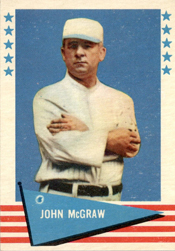
Technically, John McGraw turned down an offer to manage the Cardinals. Actually, though, he was their de facto manager for part of a season.

The question of whether McGraw was or wasn’t the Cardinals’ manager made headlines in August 1900. After manager Patsy Tebeau resigned, Cardinals president Frank Robison said publicly that McGraw, the Cardinals’ captain and third baseman, agreed to be player-manager. McGraw said Robison was mistaken.

A peculiar compromise was reached: A member of the Cardinals’ business staff, Louis Heilbroner, who had no baseball experience, became manager and sat on the bench in that role during games. McGraw made out the lineups, decided which pitchers to use and ran the team on the field.

“It appears McGraw is manager with a scapegoat in the person of Mr. Heilbroner … in case he fails to make the team win,” the St. Louis Republic declared.

Two months later, after the Cardinals went 23-25 in the 48 games managed by the Heilbroner/McGraw tandem, McGraw departed St. Louis for Baltimore. He eventually went on to become manager of the New York Giants, attaining three World Series titles and 10 National League pennants.

McGraw totaled 2,763 wins, though none were credited to him for his role with the Cardinals. Only Connie Mack (3,731) and Tony La Russa (2,902) achieved more wins as managers.

Good times, bad times

Born and raised in Truxton, N.Y., a village 65 miles west of Cooperstown, McGraw was 12 when his mother and four of his siblings died in a diphtheria epidemic. He moved in with a neighbor to escape a father who beat him.

Advancing from local sandlot baseball to the professional ranks, McGraw was 18 when he reached the majors with the 1891 Baltimore Orioles. He began as a utility player before developing into “a brilliant third baseman … who brought a keen, incisive mind to the national game, a fighter of the old school whose aggressiveness inspired his teammates,” according to the New York Times.

Nicknamed Little Napoleon by the press and Mugsy by his foes, McGraw, 26, became player-manager of the 1899 Orioles. In August, his wife, Mary, 22, died of acute appendicitis. After the season, the Orioles, a National League franchise, disbanded, and McGraw went to play for the Cardinals when the club agreed to waive from his contract the reserve clause which bound a player to a team.

Joining a club that featured three future Hall of Fame players _ left fielder Jesse Burkett, shortstop Bobby Wallace and pitcher Cy Young _ McGraw played third base and ignited the offense. His .505 on-base percentage was tops in the league. He totaled 115 hits, 85 walks and was plunked by pitches 23 times. McGraw struck out a mere nine times in 447 plate appearances.

Yet, the 1900 Cardinals were underachievers, losing 15 of 20 games in June. As the St. Louis Republic noted, “Baseball players are nervous, sensitive mortals … Despite all the hot air about … every man … pulling hard to win … it is a cinch that one-third of the team has no use or love for the other two-thirds.”

Big change is coming

The Cardinals staggered into August with a 34-42 record. Manager Patsy Tebeau had seen enough.

Born in north St. Louis near 22nd and Branch streets, Oliver Wendell Tebeau learned baseball on the Happy Hollow diamond beneath Goose Hill and became a member of the Shamrock Club team, earning the Irish nickname Patsy despite a French-Canadian surname. He went on to be a standout first baseman in the majors and managed the Cleveland club before going back to St. Louis.

Tebeau submitted his resignation to Cardinals president Frank Robison in early August 1900. Robison asked Tebeau to reconsider and to at least finish the season as manager, but Tebeau was obdurate. He and Robison agreed to stay mum about the decision until a replacement could be found.

Robison offered the job to McGraw.

On Aug. 19, 1900, the Reds won at St. Louis, 8-5, dropping the Cardinals’ record to 42-50. Afterward, Robison met in his office with seven St. Louis newspaper reporters and told them Tebeau had resigned and McGraw had accepted an offer to replace him. “Mr. McGraw will manage the club in Mr. Tebeau’s place,” Robison said. “He will have full charge of the team on the field.”

Robison also told the reporters that his secretary, Louis Heilbroner, would be business manager, acting as Robison’s representative on road trips.

That night, a St. Louis Republic reporter tracked down McGraw at the Southern Hotel, where he stayed. “I have accepted the management of the St. Louis club,” McGraw told the newsman.

Not so fast

The morning newspapers on Aug. 20 reported McGraw was manager of the Cardinals, but McGraw told the afternoon St. Louis Post-Dispatch a different story. He claimed he rejected Robison’s offer. “I would not be doing myself justice to accept the management of the team at the present time,” McGraw said to the Post-Dispatch. “I would be held responsible for any shortcomings that the team might show, and I do not care to accept this responsibility.”

As the St. Louis Republic saw it, “McGraw is evidently a bit leery of … trying to make a silk purse out of a sow’s (ear), of converting a losing team into a winning one. Though the team is strong enough to win, it is badly disorganized and full of cliques. McGraw is not sure of his ground. He doubts the fidelity of his men.”

To appease McGraw, Frank Robison and his brother, club treasurer Stanley Robison, named Louis Heilbroner as manager but all agreed McGraw would run the team on the field.

“Mr. McGraw has complete charge of the team,” Heilbroner told the St. Louis Republic. “He can … change any player, bench any player, do as he pleases with the men on the field. At least that is my understanding.”

Stanley Robison said to the Post-Dispatch, “McGraw … will have entire charge of the players when on the field. He will place the pitchers and his orders will govern their conduct during the game. Louis Heilbroner … will occupy the manager’s seat on the bench but he will not in any way interfere with McGraw’s orders.”

Most comfortable dressed in a buttoned shirt with collar and cuffs, Heilbroner was 4-foot-9, barely weighed more than 100 pounds and had a “thin, piping voice,” according to the Post-Dispatch. Many of the players he was tasked with managing  had reputations for being roughnecks.

Labeling Heilbroner, 39, as “simply a straw man,” the Republic added, “Everyone knows that Mr. Heilbroner makes not even the ordinary fan’s pretensions to knowing baseball. He is a capital business man, a first-class fellow, but he does not know baseball.”

Home alone

That afternoon, Aug. 20, “not more than 800 enthusiasts” showed up at League Park to see the visiting Reds play the Cardinals, the St. Louis Globe-Democrat reported. According to the Republic, “not enough persons were in the stands to start a game of pinochle.”

Not even McGraw was a spectator. He stayed in the clubhouse, claiming he was “under the weather,” the Globe-Democrat reported, and leaving poor Heilbroner to fend for himself in his debut as manager.

Heilbroner did a sensible thing: He gave the ball to Cy Young. Unfortunately, Young’s pitching didn’t earn any awards that day. He gave up 11 runs and was heckled from the stands before Heilbroner lifted him after six innings.

Young “dressed hurriedly and sought to even up matters in some way,” the Republic reported. “He hied himself to the grandstand and picked out a spectator who had called him a rank quitter … (Young’s) wife was seated beside the individual who roasted him while he was on the rubber. The spectator took Cy’s scolding and slunk away without making a reply.”

The Reds won, 15-7, but as the Post-Dispatch noted, “Mr. Heilbroner is not losing any sleep over the situation. He sat on the players’ bench and seemed to enjoy the game. He does not pretend to know anything about baseball from a playing standpoint (and) virtually admits that he is a figurehead.”

McGraw sat alongside Heilbroner on the bench the next day, Aug. 21, and the Cardinals beat the Reds, 9-8.

One and done

McGraw was one of two future Hall of Fame managers playing for the 1900 Cardinals. The other was his friend, catcher Wilbert Robinson, but Heilbroner remained Cardinals manager until season’s end. The Cardinals finished at 65-75 _ 42-50 with Tebeau and 23-25 with Heilbroner.

(According to John Wray of the Post-Dispatch, Heilbroner wasn’t a pushover during his stint as skipper. After Heilbroner rejected a request from pitcher Jack Powell for a pay advance, “Powell started to stuff Louie into the safe but changed his mind when the little man confronted him with such a barrage of language and threats that Big Jack fell back.”)

Because the Cardinals had waived the reserve clauses in the contracts of McGraw and Wilbert Robinson as incentive to come to St. Louis, both men became free agents after the 1900 season. McGraw returned to Baltimore, becoming part owner and player-manager of the new Orioles franchise in the American League. Robinson went with him.

In July 1902, McGraw jumped from the Orioles to the Giants and had his greatest successes, building a reputation as “the molder of championship clubs, a stickler for discipline and a martinet who saw that his orders were rigidly enforced both on and off the field,” the New York Times noted.

Patsy Tebeau never returned to baseball after leaving the Cardinals. He ran a popular saloon on North Sixth Street in St. Louis, but became despondent after his health deteriorated and his wife left him. He committed suicide at 53.

Outfielder Patsy Donovan replaced Louis Heilbroner as Cardinals manager for the 1901 season.

Heilbroner went on to scout for the Cardinals and St. Louis Browns before operating a respected baseball statistical service. He published the annual Baseball Blue Book of statistics and records. “His statistics did as much to build up the game as any one factor,” the Globe-Democrat reported.